Colton Hail had expected a housekeeper, but the woman stepping down from the Christmas Eve train looked like someone winter had already beaten halfway to the grave. The wind at Clearwater Station cut across the wooden platform, pushing smoke low over the tracks and making the horses near the depot stamp hard against the frozen mud. Evelyn Hart stood by the train door with one small travel bag in her gloved hand and a brown coat so worn that the elbows had been patched more than once. For a moment, Colton forgot every practical sentence in the agency letter and saw only how little protection she had brought against Wyoming.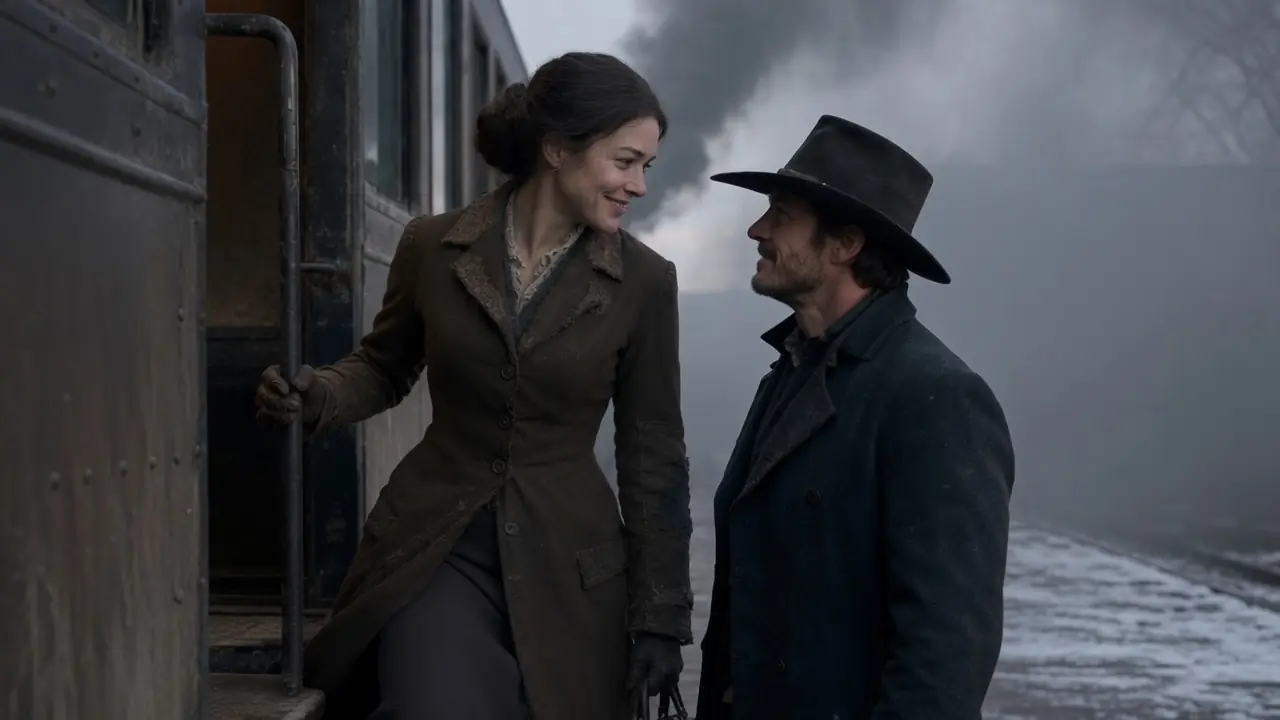
He had paid good money for help, not pity. That was the first hard thought that came to him, and he hated himself for it almost at once. His ranch needed steady hands, not another fragile soul for him to worry over. His daughter Clara needed someone who could bring warmth into a house that had forgotten how to hold it, not someone who might collapse beneath the first hard freeze.
Evelyn lifted her eyes and found him across the platform. She did not smile. She simply looked at him with a tired steadiness, as if she had already learned that first impressions often arrived carrying judgment. Her dark hair was pinned back in a plain knot, her face pale from travel, and her fingers tightened around the handle of the bag. Colton crossed the boards toward her, each step making the arrangement feel less like a contract and more like a decision he might regret.
“Miss Hart?” he asked.
“Yes,” she said, her voice low but clear.
“I’m Colton Hail.”
“I know,” she replied. “The agency described you as a practical man.”
There was no insult in the words, but Colton still felt them land. Practical was what people called a man who kept his grief quiet and his house functioning badly enough to survive. He glanced at the coat again before he could stop himself. Evelyn saw it, of course. Women who had owned little for a long time learned quickly where other people’s eyes went first.
“That coat won’t last one night on my ranch, Miss Hart,” he said, harsher than he intended. “Maybe the agency should have sent someone stronger.”
Evelyn’s chin lifted a fraction. “If clothes measured strength, Mr. Hail, I would have frozen long before this train reached Wyoming.”
The words silenced him better than anger could have. She did not speak like a beggar, and she did not lower herself for his approval. She only stood there with one poor bag, one poor coat, and a look that told him life had tried to send her back many times already.
Colton looked away first. The shame of it settled into his chest. He had asked for someone patient enough to help a grieving little girl, then nearly dismissed the woman because poverty had shown itself in wool and thread. “I meant the weather is hard,” he said.
“I believe you.”
“And the ranch is harder.”
“I believe that too.”
A gust of wind drove snow dust across the platform. Evelyn shivered before she could hide it. Colton saw the effort it took for her to remain upright, and something in him loosened. He took the travel bag from her hand without asking, surprised by how light it was. No woman should arrive at a new life carrying so little unless the old one had taken nearly everything.
“My wagon is this way,” he said.
Evelyn followed him without another word. The depot lights glowed behind them, and the train hissed as if impatient to leave the past behind. Colton helped her into the wagon, then climbed up beside her and took the reins. Clearwater Station disappeared behind them in smoke, snow, and the long dark road home.
For the first mile, neither of them spoke. The horses pulled steadily through the cold, their breath rising in white clouds. Evelyn held her hands together in her lap, trying not to tremble, and Colton pretended not to notice. He had never been good with women’s suffering unless there was something solid to fix, a broken fence, a leaking roof, a fallen horse.
“My daughter’s name is Clara,” he said at last. “She is eight.”
“The agency said she lost her mother.”
“Yes.”
“When?”
“Two years ago this February.”
Evelyn nodded, not with the shallow sympathy people used when grief made them uncomfortable, but with the careful silence of someone who understood that sorrow did not need decoration. “Children carry loss differently,” she said. “Sometimes they become too quiet because they think noise invites disaster.”
Colton looked at her sharply. “You taught school?”
“For six years.”
“What happened?”
She looked toward the dark fields. “The school closed. Then my mother took ill. Then the money ran out in the order such things usually do.”
There was no self-pity in her explanation, which somehow made it sadder. Colton tightened his hands around the reins. He had thought her worn coat told the whole story. Now he understood it was only the cover of a book he had not earned the right to open. “You have family?” he asked.
“Not anymore,” Evelyn said.
The answer was plain, but it ended the subject.
The Hail ranch appeared after another hour, its windows glowing faintly against the winter dark. The house sat low and wide beneath a roof patched in two places, with barns beyond it and open land rolling into shadow. To Colton, it looked tired but familiar. To Evelyn, it looked like both danger and shelter, the way any new home looks when a person arrives with nowhere else to go.
Clara stood at the front window when they pulled up. Colton saw the small shape vanish the moment the wagon stopped. By the time he opened the door, the girl was sitting at the kitchen table with a book open in front of her, pretending she had not been watching. Her brown hair fell in loose waves around her face, and her eyes moved quickly to Evelyn’s coat before dropping back to the page.
“Clara,” Colton said. “This is Miss Hart.”
Clara did not answer.
Evelyn stepped inside slowly, bringing the cold with her. She looked at the child, then at the room, then back at the child again. “Good evening, Clara,” she said. “I am glad to meet you.”
Clara turned a page she clearly had not read. “I already know how to read.”
Colton stiffened. “Clara.”
But Evelyn only nodded. “That is useful. Then perhaps you can tell me if I place my bag in the wrong room.”
The girl looked up, caught off guard despite herself. “Your room is upstairs.”
“Then I am grateful to have a guide who reads better than I do after a long train ride.”
It was the first small crack in the house’s silence. Clara did not smile, but she stood and walked toward the stairs. Evelyn followed, carrying herself carefully, as if exhaustion was a shawl she refused to let fall. Colton watched them go and heard the old house creak beneath their steps. For the first time in months, another woman’s voice moved through the hall.
That night, Evelyn ate stew at the kitchen table with Colton and Clara. She did not complain about the simple meal. She did not ask questions that were too personal. She thanked Clara for passing the salt and Colton for the room, then helped clear dishes without waiting to be told. By the time she went upstairs, the kitchen looked a little less abandoned.
Colton remained at the table after Clara went to bed. He stared at the lamp flame and listened to the wind press against the windows. He thought of Rosa moving through that same kitchen, humming when she kneaded bread, laughing when Clara stole bits of dough. Then he thought of Evelyn’s patched coat hanging by the door, thin and defeated. He rose, took one of Rosa’s old wool shawls from the cedar chest, and laid it outside Evelyn’s door.
In the morning, the shawl was folded neatly over the back of a chair. Evelyn came downstairs wearing it around her shoulders, though she said nothing about it. She made coffee before Colton returned from the barn and had biscuits warming near the stove. Clara sat at the table watching her with cautious suspicion, as though kindness might be a trick. Evelyn did not push. She simply worked.
Days passed with the slow rhythm of winter. Evelyn learned the house without making it feel invaded. She found where the flour was kept, which boards complained underfoot, which kettle leaked at the seam, and which window let in cold air near Clara’s chair. She mended curtains, turned leftovers into meals, and coaxed the stove to hold heat better than Colton had managed in two winters.
Clara resisted her in quiet ways. She left books out after Evelyn had stacked them. She refused jam on biscuits after Evelyn made it. She answered questions with one word and watched the new woman as if waiting for proof that she would disappear too. Evelyn accepted each small rejection without injury, which puzzled Colton more than it comforted him.
One afternoon, he found Evelyn sitting on the floor near the hearth with Clara’s broken wooden horse in her lap. The toy had lost one leg months earlier and had been left on a shelf like a memory no one wanted to disturb. Evelyn had a small knife, thread, and a sliver of wood from the kindling box. Clara stood in the doorway pretending not to care.
“That horse belonged to her mother,” Colton said quietly.
“I know,” Evelyn replied. “That is why it should not remain broken if it can stand again.”
Clara’s fingers gripped the doorframe. “You don’t know anything about my mother.”
“No,” Evelyn said gently. “But I know people sometimes keep broken things because fixing them feels like saying the hurt is over.”
The words settled into the room. Clara stared at her, eyes wide and bright. Colton felt his throat tighten, because he had been doing exactly that with half the house. Rosa’s sewing basket still sat untouched. Her blue cup remained at the back of the cupboard. Her apron hung on the pantry hook like she might return to claim it.
Evelyn finished repairing the horse by lamplight. The new leg was not perfect, but it held. She placed the toy on the table and moved away from it, giving Clara the choice. After a long while, Clara came forward and touched the horse’s mane with one finger. “It stands,” she whispered.
“Yes,” Evelyn said. “Some things can.”
Clara picked up the horse and held it against her chest. She did not thank Evelyn, but she did not turn away either. That night, Colton heard Clara crying softly in her room, and then he heard Evelyn’s footsteps in the hall. He almost rose to stop her, then stayed seated.
The next morning, Clara came down holding Evelyn’s hand. She was not smiling, but she was not small in the same way. Colton looked from his daughter to the woman beside her and understood that something had shifted without his permission. It frightened him more than loneliness had, because hope was a dangerous thing once grief had trained a man not to expect it.
By January, Evelyn’s coat became a subject Colton could no longer ignore. She wore it when she walked to the chicken shed, when she brought in kindling, when she stood on the porch calling Clara inside. The patches had begun to fail under the hard Wyoming cold. Once, Colton saw her rubbing warmth back into her fingers behind the barn, thinking no one watched.
He rode to town the next day and bought a new wool coat from Mercer’s store. Dark green, heavy, plain, lined well enough for the territory. Mrs. Mercer wrapped it in brown paper and gave him a knowing look he did not appreciate. “Housekeeper?” she asked.
“Yes,” Colton said too quickly.
“Of course,” Mrs. Mercer replied, smiling at nothing.
He left the coat on Evelyn’s bed while she was in the kitchen. That evening, she came down carrying the parcel unopened. “Mr. Hail,” she said.
Colton looked up from the ledgers. “You need a proper coat.”
“I did not ask for one.”
“No.”
“I cannot afford to have it taken from my wages.”
“It is not from your wages.”
Her face changed then, and he realized pride could be as delicate as hunger. “I work for what I receive,” she said.
“I know.”
“Then do not make charity out of me.”
Colton stood slowly. “It is not charity to keep someone from freezing under my roof.”
Evelyn looked away, the paper parcel held tight in her hands. Clara sat near the hearth watching them both. “Miss Hart,” the child said suddenly, “please wear it. Your old one makes me worry.”
Evelyn’s eyes softened at that, and the pride in her face lost its sharpest edge. She looked down at the parcel, then back at Clara. “Well,” she said quietly, “I would not want to worry the young mistress of the house.”
She wore the green coat the next morning. It transformed nothing and everything. Evelyn still moved with the same modest care, still worked hard, still kept her voice low, but the sight of her properly warmed eased something in Colton. Clara noticed too. At breakfast she said, “You look like a pine tree.”
Evelyn blinked, then laughed. It was the first time Colton had heard her laugh, and the sound startled the room into brightness.
As winter deepened, the ranch began to change in small ways. Fresh bread appeared twice a week. Clara’s drawings returned to the kitchen wall. The front room, once left cold unless guests came, held a fire most evenings. Axel and Bjorn started taking supper in the kitchen more often, claiming it was because Evelyn’s stew was better than their own, though Colton suspected the house had simply become a place men wanted to enter again.
One night, a storm came hard out of the north. Snow struck the windows like thrown gravel, and the wind pushed through every crack in the walls. Colton and the Lindfist brothers were in the barn with a heifer struggling to birth too early. Clara woke frightened and came downstairs wrapped in a quilt, calling for her father.
Evelyn took one look at the empty kitchen, the child’s pale face, and the storm outside. “Put on your boots,” she said.
Clara shook her head. “Papa said I should stay inside.”
“Then we will stay near the porch and carry a lantern. But fear grows larger when it has nothing to do.”
“What can I do?”
“You can hold the light.”
They made it as far as the barn through knee-deep snow, Evelyn shielding Clara with her body against the wind. Inside, Colton looked up in shock. “What are you doing here?”
“Bringing your daughter where she can see you are alive,” Evelyn said, breathless but steady. “And bringing more towels.”
Bjorn took the bundle from her with a grateful grunt.
The calf came after midnight, weak but living. Clara stood beside Evelyn holding the lantern with both hands, eyes wide as the tiny creature took its first trembling breath. Colton watched his daughter’s face change. Wonder, fear, grief, and joy all moved across it together. Then Clara began to cry, not quietly this time, but with the full sound of a child who had finally remembered she was allowed to feel.
Colton went to her, but Clara reached for Evelyn first. The movement struck him hard, not because he resented it, but because he understood what it meant. Evelyn had become safe. His daughter, who had trusted almost nothing since Rosa died, trusted this woman in a barn during a storm with life and death steaming in the straw.
After the storm, Colton could no longer pretend Evelyn was only help. She was in the kitchen laughter, in Clara’s renewed chatter, in the repaired hems and full pantry, in the way the house seemed to breathe again. He began to notice her not as a worker, but as a woman. The way she stood at the window before dawn, the way she touched the green coat’s sleeve as if still surprised by warmth, the way she listened before speaking.
This frightened him more than the storm. Love had taken Rosa, and grief had convinced him that wanting anything again was a kind of betrayal. So he grew stern for several days, speaking less, staying longer in the barn, letting the old distance return. Evelyn noticed, of course. She noticed everything.
On the last night of January, she found him on the porch repairing a bridle by lantern light. “Have I displeased you, Mr. Hail?” she asked.
“No.”
“Have I failed Clara?”
“No.”
“Then why do you look at me as if I have stolen something?”
Colton’s hands stilled on the leather.
He could have lied. He was good at silence, but Evelyn had never rewarded cowardice. “Because this house was dead in places,” he said. “And now it isn’t.”
“That sounds more like grief than accusation.”
“It feels like both.”
Evelyn came to stand beside the porch rail. “I did not come here to replace anyone.”
“I know.”
“Do you?”
The question broke through him with uncomfortable gentleness. Colton looked toward the dark pasture and thought of Rosa. He had loved his wife honestly. He had mourned her honestly too. But somewhere in mourning, he had begun treating life as a locked room, and Clara had been trapped inside with him.
“I almost sent you back,” he said. “Because of that coat.”
Evelyn smiled faintly. “Yes, I remember.”
“I saw poverty and called it weakness.”
“You were not the first.”
“I am sorry.”
This time, she did not answer quickly. The wind moved softly around the porch. Then she said, “I forgive you. But only because you learned to see better.”
He looked at her then, truly looked, and saw the woman from the station again. Not fragile. Not desperate. A survivor with warmth still left to give. “Would you stay?” he asked.
“I work here,” she said.
“I don’t mean as hired help.”
Evelyn’s eyes widened slightly, and the old caution returned. “Colton.”
It was the first time she used his name. He felt it like a hand against his chest.
“I am not asking for an answer tonight,” he said. “Only asking you not to think I value you by wages and room.”
She looked down at her hands. “I came with one bag.”
“I know.”
“And a coat you nearly turned away.”
“I know that too.”
Her voice softened. “Then understand why trust takes time.”
Spring came slowly, first in mud, then in thawing creek water, then in the sound of Clara laughing across the yard. Evelyn stayed. Not because she answered Colton’s question, but because leaving no longer seemed to belong to her. The spare room filled with small signs of permanence: a hairbrush on the dresser, a book near the lamp, a blue ribbon Clara had given her folded carefully by the window.
In March, Clara called Evelyn by name without the formal Miss Hart. In April, she asked if Evelyn would teach her to plant marigolds because her mother had liked yellow flowers. In May, Colton found both of them kneeling in the garden, dirt on their gloves, arguing softly about whether a worm was helpful or disgusting. He stood by the fence listening until Clara saw him and waved.
By summer, the ranch had become a home again. The Lindfist brothers teased Colton without mercy about washing before supper now. Marta Peterson visited and told Evelyn privately that she had done what neighbors had prayed someone might do. Evelyn only said, “Children know their way back if someone keeps a lamp lit.” Marta cried at that, then pretended she had dust in her eye.
Colton asked Evelyn to marry him in September beneath the cottonwoods near the creek. He did not do it with a grand speech. He brought the repaired wooden horse, Clara’s old toy, and placed it between them on the fence rail. “You taught this house to stand again,” he said. “If you are willing, I would like to spend the rest of my life making sure you never wonder whether you belong in it.”
Evelyn touched the horse, then looked toward the house where Clara watched poorly from behind a curtain. Her eyes shone, but her smile was steady. “I will marry you,” she said. “But you must promise never to judge a woman’s worth by her coat again.”
Colton smiled, the kind that felt strange because it came from a place grief had not reached in years. “I promise.”
They married before the first frost, in the front room with Clara standing between them and the Lindfist brothers pretending not to wipe their eyes. Evelyn wore a simple blue dress Marta Peterson had helped alter, and over her shoulders was the green wool coat Colton had bought her in January. Not because she needed it inside the warm house, but because Clara insisted it was part of the story. Evelyn agreed.
Years later, when people asked how Mrs. Hail came to the ranch, Colton never began with the agency letter. He began with Christmas Eve at Clearwater Station, with a late train, a thin brown coat, and the shame of a man who almost mistook poverty for weakness. Clara, older by then and no longer quiet, would interrupt to say that Papa had been a fool at first. Evelyn would laugh and say most good stories start with someone being a little foolish and learning better.
The old brown coat remained in the cedar chest, carefully folded. Evelyn refused to throw it away. Colton once asked why she kept a thing that had known so much cold. She laid her hand over the worn sleeve and said, “Because it reminds me I arrived with almost nothing, and still I was not empty.”
Colton never forgot that.
The ranch changed because one woman stepped off a train with a worn-out coat and enough courage to ask not to be sent back. A grieving child learned to laugh again. A lonely man learned that love did not replace the dead, but made room for the living. And a house that had once been only presentable became warm, not because winter softened, but because Evelyn Hart stayed long enough to light the fire.