“Who made this cornbread?”
Jonas Harlan asked the question with his hat still in one hand and dust still clinging to the knees of his trousers.
He had come into Hollis Boarding House near sundown, tired from riding fence since morning and hungry enough to eat whatever Edmund Hollis put in front of him.
The dining room smelled of beef stew, boiled coffee, damp wool, and wood smoke. Rain had threatened all afternoon but never fallen, leaving the air heavy and the men restless. Rail workers from the new grading camp sat shoulder to shoulder at the long table. A traveling drummer with a case of tin samples ate near the window. Two ranch wives from south of town picked carefully at their plates, whispering behind gloved hands.
Edmund Hollis stood at the sideboard with his ledger open, counting coins before supper was even done. He was a square man with thin lips, a stiff collar, and the habit of treating every living person as either a paying customer or an expense. When Jonas asked about the cornbread, Edmund did not look up.
“Woman in back made too much,” he said. “There’s cornbread if you want it.”
He said it the way a man might mention leftover firewood.
Jonas glanced toward the kitchen door. He had eaten at Hollis Boarding House enough times to know the food was usually plain, filling, and forgettable. The stew tasted mostly of salt and patience. The biscuits could break a tooth if left too long by the stove. Men came there because it was open, not because it was good.
But the plate Edmund pushed toward him was different.
The cornbread was golden at the edges, soft in the middle, with tiny flecks of green onion and a faint smell of honey and browned butter. Jonas took one piece because he was hungry. Then he took a bite and forgot, for a moment, how tired he was.
It was warm, tender, and rich without being sweet enough to shame itself. It tasted like someone had paid attention. Not just to the recipe, but to the hunger of the people who would eat it.
Jonas straightened.
“Who made this?”
This time his voice carried across the room.
A few men looked up. Edmund frowned as if the question itself were inconvenient. Before he could answer, the kitchen door opened.
Lucy came out carrying another plate.
She was not the kind of woman the town turned to look at twice, though Jonas could not have said why. She was small but not fragile, with brown hair pinned severely at the back of her head and flour dust on the sleeve of her faded dress. Her face was plain at first glance, but only because she seemed determined to keep it unreadable. Her eyes were gray, steady, and set somewhere beyond the room, as if she had taught herself not to expect kindness from anyone inside it.
She set the plate down near Jonas and turned to go.
“Hold on,” Jonas said.
Lucy stopped, though she did not fully turn back.
Jonas broke off another piece of cornbread and ate it standing there in front of the whole dinner crowd because he had not thought to sit first.
“That is the best cornbread I have ever had.”
The room went quiet in a small, uncomfortable way.
Lucy turned her head just enough to look at him.
Something crossed her face that was not quite gratitude. Surprise, maybe. Suspicion too. As if compliments were not gifts in her experience, but things with hooks hidden inside.
“Glad it suits you,” she said.
Her voice was low and practical.
Then she went back into the kitchen like the compliment weighed something she did not want to carry.
Jonas watched the door swing closed behind her.
Around him, the dinner crowd returned to its noise. Spoons clattered. Men scraped bowls clean. Edmund scratched another line in his ledger. Whatever had just happened, it seemed to have happened only to Jonas.
But he thought about that cornbread on the ride home.
He thought about the woman too.
Not in any grand or foolish way. Jonas was not given to sudden fancies. He had not become the owner of Harlan Ranch by chasing every pretty face or soft word that passed through town. He had learned early that feelings, like horses, could throw a man if he did not keep hold of the reins.
Still, as his horse carried him west under a violet evening sky, he kept turning the moment over in his mind like a stone he did not understand the shape of.
The way Lucy had stood there.
The way everyone else had looked through her.
The way a piece of cornbread could taste like care in a place that had very little of it.
Jonas Harlan was twenty-six years old, and the Harlan Ranch was his.
It had come to him three years earlier when his father dropped dead beside the north corral one clear morning in September. One moment Amos Harlan had been cursing a broken gate latch, and the next he was on the ground with one hand pressed to his chest and dust on his cheek. By sunset, Jonas was no longer a son learning the business. He was the man everyone looked to for orders.
The ranch was a fair-sized spread for that part of the territory. Not the largest in the county, but close enough to make smaller men resentful and larger men watchful. It had good water, decent grazing, a weather-stained barn, three bunkhouses, and more cattle each season than the one before.
Jonas had built on what his father left him, not with brilliance, but with stubbornness. He rose before dawn, rode until his shoulders ached, counted his herd twice when once would have done, and mended fences himself if the hands were too tired. The men respected him because he worked harder than any of them and spoke less than most.
The town had grown up around him without his much noticing.
What had once been a dusty crossing with a general store, a smithy, and a church now had a second street, a telegraph office, three saloons, a dry goods store, and talk of a rail spur. Men came with plans. Women came with trunks. Speculators came with maps and promises. The future was laying track toward them, and every man in town seemed eager to claim a piece of it.
Jonas had grown too, but in the dull, steady way of a man who put his attention into fence line and livestock and forgot to ask what else there might be to want.
He had been engaged once, four years earlier, to a woman named Clara Bell. She was pretty, quick-tempered, and fond of ribbons. She liked the idea of being married to a rancher until she understood what ranch life required. One morning, after a late spring storm flooded the wash and took half the south fence with it, Clara packed her things and went home to her mother in Kansas City without waiting to say goodbye.
She left a letter.
Jonas never finished reading it.
Since then, he had not gone looking for reasons to feel the lack of anything.
A man could live on work.
At least, that was what he told himself.
Lucy Bell had grown up at the county orphanage two towns over, though Bell was not truly her name. It had been written beside her on a scrap of paper when she was left at the church steps as a baby, and no one knew whether it belonged to her mother, her father, or no one at all.
At the orphanage, names were less important than chores.
Children learned early who was useful and who was trouble. Lucy was useful. She was quiet, quick-handed, and stubborn enough to keep working even when the bigger girls shoved her aside. By nine, she could peel potatoes faster than the cook. By twelve, she could stretch one chicken into soup for thirty children. By fifteen, she could bake bread by smell and know from the sound of the crust whether the oven had been too hot.
No one called it talent.
They called it duty.
When she turned eighteen, she was allowed to leave, but the orphanage cook had died the winter before, and there was no one else who could keep the kitchen running properly. So Lucy stayed. Not because anyone begged her. Not because anyone thanked her. She stayed because children still needed breakfast, and she knew what it was to wake hungry.
She left at twenty-three when the orphanage hired a married woman from Baton Rouge.
Lucy packed all she owned into one carpetbag and walked into town on her own two feet.
Hollis Boarding House needed kitchen help.
Edmund Hollis needed someone cheap.
Lucy needed work.
That was the whole arrangement.
For two years, she cooked before sunrise and cleaned after dark. She rose at four, lit the stove, hauled water, kneaded dough, chopped onions, scrubbed pots, stretched meat, boiled coffee, washed linens, and ate standing up when there was food left. Edmund paid her less than he paid the boy who swept the porch, but he gave her a narrow room off the back pantry and reminded her often that respectable work was hard for a woman with no family name.
Lucy did not argue.
Arguing required a person to believe she might be heard.
Most people in town knew her only as the cook at Hollis’s. Some called her Lucy. Others called her girl, even though she was twenty-five. The men at the long table rarely looked at her face unless they wanted more coffee. The women looked at her dress, her hands, the plainness of her hat, the absence of a ring.
She was part of the room the way a stove was part of a kitchen.
Necessary.
Hot.
Unnoticed unless something went wrong.
Jonas returned to Hollis Boarding House three evenings later.
He told himself it was because he had business in town. He needed nails from the general store, a new hinge from the smithy, and news from the rail office about supply schedules. All of that was true.
It was also true that he arrived at supper time.
Edmund looked up from the desk.
“Usual?”
“If there’s cornbread,” Jonas said.
Edmund’s eyes narrowed.
“There might be.”
Jonas sat at the long table. The stew was thin that night, with more turnip than beef, but the cornbread came warm from the kitchen. Lucy did not bring it out herself. A boy with red ears and dirty cuffs dropped the plate near Jonas and hurried away.
Jonas took one bite.
Not the same.
It was good, but plainer. No honey. No green onion. No browned butter.
He looked toward the kitchen door.
After supper, he stood near the back hallway until Lucy came out carrying a stack of plates.
She paused when she saw him.
“Something wrong with the food?” she asked.
“No.”
“Then you’re standing in the way.”
Jonas stepped aside.
Lucy moved past him, but he spoke before she reached the kitchen.
“The cornbread was different tonight.”
She stopped.
“Different bad?”
“Different less good.”
A corner of her mouth moved, not quite a smile.
“Mr. Hollis said folks don’t pay extra for fancy.”
“It wasn’t fancy.”
“No?”
“It was better.”
She looked at him then, directly.
Jonas had the strange sense that she was weighing him the way he might weigh a new horse, not trusting the surface.
“Better costs butter,” she said. “Butter costs money. Money belongs to Mr. Hollis.”
“That so?”
“In this house, yes.”
Before Jonas could answer, Edmund’s voice came from the front room.
“Lucy! Those dishes won’t wash themselves.”
Lucy lowered her eyes and went back into the kitchen.
Jonas stood there a moment longer.
Then he left without knowing why he felt angry.
The next week, Jonas brought butter.
He carried it in a wrapped crock from Mrs. Delaney’s dairy and left it on the kitchen sideboard while Edmund was arguing with a rail man about payment.
Lucy saw it first.
Her eyes moved from the crock to Jonas.
“What’s that?”
“Butter.”
“I know what butter is.”
“For the cornbread.”
She stared at him.
“You brought butter to a boarding house?”
“I brought butter to the person who knows what to do with it.”
Her expression hardened slightly.
“I don’t take charity.”
“It’s not charity if I expect something in return.”
“And what do you expect?”
“Cornbread worth eating.”
She looked at him for a long moment.
Then, unexpectedly, she gave a short laugh.
It was not a soft laugh. It was rusty, like a gate that had not opened in years.
Jonas found himself smiling.
Lucy noticed and stopped at once.
“I’ll use it if Mr. Hollis allows.”
“He doesn’t need to know.”
Her eyes sharpened.
“You tell women to hide things often, Mr. Harlan?”
The question hit harder than he expected.
“No,” he said. “And I shouldn’t have said it.”
That seemed to surprise her more than the butter.
Most men, Lucy had learned, defended careless words even after they saw the harm in them. Jonas simply stood there with his hat in his hands and accepted correction like a man who knew tools sometimes slipped and cut the wrong person.
Lucy looked away first.
“I’ll make the cornbread if there’s time.”
That night, it came out perfect.
After that, Jonas found more reasons to eat in town.
He came for horseshoe nails, grain invoices, a message from a cattle buyer, a package that was delayed, a meeting that ended early. At least, those were the reasons he told his ranch hands. The men noticed anyway.
“Boss,” Caleb, his oldest hand, said one morning as Jonas saddled his horse. “You been mighty interested in boarding house stew lately.”
Jonas tightened the cinch.
“Man has to eat.”
“Sure. But he don’t usually ride eight miles for boiled carrots.”
The other hands laughed.
Jonas shot them a look, but there was no heat in it.
He did not understand what was happening himself.
He did not know whether he was going to Hollis’s for the cornbread, the woman who made it, or the feeling he got when Lucy looked at him as if she did not care whether he owned land, cattle, or a clean shirt.
She did not flirt.
She did not soften for him.
If anything, she seemed determined not to be impressed.
That made every small kindness from her feel earned.
One evening, Jonas arrived late and found the dining room nearly empty. Rain had finally come, beating against the windows and turning the street into dark mud. A drunk slept with his head on his arms near the stove. Edmund had gone to the back office. Lucy was wiping tables alone.
“You missed supper,” she said.
“I was fixing a washed-out bridge.”
“Hungry?”
“Yes.”
“Stew’s gone.”
“That might be mercy.”
She looked at him, then at the kitchen.
“I can fry eggs.”
“I’d be obliged.”
He sat near the stove while she cooked. The boarding house settled around them, full of creaks, rain, and the faint hiss of fire. Lucy brought him eggs, fried potatoes, and a small piece of cornbread she had saved wrapped in a cloth.
“You save that for me?” he asked.
“No.”
He waited.
She wiped her hands on her apron.
“I made too much.”
“That so?”
“Yes.”
He smiled down at the plate.
Lucy frowned.
“Don’t make it into something.”
“I didn’t say anything.”
“You looked like you were about to.”
Jonas ate slowly, partly because he was hungry and partly because he did not want the quiet to end.
“Where did you learn to cook like this?” he asked.
Lucy leaned against the sideboard, arms folded.
“Orphanage.”
Jonas looked up.
She said it plainly, but he heard the years beneath it.
“Were they kind to you?”
She considered the question.
“They fed me.”
“That isn’t what I asked.”
“No,” she said. “It isn’t.”
The rain struck harder against the glass.
Lucy’s eyes moved toward the window.
“There was a cook there named Mrs. Pike. She was mean as a snake most days, but she knew food. Said hunger made children wild, and bad food made them mean. She taught me bread first. Then soup. Then how to use everything twice.”
“And did it work?”
“What?”
“Did good food make the children less wild?”
Lucy’s mouth softened.
“Sometimes.”
For the first time, Jonas saw what her face might look like if life had not taught it caution.
He wanted to ask more, but Edmund appeared from the back hallway.
“Lucy,” he said sharply, “there’s floors yet.”
The softness vanished.
“Yes, Mr. Hollis.”
Jonas stood.
“I’ll pay for the supper.”
Edmund looked at the plate.
“You ate extra.”
“I’ll pay extra.”
He set more coins on the table than the food required.
Edmund took them quickly.
Lucy did not look at the money.
But Jonas noticed her hands had gone still.
As spring moved into summer, the town changed faster than the grass could grow.
The railroad grading crew expanded. Freight wagons arrived twice a week. A new saloon opened beside the livery stable, and two churches argued over who had rightful claim to saving the same souls. Hollis Boarding House became busier, louder, and more profitable.
Lucy worked harder.
Her face grew thinner.
One afternoon, Jonas came through the back alley to deliver a sack of cornmeal from his own stores. He found Lucy standing outside the kitchen door with one hand pressed to her lower back, her eyes closed.
She straightened quickly when she heard him.
“I’m not sleeping.”
“I didn’t say you were.”
“I was resting my eyes.”
“I didn’t say you weren’t.”
She looked at the sack in his arms.
“What’s that?”
“Cornmeal.”
“I can see that.”
“For you.”
Her expression cooled.
“Mr. Harlan.”
“Jonas.”
“Mr. Harlan,” she repeated, “I told you I don’t take charity.”
“I know. This is business.”
“What business?”
“I need food for the ranch hands during branding next week. I can pay Hollis, or I can pay you.”
“You can’t pay me. I work for him.”
“Can you cook outside your hours?”
Lucy laughed, but there was no humor in it.
“What hours?”
The answer shamed him.
He shifted the sack in his arms.
“How much does he pay you?”
“That’s not your business.”
“No.”
She waited.
“But it ought to be someone’s.”
Her eyes narrowed.
“Careful, Jonas Harlan. Men start saying things like that when they want to feel noble for ten minutes.”
He took the warning seriously.
“I don’t know what I want,” he admitted. “Except I don’t like seeing work treated like it appeared by magic.”
Lucy looked at him then, and for a moment the kitchen noise behind her seemed far away.
“That’s what women are for in places like this,” she said. “Magic no one pays for properly.”
Jonas had no clever answer.
So he gave the only honest one.
“I’m sorry.”
Lucy stared at him as if apologies were a language she had heard of but never expected spoken to her.
Then she looked away.
“Branding week, how many men?”
“Twelve most days. Eighteen on Saturday.”
“What do you need?”
“Breakfast and noon meals.”
She calculated quickly.
“Beans, biscuits, cornbread, coffee, salt pork if you’ve got it, maybe pies if fruit’s cheap. I can make enough if I start early.”
“What would you charge?”
She named a number so low Jonas frowned.
“That’s not enough.”
“It is for the ingredients.”
“And your labor?”
Lucy’s mouth tightened.
“People don’t pay me for labor. They pay me not to complain.”
“I’m not people.”
She studied him again, longer this time.
Then she named another number, still too low but closer to fair.
Jonas nodded.
“Done.”
When he set the sack of cornmeal by the door, their hands brushed.
Lucy pulled back first.
Not sharply.
Carefully.
As if she could not afford to forget herself.
Branding week changed things.
Lucy came to the ranch before dawn in a borrowed wagon driven by a boy from the boarding house. She wore a plain dress, a clean apron, and a hat pulled low against the sun. Jonas had the cook shed swept and stocked before she arrived, though Caleb claimed he had never seen the boss worry so much over a stove.
The first breakfast she served made the hands fall silent.
Biscuits soft enough to split with a thumb. Gravy rich with pepper. Fried potatoes with onion. Coffee strong enough to wake the dead and insult the living. Cornbread cut into thick squares, still warm from the pan.
Caleb took one bite and stared at Jonas.
“Boss.”
“What?”
“We keeping her?”
Lucy, standing near the stove, did not smile, but Jonas saw her eyes lower.
By noon, the men were doing small unnecessary kindnesses. They brought wood before she asked. Hauled water. Washed their own plates badly but earnestly. One young hand named Moses burned his fingers grabbing a pan and apologized to Lucy as if he had insulted her family.
She seemed bewildered by it.
At Hollis’s, work was expected and invisible.
At the ranch, the men praised food because good food mattered when a day was long and hard.
On Saturday evening, after the worst of the branding was finished, Jonas found Lucy outside the cook shed watching the sunset. The west pasture glowed red-gold, and cattle moved like dark shapes against the light. Her sleeves were rolled to the elbow, and flour marked one cheek.
“You did fine work this week,” he said.
She did not turn.
“So did your men.”
“They work better when fed well.”
“Most people do.”
He stood beside her, leaving space between them.
“I paid Hollis for your time,” he said. “But this is for you.”
He held out an envelope.
Lucy looked at it but did not take it.
“You already paid.”
“I paid him. This is yours.”
“I can’t take it.”
“You earned it.”
She faced him then.
“You don’t understand. If Hollis knows I took extra money, he’ll say I cheated him. If I spend it, folks will ask where it came from. If I save it, someone will find a reason to take it.”
The bitterness in her voice was quiet, which made it worse.
Jonas lowered the envelope.
“What do you want, Lucy?”
The question seemed to strike her harder than any compliment.
Her eyes went to the pasture, then the sky, then her own hands.
“I want a kitchen where nobody calls me girl,” she said.
It came out before she could stop it.
Then she looked angry at herself.
Jonas kept his voice gentle.
“What else?”
She laughed once.
“That’s already too much.”
“No, it isn’t.”
“You don’t get to decide what is too much for a woman like me.”
“A woman like you?”
“A woman with no people. No money. No name worth writing down. No father to speak for her. No husband to make her respectable.”
Jonas felt his chest tighten.
“Your work speaks for you.”
“Work does not stand beside a woman in church,” she said. “Work does not keep men from thinking she can be handled. Work does not stop ladies in town from looking at her shoes and deciding her place.”
Jonas had no answer because she was right.
For all his land and cattle, he had never understood how little protection talent gave a woman without status.
Lucy looked back toward the cook shed.
“I should clean up.”
“Leave it,” Jonas said. “The men can do it.”
She nearly laughed.
“Men?”
“They have hands.”
The next morning, Caleb and three others washed pans under Lucy’s stern direction. They complained loudly and performed poorly, but they did it.
Lucy stood with her arms folded, trying not to smile.
By the time she returned to Hollis Boarding House, something had shifted in her.
Not enough for anyone else to notice.
Enough for Jonas.
Edmund noticed too, eventually, but not in the way Jonas hoped.
The next time Jonas came to town, Lucy was not in the dining room.
The cornbread was dry.
Edmund’s ledger sat open.
“Where’s Lucy?” Jonas asked.
Edmund’s pencil stopped.
“In back.”
“She sick?”
“She’s working.”
“I haven’t seen her.”
Edmund finally looked up.
“You got business with my cook?”
The possessive word set Jonas’s jaw tight.
“I had a question.”
“She’s busy.”
Jonas held Edmund’s stare.
From the kitchen came the crash of a dropped pan.
Then silence.
Jonas took one step toward the hallway.
Edmund moved in front of him.
“Boarders don’t go in the kitchen.”
“I’m not a boarder.”
“You’re not family either.”
The dining room had gone quiet around them.
Jonas looked at Edmund, then toward the kitchen door.
“Lucy,” he called.
No answer.
Edmund’s face reddened.
“I said she’s busy.”
The door opened.
Lucy stepped out.
There was a red mark near her wrist, not a cut, but a burn. Her face was composed, but too composed. Jonas knew livestock and weather and men hiding pain. Lucy was hiding something.
“Yes?” she said.
Jonas looked at her wrist.
“What happened?”
“Pan slipped.”
Edmund snapped, “Get back to work.”
Lucy did not move.
The room seemed to inhale.
Jonas’s voice dropped.
“Mr. Hollis, you’ll speak to her with respect.”
Edmund laughed, though it came out thin.
“In my own establishment?”
“In any room I’m standing in.”
Several rail men turned to watch fully now.
Edmund’s eyes narrowed.
“You think because you own cattle, you can tell me how to run my business?”
“No,” Jonas said. “I think because she is a human being, you can remember your manners.”
Lucy looked at him sharply, almost pleading with him to stop before things got worse.
Jonas understood.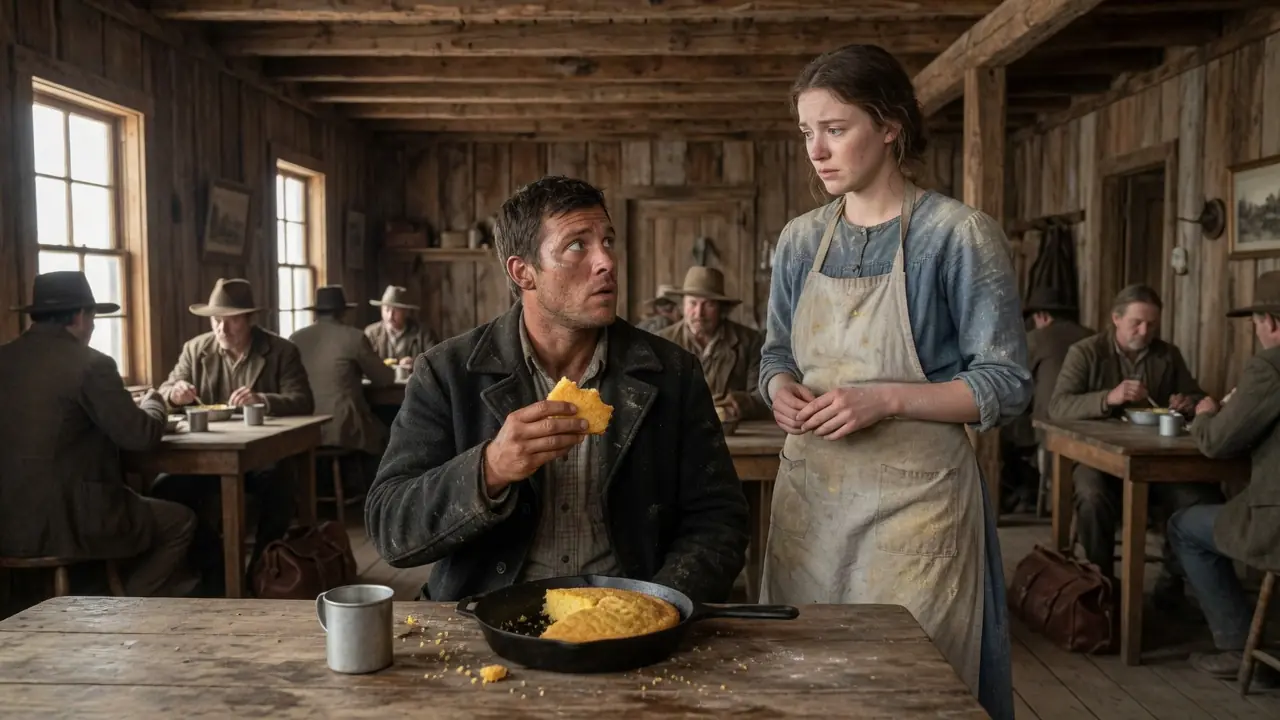
He stopped.
But the damage was done.
That night, Edmund docked Lucy’s pay for “causing a scene.”
Two days later, he docked it again for using too much butter.
The third day, he told her that if she had friends with money, she could ask them to feed her.
Lucy did not tell Jonas.
Avery-like? No Avery here. She tells no one. Need continue.
But old towns are made of thin walls, and the boy who swept Hollis’s porch had a sister who worked at the general store. By Friday, Caleb heard enough to tell Jonas.
“Boss,” he said carefully, “you might want to check on that cook lady.”
Jonas saddled his horse before the sentence was finished.
He found Lucy behind the boarding house near the water pump, sleeves wet, face pale from heat and exhaustion. She was scrubbing sheets in a tub, though laundry was not her job.
“Lucy.”
She closed her eyes briefly.
“I wondered when you’d hear.”
“What did he do?”
“What men like Hollis do when embarrassed. Made sure I paid for it.”
Jonas dismounted.
“Come work for me.”
She looked at him.
“No.”
“You haven’t heard the terms.”
“I heard enough.”
“You’d cook for the ranch. Good wages. A room if you want it, or I’ll help you find one in town. No one speaks to you like that.”
“No.”
“Why?”
“Because town already thinks it knows what women like me are.”
Jonas understood at once.
A young rancher hiring an unmarried woman to live and work at his ranch would feed every gossip from the church steps to the saloon rail.
“I can hire you proper,” he said. “Contract and all.”
“Paper doesn’t stop tongues.”
“No.”
She wrung water from a sheet, twisting it too hard.
“And I won’t be rescued by a man who thinks pity is the same as respect.”
The words hit him clean.
“That isn’t what this is.”
“Isn’t it?”
“No.”
“Then what is it?”
Jonas opened his mouth.
Closed it.
Lucy laughed softly, without pleasure.
“You don’t even know.”
She lifted the wet sheet and hung it on the line.
Jonas stood there, hat in hand, feeling useless.
Finally, he said, “I know I don’t like how he treats you.”
“That is not enough to build a life on.”
“No,” Jonas said. “It isn’t.”
She looked at him then.
Something in his answer seemed to disarm her more than argument would have.
“You should go,” she said.
Jonas nodded.
But before he mounted his horse, he turned back.
“What if it wasn’t my ranch?”
Lucy frowned.
“What?”
“What if you had your own kitchen?”
She stared at him.
“Jonas.”
“The old bakery on Second Street is empty. Roof needs work, but the oven’s sound. I could loan you the money.”
“No.”
“You could pay it back.”
“No.”
“Lucy—”
“No.” Her voice shook now. “You don’t understand what owing a man means for a woman like me.”
Jonas stopped.
This time, he heard the fear beneath the pride.
He took a breath.
“All right.”
She looked suspicious.
“All right?”
“No loan.”
“Good.”
“I’ll find another way.”
Her expression warned him not to.
He did anyway.
Not quickly. Not carelessly.
Jonas Harlan knew how to build fences, not dreams. But a dream, he discovered, needed much the same things. Posts set deep. Lines measured true. Enough patience not to quit when the first wire snapped.
He began by speaking to Mrs. Ruth Delaney, who ran the dairy and had buried two husbands, raised six children, and feared no man with a ledger.
Mrs. Delaney listened while Jonas stood awkwardly in her kitchen.
“So,” she said, “you want to help Lucy Bell open a bakery without making it look like you helped Lucy Bell open a bakery.”
“Yes, ma’am.”
“Because you like her.”
Jonas looked down at his hat.
“I respect her.”
“That was not what I asked.”
He said nothing.
Mrs. Delaney smiled.
“You Harlan men do make silence sound heavy.”
Jonas shifted.
“I don’t want her owing me.”
“Good. Then she won’t.”
Within a week, Mrs. Delaney had spoken to two church women, one widowed seamstress, and the wife of the blacksmith. All of them had eaten Lucy’s cooking at one time or another. All of them had watched Edmund Hollis treat her like a kitchen rag. None of them had quite known what to do with their discomfort until Mrs. Delaney gave it a shape.
They formed a little arrangement, though no one called it charity.
The town needed baked goods for the rail crews, socials, church meetings, and ranch supply orders. The old bakery needed a tenant. Lucy needed a chance. The women would place advance orders. Jonas would place ranch orders. Mrs. Delaney would supply butter and milk at fair credit. The blacksmith’s wife would speak to her husband about repairing the stove pipe. The seamstress would provide curtains for the front window.
And the lease?
That was the hardest part.
The building belonged to Silas Moore, who had been trying to sell it for two years.
Jonas offered to buy it quietly.
Mrs. Delaney stopped him before he could.
“No,” she said. “That puts your shadow over her door.”
So instead, Silas agreed to a low first-year lease after Mrs. Delaney reminded him of three debts, two favors, and one story from his youth he preferred his wife never hear.
When Lucy was told, she refused.
Of course she did.
She stood in Mrs. Delaney’s kitchen with her arms crossed and her face pale.
“I didn’t ask for this.”
“No,” Mrs. Delaney said. “You earned it by feeding half this town better than it deserved.”
“I can’t run a bakery.”
“You can run a kitchen.”
“That’s different.”
“Everything is different until you do it.”
Lucy looked at Jonas, who had been instructed by Mrs. Delaney to stand near the door and keep his mouth shut unless asked a direct question.
“Was this your doing?”
He answered carefully.
“Not all of it.”
“But some.”
“Yes.”
Her eyes flashed.
“I told you no.”
“You told me no loan. There is no loan.”
“That is a trick.”
“No,” Mrs. Delaney cut in. “It is women making a business arrangement with another woman. Mr. Harlan here is only one customer among many, and if he grows too proud of himself, I will personally remind him he still cannot bake a biscuit fit for company.”
Jonas nodded.
“She would.”
Lucy looked around the kitchen at the women watching her. Not with pity. Not with smugness. With expectation. As if they believed she might succeed and were already slightly impatient for her to begin.
That frightened her more than Edmund ever had.
Failure in a place like Hollis’s would mean more of the same.
Failure in her own place would mean learning she was not what she had secretly hoped.
“I don’t have a proper name for a bakery,” she said weakly.
Mrs. Delaney smiled.
“That sounds like a yes trying to hide behind a small problem.”
The bakery opened six weeks later.
Lucy named it Bell’s Oven because it was the only name she had and because, for once, she wanted to see it painted on something that belonged to her.
The sign was simple.
BELL’S OVEN
Bread, Pies, Coffee, Meals
The first morning, Lucy rose at three though no one required it. She lit the oven, kneaded dough, burned one tray of rolls, cursed softly, started again, and nearly cried when the coffee boiled over. By sunrise, the front room smelled of yeast, cinnamon, cornmeal, and fear.
Jonas arrived before the door opened.
Lucy saw him through the window.
“No,” she said when she unlocked it.
“I didn’t speak.”
“You were about to come in first.”
“I’m a customer.”
“You are not being first.”
“Why?”
“Because if you are first, everyone will say you own the place.”
Jonas stepped back at once.
“All right.”
She blinked.
He stood outside with his hat in his hands while the first customer arrived.
It was Mrs. Delaney, who bought two loaves and declared one of them already promised to a woman she did not like but intended to impress. Then came the blacksmith’s wife. Then three rail men. Then a mother with two children. Then Caleb, who bought six cinnamon rolls and ate two before reaching the door.
Only after the room had filled properly did Jonas come inside.
Lucy gave him coffee and cornbread without asking.
He paid full price.
She counted the coins twice and put them in the till.
No one in that room looked past her.
That was the first day.
There were hard days after.
Flour costs rose. The oven smoked. A storm took a shutter off the front window. Edmund Hollis told anyone who would listen that Lucy would fail before harvest. Men came in thinking a woman alone could be spoken to any way they pleased, and learned quickly that Lucy kept a rolling pin behind the counter and knew how to use her voice.
Jonas did not hover, though it took effort.
He ordered bread for the ranch twice a week and meals for work crews when needed. He repaired a loose step only after Lucy agreed to pay him in pies. He carried sacks of flour only when she asked. He learned, slowly, that helping a woman like Lucy meant respecting the shape of her independence, not rushing in because his own feelings demanded action.
And Lucy learned, more slowly, that Jonas Harlan could be told no.
That he would not punish it.
That he would return the next day with the same steady eyes and no resentment.
Summer deepened.
The rail spur came closer.
The town grew louder.
Bell’s Oven became the place where people went when they wanted coffee that did not taste boiled to death and pie that could make a tired man close his eyes. Ranch wives came for bread. Workers came for noon plates. Children pressed noses to the glass until Lucy pretended not to notice and handed out broken cookies at closing time.
Edmund Hollis lost boarders.
He blamed Lucy.
One evening, near the end of August, he came into Bell’s Oven just before closing. Jonas happened to be there, sitting near the window with coffee he had let go cold because Lucy had been telling him about a girl from the orphanage who once stole raisins and blamed a goat.
The bell over the door rang.
Lucy looked up.
Her face changed.
Edmund Hollis stood in the doorway, hat low, mouth tight.
“Well,” he said, looking around. “Fancy.”
Lucy set down the cloth she was using to wipe the counter.
“We’re closed.”
“I see you’ve gotten proud.”
Jonas began to stand.
Lucy’s eyes flicked to him once.
Not yet.
He stayed seated, though every muscle in him objected.
Edmund moved closer to the counter.
“You think this will last? A woman with no family running a business on favors?”
Lucy’s hand rested near the rolling pin.
“I said we’re closed.”
“You were nothing when I took you in.”
“No,” Lucy said. “I was hungry for work, and you were hungry for cheap labor. Don’t dress it up as mercy.”
Edmund’s face darkened.
Jonas stood now.
Edmund noticed and smiled thinly.
“Of course. Harlan money. That explains it.”
Lucy’s face went pale, but her voice stayed steady.
“Mr. Harlan is a customer.”
“A customer who bought you respectability?”
The words struck the room like a thrown glass.
Jonas took one step forward.
Lucy came around the counter before he could speak.
“No,” she said.
Edmund looked at her.
“No?”
“No, you don’t get to put your filth on what I built because you can’t stand seeing me stand upright.”
Her voice trembled, but it did not break.
“You had two years to know what I was worth, Mr. Hollis. You knew every time men asked for second helpings. You knew every time boarders said the food had improved. You knew every Sunday when your tables filled after church. You knew. You just hoped I didn’t.”
Edmund opened his mouth.
Lucy stepped closer.
“I know now.”
The room was silent.
Even Jonas barely breathed.
Lucy pointed toward the door.
“Get out of my bakery.”
For one moment, Edmund looked as if he might refuse.
Then Jonas moved to stand beside Lucy.
Not in front of her.
Beside her.
That difference mattered.
Edmund saw it. So did Lucy.
With a muttered curse, Edmund turned and left.
The bell over the door rang behind him.
Lucy stood very still.
Jonas did not touch her.
After a while, she said, “I was shaking.”
“I know.”
“I hated that.”
“You spoke anyway.”
She looked at the door.
“I did.”
Her eyes filled suddenly, and she turned away as if embarrassed by them.
Jonas waited.
Finally, Lucy wiped her face with the heel of her hand and laughed once, weakly.
“I suppose I should clean up.”
“No,” Jonas said.
She looked at him.
“What?”
“You should sit down. I’ll clean.”
“You can’t clean a bakery.”
“I can learn.”
She studied him.
“You’ll do it badly.”
“Most likely.”
“You’ll put things in the wrong place.”
“Certainly.”
“And I’ll have to fix it later.”
“Probably.”
For the second time since he had known her, Lucy truly laughed.
It changed the room.
Jonas washed the cups badly. Lucy corrected him. He swept flour into the corner instead of out the door. She called him hopeless. He smiled until his cheeks hurt.
After that night, something between them became easier, though not simple.
Lucy still guarded herself. Jonas still had silences he did not know how to cross. They were both people shaped by abandonment in different ways. Jonas had been left by a woman who decided his life was too hard. Lucy had been left before she had words to ask why.
Neither trusted happiness quickly.
But autumn came, and with it came small habits.
Jonas brought repair work only after asking. Lucy sent extra bread to the ranch only after charging him for it. He began stopping by at closing, not every night, but often enough that Caleb started grinning again. She began keeping coffee warm if she thought he might come, though she insisted it was because throwing it out would be wasteful.
One cool evening in October, Jonas found her behind the bakery planting rosemary in a wooden crate.
“You garden now?” he asked.
“I cook. Herbs help.”
He crouched nearby.
“You need more soil.”
“I know.”
“I have some at the ranch.”
Lucy looked at him.
“Of course you do.”
“What does that mean?”
“It means if I said I needed a church bell, you’d probably have one in a barn.”
“I might.”
She smiled before she could stop herself.
Jonas looked down at the rosemary.
“Lucy.”
Her hands stilled.
He had said her name differently.
Not casually.
Not as part of a question about orders or repairs.
She kept her eyes on the plant.
“Yes?”
“I’m going to ask you something. You can say no.”
“I know I can.”
He smiled faintly.
“I’d like to take you to supper.”
She blinked, then looked up.
“I make supper.”
“Then breakfast.”
“I make that too.”
“A walk, then.”
She sat back on her heels.
“People will talk.”
“They already do.”
“That doesn’t trouble you?”
“It troubles me if it troubles you.”
She looked toward the alley, where the evening light lay soft against the fence.
“It does,” she admitted. “But not for the reason you think.”
“What reason?”
“I don’t want them saying I got here because of you.”
Jonas nodded slowly.
“I don’t want that either.”
“And I don’t want to be your charity.”
“You’re not.”
“Or your project.”
“You’re not that either.”
“Or the lonely woman you noticed because you were tired of eating stew.”
He almost smiled, but saw she was serious.
“You are the woman who made me notice that I had been living like work was enough,” he said. “And that maybe I had been looking past more than cornbread.”
Lucy went quiet.
Jonas looked down at his hands.
“I don’t know how to say things prettily.”
“I’ve noticed.”
“But I would like to walk with you. In daylight. Down Main Street. Not hidden. Not ashamed. And if people talk, I’ll let you decide whether we keep walking or turn back.”
Lucy’s eyes shone in a way that made her look younger and more tired at once.
“You make it hard to distrust you.”
“I’m trying to make it unnecessary.”
She looked at him for a long time.
Then she said, “Sunday. After church crowd clears. We’ll walk by the river.”
Jonas nodded as if she had agreed to something sacred.
“Sunday.”
They walked by the river under a sky the color of polished tin.
The town saw.
Of course it did.
Mrs. Delaney saw first and pretended not to. Caleb saw and grinned so wide Jonas nearly threw a stone at him. Two women from church whispered behind parasols. Edmund Hollis watched from across the street with a face like soured milk.
Lucy kept her chin lifted.
Jonas kept his hands to himself.
They spoke of ordinary things at first. Weather. Rail rumors. Flour prices. A stubborn mule at the ranch. A little boy who had tried to pay for a cookie with a button. Then, as they reached the riverbank where cottonwoods leaned over the water, the conversation grew quieter.
“Do you miss your family?” Lucy asked.
“My father, sometimes. Though he was hard as winter ground.”
“And your mother?”
“She died when I was young. I mostly remember her singing.”
Lucy nodded.
“I don’t remember anyone.”
Jonas looked at her.
“That hurts me to hear.”
“It doesn’t hurt me the way it used to,” she said. “You can miss what you never had, but the shape of it gets blurry.”
She picked up a flat stone and turned it in her hand.
“For a long time, I thought if I worked hard enough, someone would choose me. Not as a wife necessarily. Just as a person worth keeping. Then I realized work only makes people use you longer if you don’t name your own worth.”
Jonas listened.
Lucy threw the stone into the river.
It sank without skipping.
“I’m still learning,” she said.
“So am I.”
She smiled at that.
By winter, people had stopped whispering every time Jonas entered Bell’s Oven, though not because they had become kinder. People simply grow tired of gossip when it refuses to produce scandal.
Jonas courted Lucy slowly.
So slowly that Caleb told him a funeral procession moved with more urgency.
But Lucy did not need urgency.
She needed consistency.
Jonas brought her books because he learned she liked stories but had owned very few. She sent him away with pies and exact instructions not to let the ranch hands cut them unevenly. He taught her how to read land maps. She taught him that cinnamon was not the same as nutmeg and that men who claimed not to like sweets often ate the most pie.
At Christmas, Bell’s Oven supplied half the town with bread and cakes.
Lucy stood behind the counter in a blue dress Mrs. Delaney had helped her choose, her hair pinned softer than usual. Jonas came in near closing with a small wrapped package.
“I have something for you,” he said.
Lucy eyed it.
“If it is too grand, I’ll be angry.”
“It isn’t grand.”
She opened it carefully.
Inside was a wooden-handled bread knife, finely made, practical, and balanced perfectly in the hand. Her thumb moved over the smooth handle.
“Oh,” she said softly.
“Too much?”
“No.”
She blinked hard.
“No, it’s just right.”
From behind the counter, she reached for a package wrapped in brown paper.
“I have something for you too.”
Jonas opened it.
A small cloth bundle of cornbread mix, measured and labeled in Lucy’s careful hand.
“So you don’t ride eight miles for it when the weather is bad,” she said.
He looked at the package, then at her.
“I’ll still ride eight miles.”
Her face warmed.
“You’re foolish.”
“Yes.”
“Stubborn too.”
“Yes.”
“Good,” she said.
In February, Jonas asked her to marry him.
Not in the bakery.
Not in front of the town.
Not as a grand gesture that would make people clap and make Lucy feel cornered.
He asked at the river, near the place where her first thrown stone had sunk.
Snowmelt had made the water quick and brown. The air was cold enough that their breath showed. Lucy wore a dark shawl and gloves with one mended finger. Jonas held his hat in both hands.
“I love you,” he said.
Lucy went still.
He continued before courage failed him.
“I love the way you make work honest. I love the way you speak when your voice shakes. I love the way you remember hungry children when you bake too many rolls. I love that you don’t let me become a better man in my imagination only, but make me prove it with my hands.”
Lucy’s eyes filled.
“Jonas.”
“I don’t want to own your life,” he said. “I don’t want to take you from your bakery unless you choose to leave it, and I don’t want you to become small beside me. I want to stand beside you. Like at the bakery that night. If you’ll have me.”
He took a ring from his coat pocket.
It was simple. Gold, with one small stone that had belonged to his mother.
Lucy stared at it.
Then she looked toward the river.
For a moment, Jonas feared he had misjudged everything.
Finally, she said, “I used to think being chosen would save me.”
Jonas waited.
“It doesn’t,” she said. “Not by itself. I had to choose myself first.”
“Yes.”
She looked back at him.
“But I think I could choose you too.”
His breath left him.
“Is that yes?”
Lucy laughed through tears.
“Yes, Jonas. That is yes.”
They married in April.
The church was full, though Lucy had once believed there would be no one to stand for her. Mrs. Delaney stood proudly in the front pew. The blacksmith’s wife cried openly. Caleb wore a collar so stiff he complained about it until the ceremony began, then cried harder than anyone. Several children from the county orphanage came in a wagon because Lucy had sent them bread every week since Bell’s Oven opened.
Edmund Hollis did not attend.
No one missed him.
Lucy walked down the aisle without a father to give her away.
She walked alone.
That was her choice.
Jonas watched her come toward him, and in that moment, he understood that she was not being handed from one life into another.
She was arriving.
The wedding supper was held outside Bell’s Oven, with long tables stretching into the street. There was roast beef from the Harlan Ranch, pies from every woman in town who wanted Lucy’s approval, fresh bread, beans, coffee, and, of course, cornbread.
When Jonas took the first piece, Caleb shouted from the far table, “Careful, boss. That’s how this whole thing started.”
Everyone laughed.
Lucy looked at Jonas, cheeks pink, eyes bright.
He broke off a piece and tasted it.
Then he leaned close enough that only she could hear.
“Still the best cornbread I’ve ever had.”
This time, Lucy did not turn away like the compliment weighed too much.
This time, she smiled.
Bell’s Oven remained open.
That surprised some people, though it should not have. Lucy hired two girls from the orphanage when they came of age, paying them fair wages and teaching them not only recipes but accounts, ordering, pricing, and how to look a rude customer in the eye until he remembered his manners.
Jonas continued running the ranch.
Some evenings, Lucy rode out and cooked in the ranch kitchen because she wanted to, not because anyone expected it. Other evenings, Jonas sat in the bakery after closing and washed cups badly while Lucy corrected him. They built their marriage the way both of them understood best: with work, patience, honesty, and food enough for anyone who came hungry.
Years later, when the rail spur finally came through and the town grew into something larger than anyone had imagined, people told the story often.
They told it as a sweet story.
A rancher tasted cornbread.
A forgotten cook found love.
A bakery opened.
A town changed.
But Jonas knew the truth was sharper and better than that.
Lucy had not been discovered because he praised her cornbread. She had already been worth seeing before he had the sense to look. Her hands had already known skill. Her heart had already known endurance. Her dignity had existed long before anyone in that dining room gave it a name.
The cornbread did not make Lucy special.
It only made Jonas notice what everyone else had chosen not to see.
And Lucy, who had spent her life being looked past, did not become remarkable because a rancher loved her.
She became impossible to ignore because she finally had a door with her own name above it, a kitchen where no one called her girl, and a life she had chosen with both hands.
One quiet evening, long after their wedding, Jonas found her standing in the bakery doorway at sunset. The street was golden with dust and evening light. Children ran past with broken cookies in their fists. The smell of bread drifted behind her.
“What are you thinking?” he asked.
Lucy leaned against the doorframe.
“About Hollis Boarding House.”
Jonas frowned.
“What about it?”
“The night you asked who made the cornbread.”
He smiled.
“I remember.”
“I almost hated you for that.”
“That so?”
She nodded.
“I thought you were making fun of me. Or setting me up for some kind of joke. I didn’t know what to do with being seen.”
Jonas stood beside her.
“And now?”
Lucy looked up at the sign above the door.
BELL’S OVEN.
Then she looked at him.
“Now I know being seen is not the gift,” she said. “Being respected is.”
Jonas took her hand.
The town moved around them, noisy and alive, but for a moment he heard only her voice, steady and sure.
“I’m glad it suits you,” she added.
He laughed then, remembering the first words she had ever given him.
And this time, when she smiled, she did not hide it.