For three years, Wade Mercer had imagined his ranch as a graveyard. Every frozen night in the mountains, when the wind cut through his coat and the snow erased the trail beneath Biscuit’s hooves, he saw the same picture waiting for him. A collapsed barn, broken fences, dead fields, and Margaret’s lonely grave left to the prairie. He told himself he was riding home only to say goodbye.
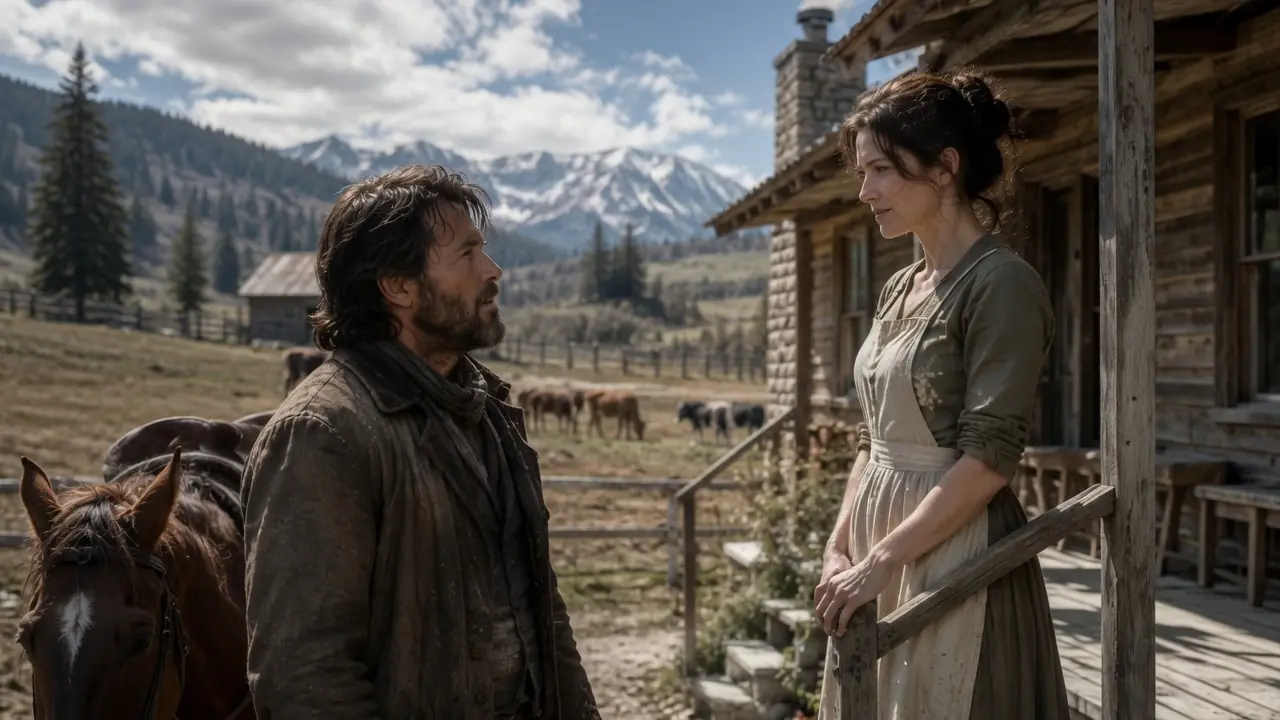
But when he reached the ridge above Mercer Ranch, Biscuit stopped beneath him so suddenly that Wade nearly slid from the saddle. Smoke rose from the chimney in a thin gray ribbon, calm and steady against the pale morning sky. The front fence along Creek Road stood straight with fresh pine rails, and the barn roof had been repaired where the winter storms should have torn it apart. In the south pasture, cattle grazed on land Wade had mourned in his heart a hundred times.
He did not move for a long moment. His beard was wild, his coat torn, his boots nearly ruined from mountain ice and hard miles. The man who had left this ranch three years earlier had been a husband, a rancher, and a man with a future. The man returning now looked more like a ghost too stubborn to stay buried.
Biscuit lowered his head and snorted, as if the old horse recognized the place before Wade dared to. Slowly, they descended the ridge toward the cabin, past a winter garden covered in neat rows, past chickens scratching freely near the shed, past a stack of split firewood arranged with careful hands. Nothing about the ranch looked abandoned. If anything, it looked more alive than when Wade had left.
Then he saw her on the porch. A woman in her thirties stood beside the railing, dark hair pinned back, flour dusting the sleeves of her simple work apron. She did not reach for a rifle or run inside to bolt the door. She only watched him with calm, tired eyes, as if she had been waiting for this moment longer than he had been riding toward it.
Biscuit stopped at the foot of the porch without being asked. That unsettled Wade more than anything, because the old horse trusted almost no one. Wade climbed down stiffly, his legs weak from exhaustion and hunger, and removed his hat with one trembling hand. He stared at the woman, then at the repaired house behind her.
“Who are you,” Wade asked, voice rough as gravel, “and why are you living in my ranch?”
The woman’s face softened, but she did not flinch. “My name is Clara Whitlock.”
“That answers half of it.”
“I know.”
Wade stepped closer, anger rising because anger was easier than confusion. “I rode through three years of hell to come home. I buried this place in my mind. I buried my wife in my heart. And now I find smoke in my chimney and a stranger on my porch.”
Clara folded her hands in front of her apron. “You are Wade Mercer.”
His eyes narrowed. “You know my name.”
“Yes.”
“You expected me?”
“Not today,” she said quietly. “But someday, yes.”
Wade gave a bitter laugh, though there was no humor in it. “Then you know this land is mine.”
“I know.”
“And yet you stand there like you belong here.”
Clara looked past him toward the pasture, where the cattle moved slowly under the cold sky. “For three years, belonging was less important than keeping it alive.”
Wade’s jaw tightened. “My wife is gone.”
“I know.”
“My foreman never came back.”
“I know.”
“The bank took everything.”
Clara shook her head gently. “No.”
That one word struck him harder than a shout. Wade stared at her, suddenly feeling the weakness in his body again. He had survived blizzards, river ice, hunger, and men who left him behind because they thought he would die anyway. But standing in front of this woman, hearing her deny the ruin he had carried for three years, nearly knocked him down.
“What do you mean, no?” he asked.
“The debts were paid.”
Wade stumbled back a step. His hand found Biscuit’s saddle before his knees gave out. “Paid by who?”
Clara’s eyes lowered. “That is a longer story than you are ready to hear standing in the cold.”
“I did not come home for manners.”
“No,” she said. “You came home because you survived.”
He looked at her sharply.
Clara stepped down from the porch and took Biscuit’s reins with a gentleness that made the horse lower his head. “And right now, Mr. Mercer, you need bread, coffee, and a chair before your pride drops you into the dirt.”
Wade wanted to refuse. He wanted to demand records, names, explanations, and every hidden truth that had grown inside his house while he was gone. But the smell of fresh bread drifted from the cabin, and his stomach twisted painfully. He had eaten dried beans for two days and snowmelt for breakfast.
Clara led Biscuit toward the small hitch rail, and the horse followed her like he had known her all his life. Wade watched, confused and offended by the ease of it. Even Margaret had needed months to win Biscuit’s trust. This stranger touched his horse once, and the old animal obeyed.
Inside the cabin, warmth wrapped around Wade so suddenly that his eyes burned. The table had been scrubbed clean, the floor swept, the curtains mended. Margaret’s blue teapot sat near the stove, polished and whole, exactly where she used to keep it. Wade froze at the sight of it, and Clara noticed.
“I almost put it away,” she said softly. “But Margaret loved that teapot.”
Wade turned on her. “Do not say her name like you knew her.”
Clara held his gaze. “I did know her.”
“No.” His voice cracked. “You don’t get to walk around my house, touch my wife’s things, and speak of her like you were family.”
Clara’s eyes filled, but her voice remained steady. “No, Wade… it was a promise I made to your dying wife before the bank tried to bury your name.”
The room went silent except for the fire snapping in the stove. Wade stared at her as if she had become part of a dream he did not trust. Margaret’s name in Clara’s mouth had already wounded him. But the word promise cut deeper, because Margaret had believed in promises the way other people believed in sunrise.
“Don’t use Margaret’s name to excuse living under my roof like this,” he said.
Clara reached into the pocket of her apron. Her fingers trembled as she pulled out a folded letter, the paper worn soft from being opened and held many times. She did not hand it to him immediately. She looked at it first, as if asking permission from the woman who had written it.
“She gave me this the night she knew she would not survive,” Clara said. “She begged me not to let them steal your home.”
Wade’s face drained of color. “Margaret knew I was alive?”
“She never stopped believing it,” Clara whispered. “Even when every man in town called you dead.”
The letter passed from Clara’s hand to Wade’s. For a long moment, he could not open it. He knew Margaret’s handwriting before he saw a single word. The careful slant, the firm pressure, the small loop she made in the letter M — all of it came back like her voice in the room.
Finally, he unfolded the page.
My dearest Wade, if these words find your hands, then God has done what the world told me He would not do. You came home.
Wade’s breath broke. He sank into the nearest chair, still holding the paper. Clara stood across from him, hands clasped so tightly her knuckles paled. She did not interrupt while he read, and that restraint was the first kindness he accepted from her.
The letter told him what had happened after he disappeared in the mountains. The cattle drive had gone wrong near the high pass, and word reached the ranch that Wade and the others had been lost in a storm. The foreman never returned, and men from town began arriving with offers that sounded like pity but smelled of greed. Then the bank claimed unpaid debts had matured, and a land agent named Silas Crowley pressed Margaret to sign away the south pasture.
Margaret refused. She was already sick by then, weaker than she let anyone see, but she fought the bank with every breath. Clara Whitlock, a schoolteacher from the next county who had once been saved by Margaret during a harsh winter, came to help her. What began as two women sorting papers became a battle to keep Mercer Ranch from being stolen under the cover of grief.
Wade read until the words blurred.
Clara knows where I hid the receipts, Margaret had written. She knows about the cattle note, the bank ledger, and the silver coins from my mother’s trunk. She knows I never believed you dead. If I cannot hold this place until you return, she will. Trust her, Wade. Not because the world is kind, but because I chose her when I could no longer stand.
Wade lowered the letter. His hands shook.
Clara spoke carefully. “She made me swear I would save the ranch first and explain only if you came home alive.”
Wade looked up, eyes wet and furious. “You let me ride back thinking I had lost everything.”
“No,” Clara said, tears slipping down her face. “I kept everything waiting, because Margaret said your heart would need a home before it could survive the truth.”
The words struck something fragile inside him. For three years, Wade had survived by not thinking too much about Margaret. If he thought of her voice, his body weakened. If he imagined her grave, his will almost failed. He had carried grief like a locked box and told himself he would open it only when he reached home.
Now the box had opened by itself.
“Where is she?” he whispered.
Clara nodded toward the east hill beyond the barn. “Under the cottonwood, where she asked to be. I kept the stone clean.”
Wade stood too fast and nearly fell. Clara reached for him, but he pulled away, not cruelly, only because he could not bear help yet. He walked out of the cabin with the letter in his hand, past Biscuit, past the woodpile, past the repaired fence he had not repaired. Clara followed several steps behind, silent.
The cottonwood stood on a low rise overlooking the ranch. Margaret had loved that hill because she could see the creek from there in spring. A simple stone marked her grave, brushed clean, with winter flowers tucked beside it. Someone had built a small rail around it to keep the cattle away.
Wade dropped to his knees.
For a long while, he did not speak. He pressed Margaret’s letter to his chest and bowed his head over the frozen ground. The wind moved through the bare branches above him, and every mile he had survived seemed to break inside him at once. Clara stopped at the bottom of the hill and let him grieve alone.
When Wade finally returned to the cabin, his face looked older. Not angrier. Just emptied. Clara had set bread, stew, and coffee on the table, but she remained standing near the stove as if waiting to be ordered out.
He sat slowly. “How much did you pay?”
Clara looked at him. “Enough.”
“That is not an answer.”
“It is the kindest one.”
Wade’s eyes lifted. “I asked for truth.”
Clara nodded, then took a ledger from the shelf by the stove. The book was thick, marked with dates, sales, purchases, and bank receipts. She placed it before him. “Margaret used her mother’s coins first. Then I sold my father’s watch, two horses, and the little house I had in Briar Creek. After the first winter, the ranch began carrying itself again.”
Wade stared at the ledger. “You sold your home?”
“It was four walls and a roof.” She glanced around the cabin. “This was a promise.”
He shook his head slowly. “Why?”
Clara’s eyes softened with memory. “Because Margaret once found me half frozen beside the road with a sick mother and no money. She brought us here, fed us, and sat up all night with my mother until the fever broke. When my mother died the following spring, Margaret buried her like family.”
Wade remembered that winter vaguely. A young woman and her mother had stayed in the spare room for several days while he was away buying feed. Margaret had mentioned them afterward, saying only that people should not have to earn mercy before receiving it. He had not known the young woman’s name then.
“That was you,” he said.
Clara nodded. “I owed her more than I could ever repay.”
“And Crowley?”
Her expression darkened. “He wanted the land for the rail spur. He thought a widow would sign. When she would not, he thought a dead man’s ranch would fall easy enough.”
Wade looked at the repaired walls, the clean floor, the food before him. “And you stood against him alone.”
“Not alone,” Clara said. “Margaret left me her courage.”
That evening, Wade ate slowly, though every spoonful seemed to hurt going down. His body needed food, but his heart resisted comfort from a stranger. Clara did not force conversation. She tended the stove, checked Biscuit, and moved through the cabin with the quiet familiarity of someone who had kept it alive through too many lonely nights.
Near midnight, Wade stood before the bedroom door. Margaret’s room. His room. Clara had not slept there; he could tell at once. The quilt on the bed was folded neatly, untouched, while a narrow cot stood near the kitchen wall with Clara’s blanket rolled at the foot.
He turned back. “You never took the bedroom.”
Clara looked up from washing dishes. “It was not mine.”
“But the house was?”
“No,” she said. “The house was waiting.”
Wade had no answer for that.
He slept in the chair by the fire instead of the bed. Dreams came hard and broken. He saw snow swallowing men, Margaret calling his name from a porch he could not reach, Clara standing between the ranch and a line of faceless men holding papers. When he woke before dawn, Clara was already outside feeding chickens.
For three days, Wade said little. He walked the property, touching fence posts, barn beams, gate hinges, and water troughs as if each repaired thing accused him of absence. Clara followed only when needed, answering questions when asked. She showed him the breeding records, the receipts, the winter feed account, and the hidden drawer where Margaret had kept her last instructions.
On the fourth day, Silas Crowley arrived.
He came in a black carriage with two men and a folder full of papers. He was thinner than Wade remembered, with a sharp nose, polished boots, and the smile of a man who believed law was whatever frightened people enough to obey. Wade was mending a gate when the carriage stopped. Clara came out of the barn, face going still.
Crowley stared at Wade as if seeing a dead man walk across his path. “Well,” he said, forcing a smile. “Mercer. The mountains finally spat you back out.”
Wade set down the hammer. “You look disappointed.”
Crowley’s smile tightened. “Surprised, perhaps. There are matters to settle.”
Clara stepped forward. “The matters were settled.”
Crowley ignored her. “A woman playing rancher does not settle bank law.”
Wade moved so quickly that one of Crowley’s men shifted back. He stopped only a step from Crowley, his voice low. “Speak to her with respect on my land.”
Crowley’s eyes narrowed. “Your land? That remains to be proven.”
Clara entered the cabin and returned with the ledger, Margaret’s letter, and a stack of receipts tied in blue ribbon. She placed them on the porch rail. “Paid in full. Signed by your bank clerk. Witnessed by Pastor Bell and Mr. Harlan from the feed office.”
Crowley’s face changed. Not much, but enough. “Those documents require review.”
“You reviewed them twice when you tried to claim the south pasture last spring,” Clara said. “You lost.”
Wade looked at Clara, and for the first time he understood what she had endured. Not only loneliness and work, but threats dressed as paperwork. Men had come to take the ranch, and she had met them with receipts, courage, and Margaret’s faith in him. Wade felt shame move through him, not because he had survived, but because part of him had doubted her.
Crowley turned to Wade. “You would trust this woman? She has lived under your roof for three years.”
Wade looked at Clara. Her face was pale, but her chin remained lifted.
Then he turned back to Crowley. “She kept my roof standing.”
Crowley’s jaw tightened.
Wade picked up Margaret’s letter and held it against his chest. “My wife trusted her. That is more than enough for me.”
Crowley’s polished confidence finally cracked. He gathered his papers with stiff hands, muttered about formal appeals, and climbed back into the carriage. Wade watched him leave until the wheels disappeared beyond Creek Road. Only then did Clara let out the breath she had been holding.
“You did not have to defend me,” she said.
Wade looked at the repaired ranch around them. “You defended me for three years when I could not stand here myself.”
Her eyes filled again, but this time she smiled through it. “Margaret said you would be stubborn.”
“She was usually right.”
“She said you would come home angry.”
“She was right about that too.”
“And hungry.”
He glanced toward the cabin. “Painfully right.”
Clara laughed softly, and the sound changed something in the yard. It did not erase grief, but it made room beside it. Wade looked toward the hill where Margaret rested beneath the cottonwood, and for the first time since returning, the sight did not break him completely. The grave was not abandonment. It was a place Clara had kept with love.
Winter softened into spring. Wade slowly reclaimed the work his body remembered better than his mind. His strength returned in pieces: one fence rail, one bucket, one morning ride across the pasture with Biscuit under him. Clara remained, though she often spoke of leaving now that he had returned.
Each time she mentioned it, Wade felt the ranch grow quieter in his imagination. He did not know what to call that feeling. It was not replacing Margaret. Nothing could. It was something different, born from gratitude, trust, and the strange intimacy of sharing a promise to the same woman.
One evening, as spring rain tapped the roof, Wade found Clara packing a small bag near the cot.
“What are you doing?” he asked.
She looked startled. “I thought it was time.”
“For what?”
“For me to go.”
Wade stood in the doorway, muddy from the barn, suddenly unable to speak. The cabin smelled of coffee and rain. Margaret’s teapot sat on the stove. Clara’s hands rested on the folded dress in her bag, and her face looked calm in the way people look when they are trying not to ask to be wanted.
“Where will you go?” Wade asked.
“Briar Creek, perhaps. I can teach again.”
“This ranch still needs work.”
“You can hire help.”
“Biscuit likes you.”
Her mouth trembled. “That old horse likes anyone with oats.”
“He likes you.”
Clara looked down. “Wade.”
He stepped closer. “Margaret asked you to keep this place alive until I came home.”
“Yes.”
“I came home.”
“Yes.”
“And found that you had done more than keep the ranch alive.” His voice roughened. “You kept my name alive. You kept her love from being buried with her. You kept a place for a man everyone else called dead.”
Clara’s eyes filled. “That was the promise.”
“No,” Wade said softly. “That was you.”
She looked at him then.
Wade took Margaret’s letter from his coat pocket. He carried it often now, folded close to his heart. “I loved my wife. I will love her until my last breath.”
“I know.”
“But Margaret was not afraid of life continuing.” He swallowed hard. “She proved that when she chose you.”
Clara whispered, “Do not say things out of grief.”
“I am not.” Wade took one more step. “I am saying I do not want you leaving because you think your place here ended the moment I returned.”
Her tears fell freely now. “And what is my place?”
Wade looked around the cabin — the polished teapot, the repaired floor, the ledger on the shelf, the bread cooling by the stove, the home that had waited for him because Clara had refused to let it die. Then he looked back at her.
“That is a much longer story than either of us is ready to finish tonight,” he said.
A laugh broke through her tears. It was small, but real. Wade smiled for the first time in what felt like years.
So Clara stayed.
Not as Margaret’s replacement. Not as a stranger guarding a dead woman’s promise. She stayed as the woman who had stood between greed and a grieving home, who had kept the fire burning when everyone else expected ashes. In time, the town stopped calling her the woman living at Mercer Ranch and began calling her Miss Clara of Mercer Ranch, which made Wade smile every time he heard it.
Months later, on the first warm morning of summer, Wade and Clara stood together at Margaret’s grave. Wildflowers grew near the rail, and the cottonwood leaves moved softly overhead. Wade placed a hand on the stone, then set fresh flowers beside the old ones. Clara stood quietly at his side.
“I came home to say goodbye,” Wade said.
Clara looked at him. “Did you?”
He nodded slowly. “But Margaret had already turned goodbye into a beginning.”
The wind moved over the hill, down across the pasture, through the repaired fences, and into the yard where Biscuit grazed lazily near the porch. Smoke rose from the chimney though the day was warm, because Clara had bread in the oven. Mercer Ranch stood whole beneath the sky, no longer a graveyard in Wade’s mind.
It was scarred. It was changed. It was alive.
Wade looked at Clara, and she looked back with the same calm courage that had greeted him the day he returned from the mountains.
For three years, he had believed he was riding home to bury the last piece of his life.
Instead, he had found a promise waiting on the porch.
And a woman brave enough to keep it alive until he was strong enough to come home.