“We don’t serve people like you.”
Vanessa Cole said it with the clean, sharp confidence of someone who had never expected to pay for cruelty. Her manicured fingers rested on the white marble reception counter, inches from the single crumpled dollar the old man had placed there. The salon behind her glittered with mirrors, glass shelves, black leather chairs, and soft white lights that made every surface look too polished to touch. Every head in the room turned toward the old man in the ragged brown jacket.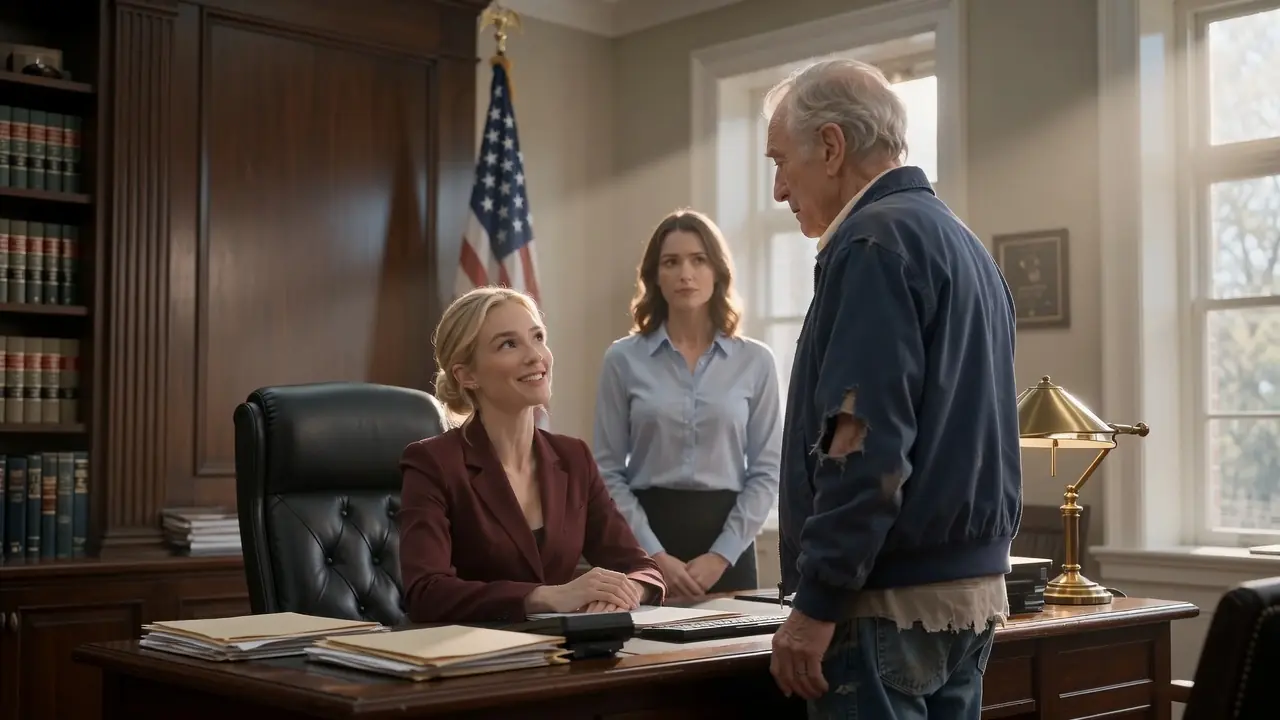
Arthur Whitman stood very still. His shoulders were bent with age, his gray hair stuck out unevenly from beneath a worn cap, and his hands trembled slightly as they hovered near the counter. The dollar bill between him and Vanessa looked small, almost pitiful, flattened by years of folding and unfolding. Yet his eyes did not look broken. They looked tired, patient, and strangely awake.
“I only asked for a haircut,” he said quietly.
Vanessa’s lips curved. “A haircut here starts at fifty dollars.”
“I know,” Arthur said. “I was hoping someone might let me pay the rest later. I have a job interview tomorrow morning.”
A few people shifted in their chairs. One woman under a silver hair dryer lowered her magazine. A stylist near the shampoo station paused with a towel in his hand. Nobody spoke, but discomfort spread through the room like a cold draft.
Vanessa looked at the dollar again, then pushed it back with the tip of one finger. “Then take your one dollar and get out before you embarrass this place.”
The old man did not reach for the bill.
For a moment, the salon seemed to hold its breath. The expensive silence, the kind people buy with appointments and memberships, became heavy. Arthur looked past Vanessa at the row of stylists, the customers pretending not to stare, and the tall wall behind the reception desk where the salon’s gold-lettered name glowed under the lights.
Whitman House Salon.
His name.
Not that anyone in the room appeared to know it.
Vanessa folded her arms. “Did you hear me?”
“I heard you,” Arthur said.
“Then leave.”
A chair scraped softly near the back of the salon.
“I’ll do it.”
The voice was calm, but it carried. A young stylist stepped forward from behind the third chair, still holding the towel he had been folding. His name tag read Noah Bennett. He was in his early thirties, with dark hair, tired eyes, and the kind of quiet expression that made people underestimate how much he noticed.
Vanessa turned sharply. “Noah.”
Noah kept his eyes on Arthur. “Sir, come with me.”
Vanessa let out a short laugh. “Are you serious?”
“Yes.”
“He has one dollar.”
“Then I’ll take one dollar.”
Her face tightened. “This is not your private charity project.”
Noah stepped beside Arthur and gently touched the old man’s shoulder. “No, it’s a salon. And he asked for a haircut.”
Vanessa’s eyes flashed with anger. “You want to waste a chair on him while real clients are waiting?”
Noah looked around the room. Only two clients were waiting, and both were pretending very hard not to be involved. He looked back at Vanessa. “A person becomes a real client when he walks through the door.”
The words landed harder than he expected.
Arthur turned slightly toward him. “You don’t need to risk your job for me.”
Noah gave him a faint smile. “Maybe my job should be worth risking for the right reason.”
Vanessa pointed toward the door. “If you put him in that chair, Noah, I’m reporting you to the manager.”
“Do that.”
Her mouth opened, but no answer came fast enough. Noah guided Arthur toward his station, moving slowly so the old man could keep his balance. The room watched them cross the shining floor, one man in polished black shoes and a crisp apron, the other in cracked boots and a jacket that looked like it had survived ten winters too many.
Noah pulled out the chair. “Careful, sir.”
Arthur lowered himself into it with a soft breath. His hands gripped the armrests for a second before he relaxed. In the mirror, he saw Vanessa still glaring from the counter, saw the customers watching through lowered eyes, saw Noah reach for a clean cape and shake it open with quiet dignity.
“Thank you,” Arthur whispered.
Noah fastened the cape around his neck. “No need to thank me.”
“There is always a need to thank kindness.”
Noah paused, surprised by the way the old man said it. Not desperately. Not weakly. As if kindness were not a favor but a measure by which every person in the room had just been weighed.
“What kind of cut do you want?” Noah asked.
Arthur looked at himself in the mirror. The face staring back was one he had barely recognized that morning. Hollow cheeks, white stubble, tired eyes, hair left untamed by weeks of pretending he was merely another forgotten old man. “Something respectable,” he said. “Something that would make a stranger look twice before dismissing me.”
Noah’s expression softened. “I can do that.”
He began gently, combing through the tangled hair with care instead of impatience. He did not tug, did not sigh, did not speak down to Arthur. He treated the old man’s head the same way he treated the heads of customers who arrived with platinum cards and diamond watches. That was the part Arthur noticed most.
Vanessa noticed too.
She walked closer after a few minutes, heels clicking against the floor. “Noah, this is ridiculous.”
Noah kept working. “Then don’t watch.”
“You’re making the salon look cheap.”
Arthur’s eyes lifted to hers in the mirror. “No, Miss Cole. You did that at the counter.”
Vanessa blinked. “Excuse me?”
Noah stopped moving for half a second.
Arthur’s voice remained soft. “A poor man asking for help did not cheapen this room. Your answer did.”
Color rose in Vanessa’s cheeks. “You don’t know anything about this room.”
Arthur looked at the gold letters reflected behind her. “I know more than you think.”
She laughed again, but there was less certainty in it now. “Noah, finish your little charity cut and get him out before Mrs. Langford arrives. She has a premium appointment.”
Arthur’s eyes narrowed almost invisibly. “Premium.”
Vanessa smiled with satisfaction. “Yes. Premium. That means important.”
Noah resumed cutting, but his jaw tightened. “People are important before they pay.”
“You sound like a greeting card,” Vanessa snapped.
“No,” Arthur said quietly. “He sounds like someone who understands why this place was built.”
The scissors stopped again.
Noah looked at Arthur in the mirror. “You’ve been here before?”
Arthur gave no answer at first. His gaze moved over the salon slowly, not like a customer admiring the shine, but like a man remembering where things once stood. The first Whitman House had not looked like this. It had been a narrow room in St. Louis with two secondhand chairs, a cracked sink, and a front window that fogged in winter. Arthur had opened it with his wife, Lillian, and a savings envelope she hid inside a flour tin.
They had served factory workers, church women, widows, businessmen, janitors, brides, children, tired fathers, and anyone who needed to feel human again for half an hour. Lillian always said a salon was not built on hair. It was built on the way people looked at themselves when they left. Arthur had spent forty years proving her right.
Then Lillian died.
After that, the company grew faster than Arthur’s grief could follow. Investors came. Managers came. Branding consultants came with words like prestige, luxury, client tier, demographic fit, and premium experience. Arthur had stepped back, first to recover, then because everyone told him he had earned rest.
But rest had become distance.
Distance had become ignorance.
And ignorance had allowed people like Vanessa Cole to stand beneath his name and say, We don’t serve people like you.
“I opened my first shop with a woman who would have fired anyone for speaking the way you did,” Arthur said.
Vanessa rolled her eyes. “Good for her.”
Noah’s scissors froze.
Arthur smiled faintly, but there was no warmth in it. “It was.”
The haircut continued. Little by little, the ragged edges fell away. Noah trimmed carefully around Arthur’s ears, cleaned the neckline, shaped the uneven white hair into something dignified and sharp. The change was not magical, but it was powerful. The old man in the mirror began to look less like someone the world had thrown aside and more like someone the world had been foolish to overlook.
One of the waiting customers, an older woman with pearls at her throat, watched silently. Her expression had changed. At first she had looked annoyed by the disruption. Now she looked ashamed.
Arthur noticed that too.
Noah removed the cape after the final brush. “There you go, sir.”
Arthur looked at himself for a long moment. “You have good hands.”
Noah smiled. “Thank you.”
“And better instincts.”
Noah lowered his eyes, uncomfortable with praise. “I just did what anyone should have done.”
Arthur turned in the chair and looked toward the reception desk. “And yet only one person did.”
Vanessa made a small sound of irritation. “Wonderful. Inspirational. Are we finished now?”
Arthur slowly reached into his ragged jacket.
The room seemed to tighten.
His hand moved carefully, not because he wanted drama, but because his fingers were old and the pocket was deep. Vanessa looked impatient. Noah looked confused. Arthur drew out a small leather cardholder, worn at the edges but beautifully made.
From it, he removed a card.
Gold.
Heavy.
The light struck it and flashed across the mirror.
Noah accepted it when Arthur held it out. He turned it over, read the engraved letters, and went rigid. His breath caught so suddenly that Vanessa noticed.
“What?” she demanded.
Noah looked from the card to Arthur, then back again. His face had gone pale. “You’re… the owner of this place?”
The entire salon fell utterly still.
Vanessa’s smile disappeared.
Arthur rose from the chair slowly, but when he stood, the stoop in his shoulders seemed less like weakness and more like something he had chosen to carry until the right moment. He took the card from Noah’s hand and held it where Vanessa could see.
Arthur Whitman. Founder. Principal Owner. Lifetime Gold Authority.
Vanessa stared at the card as if it had appeared from another world.
“No,” she whispered.
Arthur’s voice was calm. “Yes.”
A customer gasped softly. The stylist near the shampoo station covered her mouth. Someone at the back dropped a comb, and the sound clicked across the floor like a tiny verdict.
Vanessa’s lips parted. “Mr. Whitman, I didn’t recognize you.”
“That is true.”
“I mean, if I had known—”
Arthur’s eyes sharpened. “If you had known I was rich, you would have treated me better.”
Her face flushed.
“That is not a defense,” he said. “It is the problem.”
Noah stepped back, still stunned. “Sir, I had no idea.”
“I know,” Arthur said, turning to him. “That is why your kindness matters.”
Vanessa came around the counter, panic replacing arrogance. “Mr. Whitman, please. I was protecting the salon’s standards.”
Arthur looked around the glittering room. “Standards?”
“Yes. We have a certain image.”
“I built this company on dignity,” Arthur said. “Not image.”
She swallowed. “I made a mistake.”
“No,” Arthur replied. “A mistake is booking the wrong time. A mistake is spilling coffee. You looked at a man with one dollar and decided he was not human enough for courtesy.”
The words struck her harder than shouting would have.
Vanessa’s eyes filled with tears, but Arthur had lived long enough to know tears could come from fear of consequences as easily as remorse. He did not soften. Behind him, Noah stood silent, and the rest of the salon seemed afraid to move.
“Start packing your things,” Arthur said icily.
Vanessa’s mouth fell open. “You’re firing me?”
“I am removing you from the front door before you decide who else is unworthy of entering.”
“Please,” she said. “I need this job.”
Arthur looked at the crumpled dollar still lying on the counter. “So did the man you tried to throw out.”
Her face crumpled.
For a moment, nobody spoke.
Then the older woman with pearls stood from her waiting chair. “Mr. Whitman?”
Arthur turned.
“I heard what she said,” the woman admitted. “And I said nothing. I’m sorry.”
Arthur looked at her for a long moment. “Silence is how cruelty gets comfortable.”
She nodded, ashamed.
He turned to the rest of the room. “That applies to everyone here.”
The stylists lowered their eyes. A few customers shifted in embarrassment. Noah stood straighter, but even he looked wounded by the truth of it. The salon had not only failed because Vanessa was cruel. It had failed because everyone else had allowed cruelty to take up space without challenge.
Arthur walked to the reception desk and picked up the crumpled dollar. He smoothed it carefully against the marble counter. Everyone watched as if the bill had become more important than the gold card.
“When my wife and I opened our first shop, a man came in with seventy-five cents and asked us to clean him up for his daughter’s wedding,” Arthur said. “He had worked thirty years in a warehouse. His suit was too large, his shoes were cracked, and he smelled like machine oil. Lillian stayed late and cut his hair for nothing.”
His voice softened when he said her name.
“The next week,” Arthur continued, “that man sent us twelve customers from the warehouse. Not because we gave him charity. Because we gave him dignity.”
Noah listened without moving.
Arthur looked at Vanessa. “You saw one dollar and thought it measured my worth. That tells me you have no idea what business you are in.”
Vanessa had no answer.
The manager, a nervous man named Colin Price, finally came out from the office. He had clearly heard enough to understand disaster had arrived, but not enough to know where to stand. “Mr. Whitman,” he said weakly. “We weren’t expecting you.”
Arthur looked at him. “That was the point.”
Colin glanced at Vanessa, then at Noah, then at the customers. “I can handle this privately.”
“No,” Arthur said. “It happened publicly.”
Colin went pale.
Arthur turned toward him fully. “How long has your receptionist been deciding which customers look worthy?”
Colin opened his mouth, then closed it.
Arthur waited.
“I’ve had complaints,” Colin admitted.
“How many?”
“A few.”
“How many?”
Colin lowered his eyes. “Nine written complaints in six months.”
The room stirred.
Arthur’s voice dropped. “And what did you do?”
“I spoke to her.”
Vanessa looked at him, betrayed.
Arthur nodded slowly. “You spoke. And she continued.”
Colin said nothing.
“Then you failed the door too,” Arthur said.
The manager’s face collapsed.
Arthur pointed gently toward the office. “You and Miss Cole will wait there for corporate review. Do not touch the schedule. Do not delete files. Do not speak to staff unless spoken to.”
Colin hesitated.
Arthur’s gaze hardened. “Now.”
Vanessa and Colin walked toward the office in silence. The sound of the door closing behind them seemed to release the salon from a spell. People breathed again. A stylist near the shampoo station began quietly crying.
Arthur turned back to Noah.
“You,” he said.
Noah stiffened. “Sir?”
“How long have you worked here?”
“Two years.”
“Has this happened before?”
Noah looked toward the closed office door. “Yes.”
“Why didn’t you report it?”
“I did once.”
Arthur waited.
“Colin said Vanessa was just strict with the brand image,” Noah said. “After that, my hours got cut for three weeks.”
Arthur closed his eyes briefly.
There it was. Not one cruel employee, but a culture protecting her. A front desk turned into a gate. A manager mistaking silence for order. A brand polished so hard it had lost the fingerprints of the people it was built to serve.
Arthur opened his eyes. “I am sorry.”
Noah looked startled. “Sir, you don’t have to apologize to me.”
“Yes,” Arthur said. “I do. My name is on the wall.”
That sentence changed the room more than the firing had.
Because power almost never apologized downward. People with names on walls usually blamed the people beneath them. Arthur had made millions of dollars in this business, and now he stood in a ragged jacket holding one crumpled dollar, admitting that ownership meant responsibility.
He turned to the waiting customers. “Anyone who wishes to leave may do so with no charge for services today. Anyone who stays will be served by staff who understand that dignity is not a premium upgrade.”
No one left.
Arthur looked at Noah. “Finish your day. Then come to my office tomorrow morning.”
Noah swallowed. “Am I in trouble?”
“No,” Arthur said. “You are being considered.”
“For what?”
“For the kind of leadership this place forgot.”
Noah had no words.
The next day, Arthur arrived in a suit.
That caused almost as much shock as the gold card. Without the ragged jacket and worn cap, he looked like the founder in the old company photographs: older, thinner, but unmistakable. He walked through the salon at nine in the morning with two corporate staff members, reviewed the complaint files, interviewed employees, and removed Colin Price from management before lunch.
Vanessa’s termination followed by noon.
There were procedures, of course. Forms, signatures, final pay, documentation. Arthur followed them all because dignity did not disappear when someone lost a job. But he did not confuse dignity with softness. Vanessa had been cruel where kindness was required, and Colin had protected polish over people.
By the end of the week, Noah Bennett became interim floor lead.
He tried to refuse.
“I’m just a stylist,” he said.
Arthur stood beside Chair 4, watching sunlight move across the mirrors. “No. You are a stylist who remembered what the rest of the room forgot.”
“I don’t know how to manage a salon.”
“You know how to treat people,” Arthur said. “The rest can be taught.”
Noah looked toward the reception counter, now staffed by a soft-spoken woman named Iris who greeted every person the same way, whether they wore designer coats or construction boots. “What if I fail?”
Arthur gave him a faint smile. “Then fail while doing the right thing. It is cleaner than succeeding at the wrong one.”
The story spread faster than Arthur wanted. A customer posted about the old man with the gold card. Someone else added details about the receptionist. By the following week, people were calling Whitman House not to ask about premium appointments, but to ask whether the salon really had a one-dollar haircut policy.
Arthur did not create a policy.
He created something better.
Every Monday morning, before regular appointments, Whitman House opened two chairs for anyone preparing for a job interview, court hearing, shelter placement, school return, or fresh start. No questions designed to humiliate. No proof demanded at the front desk. The service was called The Lillian Hour.
Noah suggested the name.
Arthur approved it without speaking for nearly a minute.
The first man who came for The Lillian Hour was a warehouse worker recently laid off. The second was a woman going to an interview after three years home caring for her mother. The third was a nineteen-year-old boy aging out of foster care who had never had a professional haircut in his life. Each left standing a little straighter than when they entered.
And none of them were made to place their worth on the counter first.
Months later, Arthur returned to the salon wearing the same ragged jacket. Not as a disguise this time, but as a reminder. The jacket hung in a frame near the staff room, beside the crumpled dollar, carefully preserved under glass. Beneath it, a small plaque read: We do not measure people before we serve them.
Noah stood beside him when the frame was mounted.
“Do you think it will matter?” Noah asked.
Arthur looked through the glass at the old jacket. “Only if people remember why it is there.”
“They will.”
“People forget.”
“Then we’ll remind them.”
Arthur smiled.
The salon was different now. Not less elegant, not less successful, not less premium in the ways customers expected. The mirrors still shone, the chairs remained black leather, the lights were still white and perfect. But the room no longer felt cold.
People noticed. They noticed before they understood why. The greeting at the door changed. The way stylists spoke changed. The way customers looked at one another changed because kindness, like cruelty, teaches a room how to behave.
One afternoon, a man entered with paint on his jeans and saw the prices on the wall. He began to back out, embarrassed.
Iris looked up from the desk. “Sir?”
“I’m sorry,” he said. “Wrong place.”
Noah stepped from behind his chair. “No, you found the right place. What do you need?”
Arthur, sitting quietly near the window, heard the words and closed his eyes.
That was all he had ever wanted Whitman House to be.
Not a place where money bought respect.
A place where respect came first, and the haircut followed.