Evelyn Hawthorne entered the forty-second floor of Hawthorne & Beck carrying a gray cleaning caddy in one hand and pushing a supply cart with the other. She wore a light-blue uniform, plain black shoes, and a plastic identification badge bearing the borrowed name Evelyn Harris. At fifty-eight, she was a dignified Black woman with deep brown skin, intelligent dark eyes, and short neatly styled hair touched with silver near the temples. Nothing about her appearance suggested that she owned fifty-eight percent of the company surrounding her.
That was precisely why she had dressed that way.
Hawthorne & Beck had begun as a small accounting firm founded by Evelyn’s father, Samuel Hawthorne, and his college friend, William Beck. Over four decades, it had grown into a nationwide consulting company with more than six thousand employees, offices in twelve states, and clients whose names appeared on skyscrapers. Samuel had taught Evelyn every part of the business, from payroll and client relations to the importance of remembering the names of people who cleaned the offices after executives went home. He often said a company revealed its true character in the way powerful employees treated people who could do nothing for them.
After Samuel died, Evelyn inherited his shares but refused to become a decorative figurehead. She studied finance, served on the audit committee, and gradually purchased additional stock from retiring partners until she became the majority shareholder. Although the board knew her authority, most regional employees had never met her in person. Corporate photographs showed her in tailored suits, with longer hair and glasses she no longer wore.
During the previous six months, Evelyn had received troubling reports from the Manhattan headquarters. Cleaning employees claimed executives entered locked rooms without warning, shouted at them, and blamed them for missing objects that later appeared inside private offices. Junior staff described a culture in which managers humiliated anyone with a service badge or an hourly contract. More seriously, anonymous messages suggested that Regional Director Alan Greaves had manipulated vendor agreements and redirected company money into consulting firms connected to his brother-in-law.
Alan denied everything.
He produced spotless reports whenever corporate auditors visited. Employees praised him during formal interviews, then contacted the ethics line afterward to say they had been too afraid to speak honestly. Several people who filed complaints lost desirable shifts or were transferred to smaller accounts. None could prove retaliation because Alan was careful never to put the real reason in writing.
Evelyn decided not to announce her next visit.
Only three people knew about the disguise: the board chair, the head of legal affairs, and Miriam Cole, the sixty-three-year-old supervisor of the Manhattan cleaning team. Miriam had worked for the company for nineteen years and had never missed a shift without calling. She helped Evelyn obtain the uniform, temporary badge, and morning assignment without telling the other cleaners who she was.
“People will speak differently around you when they think you cannot affect their careers,” Miriam warned.
“That is what I’m counting on.”
“They may say things you cannot forget.”
Evelyn fastened the borrowed badge. “Then perhaps I should hear them.”
Her first hour inside the building confirmed more than the written complaints had revealed. A young executive dropped an empty coffee cup onto Evelyn’s cart even though a trash bin stood three feet away. Another man snapped his fingers and pointed toward a spill without looking up from his phone. When Evelyn asked whether a conference room was occupied before entering, a department manager told her, “You clean. You don’t need a meeting invitation.”
Evelyn recorded every incident mentally.
She also noticed the employees who behaved differently. A receptionist named Leah held the elevator door and thanked her. A junior analyst moved his laptop so Evelyn could wipe the table and apologized for being in her way. One vice president carried his own trash to the bin and greeted her by the name printed on the badge.
Small acts mattered because cruelty was rarely universal. It survived when decent people believed silence was safer than confrontation.
At ten thirty, Miriam sent Evelyn to the executive boardroom. The weekly regional meeting was scheduled for eleven, and Alan had ordered the room prepared with bottled water, polished glasses, and fresh notepads. Evelyn entered through the side door and began wiping the long walnut table while the first executives arrived.
Most ignored her.
They discussed profit projections, client renewals, and an upcoming restructuring plan that would eliminate more than seventy support positions. Evelyn listened without appearing to listen. The proposed cuts affected receptionists, mailroom workers, security personnel, and cleaning staff, while executive bonuses would increase if the regional office reduced operating expenses.
Alan Greaves entered carrying a leather portfolio.
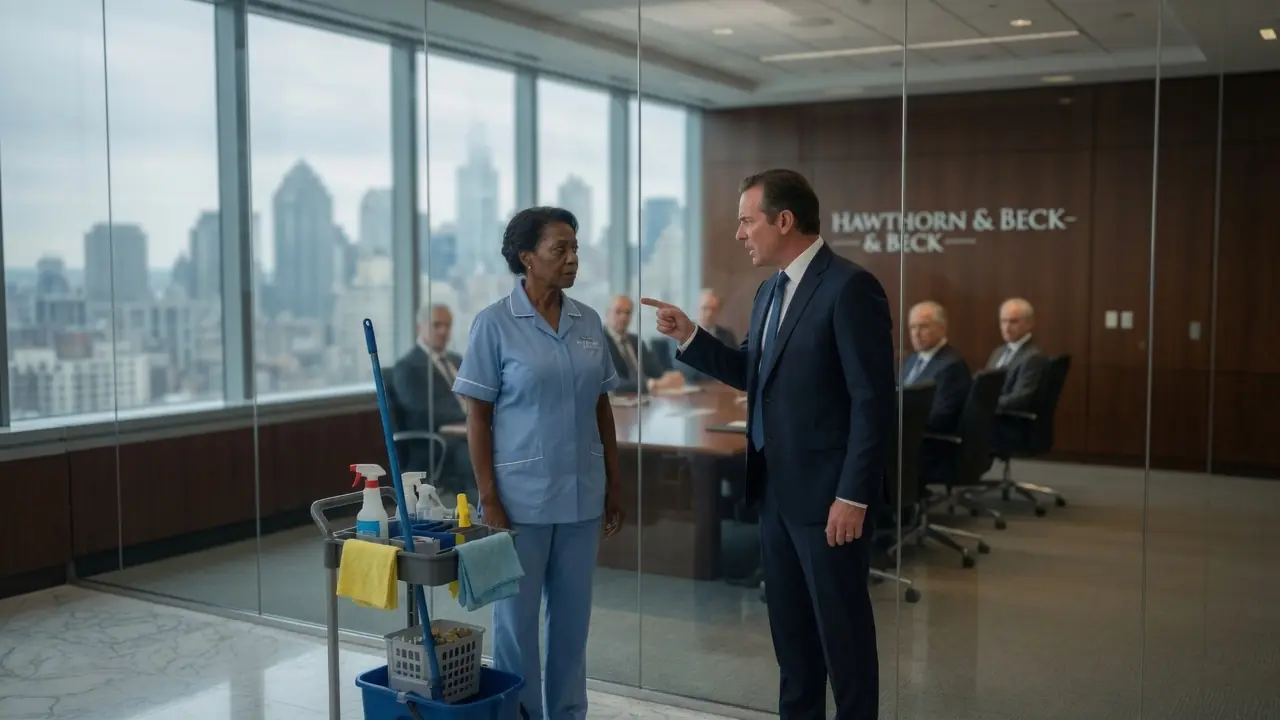
At forty-eight, he was tall and sharply dressed, with slicked-back brown hair, an expensive navy suit, and the impatient expression of a man accustomed to having doors opened before he reached them. He greeted the senior vice presidents, complimented one man’s watch, and walked past Evelyn without acknowledging her. Then he placed his portfolio on the table she was still cleaning.
“You missed a mark,” he said, pointing toward a faint ring left by a coffee cup.
Evelyn wiped it away.
Alan ran one finger across the polished surface and inspected it as if searching for proof of failure. “Miriam was told this room had to be ready ten minutes ago.”
“The meeting begins at eleven.”
He looked at her badge. “Did I ask when it begins, Evelyn?”
“No, sir.”
“Then don’t answer questions I didn’t ask.”
Several executives heard him, but no one reacted. Evelyn continued arranging the glasses while Alan opened his presentation. The first slide displayed a plan titled Operational Efficiency and Regional Growth. Beneath the polished language were the cuts Evelyn had already heard discussed.
A finance director named Rebecca Sloan questioned one of the vendor expenses. “The facilities contract increased by twenty-three percent, but cleaning coverage was reduced.”
Alan’s voice cooled. “The vendor had to absorb rising costs.”
Rebecca studied the figures. “The owner of that company appears to share an address with your wife’s brother.”
The room became quiet.
Alan closed the document on his screen. “That matter was reviewed.”
“By whom?”
“Internal procurement.”
Evelyn paused beside the supply cart.
The vendor was Northbridge Facilities Group, one of the companies mentioned in the anonymous reports. Its contract had nearly doubled in value while wages for cleaners remained unchanged. Evelyn knew that Alan’s brother-in-law controlled Northbridge through a chain of smaller companies, but she wanted to hear Alan explain it in front of witnesses.
She picked up a printed expense summary that had been left beside his portfolio.
Alan noticed immediately.
“What are you doing?”
Evelyn looked at the page. “The total on this report doesn’t match the vendor invoice beneath it.”
Every face turned toward her.
Alan stepped closer. “Put that down.”
“The difference is forty-eight thousand dollars.”
His expression tightened. “You are here to clean the table, not read confidential documents.”
Evelyn returned the paper but did not lower her gaze. “Then perhaps confidential documents should not be left where anyone can see them.”
A few executives shifted uncomfortably.
Alan pointed toward the side door. “This boardroom is for executives. Take your cleaning cart and get out.”
Evelyn remained still.
“Finish presenting the missing expense reports first,” she said.
The statement landed harder than shouting.
Alan’s face reddened. “Excuse me?”
“The Northbridge invoices. Three months are missing from the packet.”
Rebecca looked toward the documents. “She’s right.”
Alan ignored her and moved closer to Evelyn. “Security will remove you before you touch another company document.”
Evelyn reached into the side pocket of the cleaning cart and removed a sealed folder.
Alan laughed bitterly. “What is that, a complaint form?”
“No.”
She placed a shareholder certificate on the table and turned it so the board members could read the name printed across the top.
EVELYN HAWTHORNE.
Alan stared at it.
Rebecca looked from the certificate to Evelyn’s face, recognition arriving slowly. Another executive opened the company website on his tablet and compared the official photograph with the woman standing beside the cleaning cart. His mouth fell open.
Evelyn removed the plastic badge and placed it beside the certificate.
“Call security,” she said calmly. “Then explain why you threatened the woman who owns this company.”
No one spoke.
Alan looked around the room as if expecting someone to tell him it was a joke. His confident posture collapsed by degrees: first his shoulders, then his jaw, then the hand still pointing toward the door. He finally recognized the woman whose voting power exceeded that of every executive in the room combined.
“Ms. Hawthorne,” he said. “I didn’t realize—”
“That is the problem.”
His eyes moved toward the board members. “There has been a misunderstanding.”
Evelyn’s voice remained steady. “You saw a cleaning woman and decided she was too insignificant to question you. Nothing about that was misunderstood.”
Alan attempted a smile. “I apologize for my tone.”
“Would you apologize if my name were Evelyn Harris?”
He did not answer.
The side door opened, and company attorney David Lin entered with two compliance officers. Evelyn had sent him a silent message through the smartwatch beneath her uniform sleeve when Alan began discussing the vendor expenses. The investigators carried document cases and evidence-preservation orders already approved by the board chair.
David addressed the room. “No one may remove or alter files, messages, or electronic records relating to Northbridge Facilities Group. Regional servers have been placed under legal hold.”
Alan turned pale. “You planned this?”
Evelyn faced him. “I planned to learn the truth. You provided it.”
He looked toward Rebecca. “These accusations are based on incomplete numbers.”
“Then complete them,” Evelyn replied.
Alan reached for his portfolio, but one compliance officer stepped forward. “Please leave all company materials on the table.”
“I have personal documents inside.”
“They will be reviewed in your presence.”
His anger returned for a moment. “You cannot treat me like a criminal because a disguised shareholder walked into my meeting.”
Evelyn’s eyes hardened. “This investigation began before I entered the building. Your behavior today only confirmed why employees were afraid to speak.”
Alan turned toward the other executives. “Are all of you going to sit there while she humiliates me?”
Rebecca answered quietly. “You ordered her out before asking who she was.”
“She was interfering with a confidential meeting.”
“She identified a missing expense report in under thirty seconds.”
Alan slammed one hand against the table. “Enough.”
The sudden sound made a young administrative assistant near the wall flinch. Evelyn noticed. Alan noticed her noticing and immediately lowered his voice.
“This is a coordinated attack,” he said. “I have increased revenue in this region for five consecutive years.”
“At what cost?” Evelyn asked.
“Results require difficult decisions.”
“Does that include cutting seventy support positions while directing millions toward your relative’s company?”
“The contract was competitive.”
“Then you will have no difficulty proving it.”
David instructed Alan to surrender his building access card and corporate devices pending investigation. Alan protested that removing him during an active restructuring would damage the company. Evelyn replied that allowing him continued access could damage it more.
He removed the badge from his belt and threw it onto the table.
As security escorted him from the room, he stopped beside the cleaning cart. “You dressed this way to trap me.”
Evelyn looked directly at him. “I dressed this way to see who you were when you believed I had no power.”
The boardroom doors closed behind him.
For several seconds, the remaining executives sat frozen. Some appeared embarrassed by Alan’s conduct. Others looked frightened because they had watched similar behavior for months without objecting. Evelyn did not allow them to hide behind surprise.
“How many of you knew about the after-hours meetings with Northbridge?” she asked.
No hands rose.
“How many noticed that cleaning wages remained flat while the contract increased?”
Rebecca slowly lifted her hand. Two others followed.
“And who reported it?”
Rebecca was the only one who kept her hand raised.
Evelyn looked around the table. “A company does not become corrupt because one man breaks the rules. It becomes corrupt when everyone who sees it decides silence is more profitable.”
One executive objected. “We didn’t have proof.”
“You had questions.”
“Questions can destroy careers.”
“Silence destroyed other people’s careers instead.”
Evelyn asked the compliance team to begin individual interviews. She also ordered the planned staff cuts suspended until the board could review every financial assumption supporting them. The executives were told that retaliation against any employee would result in immediate dismissal.
Then Evelyn returned to the cleaning cart.
She pushed it from the boardroom herself.
In the hallway, Miriam waited near the elevators. She had heard enough through nervous employees to understand what happened. Her expression held no triumph, only weary relief.
“Was it as bad as you expected?” she asked.
“Worse.”
Miriam looked down. “I warned you.”
“You also warned the company for nearly a year.”
“They stopped listening.”
“I’m listening now.”
Evelyn asked Miriam to join the investigation as an employee representative. At first, Miriam refused because she feared managers would blame her for helping expose Alan. Evelyn promised protection but did not ask for trust she had not yet earned.
“You should not have needed the owner beside you before your complaint mattered,” Evelyn said.
Miriam’s eyes filled with tears. “No, ma’am. We shouldn’t have.”
The investigation lasted seven weeks.
Auditors discovered that Northbridge Facilities Group had received more than three million dollars above market rates over four years. Alan’s brother-in-law controlled the company through a holding business registered in Delaware. Payments were divided among several accounts to avoid internal review limits.
Alan had also approved fake maintenance projects, billed Hawthorne & Beck for equipment that was never purchased, and pressured finance employees to classify unusual expenses as emergency services. Managers who questioned him were transferred or given damaging performance reviews. Cleaning staff received fewer hours even as the company was charged for expanded coverage.
The fraud affected more than company profits. Because Alan claimed support costs were rising, he justified freezing wages for receptionists, security guards, mailroom workers, and cleaners. Several employees had taken second jobs. One woman had lost her apartment after her weekly hours were cut without warning.
Alan’s disrespect in the boardroom was only the visible edge of a much larger failure.
The board terminated him for financial misconduct, retaliation, conflicts of interest, and violations of workplace policy. Evidence was referred to federal investigators and state prosecutors. Northbridge’s contract was canceled, and Hawthorne & Beck began legal proceedings to recover the stolen funds.
Yet Evelyn refused to pretend firing one executive solved everything.
The company had ignored repeated warnings because Alan’s region remained profitable. Senior leaders had treated revenue as proof of good management. Employees who cleaned rooms, answered phones, delivered mail, and guarded entrances were seen as expenses rather than people with knowledge worth hearing.
Evelyn ordered several reforms.
All vendor contracts above a fixed amount would require independent conflict checks. Hourly and contract workers received direct access to the ethics committee without going through regional management. Retaliation claims would be investigated by outside counsel, and executives’ bonuses would depend partly on verified employee-treatment standards rather than revenue alone.
She also required every senior leader to spend one full workday each quarter shadowing someone outside the executive structure. Not observing from a distance. Working beside them.
Some board members dismissed the idea as symbolic.
“So was my blue uniform,” Evelyn replied. “It revealed more truth than six months of reports.”
The seventy support jobs were preserved. Money recovered from the fraudulent contracts funded wage adjustments for the lowest-paid employees and improved benefits for long-term contract workers. Miriam became director of workplace services, a permanent management role with authority over vendor selection and employee safety.
Rebecca Sloan was promoted to interim regional director.
When Evelyn offered her the position, Rebecca hesitated. “I asked questions, but I still stayed in that room while he insulted you.”
“You recognized the numbers were wrong.”
“I did not defend the woman I thought was a cleaner.”
Evelyn appreciated the honesty. “Then remember that failure when you have authority.”
Rebecca accepted the role under a six-month review period. Her first act was to meet with every support department without senior managers present. She listened more than she spoke.
Three months later, Evelyn returned to the Manhattan office wearing a charcoal suit and carrying no cleaning supplies. Employees recognized her immediately. Some straightened nervously, while others greeted her with genuine warmth.
She stopped beside the reception desk where Leah was working.
“You held the elevator for me,” Evelyn said.
Leah looked confused. Then she recognized the borrowed identity. “That was you?”
“Yes.”
“I thought you looked familiar.”
“You were kind before familiarity mattered.”
Evelyn handed her a written commendation, but Leah tried to refuse it. “I only held a door.”
“Small doors reveal large habits.”
Inside the boardroom, the walnut table had been rearranged so support department leaders could attend monthly operational meetings. Miriam sat near the center rather than against the wall. No cleaning cart stood beside her, yet Evelyn remembered exactly where hers had been positioned when Alan pointed toward the door.
The company did not become perfect.
No organization ever did.
There were still disagreements, difficult personalities, budget pressure, and managers tempted to protect their own interests. But complaints no longer vanished inside regional offices, and executives knew that treatment of lower-paid employees could affect their own evaluations.
A year later, Evelyn spoke at the company’s national leadership conference. She stood before hundreds of managers and projected no photograph of Alan, no financial chart, and no dramatic image of herself revealing the shareholder certificate.
Instead, the screen behind her showed a simple light-blue cleaning uniform.
“Many people believe power reveals character,” she told them. “That is only partly true. The absence of visible power reveals it faster.”
She explained that Alan had not become disrespectful because she was disguised. The disguise merely removed the consequence he expected from insulting her. He believed the woman in front of him could not affect his career, reputation, or income.
That belief gave him permission to show who he had always been.
“Respect that appears only after a title is revealed is not respect,” Evelyn said. “It is fear wearing better clothes.”
The room remained silent.
Evelyn thought of her father, Samuel, and the lessons he had repeated when she was young. He had known the names of the cleaners, security guards, and cafeteria workers because he understood that ownership was not simply control of money. It was responsibility for the dignity of every person working under the company’s name.
After the speech, Evelyn returned to Manhattan and visited the boardroom alone.
Late-afternoon sunlight spread across the table. The city stood beyond the windows, enormous and indifferent. Evelyn touched the place where she had set down the shareholder certificate.
She did not feel victorious.
She felt accountable.
Alan had humiliated her because he thought she was powerless. But hundreds of employees had endured similar treatment without a certificate capable of changing the room. They could not reveal themselves as owners, and they should never have needed to.
That was the lesson Evelyn carried forward.
The regional director had ordered a cleaning woman out of the boardroom.
Then he learned she owned the company.
But his greatest failure was not insulting a majority shareholder.
It was believing an ordinary cleaning woman would have deserved less respect.