The first pile of rice husks appeared along the Turner fence line when Caleb Turner was eleven years old.
At first, it looked almost harmless, a pale golden ridge dumped beside the drainage ditch where the family’s cornfield met the back road to Hale Rice Mill.
His father, Daniel Turner, stood with one hand on the fence post and stared at it for a long time without speaking.
Caleb remembered the way his father’s jaw tightened, not with fear, but with the quiet anger of a man too poor to fight someone richer.
By the next year, the pile had doubled.
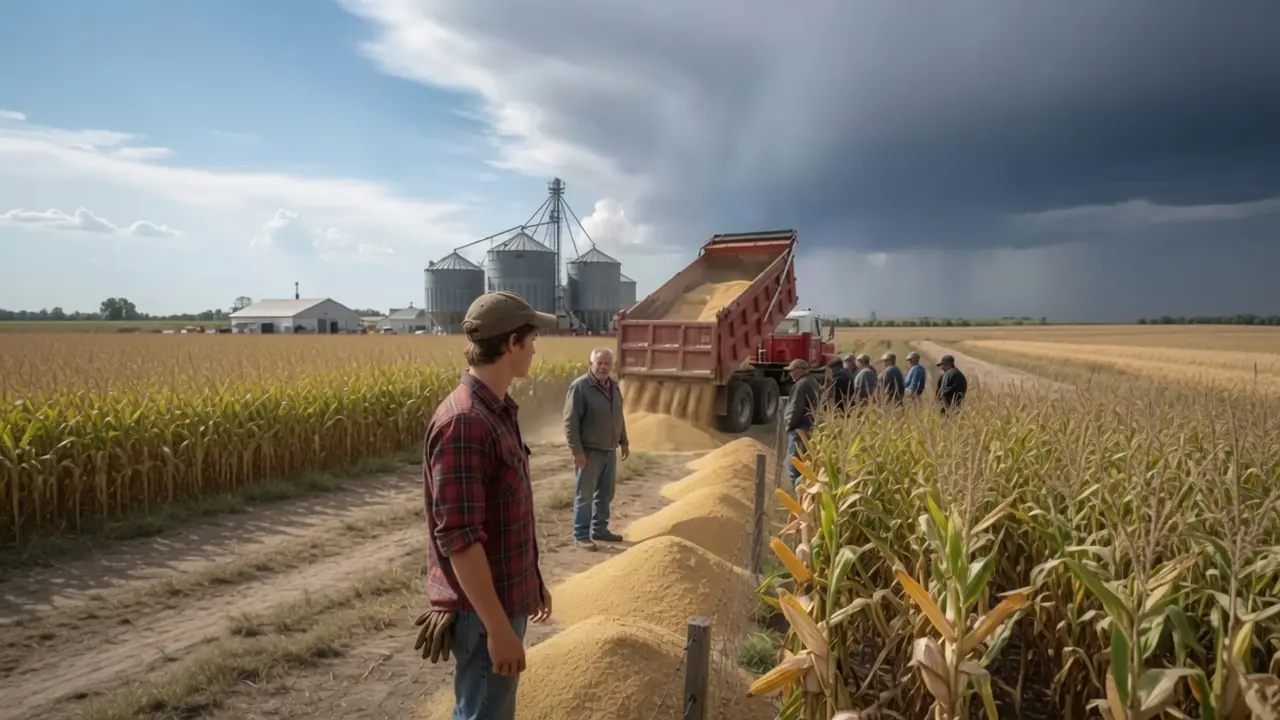
By the third year, the husks stretched nearly a quarter mile along the edge of the farm, rising in loose, dusty waves that blew across the field whenever the wind came from the east.
The soil near the fence grew dry, pale, and stubborn, refusing to hold water the way it once had.
Daniel complained to the county twice, but Martin Hale, the rice mill manager, always arrived with clean boots, folded papers, and a smile that made every insult sound legal.
“It’s agricultural byproduct,” Martin said the first time Caleb heard him defend it.
He stood beside his truck in a white shirt, looking at the Turner land like it was already defeated.
“Plenty of farmers would thank us for free organic matter.”
Daniel looked at the dead strip near the fence and answered, “Then dump it beside their homes, not my field.”
Martin laughed in that soft way grown men laugh when they do not think a poor man can touch them.
“Daniel, you don’t have the money for lawyers, and I don’t have the time for complaints.”
Caleb stood behind his father, small hands curled into fists, learning that unfairness could wear a business logo and still call itself progress.
His father did not shout, because shouting would not move the piles.
The Turner farm was only seventy acres, small compared with the wide operations surrounding it.
Daniel grew corn, soybeans, and a little patch of vegetables his late wife had once loved tending before cancer took her when Caleb was nine.
After her death, the farm became both work and memory, every row tied to something she had touched, planted, cooked, or prayed over.
Daniel held on to the land with the stubbornness of a man who believed selling would mean losing her a second time.
But the land was changing.
The field nearest the husks turned hard after rain, then dusty after sun, as if the soil had forgotten how to breathe.
Corn came up uneven, the stalks thinner near the fence, their leaves curling too early in summer heat.
Neighbors began saying Daniel Turner was finished, though most of them said it kindly, which somehow made it hurt more.
He heard men at the feed store say the farm was too small to survive.
He heard women at church whisper that Daniel should sell while there was still value left.
He heard boys at school call the fence field “the rice dump” and laugh when Caleb walked past with mud on his jeans.
He learned to keep his face still, the way his father did.
When Caleb turned fourteen, Daniel’s cough began.
At first, it was just a rough sound in the mornings, something he waved away while tightening bolts or checking seed bags.
Then the cough stayed through lunch, then supper, then the long hours after dark when Caleb lay awake listening from the next room.
Daniel refused to leave the farm for doctors until he nearly collapsed beside the tractor shed.
The diagnosis came with words Caleb hated because they sounded too clean for what they meant.
Lung disease, complications, exposure, treatment, uncertainty.
Daniel came home from the clinic with medicine in a paper bag and a tiredness in his eyes Caleb had never seen before.
He still walked the fields every morning, but slower now, one hand resting on fence posts he used to pass without noticing.
One evening, Caleb found him standing beside the rice husk piles again.
The sun was low, turning the husks almost beautiful, and that beauty made Caleb angry.
His father bent, picked up a handful, and let the dry shells slip through his fingers.
“Waste is only waste when nobody knows what to do with it,” Daniel said quietly.
Caleb looked at him.
“What does that mean?”
Daniel smiled faintly, though the smile could not hide his exhaustion.
“It means every problem has a second face, son, if you’re patient enough to study it.”
After that, Caleb began studying.
He checked books out of the county library about soil, compost, mulch, drainage, rice husk ash, and organic matter.
Some of the words were hard, so he copied them into a notebook and looked them up after chores.
He learned that rice husks did not rot quickly, but they could loosen heavy soil, protect moisture, and become powerful when mixed with manure, leaves, water, and time.
At first, Daniel laughed when he saw Caleb dragging sacks of husks away from the fence.
It was not mocking laughter, only surprised affection, the kind that softened his whole face.
“You planning to steal the mill’s trash?” he asked.
Caleb wiped sweat from his forehead and said, “They dumped it on us, so I figure it’s already ours.”
Together, father and son started with one small test plot behind the barn.
They mixed rice husks with cow manure from Mr. Bell’s dairy, chopped leaves, kitchen scraps, and muddy water from the pond.
The first pile smelled awful, steamed strangely, and attracted every fly in the county.
Caleb loved it anyway, because it was the first time the dumped husks looked like something besides humiliation.
Daniel taught him to watch the compost like he watched crops.
Too dry meant the pile slept, too wet meant it soured, too cold meant it needed turning, and too hot meant it needed air.
Caleb wrote everything down: dates, temperatures, rain, smell, color, texture, and how quickly worms appeared beneath the pile.
By the time he was fifteen, his notebook was thick with observations no one else cared about yet.
Then Daniel died in late winter.
The funeral was small, held at the white church near the highway, with neighbors bringing casseroles and speaking in lowered voices as if grief were sleeping nearby.
Caleb stood beside his father’s grave with mud on his boots because the morning thaw had softened the cemetery road.
He did not cry in front of the others, but that night he sat in the tractor seat and sobbed until his throat hurt.
After the funeral, people expected the farm to end.
An uncle from two counties over suggested selling before debt swallowed everything.
The banker, Mr. Alden, spoke gently about “practical realities,” which Caleb understood meant grown men had already decided what a fifteen-year-old could not do.
Martin Hale sent no flowers, no card, and no apology for the years of husks piled like insult beside the fence.
Caleb stayed.
He woke before sunrise, fed the animals, checked the compost, repaired what he could, and finished schoolwork at the kitchen table under a lamp that flickered when the wind was hard.
His hands became rougher, his shoulders sharper, and his eyes older than they should have been.
Every night, he read his father’s old field notes and added his own beneath them.
The neighbors laughed when he began spreading composted rice husks across the dead strip near the fence.
They laughed harder when he used a borrowed manure spreader to scatter the mixture over the driest patches of the farm.
One man called across the road, “Boy, you’re burying dead land under dead trash.”
Caleb only lifted one hand, not in greeting, but to shield his eyes while checking the spread pattern.
At school, the jokes followed him.
Boys called him “Husk King” and asked if he planned to grow rice in Iowa soil.
A teacher told him his science fair project was “ambitious but unrealistic,” which was just a polite way of saying foolish.
Caleb entered the project anyway, bringing soil samples, photos, rainfall notes, and a jar of compost that made half the class complain.
He did not win.
The blue ribbon went to a solar oven made from foil and cardboard.
But one of the judges, a county extension agent named Dr. Marian Brooks, stayed behind after everyone left and asked where he had learned to track soil structure.
Caleb showed her the notebook, and for the first time since his father died, an adult looked at his work like it mattered.
Dr. Brooks visited the farm two weeks later.
She walked the fence line, dug into the test plots, rubbed soil between her fingers, and asked questions Caleb could answer because he had lived the answers.
She did not laugh at the husks or call them trash.
She said, “You may be building carbon where everyone else saw waste.”
Those words stayed with him all summer.
Caleb began testing more seriously, laying out rows with different amounts of composted husks, raw husk mulch, manure, and control strips with nothing added.
He measured soil moisture after rain, checked root growth, counted worms, and compared plant height every Friday evening.
The field did not transform overnight, but it began to change in ways only someone patient would notice.
The first green difference appeared near the old dead strip.
Corn planted in the treated rows came up stronger, with darker leaves and deeper roots that held through dry spells.
The soil under the husk mulch stayed cooler, softer, and easier to work with a hoe.
When rain came hard, the treated rows did not seal into crust the way the untreated soil did.
By the second season, the laughter faded into curiosity.
Neighbors slowed their trucks near the fence and looked longer than they meant to.
Mr. Bell from the dairy asked if Caleb wanted more manure for the compost pile, pretending he only needed somewhere to put it.
Even the boys at school stopped calling him Husk King after his crop report beat farms twice his size in soil recovery numbers.
Martin Hale noticed last, or at least he pretended to.
The rice mill continued dumping husks near the Turner fence, but now Caleb hauled them away faster than the piles could grow.
He built windrows behind the barn, mixed them with manure and green waste, and turned them with an old tractor attachment he repaired from scrap.
What had once looked like a wound along the fence became the raw material for the farm’s recovery.
Then came the drought summer.
Rain missed the county for weeks, clouds passing overhead without mercy while corn curled across the region.
Neighbors watched their fields with helpless faces, and the mill road turned powdery under truck tires.
Caleb’s farm suffered too, but the treated soil held moisture longer than anyone expected.
By August, the difference was visible from the road.
Fields around him stood pale and tired, but the Turner rows remained stubbornly green, not perfect, but alive.
The corn nearest the old husk line grew tall enough to hide Caleb when he walked between rows.
Dr. Brooks returned with two colleagues, took samples, and called the results “remarkable.”
The newspaper came next.
A reporter from the county weekly took Caleb’s picture beside a compost row, his hair windblown and his shirt streaked with dirt.
The headline read, Teen Farmer Turns Rice Mill Waste Into Soil Solution.
Caleb hated the photo, but he cut out the article and placed it beside his father’s picture on the mantel.
The article reached farther than he expected.
Farmers from other counties called asking about husk ratios, compost times, and whether raw husks could help sandy soil.
The county invited him to speak at a soil meeting, where he stood nervously in front of men who had once dismissed him.
He brought jars of dead soil, treated soil, raw husks, and finished compost, because his father had taught him that truth was stronger when a man could hold it in his hand.
Martin Hale attended that meeting.
He sat in the back row with his arms folded, wearing the same smug look he had worn for years along the fence.
When Caleb finished explaining his process, Martin stood and smiled like the room belonged to him.
“Well, I suppose the boy should thank Hale Rice Mill for providing the materials,” he said.
A few men chuckled, but not many.
Caleb looked at him across the room, seeing the man who had mocked his father, ignored complaints, and dumped waste because he believed the Turners were too small to resist.
His hands trembled once, then stilled.
“No, Mr. Hale,” Caleb said. “I spent years turning your arrogance into topsoil.”
The room went quiet.
Martin’s smile tightened.
“That is a bold way to speak to the company that helped you.”
Caleb lifted the soil report Dr. Brooks had prepared and held it where everyone could see the county seal.
“You did not help us,” Caleb said.
“You dumped waste beside a family farm until the soil failed, because my father could not afford to fight you.”
Martin’s face reddened, but Caleb did not stop.
“My father left me land, not excuses, and your waste just made it fertile again.”
Someone in the back whispered, “Lord.”
Dr. Brooks watched without interrupting, her expression steady.
Martin stepped into the aisle, his voice low and sharp.
“You should be careful, boy. Success makes people forget who they are.”
Caleb stepped down from the front platform and faced him directly.
“I know exactly who I am.”
He held the report at his side, his eyes locked on Martin’s.
“I am the son of the farmer you thought you could bury under trash, and next harvest, you’ll be buying back what you dumped at my fence.”
That sentence changed the room.
Men who had once laughed looked at the floor, not from shame alone, but because they knew it was true.
The mill had started paying disposal fees in other counties because environmental rules had tightened, and Caleb’s compost had become valuable.
Martin had come expecting gratitude and found a young farmer holding proof.
Within months, the county required Hale Rice Mill to stop open dumping along farm boundaries.
Dr. Brooks helped Caleb form a cooperative that collected rice husks, dairy manure, leaves, and crop residue to produce compost for local farms.
The first year was small, messy, and exhausting, but the demand grew quickly after drought-hit farmers saw Caleb’s fields.
By seventeen, he was running both the Turner farm and a soil amendment business out of the old machine shed.
He did not become rich all at once.
Success came in repairs first: a new roof for the barn, a working irrigation pump, a safer grain wagon, and a used pickup that did not require prayer before starting.
Then came paid orders, then contracts, then a partnership with the county conservation office.
Every improvement felt like a conversation with his father.
Caleb kept one strip along the original fence untouched.
It remained hard, pale, and nearly lifeless, a narrow scar where husks had once choked the soil before he learned how to transform them.
When visitors asked why he did not repair that part too, he would bend, pick up a handful of dry dirt, and let it fall.
“Some ground stays as witness,” he would say.
Martin Hale tried to buy into Caleb’s business two years later.
He arrived at the farm in a polished truck, smiling too widely, carrying papers that called the proposal a “strategic partnership.”
Caleb met him beside the compost rows, now dark and steaming, alive with heat and worms.
The same fence stood nearby, but the power between them had changed completely.
Martin offered money, trucks, storage buildings, and mill contracts.
He spoke of branding, expansion, and how the story would look good if they worked together.
Caleb listened until Martin said, “We can both benefit from what my mill created.”
Then Caleb closed the folder and handed it back.
“Your mill created a problem,” Caleb said.
“My father gave me the backbone to study it, and I created the solution.”
Martin’s jaw tightened with the old anger, but the old leverage was gone.
Caleb added, “If you want your husks processed, you can pay the same rate as everyone else.”
Martin stared at the young man standing before him.
He no longer saw a grieving boy, a poor farm kid, or someone easy to bury under paperwork and waste.
He saw a farmer who had turned insult into income, damage into recovery, and patience into power.
For the first time, Martin Hale had to pay for what he once dumped for free.
Years later, the Turner farm became a place people visited to learn how wounded soil could return.
Caleb studied agronomy, but he never left the land long enough to forget where his knowledge began.
He taught other farmers how to use waste wisely, how to test before applying, how to mix carbon and nitrogen, and how to listen when the ground seemed too tired to speak.
He always started with the story of the fence line.
He told them about his father standing beside the first husk pile.
He told them about the years of laughter, the failed complaints, the dead rows, and the notebook that slowly filled with answers.
He told them that not every insult could be turned into a harvest, but some could, if a person had patience, guidance, and enough stubborn love for the land.
And when he finished, he would take visitors to the living field where corn rose tall from soil once written off as dead.
At harvest, Caleb still walked the rows before the machines started.
He liked to touch the leaves, feel the soil, and listen to the dry music of corn waiting to be gathered.
Sometimes he could almost hear his father’s voice in the wind near the fence.
Waste is only waste when nobody knows what to do with it.
The rice mill had tried to bury the Turner farm beneath years of unwanted husks.
Neighbors had laughed when a boy spread that “trash” across the fields.
But Caleb learned that the land, like people, could recover when given protection, patience, and something broken made useful again.
What they dumped at his fence became the golden harvest that saved his family’s name.