“Did you get lost?”
The question cut through the quiet elegance of Whitmore House Boutique like a crack across glass. Beneath the crystal chandeliers, surrounded by marble floors, velvet chairs, and handbags displayed behind spotless glass, Margaret Whitmore turned slowly toward the young woman who had spoken. Margaret was seventy-three years old, with silver hair resting neatly against the collar of her simple beige coat and thin gold glasses balanced on her nose. She had entered the boutique alone, carrying no famous handbag, wearing no visible diamonds, and asking for no attention.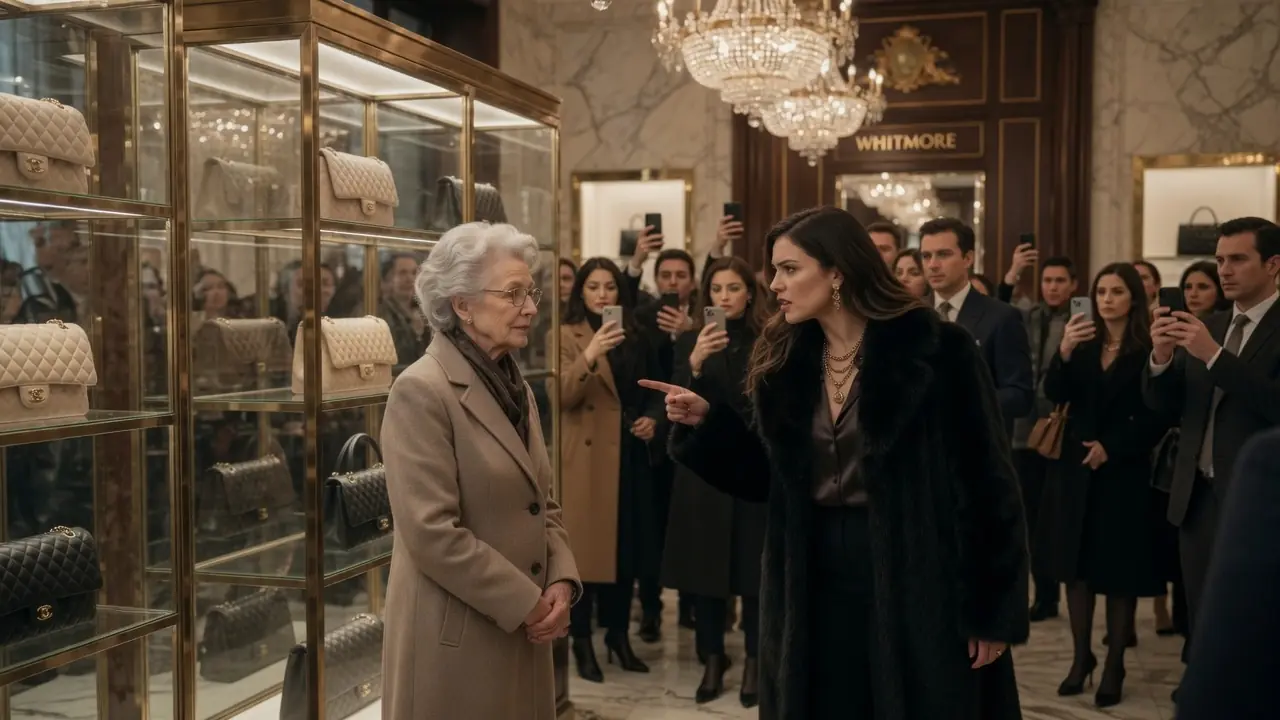
The young woman staring at her was Vivian Cross, a name whispered often enough in Manhattan’s luxury circles to make sales associates stand straighter. Vivian wore a black designer blazer, a fitted skirt, pointed heels, and a handbag that cost more than some people’s yearly rent. Her dark hair fell perfectly over one shoulder, and her sunglasses sat on top of her head like a crown. She had been admiring herself in the mirror more than the merchandise when Margaret’s quiet presence offended her.
Margaret looked back at the glass display. Inside sat a structured cream handbag with a silver clasp, one of the boutique’s most famous pieces. Her late husband had once joked that it looked too delicate for a woman who built an empire with sharper hands than any man in the room. Margaret had come that afternoon not to shop, but to see whether the company still carried the spirit she had poured into it decades earlier. She wanted to know if the brand bearing her name still understood dignity.
“I’m just looking,” Margaret said calmly.
Vivian laughed, loud enough for nearby customers to hear. “Looking?”
A sales associate near the scarf wall stopped folding silk. Another customer lowered a compact mirror. At the far end of the boutique, a woman slowly lifted her phone, sensing trouble before anyone else admitted it. The boutique, which had moments earlier been filled with soft conversations and the gentle click of heels, became still.
Vivian stepped closer, her eyes moving over Margaret’s plain coat and practical shoes. “Do you even know what these bags cost?”
Margaret’s hands remained folded in front of her. “Yes.”
The answer was so simple that it seemed to irritate Vivian more than any argument could have. She wanted embarrassment, apology, a nervous smile, some sign that the old woman understood her place. Instead, Margaret stood beneath the chandelier as if expensive glass and polished marble had no power to make her feel small. That quiet steadiness made Vivian’s contempt sharpen.
“This place isn’t for people like you,” Vivian said.
The words landed hard enough to change the room. One customer inhaled sharply. The sales associate near the scarves looked toward the back office, waiting for a manager who had not yet appeared. No one defended Margaret. The silence around her was not empty; it was crowded with fear, curiosity, and the selfish relief of people glad they were not the target.
Margaret looked at Vivian for a long moment. “People like me?”
Vivian smiled. “Don’t pretend you don’t understand.”
“I prefer not to assume ugliness unless someone says it clearly.”
A few eyes widened. Vivian’s face flushed, but not with shame. She took another step forward, lowering her voice just enough to sound dangerous while still making sure the audience heard. “Women like you come in to touch what you’ll never own. Then you waste everyone’s time pretending curiosity is the same as belonging.”
Margaret did not move.
Vivian’s hand shot forward before anyone expected it. The slap cracked across the boutique, sharp and shocking beneath the chandeliers. Margaret’s head turned slightly from the force, and a pair of sunglasses slipped from a customer’s hand, clattering onto the marble floor. Several people gasped, but still no one stepped in.
Margaret slowly adjusted her glasses.
Then she turned back to Vivian.
There was no rage in her face. No panic. No humiliation. Only a tired sadness, the kind that comes from seeing a beautiful room fail an ugly test.
“Is this how your family taught you to behave?” Margaret asked softly.
Somehow, the quiet question struck harder than the slap.
For half a second, uncertainty flickered across Vivian’s face. Then pride returned, louder because it had been threatened. “Family?” she scoffed. “Please. I built my own life. People like you should know where they belong.”
Margaret looked around the boutique. She saw the silent customers, the raised phones, the frozen sales associates, the polished displays, and the handbag she had designed from a sketch on a napkin forty-two years earlier. She remembered the first Whitmore shop, a narrow room with cracked walls and secondhand shelves. Back then, she had greeted every woman herself, whether she arrived in pearls or worn boots, because Margaret had believed luxury should make a person stand taller, not make someone else kneel.
Hurried footsteps sounded from the back office.
The boutique manager, Julian Vale, rushed into the showroom with his face pale and his tie crooked. He had been on a call with the regional director when a junior associate burst into his office whispering that something terrible had happened on the floor. At first, he expected an angry celebrity, a broken display, or a payment dispute. Then he saw the elderly woman in the beige coat standing beside the glass case.
Julian froze.
Every drop of color left his face.
Vivian noticed him and smiled with relief, certain that authority had arrived for her. “Finally. Please remove this woman before she embarrasses the store any further.”
Julian did not look at Vivian.
He walked straight toward Margaret, stopped two steps away, and lowered himself into a deep bow.
“I’m deeply sorry,” he said, his voice shaking. “Founder.”
The word exploded silently through the boutique.
Founder.
Phones stayed lifted. Customers stared. The sales associate near the scarves covered her mouth with both hands. Vivian’s smile collapsed so completely that for a moment she looked younger, almost frightened.
“What did you just call her?” Vivian demanded.
Julian kept his eyes lowered. “Mrs. Margaret Whitmore founded Whitmore House.”
Margaret said nothing.
Vivian let out a nervous laugh. “That’s impossible.”
Julian straightened slowly, but his face remained full of alarm. “No, Ms. Cross. It is not.”
Vivian looked from Julian to Margaret, then to the glass displays around them. “Whitmore as in… this Whitmore?”
Margaret finally spoke. “Yes.”
The room seemed to shrink around Vivian. The handbags, the brass letters, the mirrored walls, the embossed shopping bags, the invitations she had fought to receive, the private sales she bragged about online — all of it suddenly pointed back to the old woman she had just struck. Vivian’s fingers tightened around the strap of her handbag.
Julian turned to Vivian, his expression no longer apologetic. “Because of what has happened today, you will no longer receive service from this boutique.”
Vivian blinked. “You’re joking.”
“I am not.”
“You cannot ban me for a misunderstanding.”
Margaret’s eyebrow lifted slightly. “Which part was misunderstood?”
Vivian looked toward the watching customers. Her voice lowered. “I didn’t know who you were.”
Margaret’s eyes remained steady. “That is not an apology. That is an explanation of why you thought cruelty was safe.”
The words left Vivian silent.
Julian stepped toward the counter and spoke to the senior associate. “Please contact client relations and security. Ms. Cross’s customer privileges are to be suspended immediately pending permanent termination.”
Vivian’s face went white. “Permanent termination?”
Julian looked at her. “Whitmore House reserves the right to refuse service to clients who abuse staff, customers, or guests.”
“I am not just some customer,” Vivian snapped, panic making her voice sharp. “My family has spent hundreds of thousands with this company.”
Margaret looked at her quietly. “And learned nothing worth keeping.”
A few customers shifted. Someone whispered, “Oh my God.” The woman filming near the perfume display kept her phone steady, tears in her eyes now for reasons she did not fully understand. She had expected drama. She had captured a verdict.
Vivian pointed at Julian. “If you do this, I’ll call my attorney.”
Julian nodded. “You may.”
“I’ll call corporate.”
Margaret said, “Corporate is expecting my report.”
Vivian stared at her.
Margaret stepped closer, not angrily, but with the calm authority of someone who had built the floor beneath their feet. “Do you know why I created this company, Ms. Cross?”
Vivian did not answer.
“My mother cleaned houses for women who would not let her enter through the front door. She owned one good handbag in her entire life, and she carried it to church every Sunday like it was proof that beauty could still belong to her.” Margaret’s voice remained low, but every person in the boutique listened. “When I founded Whitmore House, I promised myself no woman would be made to feel small in a room selling things meant to make her feel strong.”
Vivian’s lips trembled, though whether from humiliation or awakening, no one could tell.
Margaret continued, “You saw a plain coat and decided I was beneath you. You saw age and decided I could be pushed aside. You saw quiet and mistook it for permission.”
The boutique remained completely silent.
Then security arrived.
Two uniformed guards approached carefully, clearly uncomfortable. They knew Vivian Cross. Everyone in that world knew clients who treated stores like personal stages. But they also knew Margaret Whitmore, at least by reputation, and the sight of her standing calmly with a red mark on her cheek made their faces tighten.
Julian gestured toward Vivian. “Please escort Ms. Cross from the boutique.”
Vivian recoiled. “You’re throwing me out?”
Margaret looked at her. “No. You threw yourself out when you decided dignity was only for people dressed to your liking.”
Vivian turned toward the other customers. “Are you all seriously watching this?”
No one defended her.
A woman in a gray suit near the jewelry case finally spoke. “We watched you hit an elderly woman.”
Vivian’s eyes filled with fury and shame. “She provoked me.”
Margaret’s voice was gentle. “By existing?”
That silenced her again.
The guards did not touch Vivian at first. They only stood nearby, waiting. It was clear they would not allow another scene. Vivian grabbed her handbag and strode toward the door, but halfway there, she turned back.
“You’ll regret humiliating me,” she said.
Margaret’s expression did not change. “I survived poverty, widowhood, boardrooms full of men who laughed at me, and forty years of people telling me I should be grateful for a smaller seat at my own table. I doubt your anger will be the thing that breaks me.”
Vivian left with the guards beside her.
The glass doors closed behind her, and the boutique released a breath it had been holding.
Julian turned back to Margaret, shame heavy in his face. “Mrs. Whitmore, I failed to protect you.”
“Yes,” Margaret said.
He swallowed. “I’m sorry.”
“I believe you are.”
“What can we do?”
Margaret looked around the showroom. “Start by asking why no one moved.”
No one spoke.
Her gaze passed over the sales associates, the customers, the manager, and the security guards. “One woman’s cruelty did not fill this room by itself. Silence helped it grow.”
A young associate began crying quietly. “I wanted to say something.”
Margaret looked at her. “Why didn’t you?”
“I was afraid of losing my job.”
Margaret nodded. “Then that is the first thing we fix.”
Within an hour, the incident had spread online. The video showed everything: Vivian’s question, Margaret’s calm answer, the insult, the slap, the manager’s bow, and the word “Founder” breaking the room open. Clips appeared with captions like “Rich customer hits elderly woman, learns who owns the brand” and “Luxury boutique founder bans abusive client.” Millions watched before dinner.
Whitmore House issued a statement before sunset, but Margaret personally rewrote the first draft. The public relations team wanted polished language about regrettable incidents and client standards. Margaret crossed out half the page with a fountain pen.
The final statement was direct.
Today, our founder Margaret Whitmore was humiliated and struck inside one of our boutiques because a customer judged her by appearance. The issue is not only one customer’s cruelty, but the silence that allowed it to continue. Whitmore House will review training, staff protections, and customer conduct policies immediately. Luxury without dignity is failure.
The statement changed the conversation.
Some praised Margaret. Some mocked Vivian. Some asked why people only cared when the victim turned out to be powerful. Margaret read that last question twice and underlined it. It was the only question that mattered.
The next morning, Margaret returned to the boutique.
This time, the staff gathered before opening. No customers, no cameras, no performance. Julian stood at the front, looking like a man who had not slept. The young associate who had cried was there too, eyes red but determined. Margaret wore the same beige coat.
“I am not here to frighten you,” she said.
The staff stood stiffly.
“I am here because yesterday showed me that this company forgot one of its oldest rules.” She looked toward the display cases. “A client may buy a bag. She may not buy the right to humiliate anyone.”
A few heads lowered.
Margaret continued, “From today forward, any employee who witnesses abuse has authority to call a dignity stop. Sales pause. Security is called. Management responds. No one will lose commission, hours, or position for protecting a person from cruelty.”
The room stirred.
Julian lifted his head. “That will change how we handle VIP clients.”
“Yes,” Margaret said. “That is the point.”
A senior associate spoke carefully. “Some clients spend millions a year.”
Margaret looked at her. “Then they can afford manners.”
For the first time, a few nervous smiles appeared.
Margaret turned toward the young associate. “What is your name?”
“Anna.”
“Anna, yesterday you wanted to speak.”
Anna nodded, tears returning.
“Next time, you will have policy standing behind you. But remember this: policy may protect your job, but courage must still open your mouth.”
Anna wiped her eyes. “Yes, Mrs. Whitmore.”
Margaret softened. “Good.”
Vivian Cross did not disappear quietly. People like her rarely do. Her first statement claimed the video lacked context. Her second statement blamed stress. Her third, released by an attorney, said she regretted that “an interaction was misinterpreted.” None of them helped.
The problem was not only the video. The problem was that women who had endured Vivian at charity luncheons, private sales, gallery openings, and board dinners began telling their own stories. Staff from other boutiques remembered being snapped at, threatened, and insulted. Former assistants spoke of being treated like furniture. The image Vivian had built around elegance began cracking from the inside.
Then Whitmore House made the ban official.
Not only one boutique.
Every brand under its ownership.
No personal shopping services. No private previews. No custom orders. No event invitations. No client account access. Vivian’s name was removed from the elite registry she had spent years climbing toward. The empire she had used as a mirror had closed its doors.
For a woman like Vivian, it was more than shopping. It was exile from the world she believed proved her worth.
Three weeks later, Margaret received a handwritten letter.
She recognized the careful stationery before reading the name. Vivian Cross. Margaret almost set it aside. She did not owe Vivian emotional labor. But something made her open it.
The letter began badly, with polished phrases that sounded like an attorney had breathed over them. Then, halfway down the page, the handwriting changed. Less controlled. More honest.
I thought you humiliated me because you had power, Vivian wrote. Then I watched the video without sound and saw my own face. I looked happy while hurting someone. I do not know when I became that kind of woman, but I know I did not hate it enough until everyone else saw it too.
Margaret paused.
The letter continued.
I am not asking for my privileges back. I am not asking for forgiveness. I am trying to say the thing I should have said when I still had the chance. I am sorry I struck you. I am sorry I spoke to you as if your clothes gave me the right to decide your worth. I am most ashamed that I was only frightened after I learned your name.
Margaret folded the letter slowly.
She did not call Vivian. She did not restore anything. Apology was not a coupon redeemable for access. But she placed the letter in a drawer instead of the trash, because honest shame, however late, was still different from performance.
Months passed. Whitmore House changed in visible and invisible ways. Boutique staff received new training, but more importantly, new protection. The dignity stop policy was used in London when a client screamed at a doorman. It was used in Los Angeles when a celebrity mocked a sales associate’s accent. It was used in Chicago when a wealthy customer shoved a cleaning worker’s cart aside and called her invisible.
Each time, sales paused.
Each time, management responded.
Each time, the company chose people over purchases.
The policy cost Whitmore House several high-spending clients in the first year. It gained thousands more who respected what the brand had finally said clearly. Margaret did not pretend business was charity. She had built an empire and knew numbers mattered. But she also knew a company that profited from aspiration had a duty not to weaponize shame.
On the anniversary of the incident, Margaret visited the Manhattan boutique again. The chandeliers still glittered. The marble still shone. Handbags still rested behind glass, beautiful and expensive as ever. But near the entrance, engraved into a brass plaque, were words Margaret had spoken in the first staff meeting after the slap.
Luxury without dignity is failure.
Anna, the young associate, now greeted customers at the front. She smiled when Margaret entered, not with fear, but with pride. “Good afternoon, Mrs. Whitmore.”
“Good afternoon, Anna.”
A woman in a simple coat stood near the same display Margaret had examined a year earlier. She looked nervous, perhaps overwhelmed by the prices and the quiet perfection of the room. Anna noticed at once and approached with warmth.
“Please take your time,” Anna said. “You’re welcome to look.”
The woman smiled with relief. “Thank you. I wasn’t sure if I should touch anything.”
Anna gently unlocked the case and lifted out the cream handbag. “Beautiful things are meant to be seen up close.”
Margaret watched from across the room, her heart tightening.
That was all she had wanted from the beginning. Not special treatment because she was founder. Not revenge because she had been insulted. Only a room where a woman in a plain coat could look at something lovely without being made to feel foolish for wanting beauty near her.
Julian came to stand beside her. “We are still learning.”
Margaret nodded. “Good.”
“Good?”
“The day this company thinks it has nothing left to learn is the day I sell my shares and haunt you all personally.”
Julian laughed, then realized she might only be half joking.
Margaret looked once more at the plaque, the displays, the staff, and the woman now smiling as she held the handbag carefully in both hands. The boutique had not become perfect. No room full of people ever was. But it had remembered something important.
Money could buy leather, diamonds, glass, and marble.
It could buy invitations, private rooms, and doors that opened quickly.
But it could not buy class.
Class was how a person treated someone they believed had nothing to offer them.
Vivian Cross had learned that lesson in the most public way possible. Whitmore House had learned it too, because no company was innocent simply because its founder had been wronged inside its walls. Margaret had been struck once, but the echo had traveled through every boutique she owned.
Now, as chandeliers brightened above the marble floor, Margaret adjusted her glasses and smiled faintly.
The empire she built had nearly forgotten why it existed.
Then one cruel question revealed the truth.
“Did you get lost?”
No, Margaret thought, watching Anna welcome another quiet customer inside.
For the first time in years, Whitmore House had found its way back.