“Seriously, pick them up. Don’t waste my time, filthy old man.”
The words cut across the marble entrance of the Meridian Grand Hotel like a knife drawn slowly in public. Thomas Reed was already bending toward the floor, his silver hair catching the bright afternoon light, one white-gloved hand reaching for the luxury car keys that had skidded beneath the valet podium. Around him, the five-star hotel had gone strangely quiet. The doorman stopped with one hand on the brass handle, a bellhop froze beside a luggage cart, and several guests turned to watch as if humiliation had become part of the afternoon entertainment.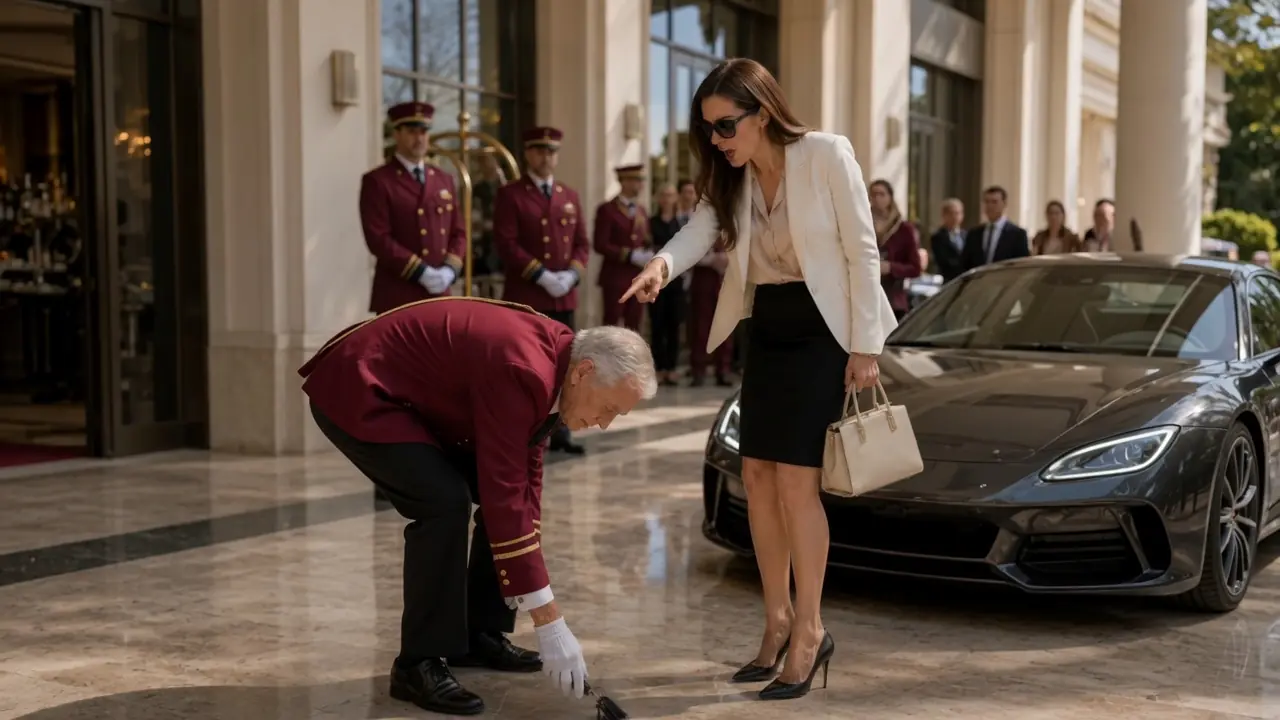
Vivian Cross stood over him in a white blazer, black skirt, designer sunglasses, and sharp black heels. Her cream handbag hung from one wrist, and her mouth twisted with the kind of impatience that came from never being told no. Behind her, a sleek black sports car idled beneath the hotel canopy, its paint shining like a mirror. She had tossed the keys at Thomas without looking, and when they hit the floor instead of his hand, she blamed him for failing to catch them.
Thomas did not answer right away. At seventy-two, he moved more slowly than the young valets, but there was nothing weak in the way he carried himself. His faded green uniform was brushed clean, his shoes were polished, and his posture held a quiet dignity that years of service had not worn down. He picked up the keys carefully, wiped them with his glove, and rose with effort.
“I’m sorry, ma’am,” he said softly. “I only wanted to make sure your car was safe.”
Vivian laughed with disbelief. “Safe? Do you have any idea how much that car costs?”
Thomas held the keys out with both hands. “I’ll be very careful.”
“You’d better be.” She leaned closer, her voice loud enough for everyone under the canopy to hear. “If you scratch it, you’ll never earn enough in your little valet job to fix even the wheel.”
A few guests looked away. Not because they disagreed, but because watching cruelty made them uncomfortable when they had no intention of stopping it. Two security guards stood near the revolving doors, their faces tight, but neither stepped forward. A young valet named Luis stared at Thomas with helpless anger, his hands clenched at his sides.
Thomas saw the boy’s face and gave the smallest shake of his head. Not here. Not yet.
Vivian noticed. “Oh, look at that. Now you’re giving signals?” She stepped closer and pointed toward the ground again. “Maybe I should drop them one more time so you can practice.”
Thomas’s jaw tightened, but he lowered his eyes. “There’s no need for that, ma’am.”
“No need?” she snapped. “You are the help. Your job is whatever I need it to be.”
The sentence landed hard. It was not the first time Thomas had heard something like it. In fifty years of working around hotels, restaurants, and wealthy guests, he had learned that money did not always make people cruel. But when cruelty already lived inside someone, money gave it nicer clothes.
The Meridian Grand had been alive with movement before Vivian arrived. Guests in tailored suits crossed the lobby with leather briefcases. Families posed near the fountain. Businessmen checked watches while waiting for cars. A wedding party upstairs filled the mezzanine with laughter. But now the whole entrance seemed to hold its breath around one elderly man and one woman who believed the uniform made him small.
Vivian reached for the keys, then suddenly pulled them back before he could pass them to Luis. “No. You park it.”
Thomas looked at her. “Of course.”
“And don’t take all day.”
Luis stepped forward. “Mr. Reed, I can—”
Vivian turned sharply. “Did I ask you?”
Luis stopped.
Thomas placed one hand lightly on Luis’s shoulder as he passed, a quiet warning to stay calm. Then he walked toward the car. His steps were steady, but his knees ached more than usual. He had been standing since six that morning, greeting guests, opening doors, and watching the hotel he loved from the position where people revealed themselves most honestly.
That was why he still wore the valet uniform.
Most people at the Meridian Grand believed Thomas was only an old employee who had refused to retire. Some knew he had been there for decades. A few senior staff called him Mr. Reed with unusual respect, but they never explained why. To new hires, he was just the gentle old valet who remembered every guest’s name, carried peppermints for children, and polished the brass rail before sunrise even when no one asked.
They did not know that Thomas Reed had bought the broken building forty years earlier when it was nothing but a failing hotel with cracked windows and unpaid bills. They did not know he had slept in the basement office during the first winter because there was no money left for heat in his apartment. They did not know his late wife, Marian, had sewn the first staff uniforms herself, or that their son Daniel had learned to count by stacking room keys on the front desk.
They did not know Thomas still owned the controlling share.
Daniel Reed, now thirty-eight, was the CEO. He ran the Meridian Group with sharp intelligence and a modern vision, but Thomas remained the founder, the heart, and the quiet conscience of the hotel. Twice a month, he dressed as a valet and worked the entrance, not because he needed money, but because he believed the front door told the truth faster than any management report.
That afternoon, the truth had walked up in black heels.
Thomas parked Vivian’s car perfectly. When he returned, she was still waiting near the entrance, tapping one heel against the marble floor. She looked irritated that he had not made a mistake. He handed her the claim ticket.
She snatched it from him. “Finally.”
“You’re welcome, ma’am.”
That seemed to anger her even more. “Don’t act proud. You managed to park a car. Congratulations.”
Thomas said nothing.
Vivian leaned in. “You people always think being polite hides incompetence.”
A low murmur moved through the watching guests. Luis took a step forward again, but Thomas lifted his hand slightly.
Then Vivian did something that made even the doorman gasp.
She grabbed Thomas by the sleeve of his green uniform and yanked him closer. “Listen carefully. When I come back, you will bring my car immediately. Not after chatting. Not after limping around. Immediately.”
Thomas looked down at her hand on his arm. His voice stayed quiet. “Please let go of my sleeve.”
Her sunglasses slipped slightly down her nose. “Or what?”
The revolving doors behind them spun suddenly.
A sharply dressed young man burst through, followed by two hotel executives and a security supervisor. Daniel Reed’s face was pale with fury. He had been in a second-floor conference room when the security feed flashed onto a monitor during a systems check. At first, he saw only an angry guest and a valet. Then he recognized the valet’s silver hair, the slight bend in his shoulders, and the woman’s hand gripping his sleeve.
His voice thundered beneath the entrance canopy. “Stop.”
Every conversation died instantly.
Vivian released Thomas’s arm and turned, annoyed. “And who exactly are you?”
Daniel walked straight past her to Thomas. He did not answer at first. He placed one protective hand on the elderly man’s shoulder and looked at the red marks on his sleeve where her fingers had pulled the fabric. His jaw tightened.
“Dad,” Daniel said, his voice low. “Are you all right?”
The word hit the entrance harder than any shout.
Dad.
Vivian’s expression froze.
Guests began whispering at once. The doorman’s eyes lowered. Luis looked like he might cry from relief. The security guards straightened so quickly they nearly knocked shoulders.
Vivian looked from Daniel’s expensive suit to Thomas’s valet uniform. “Dad?”
Daniel turned toward her. “Yes.”
She forced a laugh, brittle and nervous. “There must be some misunderstanding.”
Daniel’s eyes were cold. “The only misunderstanding is that you believed his uniform made him powerless.”
Thomas touched Daniel’s arm gently. “Son.”
Daniel did not look away from Vivian. “No. Not this time.”
Vivian’s confidence returned in fragments. “Your employee was slow, careless, and disrespectful. I am a guest here.”
Thomas spoke before Daniel could. “I was not disrespectful.”
She pointed at him. “You dropped my keys.”
“You threw them.”
The simplicity of the answer made several people in the crowd shift uncomfortably. Vivian looked around and realized, perhaps for the first time, that she was no longer controlling the story.
Daniel stepped closer. “This man is Thomas Reed. Founder of the Meridian Grand. Majority owner of the Meridian Group. The person whose name is on the first deed, the first payroll loan, and the scholarship fund that pays for half the hospitality interns in this building.”
Vivian’s face lost color.
Thomas lowered his eyes, not from shame, but from discomfort at being praised in public. He had never liked announcements about himself. He preferred work to applause and service to ceremony. But Daniel had carried this silence long enough.
Daniel continued, each word measured. “He is also my father. And you just insulted him, grabbed him, and ordered him around in front of the staff he has spent his life protecting.”
Vivian swallowed. “I didn’t know.”
Daniel’s gaze hardened. “That is not a defense.”
“I mean, if I had known who he was—”
“That makes it worse.”
The entrance went completely still.
Daniel’s voice dropped, but somehow carried farther. “You are telling me you would have treated him with respect only if you knew he was rich.”
Vivian’s mouth opened. No answer came.
Thomas finally stepped between them slightly. “Daniel, enough.”
“No, Dad.” Daniel’s eyes softened when he looked at him, then hardened again when he turned back to Vivian. “You taught me this hotel’s first rule before I could reach the front desk. Every guest and every worker is seen before they are judged. Today, she violated that rule before she even entered the lobby.”
A man in a dark suit stepped forward from behind Vivian. He looked embarrassed and frightened. “Daniel, please. Vivian is my wife. I’m Charles Cross. We’re here for the partnership dinner upstairs.”
Daniel looked at him slowly.
Charles Cross was not a random guest. He was the CEO of Crosswell Properties, a luxury development firm negotiating a major hospitality partnership with the Meridian Group. The dinner upstairs was supposed to finalize a deal involving three new hotel properties. Vivian had arrived early to prepare for the private event, and now every executive standing in the entrance understood the disaster unfolding in real time.
Daniel’s expression did not change. “I know who you are.”
Charles lowered his voice. “Can we discuss this privately?”
Vivian whispered, “Charles, tell him.”
Charles looked at his wife, then at Thomas, then at the crowd. For once, his polished confidence cracked. “Vivian, be quiet.”
Her eyes widened. “Excuse me?”
He did not repeat himself.
Daniel turned toward his chief operating officer, Marlene Shaw. “Cancel the partnership dinner.”
Charles went pale. “Daniel.”
“Cancel it,” Daniel said again. “The Meridian Group will not attach its name to a family that treats service workers as disposable.”
Charles stepped closer. “This deal is worth hundreds of millions.”
Thomas looked at Daniel then. He knew what that kind of money meant. Expansion, new jobs, investor confidence, national press. But he also knew what Marian would have said. A hotel that sells its soul for marble will one day have no room warm enough for decent people.
Daniel did not hesitate. “Then it is expensive proof of what we will not become.”
Vivian’s voice shook. “You can’t cancel a business deal because I was upset about my car.”
Daniel looked at her. “You were not upset about your car. You were cruel to a man because you thought he had to take it.”
The words silenced her.
Marlene stepped aside to make the call. Staff members watched with stunned faces. Some guests nodded quietly. Others stared at Vivian with the fascinated discomfort people feel when wealth fails publicly.
Thomas exhaled slowly. “Daniel, may I speak?”
His son stepped back at once. “Of course.”
Thomas turned toward Vivian. His cheek was not marked by a slap in this version of the truth, but his dignity had been struck in front of everyone. Still, his voice held no hatred.
“Mrs. Cross,” he said, “I have parked cars for presidents, actors, teachers, nurses, construction workers, and grandparents bringing children to see the city for the first time. I have opened doors for people who tipped a hundred dollars and people who could only say thank you. The work never made me less than anyone.”
Vivian’s eyes glistened, but Thomas did not stop.
“What made this moment ugly was not that you asked me to pick up keys. It was that you needed me to feel beneath you while doing it.”
She looked down.
Thomas continued, “If you had apologized when the keys fell, I would have parked your car and wished you a pleasant stay. Instead, you showed every person here what you believe service means.”
Charles closed his eyes.
Vivian whispered, “I’m sorry.”
Thomas studied her. “Are you sorry because you hurt an old man, or because you discovered the old man owns the hotel?”
The question left her with nowhere to hide.
A few guests lowered their heads. Daniel watched his father with quiet pride. Thomas had always been gentler than people expected, but his gentleness had never been weakness. It was discipline. It was power held carefully.
Vivian covered her mouth. For the first time, she seemed truly shaken. “I don’t know.”
Thomas nodded sadly. “Then start there.”
Daniel turned to security. “Mrs. Cross will not be staying at this hotel tonight.”
Charles looked up sharply. “Daniel, please.”
“You may remain if you choose,” Daniel said to Charles. “But the partnership meeting is canceled, and our legal team will send formal notice by morning.”
Charles stared at him. “You’re serious.”
Daniel looked toward Thomas. “More serious than I have ever been.”
Vivian’s bags were still in the trunk of her sports car. Luis retrieved them, not because she deserved the kindness, but because the hotel’s standards did not lower themselves to match hers. He placed the luggage beside her carefully. Vivian could barely look at him.
Thomas noticed.
“Luis,” he said.
The young valet straightened. “Yes, Mr. Reed?”
“Thank you for serving with dignity.”
Luis’s eyes filled. “Yes, sir.”
Vivian heard that too. Something in her face changed again, smaller this time, less defensive. She had spent ten minutes treating the valet station like a place for invisible people. Now she was watching the invisible become named.
Charles guided her toward the car, but before getting in, Vivian turned back. “Mr. Reed.”
Thomas waited.
“I am sorry,” she said, voice trembling. “Not enough. Not properly yet. But I am.”
Thomas did not smile. “Then do something with it.”
The car pulled away from the entrance, leaving behind a silence that felt like the end of a storm.
Daniel turned to the crowd. “Ladies and gentlemen, I apologize for what you witnessed at our entrance today. No guest, employee, or visitor should be humiliated under this roof. Anyone who feels uncomfortable may speak with our front desk, and anyone who filmed this is free to keep their recording. We will not pretend it did not happen.”
That mattered. Several guests looked surprised. Many luxury hotels cared more about polished silence than truth. But the Meridian Grand had not been built that way, and Thomas’s son had just reminded everyone.
Daniel faced the staff. “All valet and front-door staff, please gather inside in ten minutes. Paid time. No one loses wages for speaking about what happened.”
Thomas put a hand on his shoulder. “You handled that well.”
Daniel laughed once, bitter with emotion. “I nearly lost my mind.”
“I noticed.”
“She grabbed you.”
“I have survived worse.”
Daniel’s eyes filled. “You should not have to.”
Thomas looked at him for a long moment. “That is why I still stand at the door.”
Inside the hotel, the staff meeting took place in the lobby lounge instead of a back room. Thomas insisted on it. He did not want the people who worked outdoors, carried bags, parked cars, cleaned rooms, and opened doors to feel like their dignity belonged behind the scenes.
Valets, bellhops, housekeepers, front desk clerks, managers, and security guards gathered in a wide circle. Some still looked shaken. Others looked ashamed for not stepping in sooner. Thomas stood beside Daniel, still in his green uniform.
“I know many of you wanted to help,” Thomas began. “Some of you were afraid of the guest. Some were afraid of losing your job. Some thought it was not your place. I understand all of that.”
Luis looked down.
Thomas continued, “But a hotel is not judged only by how quickly it serves the powerful. It is judged by whether the least powerful person under its roof can stand without being crushed.”
The room was silent.
Daniel stepped forward. “Effective immediately, every employee has authority to call a dignity stop.”
Marlene nodded and explained the new rule. Any staff member witnessing abuse toward an employee, guest, contractor, or visitor could pause service and call a manager without punishment. Guest status would not excuse mistreatment. Repeat offenders could be removed regardless of wealth or reservation level. Every incident would be documented and reviewed by leadership, not hidden to protect ratings.
A housekeeper named Ana raised her hand slowly. “Even if it is a VIP guest?”
Daniel answered without hesitation. “Especially then.”
The words moved through the room like clean air.
Thomas smiled faintly. “My wife Marian used to say luxury without kindness is only expensive emptiness.”
Several older staff members smiled at the name. Marian Reed had been gone twelve years, but many still remembered how she greeted employees in the staff cafeteria before she ever entered the executive dining room. She had believed hotels were homes for people far from home, including the people who worked there.
That evening, Thomas finally changed out of the valet uniform. He sat with Daniel in the founder’s office on the second floor, overlooking the entrance where the incident had happened. The sports car was gone. The marble had been cleaned. Guests moved in and out as usual, but something felt different.
Daniel poured tea into two cups. “You could stop doing this.”
Thomas accepted the cup. “Working the door?”
“Yes.”
“I could.”
“You don’t need to prove anything.”
“I know.”
“Then why keep putting yourself in situations where people might disrespect you?”
Thomas looked out the window. “Because they reveal whether we have taught the hotel properly.”
Daniel sat across from him, tired and still angry. “I hate seeing people treat you like that.”
Thomas smiled gently. “Then make sure they cannot treat anyone like that here.”
Daniel nodded.
The canceled Crosswell partnership made business headlines within days. Reporters framed it as a shocking collapse of a major luxury development deal. Rumors spread about the entrance incident, and eventually a short video appeared online. It showed Vivian pointing at Thomas, the keys on the floor, Daniel rushing out, and the stunned moment when everyone learned the elderly valet was his father.
Public reaction was swift. Some praised the hotel. Some accused Daniel of overreacting. Others said a business deal should never be canceled over one emotional moment. Daniel read none of the comments after the first day. Thomas read them quietly and shook his head at how many people still believed respect should depend on someone’s importance.
Three weeks later, Charles Cross requested a private meeting. Daniel refused twice. On the third request, Thomas asked him to accept.
“Why?” Daniel asked.
“Because people are not contracts,” Thomas said. “Sometimes they return with something to learn.”
Charles arrived without Vivian. He looked thinner, less polished, and far less certain of himself. In the conference room, he did not begin with numbers.
“My wife is in counseling,” he said.
Daniel said nothing.
Charles turned to Thomas. “She has not stopped talking about your question.”
Thomas folded his hands. “Which one?”
“Whether she was sorry for hurting an old man or sorry because he owned the hotel.”
Thomas nodded slowly. “And?”
“She said at first she was sorry because of the hotel.” Charles swallowed. “Then because of the video. Then because of the deal. But last week, she said she saw a man at a parking garage struggling with bags, and she started to walk past because he was staff. Then she stopped. She helped him. She cried afterward.”
Daniel remained guarded. “That does not restore the deal.”
“I know,” Charles said. “I did not come for that.”
Thomas looked at him. “Why did you come?”
Charles placed a document on the table. “Crosswell Properties is creating a service-worker dignity fund. Independent board. Not branded as charity from us. Training grants, legal support, emergency aid for hospitality workers facing abuse or retaliation. Vivian is funding the first year from her personal trust.”
Daniel studied him carefully. “Is this public?”
“No.”
“Will it become public?”
“Only if the board decides transparency requires it. But there will be no press event.”
Thomas looked at the document. “Good.”
Charles exhaled quietly. “So you approve?”
Thomas’s eyes lifted. “I approve of beginnings. Not performances.”
Charles nodded. “That is fair.”
Months passed, and the Meridian Grand changed in ways guests could see and ways they could not. A small sign appeared near the valet podium: Our staff serve with dignity. Abuse will not be tolerated. Some guests laughed when they first saw it. They stopped laughing when they realized the hotel meant it.
Luis was promoted to valet captain. Ana joined the employee advisory board. Security guards received new training that focused not only on protecting property, but protecting people from humiliation. The dignity stop policy was used four times in its first year. Three guests apologized. One was removed. None of the employees involved lost wages or hours.
Thomas still worked the entrance twice a month.
The first time he returned in uniform after the incident, the staff tried to treat him like glass. He told them that would irritate him faster than any insult. By noon, things felt almost normal again. He opened doors, greeted taxis, helped an elderly guest with a cane, and gave a peppermint to a little boy who was afraid of the revolving doors.
Near sunset, a woman in a modest coat stepped out of a rideshare with two heavy bags. She looked nervous approaching the grand entrance, glancing at the luxury cars and polished glass. Thomas stepped forward.
“Welcome to the Meridian Grand,” he said warmly. “May I help you?”
The woman relaxed at once. “Thank you. I wasn’t sure I was in the right place.”
Thomas smiled. “Then I’m glad I was here to tell you that you are.”
From the lobby, Daniel watched his father through the glass. The old green uniform, once mistaken for smallness by the wrong people, looked different to him now. It looked like history. Like humility. Like a warning that the worth of a person never arrives with a title, a car, a suit, or a room rate.
That night, after Thomas finished his shift, Daniel walked him to the staff exit.
“You know,” Daniel said, “everyone calls you the founder again.”
Thomas chuckled. “I was enjoying being just Thomas.”
“You were never just Thomas.”
“No,” Thomas said gently. “But every employee here should be able to be just themselves and still be respected.”
Daniel smiled. “That sounds like something Mom would have said.”
“It is something your mother did say.”
They stood together for a moment in the quiet hallway, father and son, CEO and founder, both shaped by a woman who had believed hospitality began with seeing people. Then Thomas patted Daniel’s shoulder and headed toward the parking garage, moving slowly but proudly.
At the entrance, the valet podium gleamed beneath the lights. Cars came and went. Guests arrived tired, excited, impatient, wealthy, ordinary, nervous, and hopeful. The staff opened doors for all of them.
And every time someone dropped their keys, someone bent to pick them up.
Not because they were beneath anyone.
Because service, when given with dignity, was never a sign of low status.
It was the foundation the entire hotel had been built on.