Aaliyah Morgan entered the Rolex boutique at eleven minutes past ten on a clear Tuesday morning. She wore an elegant cream suit, low black heels, and a pair of simple gold earrings that had belonged to her mother. Her straight black hair rested neatly against her jaw, and a slim leather portfolio hung from one hand. Nothing about her appearance was accidental, yet nothing announced that she controlled an investment company worth several billion dollars.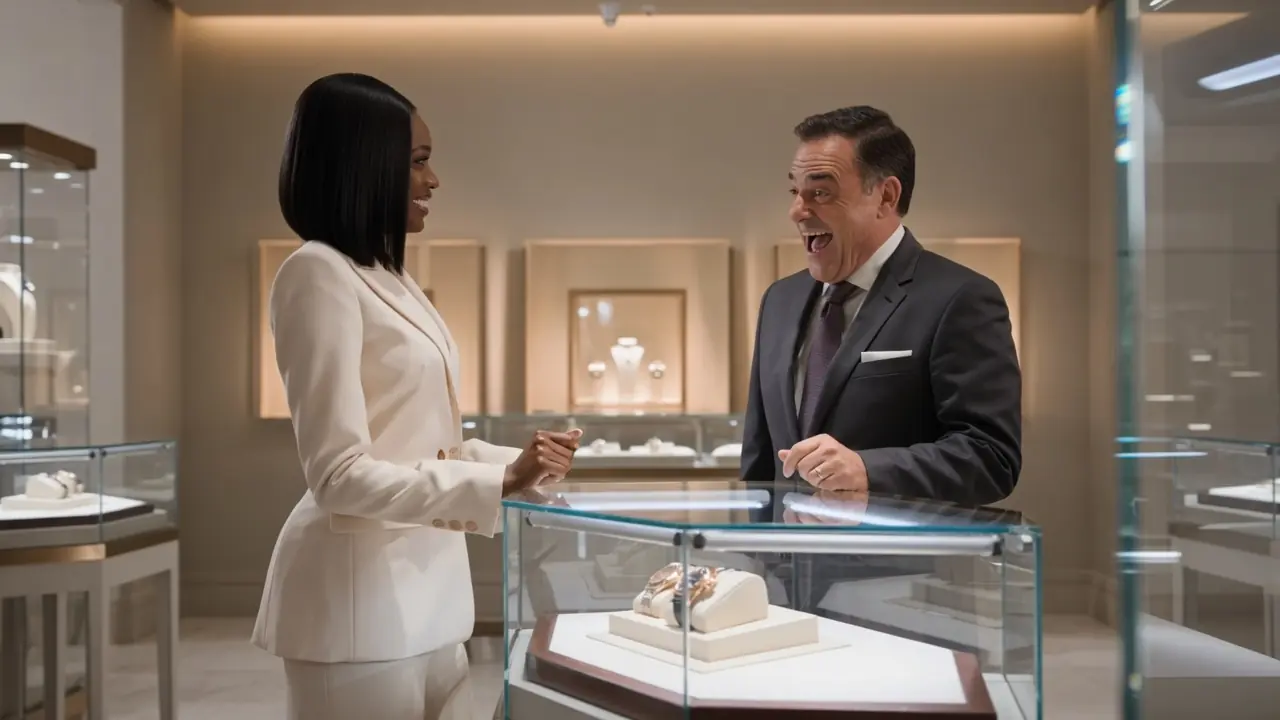
The boutique occupied the ground floor of the Halstead Crown Hotel in downtown Chicago. Its marble entrance opened into a quiet showroom filled with glass displays, private consultation tables, and soft lighting designed to make every watch appear more valuable than the building around it. Two security officers stood near the doors, while sales associates moved between customers carrying velvet trays. Aaliyah paused near the entrance and looked toward the central display.
She had come for one specific watch.
Her father, Samuel Morgan, was retiring after forty-three years as a precision machinist. He had spent most of his life working with gears, tolerances, and mechanical systems, but he had never owned a fine watch. Whenever Aaliyah asked why, he laughed and said a man who repaired clocks all day did not need one expensive enough to make him afraid of scratching it.
Samuel had raised Aaliyah alone after her mother died when Aaliyah was nine. He worked double shifts, repaired neighbors’ appliances at night, and packed her school lunches before sunrise. When she received a scholarship to Northwestern University, he sold the vintage motorcycle he had restored over twelve years to cover the expenses the scholarship did not. He never told her until she noticed the empty space inside his garage.
The platinum Rolex displayed beneath the central glass case had a dark blue dial and understated hour markers. It was elegant without demanding attention, much like Samuel himself. Aaliyah had seen the model during a private corporate event several months earlier and decided it would be his retirement gift. She wanted to purchase it personally rather than send an assistant.
A young sales associate named Maya Bennett noticed her first.
“Good morning,” Maya said. “Welcome. Is there a particular model you would like to see?”
“Yes. The platinum Day-Date in the center case.”
Maya’s expression brightened. “Of course. That is a remarkable piece.”
She reached toward the key secured beneath the counter, but a man’s voice stopped her.
“Maya.”
The senior sales manager approached from a private consultation room. Victor Hale was forty-seven, carefully groomed, and dressed in a dark gray suit with a white pocket square. His movements carried the confidence of someone accustomed to deciding which customers received attention and which customers were encouraged to leave quickly.
He looked at Aaliyah before glancing toward the platinum watch.
“I’ll handle this,” he said.
Maya stepped back reluctantly.
Victor placed both hands on the glass counter. “You are interested in the Day-Date?”
“Yes.”
“That particular model is not available for casual viewing.”
“I am not casually viewing it.”
Victor studied her cream suit, portfolio, and unbranded handbag. His eyes paused briefly on her plain gold earrings before returning to her face. The assessment lasted only seconds, but Aaliyah recognized it immediately.
She had experienced the same look inside banks when she sought funding for her first company. She had seen it at business conferences where people assumed she belonged to the catering staff. Even after appearing on magazine covers, she occasionally entered rooms where someone decided her value before learning her name.
“How familiar are you with the brand?” Victor asked.
Aaliyah looked toward the watch. “Familiar enough to know why I came.”
“The price exceeds one hundred thousand dollars.”
“I know.”
“We have several more accessible models near the entrance.”
“I did not ask for those.”
Victor smiled faintly. “Clients sometimes become attracted to a display piece without understanding the financial commitment.”
Aaliyah rested her portfolio on the counter. “Unlock the case.”
The smile disappeared.
“Excuse me?”
“I would like to examine the watch before purchasing it.”
Victor glanced toward Maya, as though Aaliyah’s directness confirmed something he had already decided about her. Two customers at a nearby consultation table looked over. The showroom remained quiet enough that every word carried farther than ordinary conversation.
“This boutique has procedures,” Victor said. “We do not remove rare inventory without confirming a customer’s purchase history.”
“My purchase history is irrelevant if I can pay for the watch today.”
“That is not how luxury relationships work.”
Aaliyah almost smiled. “Luxury relationships?”
“Established clients receive priority access.”
“Is the watch already reserved?”
“No.”
“Then it is available.”
Victor folded his arms. “Available does not mean available to everyone.”
Maya looked down.
Aaliyah heard the meaning beneath the words. Victor had not openly mentioned her race, but his tone made clear that he had placed her outside the category of people he believed belonged inside the boutique. She had spent enough years dealing with carefully disguised contempt to recognize it without requiring a confession.
“May I speak with another associate?” she asked.
“I am the senior sales manager.”
“That did not answer my question.”
Victor’s mouth tightened. “Everyone here follows my direction.”
Aaliyah turned toward Maya. “Would you be willing to show me the watch?”
Maya hesitated.
Victor answered for her. “She will not.”
Aaliyah looked back at him. “Then I would like your full name.”
His expression shifted slightly. “Victor Hale.”
“Thank you.”
“Why?”
“So I can document who refused service before checking whether I could complete the purchase.”
Victor laughed, and the sound attracted more attention from the employees. “You have not been refused service.”
“You offered me products I did not request and refused to unlock the product I came to buy.”
“Because you have provided no reason for me to believe this is a serious transaction.”
Aaliyah opened her leather portfolio.
Victor watched as she removed a black metal card issued through a private institutional banking program. The card carried no visible number, only her name and a small silver emblem. She placed it on the glass between them.
“Is that sufficient?”
Victor picked it up and turned it over.
“These cards can be ordered online.”
Aaliyah stared at him. “Not this one.”
“I have seen convincing imitations.”
“Then verify it.”
He placed the card down without using the terminal. “I am not processing a six-figure purchase simply because someone places an unusual card on my counter.”
The word someone was delivered with deliberate care.
Maya stepped closer. “Mr. Hale, I can contact the card service and verify the account.”
Victor turned sharply. “Return to your station.”
“There are no other customers waiting.”
“That was not a request.”
Maya moved away, but her face had become tense.
Aaliyah placed one hand over the card. “You have now refused verification twice.”
Victor lowered his voice. “Ma’am, people visit boutiques like this for photographs, attention, and stories they can tell online. My responsibility is protecting the store’s inventory and its real clients.”
“Real clients?”
“Clients with established relationships.”
“People who look the way you expect wealth to look.”
His eyes narrowed. “You are attempting to create an issue where none exists.”
“The issue existed before I entered. I merely reached the counter.”
One of the security officers began watching the exchange more closely. Victor noticed and straightened his jacket, appearing to recover confidence from the visible presence of authority.
He pointed toward the entrance. “Perhaps another store would be more suitable.”
Aaliyah remained still. “I came here to purchase this watch for my father.”
Victor glanced toward the display and smiled again.
“It costs more than women like you earn in a year.”
The boutique fell silent.
Maya’s eyes widened. The older couple at the consultation table stopped speaking, while another sales associate froze beside a wall display. Even the security officer looked toward Victor with disbelief.
Aaliyah did not immediately respond.
She thought of Samuel coming home with oil beneath his fingernails and exhaustion in his shoulders. She remembered him sitting at the kitchen table, carefully repairing a broken school watch she had found at a thrift store because they could not afford a new one. He had taught her never to measure human worth by clothing, titles, addresses, or money.
Victor stood behind a case filled with expensive objects and understood none of that.
Aaliyah’s voice remained calm.
“I came to buy it for my father, not ask your permission to belong here.”
Victor reached for the telephone beneath the counter. “Leave now, or I’ll have security remove you.”
The nearest officer stepped forward but did not approach Aaliyah.
“Sir,” the officer said, “she has not threatened anyone.”
Victor glared at him. “She is refusing to leave private property.”
“I am requesting service at a retail business,” Aaliyah replied.
“You are disrupting the showroom.”
“The showroom became disrupted when you insulted me.”
Victor lifted the receiver. “Security will escort you out.”
Aaliyah picked up her executive card and replaced it inside the portfolio. Then she removed a second card and placed it beside the glass display. It carried the crest of Morgan Crown Holdings and her title printed beneath her name.
Aaliyah Morgan
Founder and Chief Executive Officer
Morgan Crown Holdings
Victor looked at it briefly.
“Printing another card does not improve your situation.”
Aaliyah closed the portfolio. “Call the owner first, Victor.”
“Why?”
“Then ask why your new CEO is standing at your counter.”
He stared at her.
Several employees exchanged confused looks.
Victor laughed again, but this time the sound was shorter. “The boutique is owned by Halstead Luxury Retail.”
“Yes.”
“The chief executive is David Halstead.”
“Until nine this morning.”
Maya looked toward the private office.
Aaliyah continued. “Morgan Crown Holdings completed the controlling acquisition of Halstead Luxury Retail ninety-two minutes ago. I am here to conduct an unannounced management review before meeting the regional directors.”
Color slowly left Victor’s face.
He looked toward the card again, then toward the office door as though expecting someone to tell him the statement was impossible. The telephone rang before he could speak.
No one moved.
It rang a second time.
Victor lifted the receiver.
“Rolex salon, Victor Hale speaking.”
His expression changed almost immediately.
“Yes, Mr. Halstead.”
A pause followed.
Victor looked toward Aaliyah.
“She is here.”
Another pause.
“No, sir. I did not recognize her.”
His grip tightened around the telephone.
“I understand.”
Victor listened for nearly thirty seconds before lowering the receiver. His earlier smile had disappeared completely.
Maya stepped closer to Aaliyah. “Ms. Morgan, I’m sorry.”
“You attempted to assist me.”
“I should have done more.”
“You were operating beneath someone who controlled your employment. We will discuss that honestly, but not publicly.”
Victor cleared his throat. “Ms. Morgan, there has been a misunderstanding.”
Aaliyah turned toward him. “Which part?”
“I did not know your identity.”
“That is not a misunderstanding. It is an admission.”
He glanced toward the customers. “We should continue this conversation privately.”
“You insulted me publicly.”
“I was protecting a valuable product.”
“From a Black woman who asked to buy it?”
Victor’s eyes moved quickly toward the cameras.
“I never mentioned race.”
“You did not have to.”
“That accusation is extremely serious.”
“So was your behavior.”
David Halstead entered the boutique several minutes later with regional director Claire Benton, human resources chief Lillian Cho, and two members of the acquisition transition team. David had managed the family retail company for twenty-six years and had negotiated its sale after declining revenue and several unsuccessful expansions. He looked older than he had during the morning’s signing ceremony.
“Aaliyah,” he said, “I am deeply sorry.”
She turned toward him. “Did you know this was happening in your stores?”
“No.”
“Then either your reporting system failed or your managers learned to hide what customers experienced.”
David looked toward Victor. “What exactly happened?”
Aaliyah did not answer first.
She looked toward Maya.
“Tell him.”
Maya’s hands tightened around each other. Victor watched her with the expression of a supervisor silently reminding an employee who controlled her schedule, commissions, and performance reviews.
Aaliyah noticed.
“No retaliation will be tolerated,” she said. “Not today or afterward.”
Maya took a breath.
She described Victor refusing to unlock the display, dismissing Aaliyah’s identification, rejecting payment verification, and threatening security. Then she repeated his statement about women like her never earning enough to afford the watch.
David’s face hardened.
Victor stepped forward. “She is omitting the context.”
Claire Benton looked at him. “What context makes that statement appropriate?”
“The customer was aggressive.”
Aaliyah raised an eyebrow.
“I was cautious because the card could not be confirmed immediately,” Victor continued. “Luxury boutiques face sophisticated theft attempts.”
The security officer spoke from near the entrance.
“She did not attempt to touch or remove anything.”
Victor looked at him sharply.
The officer continued. “She asked for the case to be opened and offered identification. She remained calm.”
Another sales associate named Daniel Price raised his hand slightly. “That is what I saw too.”
Victor turned toward him. “Nobody asked you.”
Lillian Cho opened a notebook. “I am asking now.”
Daniel described several similar incidents involving customers Victor considered unsuitable. A Black surgeon had been denied access to a limited-edition watch until his white colleague returned from parking the car. A Latino contractor wearing work clothes had been followed by security despite presenting proof of a confirmed appointment. An elderly Asian couple waited forty minutes while later arrivals received immediate service.
Each time, Victor described the customers as suspicious, confused, or unlikely to complete a purchase.
Maya added another example.
Victor had instructed employees to assess clothing, accent, age, and occupation before bringing out high-value inventory. Associates who challenged the practice lost commission opportunities. Complaints were entered into the internal system, but Victor marked them resolved before regional management reviewed them.
David looked physically ill.
“How many complaints?” he asked.
Maya glanced toward the office. “At least seventeen since January.”
Claire immediately requested access to the boutique records.
Victor moved toward the office door. “Those files contain private customer information.”
“So does the investigation we are beginning,” Claire replied.
Aaliyah remained beside the platinum watch.
She had expected to evaluate inventory, staffing levels, sales conversion, and customer experience. Instead, a single refusal had exposed a culture where employees learned to judge people according to Victor’s assumptions and remain silent to protect their careers.
Victor approached her cautiously.
“Ms. Morgan, I sincerely apologize.”
“For what?”
“For failing to recognize you.”
The answer confirmed everything.
Aaliyah looked directly at him. “You still do not understand.”
“I understand that you are the new chief executive.”
“That is not why I deserved service.”
Victor swallowed.
“You are apologizing because my name carries power,” she continued. “The surgeon, contractor, elderly couple, and every customer you dismissed deserved the same apology before anyone checked a bank balance.”
He lowered his voice. “One mistake should not destroy twenty years of work.”
“This is not one mistake.”
“You have only heard accusations.”
“That is why there will be an investigation.”
Victor glanced toward David. “Am I being fired?”
Aaliyah answered carefully. “You are suspended effective immediately. Your access badge, keys, and company devices will remain here while independent reviewers examine the records.”
His expression hardened. “You came in disguised to trap me.”
“I wore a business suit and introduced myself only when ordinary service became impossible.”
“You intentionally came without an entourage.”
“Yes.”
“Then you wanted someone to make a mistake.”
“No. I wanted to see whether respect disappeared when power did.”
Victor looked around the showroom.
No employee defended him.
He removed his badge and placed it on the counter beside the watch. Security escorted him toward the entrance, but he stopped before leaving and turned toward Aaliyah.
“You will regret letting emotional reactions control business decisions.”
Aaliyah’s expression did not change.
“I built my company by separating emotion from evidence. The evidence is why you are leaving.”
The investigation lasted five weeks.
It uncovered twenty-nine complaints connected to Victor’s management. Several customers had moved major purchases to competing boutiques after being ignored, questioned, or treated as security risks. The lost revenue exceeded three million dollars, proving that discrimination had not protected the business.
It had driven business away.
Victor had also manipulated commission assignments, rewarding employees who copied his methods and punishing those who treated customers more patiently. He removed Maya from premium appointments after she assisted a young Black entrepreneur without first asking for proof of income. Daniel lost two weekend shifts after objecting when security followed a customer wearing construction clothes.
Victor’s employment was terminated.
Two assistant managers received disciplinary action for helping bury complaints. Another employee resigned after admitting that he had learned to imitate Victor because cruelty brought better sales assignments. Others completed mandatory retraining and participated in interviews with customers whose experiences had been dismissed.
Aaliyah refused to describe the problem as one bad employee.
She changed the reporting structure across all forty-two boutiques acquired through Halstead Luxury Retail. Complaints could no longer be closed by the manager named in them. Employees gained access to an independent ethics channel, and commission assignments became transparent.
Most importantly, she changed how rare inventory was presented.
Customers could still be asked to follow security procedures, but the rules had to apply equally. Clothing, race, age, accent, disability, and visible wealth could never be used as substitutes for behavior. Employees were trained to verify information without humiliating the person providing it.
Maya Bennett was promoted to client experience manager after completing an independent interview process. She initially worried the promotion would appear to be a reward for supporting the new CEO. Aaliyah insisted she compete fairly and recused herself from the final decision.
Maya earned the role through her record, customer feedback, and willingness to tell the truth under pressure.
The platinum watch remained inside the display throughout the investigation.
Aaliyah could have purchased it from another boutique, but she waited. She wanted the transaction completed only after the store proved that its culture had changed. Five weeks later, she returned without warning, wearing a navy dress, flat shoes, and the same gold earrings.
A new associate named Caleb Wright greeted her near the entrance.
“Good morning. How may I assist you?”
“I would like to see the platinum Day-Date.”
“Of course.”
He unlocked the case without asking what she earned, who she knew, or why she believed she belonged. He placed the watch on a velvet tray and explained its movement, history, and care requirements. He spoke to her as a customer rather than a test.
Maya watched from across the showroom but did not interrupt.
Aaliyah purchased the watch.
Three days later, Samuel Morgan attended his retirement dinner inside the machine shop where he had worked for more than four decades. Former apprentices, coworkers, neighbors, and family members filled the large break room. Samuel wore the same brown jacket he had owned for fifteen years and complained that everyone had made too much fuss.
Aaliyah stood beside him holding a small green box.
“I told you not to spend foolishly,” he said.
“You have been telling me that since I was nine.”
“And you still ignore me.”
“Only when necessary.”
She opened the box.
Samuel stared at the platinum Rolex without touching it.
“Aaliyah.”
“It is for you.”
“No.”
“Yes.”
“This costs more than my first house.”
“That house had plumbing problems.”
“It still stood.”
“So will the watch.”
The room laughed, but Samuel’s eyes filled.
He lifted the watch carefully and turned it beneath the light. His hands, scarred by decades of tools and machinery, moved with the precision they had always possessed. He examined the case, crown, bracelet, and movement through the transparent documentation photographs.
“Why this one?” he asked.
“Because you taught me time means nothing unless we use it to build something worth leaving behind.”
Samuel looked at her.
“You built yourself,” he said.
“You sold your motorcycle.”
His expression changed. “Who told you?”
“Aunt Patricia.”
“That woman cannot keep a secret.”
“She kept it for twenty years.”
Samuel looked again at the watch. “I would sell it again.”
“I know.”
He allowed Aaliyah to fasten it around his wrist.
The platinum watch looked elegant against his weathered skin, but its true value rested in everything no sales manager could have seen from the outside. It represented night shifts, repaired school shoes, careful lunches, sold dreams, and a father who never allowed poverty to become shame.
Samuel touched the dial.
“Did they treat you well when you bought it?” he asked.
Aaliyah hesitated.
Her father recognized the pause immediately.
“What happened?”
She told him.
She did not hide Victor’s words, the refusal, or the investigation. Samuel listened without interrupting, his expression growing heavier with every detail.
When she finished, he looked toward the watch.
“You still bought it there.”
“Yes.”
“Why?”
“Because leaving would have protected me. Changing the store may protect the next person.”
Samuel nodded slowly.
“That sounds like your mother.”
Aaliyah smiled. “You always say that when I am stubborn.”
“Your mother was very stubborn.”
“So were you.”
“That is different.”
The retirement dinner continued around them.
Samuel eventually raised his wrist when coworkers asked to see the gift, but he never mentioned the price. He told them his daughter had purchased it because she believed he deserved something built to last.
Months later, the Chicago boutique displayed a new statement near its entrance.
It contained no photograph of Aaliyah, no story about the acquisition, and no reference to the wealthy CEO once insulted at the counter. She refused to let the company turn discrimination into a marketing campaign.
The statement carried only one sentence:
Respect must arrive before the customer’s name, title, or balance.
Aaliyah visited the boutique again one year later.
A young Black man wearing a delivery uniform stood near the central display, examining a gold watch during his lunch break. An associate approached, opened the case, and invited him to try it on.
The man laughed nervously. “I cannot afford it yet.”
“That is all right,” the associate replied. “You are still welcome to see it.”
Aaliyah watched from near the doorway.
The interaction produced no sale that afternoon. It created no impressive figure for the quarterly report. Yet it revealed more about the company’s future than any revenue chart could show.
The customer left smiling rather than humiliated.
The associate returned the watch without resentment.
Maya noticed Aaliyah and approached quietly.
“Was that the test?” she asked.
Aaliyah looked toward the door through which the delivery worker had exited.
“No,” she said. “That was the standard.”
Victor had believed the greatest mistake of his career was insulting the woman who owned the boutique group.
He was wrong.
His greatest mistake was believing anyone needed to own the store before deserving dignity.