Eleanor Hayes had never believed expensive clothing made a person important. Her late husband, Samuel, used to say a clean conscience lasted longer than a tailored suit and cost much more to earn. Even after their small transportation business grew into a company serving hospitals across Texas, Eleanor continued wearing the same gray wool coat he had bought for her twentieth wedding anniversary. The sleeves were faded, but she could still remember Samuel fastening the buttons around her while laughing that Houston would never become cold enough to justify the price.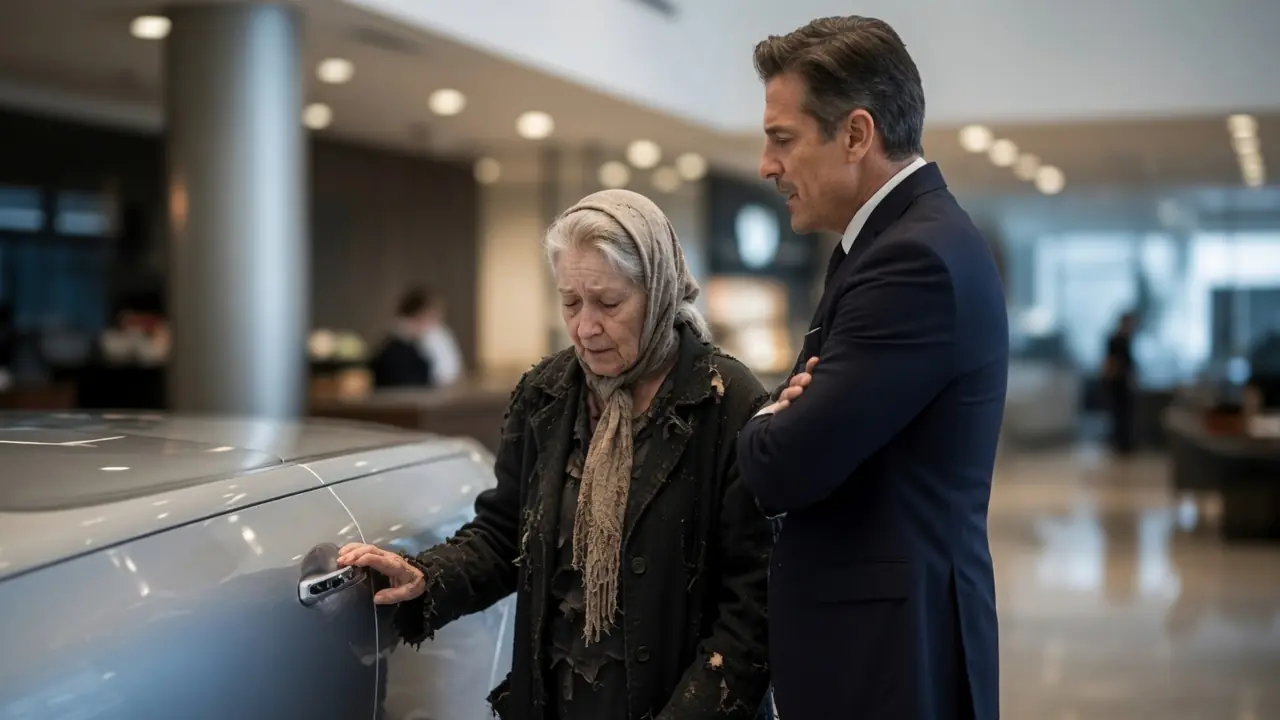
On a bright Tuesday morning, Eleanor stood outside Preston Luxury Motors in downtown Houston with one hand resting on her worn leather handbag. Behind the glass walls, polished SUVs reflected the showroom lights, each one displayed as though no ordinary person should breathe too close to the paint. Eleanor had come without her driver, assistants, or company attorney because she wanted to inspect the vehicles personally. Her employees would be transporting elderly patients, disabled veterans, and children receiving long-term medical treatment, so comfort and safety mattered more to her than any sales presentation.
Hayes Community Mobility operated one hundred and forty-seven vehicles across Texas. Eleanor and Samuel had started the company thirty-one years earlier with a single used van and a promise that no patient would miss a medical appointment because they lacked transportation. Samuel drove during the day while Eleanor answered calls from their kitchen table at night. They slept little, earned less, and often paid for fuel before paying themselves.
After Samuel died from heart failure five years earlier, Eleanor considered selling the company. Instead, she expanded the service into rural counties where elderly residents sometimes waited months for specialist appointments. The company now employed more than three hundred people and held long-term contracts with hospitals, rehabilitation centers, and veterans’ organizations. Eleanor remained majority owner, although most business magazines described her only as a private widow who avoided interviews.
Preston Luxury Motors had supplied vehicles to Hayes Community Mobility for nearly eight years. The original owner, Richard Preston, personally negotiated the first fleet agreement with Samuel. Since then, the company had purchased thirty-two vehicles from the dealership and spent hundreds of thousands of dollars on maintenance. Eleanor had never visited the showroom because her operations director handled most transactions.
That morning was different.
Hayes Community Mobility needed twelve premium silver SUVs for a new executive medical service. The contract was worth more than one million dollars, with another substantial amount expected through maintenance and future replacements. Eleanor wanted to examine the passenger space, door height, seating position, and emergency-access features before signing. She had instructed her office not to reveal that she was coming.
The revolving door opened quietly.
A receptionist seated near the entrance looked up from her computer. She noticed Eleanor’s faded coat, plain brown shoes, headscarf, and old handbag before offering a smile that never reached her eyes. Two salesmen standing beside a black sports car glanced toward Eleanor, then immediately returned to their conversation.
“Good morning,” Eleanor said. “I would like to see the silver SUV near the center display.”
The receptionist hesitated. “Do you have an appointment?”
“No.”
“Our senior consultants are currently occupied.”
Eleanor looked around the nearly empty showroom. One salesman was drinking coffee, while another scrolled through his phone. A young woman at a desk near the windows appeared ready to stand, but a sharply dressed man stepped from a glass office before she could move.
Victor Preston was forty-five, tall, carefully groomed, and proud of sharing the dealership’s family name. He was Richard Preston’s nephew, though he often allowed customers to assume he was the owner’s son. Victor had become sales manager six months earlier after promising to increase luxury margins and discourage customers who wasted staff time.
He approached Eleanor with his arms folded.
“Is there a problem?” he asked.
“I hope not,” Eleanor replied. “I would like information about that silver SUV.”
Victor followed her gaze. “That model begins above ninety thousand dollars.”
“I know.”
He looked at her clothing again. “We have used vehicles at another location.”
“I am not looking for a used vehicle.”
“Perhaps something more economical would suit your circumstances.”
Eleanor’s expression remained calm. “You do not know my circumstances.”
Victor gave a small laugh. “I have worked in car sales for twenty years. I understand customers quickly.”
“That may be your problem.”
The receptionist lowered her eyes to hide a reaction.
Eleanor walked toward the silver SUV. Its paint carried a soft metallic finish, and the rear passenger doors appeared wide enough for patients with limited mobility. She reached toward the handle, intending to inspect the interior.
Victor moved between her and the vehicle.
“Please do not touch the display.”
Eleanor stopped. “Is it not for sale?”
“It is reserved for serious buyers.”
“I am a serious buyer.”
“Then where is your appointment?”
“I did not realize money required an appointment.”
Several employees began watching. A couple seated at a nearby desk paused their conversation, while the young female salesperson near the window quietly stood. Her name tag identified her as Maya Collins.
“Mr. Preston,” Maya said, “I can show her the vehicle.”
Victor turned toward her. “Sit down.”
“I’m available.”
“I said sit down.”
Maya returned to her chair, but her face showed embarrassment.
Eleanor looked back at Victor. “I would like to inspect the second-row seating and cargo area.”
Victor stepped closer and lowered his voice, though not enough to keep others from hearing. “Ma’am, this is a luxury dealership. People cannot wander in from the street and handle expensive vehicles because they feel curious.”
“I am not curious.”
“Then what exactly are you doing here?”
“I came to buy silver SUVs.”
Victor looked toward the two salesmen near the sports car. One smirked, and the other covered a laugh with his coffee cup. The reaction gave Victor confidence.
“How many imaginary SUVs are you planning to buy?” he asked.
“Twelve.”
The showroom became quiet.
Victor stared at her for a moment, then laughed openly. “Twelve?”
“Yes.”
“For what?”
“A transportation fleet.”
“Do you even operate a vehicle?”
Eleanor tightened her fingers around the handle of her handbag. “You should be asking about the company’s requirements, not my age.”
Victor shook his head. “I should be protecting the showroom from people who come here to play pretend.”
Eleanor looked toward the silver SUV again. “Move aside.”
His smile disappeared. “Excuse me?”
“I asked to inspect the vehicle. Either assist me or find someone who will.”
Victor stepped even closer, blocking her path completely. His expensive cologne filled the space between them.
“Do not touch it,” he said. “You smell like poverty, and women like you do not buy cars here.”
No one spoke.
Maya rose again, her chair scraping against the floor. The receptionist stared at Victor in disbelief, while one of the younger salesmen looked suddenly ashamed. The couple at the nearby desk turned fully toward the confrontation.
Eleanor did not immediately answer.
For one painful second, she remembered arriving at a dealership with Samuel thirty-one years earlier. They had worn cheap clothes because every dollar they owned had gone into starting the transportation service. A salesman laughed when Samuel asked about financing a used van and told them to return after learning how business worked.
Samuel had walked out humiliated.
They purchased their first vehicle from a small independent dealer who listened before judging them. Years later, Samuel bought every company vehicle from people who treated drivers, cleaners, and executives with equal respect. Eleanor had believed Preston Luxury Motors shared that principle.
Victor looked pleased by her silence.
Eleanor raised her chin. “I came to purchase twelve vehicles, not beg for one.”
Victor pointed toward the revolving door. “Then take your fantasy somewhere else before I call security.”
Eleanor’s eyes moved toward the security officer near the entrance. He was an older man named Paul Jenkins, and he did not approach. His expression suggested he understood that the only threat in the showroom was standing in an expensive suit.
Eleanor opened her handbag.
Victor stepped backward, as though expecting her to produce stolen papers or demand money. Instead, she removed a black business card and placed it on the polished table beside him. He glanced down without picking it up.
The card read:
Eleanor Hayes
Chairwoman and Majority Owner
Hayes Community Mobility
Victor’s expression barely changed. “Anyone can print a card.”
“That is true.”
“You expect me to believe you own that company?”
“No.”
Eleanor returned the card to her handbag. “I expect you to remember this moment when someone confirms it for you.”
Victor folded his arms. “Is that a threat?”
“No. It is a courtesy.”
She turned toward the exit.
Maya stepped away from her desk. “Mrs. Hayes, please wait. I would be honored to assist you.”
Victor’s voice became sharp. “Maya, another word and you can leave with her.”
Eleanor stopped and looked at the young woman. “What is your full name?”
“Maya Collins.”
“Thank you for offering kindness when it could cost you.”
Victor laughed again. “This little performance is over.”
Eleanor faced him one final time. “Call your owner before you celebrate, Victor. Then ask why the Hayes fleet account just canceled every order.”
She walked toward the revolving door.
The security officer opened it for her. “I’m sorry, ma’am.”
“You have nothing to apologize for.”
Outside, Eleanor crossed the sidewalk and sat on a stone bench beneath the dealership awning. Her hands were trembling, though not from weakness. Humiliation could still wound a person even when they knew their own worth.
She called her operations director.
“Daniel,” she said, “cancel the Preston order.”
There was a pause. “All twelve vehicles?”
“All pending vehicles, maintenance extensions, and future fleet negotiations.”
“That will surprise them.”
“It should.”
“May I ask what happened?”
Eleanor looked through the showroom glass. Victor was speaking to the receptionist with visible irritation, likely ordering her to forget the encounter. “Their sales manager explained exactly how much our business means when he does not recognize the person offering it.”
Daniel’s voice hardened. “Do you want legal involved?”
“Not yet.”
“What do you want?”
“The truth to reach Richard Preston before Victor changes it.”
Daniel promised to call the dealership owner immediately.
Inside, Victor returned to his glass office. He believed Eleanor’s warning was another desperate attempt to regain dignity after being exposed. He poured coffee, adjusted his tie, and began reviewing the afternoon schedule.
Five minutes later, the dealership’s fleet director rushed into the office.
“Did you speak to someone from Hayes Community Mobility?”
Victor looked up. “An elderly woman claimed she represented them.”
“What did she look like?”
“Gray coat, old handbag, clearly confused.”
The fleet director’s face lost color. “That was Eleanor Hayes.”
Victor leaned back. “Impossible.”
“She owns the company.”
“She said she wanted twelve vehicles.”
“Those were the twelve vehicles.”
Victor’s fingers tightened around the coffee cup.
The fleet director placed a tablet on the desk. An email from Hayes Community Mobility had arrived moments earlier. It terminated the pending purchase agreement, canceled three maintenance renewals, and suspended all future transactions with Preston Luxury Motors.
The total projected loss appeared near the bottom.
Victor read it twice.
“This is an emotional reaction,” he said. “Richard will fix it.”
The fleet director stared at him. “What did you say to her?”
“Nothing that cannot be explained.”
“What did you say?”
Victor looked toward the showroom windows. Employees were watching through the glass, and Maya stood beside the reception desk with her arms folded.
Before Victor could answer, his office phone rang.
Richard Preston’s name appeared on the display.
Victor answered immediately. “Uncle Richard, there has been a misunderstanding.”
“What did you do?”
The owner’s voice was cold enough to erase the confidence from Victor’s face.
“A woman entered without an appointment and claimed she wanted twelve vehicles.”
“That woman has spent nearly four million dollars with this dealership.”
“She did not identify herself properly.”
“She gave you her name.”
“She looked nothing like an institutional buyer.”
Richard remained silent for several seconds.
Victor rushed to continue. “I was protecting the inventory. Anyone could walk in and claim to represent a company.”
“Did you verify her identity?”
“No.”
“Did you ask for company documentation?”
“No.”
“Did you offer her a seat?”
Victor did not answer.
Richard’s voice became quieter. “Did you tell Eleanor Hayes that she smelled like poverty?”
Victor looked through the glass again.
Someone had recorded the confrontation.
The video had already reached Richard.
“I used an unfortunate phrase.”
“You will remain in your office until I arrive.”
The call ended.
Victor stood motionless, still holding the telephone.
Forty minutes later, a black sedan stopped outside the dealership. Richard Preston stepped from the rear door with the company’s legal counsel and regional director. Richard was sixty-eight, silver-haired, and known for remembering the names of mechanics, cleaners, and receptionists long after executives forgot them.
Another vehicle arrived behind his.
Eleanor emerged wearing the same gray coat.
Maya hurried toward the entrance, but Victor left his office first. He crossed the showroom quickly, attempting to regain control before the owner entered.
“Mrs. Hayes,” he said, forcing a smile. “I’m pleased you returned.”
Eleanor stopped beside the silver SUV.
Victor extended one hand. “I owe you an apology for the confusion.”
She looked at his hand but did not take it. “What confused you?”
“The circumstances.”
“My request was clear.”
“You arrived without advance notice.”
“Customers do that every day.”
“The card was not presented until later.”
“I asked to buy a vehicle before you insulted me.”
Victor lowered his voice. “Surely we can resolve this professionally.”
Eleanor looked around the showroom. The same employees who had witnessed her humiliation were now pretending not to listen. She spoke loudly enough for everyone to hear.
“Professionalism would have been checking my name before deciding my clothes made me worthless.”
Richard entered behind her.
“Eleanor,” he said, “I am deeply sorry.”
She turned toward him. “You did not speak the words.”
“No, but they were spoken inside my company by a manager I appointed.”
Victor looked toward his uncle. “I increased sales by twenty percent.”
Richard’s expression hardened. “That is your defense?”
“I protected high-value customers.”
Eleanor looked at him. “From whom?”
Victor opened his mouth but could not answer.
Richard asked Maya, the receptionist, both salesmen, and the security officer to describe what happened. Each account confirmed Eleanor’s version. One salesman admitted he laughed when Victor mocked her twelve-vehicle request.
“I thought she was lying,” he said.
“Why?” Richard asked.
The salesman looked down. “Because of how she was dressed.”
Richard turned toward the other employees. “How many customers have been treated this way?”
No one answered at first.
Maya finally raised her hand.
She described three previous incidents. Victor had refused to let a construction company owner test-drive a vehicle because he arrived wearing work boots. He ignored a Black physician who entered after a hospital shift and directed security to follow a Latino family until they left. Each customer later purchased elsewhere.
The receptionist added that Victor regularly instructed staff to screen customers by clothing before offering premium models. Employees who objected lost sales opportunities.
Richard looked physically ill.
Victor’s face reddened. “Luxury sales require judgment.”
“No,” Eleanor said. “They require service.”
Victor turned toward her. “You wanted special treatment because you are wealthy.”
“I wanted ordinary treatment before you knew I was wealthy.”
The answer silenced him.
Richard requested that everyone move into the central consultation area. Customers remained at a respectful distance, while legal counsel reviewed the video recording and fleet cancellation documents.
Victor stood near the silver SUV with his arms at his sides.
Richard addressed him directly. “You are suspended immediately.”
Victor stared at him. “Over one customer?”
“Over a culture you created.”
“I am family.”
“You are my nephew,” Richard replied. “That is why I should have watched more carefully, not why you should escape consequences.”
Victor’s expression shifted from disbelief to anger. “You would choose her company over me?”
Richard looked at Eleanor. “This is not about choosing an account.”
Eleanor stepped closer. “It should not be about saving my account either. If you only punish him because I control twelve vehicles, then the next poor customer will still be worthless.”
Richard nodded slowly.
She continued. “Investigate every complaint. Speak to employees without Victor present. Review security instructions and rejected test drives. Then decide whether your dealership deserves another chance.”
Victor pointed toward her. “You planned this.”
“I planned to inspect an SUV.”
“You came dressed like that to trap us.”
Eleanor touched the sleeve of her gray coat. “My husband bought this for me before we could afford one reliable van.”
The anger in her voice softened into something heavier.
“We entered dealerships wearing clothes like these and were treated exactly as you treated me today. We promised that if our company ever became successful, no driver, patient, widow, or worker would be judged before speaking.”
She looked toward the silver SUV.
“I came here because the vehicles will carry people who already spend too much of their lives feeling weak. Your manager reminded me that comfort begins before anyone enters the car.”
Victor looked around for support.
No one stepped forward.
Richard removed Victor’s access badge and handed it to legal counsel. The security officer escorted him toward the exit, but Eleanor raised one hand.
“Wait.”
Victor stopped.
She approached him slowly.
“You said I smelled like poverty,” she said. “I remember poverty clearly. It smelled like Samuel’s work shirt after sixteen hours of driving. It smelled like gasoline on my hands and soup stretched across three nights.”
Victor’s face remained rigid.
“Poverty never made us cruel,” Eleanor continued. “Power did that to you.”
She stepped aside.
Victor left the showroom.
The investigation lasted three weeks.
It revealed that Victor had rejected at least seventeen serious customers based on appearance. He manipulated lead assignments, retaliated against Maya, and encouraged staff to treat lower-income visitors as security risks. The dealership lost several large accounts before anyone connected the pattern.
Victor was terminated.
The two salesmen who laughed during Eleanor’s humiliation received formal discipline and mandatory retraining. One later resigned. The receptionist was cleared because records showed she repeatedly attempted to refer overlooked customers to available staff.
Maya Collins became interim customer experience manager.
Her first policy change was simple. Every visitor would be greeted within sixty seconds and asked what assistance they wanted before anyone discussed budget. Security could not monitor a customer without documented behavior, and clothing could never be listed as a reason for suspicion.
Richard met Eleanor again after the investigation.
He did not ask her to restore the fleet order immediately. Instead, he presented the findings, employee protections, and a new complaint system monitored outside the dealership. He also offered to donate transportation vans to two community clinics.
Eleanor reviewed every page.
“You understand this does not purchase forgiveness,” she said.
“Yes.”
“Nor does it guarantee our contract.”
“I know.”
“Then why do it?”
“Because you were right. Saving your order is not enough.”
Eleanor allowed Hayes Community Mobility to invite three dealerships into a new bidding process. Preston Luxury Motors participated alongside two competitors. Maya led the presentation instead of Richard.
She focused on passenger accessibility, maintenance response, driver training, and dignity for elderly clients. She never mentioned that Eleanor controlled the final decision.
Preston won the contract by a narrow margin.
Eleanor purchased twelve silver SUVs, but the agreement included strict customer-service requirements and annual independent reviews. The first vehicle was dedicated to Samuel Hayes and used to transport veterans to specialist appointments outside Houston.
On the morning it entered service, Eleanor stood beside the SUV wearing her old gray coat.
Maya offered her the keys.
“Would you like to drive it?” she asked.
Eleanor smiled. “My employees would strongly prefer that I did not.”
A driver opened the rear passenger door.
The first passenger was an eighty-one-year-old widow named Clara Bennett, who needed transportation to a cardiac clinic. She wore a faded dress and carried a small plastic shopping bag containing her medicine.
Before entering, Clara touched the polished door and pulled her hand away.
“Is it all right?” she asked.
Eleanor opened the door wider. “It is here for you.”
Clara looked at Eleanor’s coat. “Do you work for the transportation company?”
“In a manner of speaking.”
The widow smiled and climbed inside.
Eleanor closed the door gently.
She watched the silver SUV leave the dealership and merge into the Houston traffic. It looked expensive beneath the morning sun, but its value had nothing to do with polished paint or leather seats.
Its value rested in whom it carried.
Behind Eleanor, the showroom doors opened for a man wearing dusty overalls. He paused uncertainly near the entrance.
Maya approached with a welcoming smile.
“Good morning, sir. What would you like to see?”
The man pointed toward a black truck.
Maya walked beside him without asking whether he could afford it.
Eleanor watched from a distance.
That was the answer she had returned for.