The first thing Adrian Cole noticed about the elderly woman was not her face.
It was her shoes.
They were clean but worn, with faint cracks along the brown leather and one heel repaired more carefully than professionally. Her long coat was equally plain, and the black handbag hanging from her wrist looked at least twenty years old. A wooden cane supported her right side as she entered Maison Étoile, one of Manhattan’s most exclusive diamond boutiques.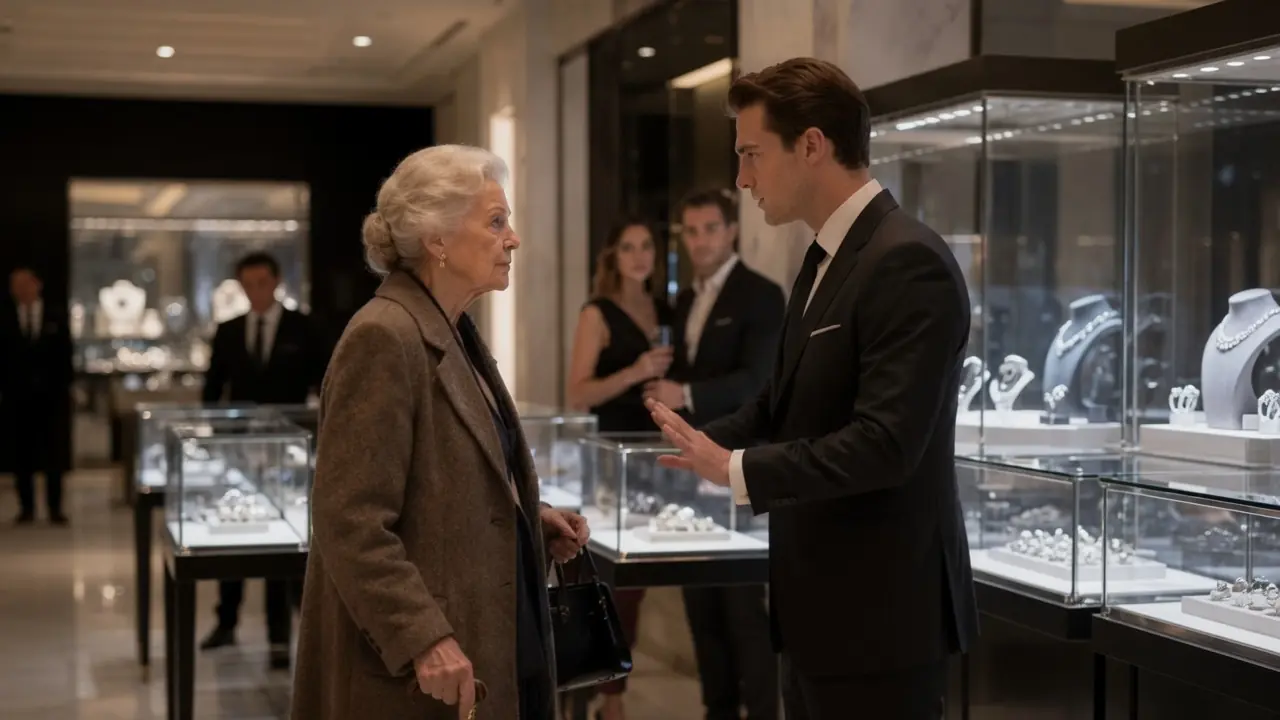
Adrian stood behind a glass display filled with engagement rings valued between forty thousand and three hundred thousand dollars. He was thirty-two, handsome in the polished way luxury retail demanded, with a tailored black suit and silver cuff links bearing the boutique’s star emblem. He greeted wealthy customers by name, remembered which champagne they preferred, and could identify a designer handbag from across the room. He also believed he could determine a customer’s value before that person reached the counter.
The elderly woman entered alone.
Nobody opened the door for her, though two sales associates stood close enough to do so. A younger employee named Sophie glanced toward the woman and started to move, but Adrian gave her a subtle shake of the head. Sophie stopped because she had learned that questioning him could cost her commission.
The woman paused beneath the chandelier and looked slowly around the showroom.
Her name was Eleanor Whitmore, though nobody inside knew it yet. At seventy-two, she had spent more than forty years building Whitmore Properties from one neglected apartment building into a portfolio of commercial towers, hotels, and retail spaces across New York. Maison Étoile occupied the ground floor of her most prestigious Fifth Avenue property.
Eleanor had never visited the boutique as its landlord.
Her property managers handled inspections, lease payments, and maintenance disputes. The boutique had always appeared successful on paper, paying rent on time and reporting strong sales. Yet during the previous eighteen months, Eleanor’s office had received eleven complaints from customers who claimed they were followed, humiliated, denied service, or threatened with removal because employees believed they looked poor.
The boutique’s manager, Claire Bennett, dismissed every complaint.
She described the incidents as misunderstandings involving security policies and difficult customers. Her reports emphasized that Maison Étoile handled millions of dollars in jewelry and could not allow unrestricted access to merchandise. Eleanor might have accepted one explanation, but eleven explanations using almost identical language felt less like truth than preparation.
She decided to investigate personally.
That morning, Eleanor left her driver two blocks away and wore the coat she once used while collecting rent from broken buildings during the early years of her company. The shoes had belonged to her sister, Margaret, who died the previous spring. Eleanor carried the old handbag because it held a small velvet box connected to the reason she had entered the boutique.
Her granddaughter, Lily, was getting married in four months.
Eleanor wanted to have Margaret’s engagement diamond reset into a necklace that Lily could wear during the ceremony. The stone was not especially large, but it represented sixty years of marriage, hardship, and forgiveness. Eleanor wanted someone skilled enough to handle it without treating its emotional value as less important than its market price.
Adrian watched her move toward the center display.
He did not offer champagne.
He did not introduce himself.
He allowed her to walk between the cases while standing close enough to make clear that she was being observed. When Eleanor stopped beside a tray of vintage diamond pendants, she noticed his reflection following her in the glass.
“May I see that one?” she asked.
She pointed toward a delicate platinum setting with a pear-shaped center stone.
Adrian stepped quickly between her and the display.
“You may look,” he said coldly, “but do not touch anything in this boutique.”
Eleanor slowly turned toward him.
Two customers near the private consultation room heard the remark. One woman glanced at Eleanor’s shoes before returning to her champagne. Her husband continued studying a watch as though nothing unusual had happened.
“Why am I forbidden,” Eleanor asked, “when every other customer can handle the jewelry?”
Adrian gave her a practiced smile that contained no warmth.
“Because you clearly cannot afford it. It’s just store policy.”
Eleanor rested both hands on her cane.
“Is there a written policy stating that customers must display wealth before receiving service?”
Adrian’s smile tightened.
“Our employees are trained to exercise judgment.”
“And your judgment is based on my coat?”
“It is based on experience.”
Eleanor looked toward a young couple seated at another case. The man wore jeans and a sweatshirt but had arrived in a luxury sports car. A sales associate had immediately placed three rings before them. Nobody asked for proof that they could pay.
“You allowed that gentleman to touch several pieces,” Eleanor said.
“He has an appointment.”
“Did you ask whether I had one?”
Adrian’s eyes hardened.
“Madam, I’m trying to avoid embarrassing you.”
“You began by telling me not to touch anything.”
“That was for your protection as much as ours.”
Eleanor almost laughed.
She had heard prejudice dressed in many respectable costumes during her career. Sometimes it wore the language of neighborhood preservation. Sometimes it called itself financial caution, tenant selection, or professional standards. Adrian had chosen protection and policy because those words sounded cleaner than contempt.
Sophie approached carefully.
“Mr. Cole, perhaps I could show her something from the estate collection.”
Adrian turned toward her.
“You have clients waiting.”
“They’re completing paperwork.”
“I said I’ll handle this.”
Sophie looked at Eleanor apologetically before returning to her station. That brief attempt mattered. It showed Eleanor that not everyone in the boutique agreed, though agreement without action offered little protection to the person being humiliated.
Eleanor opened her handbag.
Adrian immediately stepped closer.
“What are you doing?”
“Taking out an item.”
“You cannot sell personal jewelry here.”
“I didn’t ask to sell it.”
She removed the small velvet box.
Adrian watched her hands as if expecting stolen merchandise to appear. Eleanor opened the lid and revealed Margaret’s diamond ring. The setting was old-fashioned, the platinum scratched, and the stone slightly loose from decades of wear.
For the first time, Adrian showed genuine interest.
He leaned closer but did not invite her to place the ring on the counter.
“That setting is damaged,” he said.
“I know.”
“The stone is not especially valuable.”
“I did not ask for an appraisal.”
“Our restoration services begin at five thousand dollars.”
“I can pay for skilled work.”
Adrian sighed.
“People often misunderstand sentimental value and market value. This is not a repair kiosk.”
Eleanor closed the box.
“My sister wore this ring for sixty years.”
“That does not increase its worth.”
“Not to you.”
“No,” Adrian replied. “Not to the market.”
A man behind the watch display laughed softly. Eleanor heard him whisper something to his wife about elderly women wasting salespeople’s time. Adrian heard it too and smiled as if they shared an intelligent joke.
Eleanor felt anger move beneath her calm.
She had not expected special treatment. She had not entered hoping employees would recognize her name or fear her authority. She wanted to know whether the complaints were true, and within ten minutes Adrian had provided more evidence than the written reports ever could.
He had not merely refused service.
He had attempted to reduce memory, grief, and love into a price he could dismiss.
Eleanor placed the velvet box back inside her handbag.
“I would like to speak with your manager.”
Adrian straightened.
“She is busy.”
“Then I will wait.”
“We do not encourage people to remain in the showroom without an appointment.”
“I am requesting assistance.”
“You have received an explanation.”
“I received an insult disguised as policy.”
The nearby customers stopped pretending not to listen.
Adrian’s face reddened. He had built his authority on the assumption that people he dismissed would become embarrassed and leave quietly. Eleanor’s refusal threatened him more than anger because she remained calm enough for everyone to hear exactly what he was doing.
He pressed a button beneath the counter.
A moment later, Claire Bennett emerged from the private office. She was forty-five, elegantly dressed in a navy suit, with blonde hair arranged perfectly around her face. Her expression carried concern until she saw Eleanor.
Then her concern shifted toward Adrian.
“What is happening?”
“This woman refuses to leave,” Adrian said.
Eleanor looked at him.
“I never said I would not leave. I asked to speak with the manager.”
Claire turned toward her.
“I am Claire Bennett. What seems to be the issue?”
“Your salesman told me I may look but cannot touch anything because I clearly cannot afford your jewelry.”
Claire glanced at Adrian.
“Did you say that?”
“I explained our handling policy.”
“You mentioned my ability to pay,” Eleanor corrected.
Adrian lowered his voice.
“She entered without an appointment, has been moving between displays, and produced an unverified ring.”
“It belongs to my late sister.”
Claire looked at the handbag but made no request to see the ring.
“Maison Étoile maintains strict security standards,” she said. “Our merchandise is extremely valuable.”
“Does your policy prohibit elderly women in worn shoes from receiving service?”
Claire’s expression sharpened.
“Do not twist my words.”
“I repeated what your employee told me.”
“I’m sure he intended to protect the merchandise.”
“From what?”
Claire looked around the showroom. Customers were watching openly now, and one had begun recording with a phone. Instead of recognizing the danger of the situation, Claire saw only a loss of control.
She stepped closer to Eleanor.
“You need to leave.”
“I came here to request restoration work.”
“We are declining the commission.”
“Based on the ring?”
“Based on your behavior.”
Eleanor’s hand tightened around her cane.
“What behavior?”
“You have disrupted the showroom, challenged an employee, and upset our clients.”
“I asked to see a necklace.”
Claire pointed toward the entrance.
“Leave now, or I will call security to throw you out.”
The final words crossed a boundary even Adrian had avoided.
Sophie looked horrified.
The young couple near the engagement rings stood and moved away from their sales associate. One customer lowered his phone, perhaps deciding the entertainment had become too uncomfortable. Eleanor remained still.
Then she removed her own phone.
Claire folded her arms.
“Calling someone will not change our decision.”
Eleanor typed one short message to Marcus Hale, the senior property director responsible for the building.
Begin the Whitmore review. Send the ownership notice now.
She pressed send.
For three seconds, nothing happened.
Then Adrian’s phone vibrated.
Claire’s phone followed.
Every employee device inside the boutique sounded almost simultaneously. The front desk tablet displayed a new corporate notice, and the screen near the private office changed from the store logo to a message from Whitmore Properties.
Claire frowned and opened the email.
Her face lost color.
The notice stated that building owner Eleanor Whitmore was conducting an immediate investigation into discriminatory customer practices at Maison Étoile. It instructed employees to preserve security footage, transaction records, internal complaints, and communications. Any attempt to delete or alter information would be treated as interference with a formal lease-compliance review.
A photograph appeared beneath the notice.
It showed Eleanor standing beside the building during its reopening twenty years earlier.
Claire looked from the screen to the elderly woman.
“Why does this notice say you own the entire building?”
Eleanor slipped the phone into her handbag.
“Because I came here to learn how you treat people you believe have no power.”
Adrian stepped backward.
Claire’s voice became softer immediately.
“Mrs. Whitmore, I had no idea.”
“That is the problem.”
“This has been an unfortunate misunderstanding.”
“No. A misunderstanding occurs when two people interpret the same respectful action differently. You threatened to have me thrown out.”
Claire lowered her hand.
“I was trying to de-escalate the situation.”
“You escalated it.”
“Please allow us to move into my office.”
“Why?”
“For privacy.”
Eleanor looked around the showroom.
“You chose to humiliate me publicly.”
Claire’s eyes moved toward the customers.
“We can resolve this without damaging the boutique.”
“You are worried about damage now because you discovered I can cause it.”
Adrian approached with a desperate smile.
“Mrs. Whitmore, I apologize if my words seemed harsh.”
“They did not seem harsh. They were harsh.”
“I believed I was following policy.”
“What policy?”
He looked toward Claire.
She gave him no answer.
Eleanor removed a slim folder from her handbag. It contained copies of the eleven complaints Claire had dismissed. She placed them one by one on the nearest display case.
An elderly teacher had been told the store did not offer payment plans before she asked about price.
A home-care worker wearing scrubs had been followed until she left.
A Black couple had been asked to prove they held an appointment while white tourists entered the same private room without verification.
A delivery driver buying an anniversary pendant had been laughed at after asking to see less expensive designs.
Claire recognized every document.
Her confidence disappeared.
“You investigated these complaints yourself?” Eleanor asked.
“We found no policy violations.”
“Who conducted the investigations?”
“Our management team.”
“You.”
“I reviewed them.”
“Did you interview the customers?”
Claire hesitated.
“Where possible.”
“Did you preserve the footage?”
“Our system automatically deletes older recordings.”
“Only after sixty days. Several complaints were closed within forty-eight hours.”
Claire looked toward Adrian.
He remained silent.
Sophie stepped forward.
“I reported two incidents.”
Everyone turned toward her.
Claire’s expression became dangerous.
“Sophie, this is not the time.”
“It was never the time,” Sophie said, though her voice trembled. “You told me customers who looked uncertain were wasting our energy. You said we should protect the luxury atmosphere.”
“I said no such thing.”
“You said it during training.”
Another employee lowered her eyes.
Then she nodded.
“So did I,” she said quietly. “I heard it too.”
Claire’s control began collapsing from the inside.
Eleanor looked toward Sophie.
“What happened after you reported the incidents?”
“My weekend shifts were reduced.”
Claire interrupted.
“That was a scheduling decision.”
“It happened the next morning.”
Eleanor turned toward Marcus Hale as he entered through the boutique doors with the company’s attorney and two compliance investigators. He had arrived from the building office upstairs after receiving her message.
The atmosphere changed immediately.
Marcus was sixty, calm, and careful with every word. He greeted Eleanor as Mrs. Whitmore rather than boss because she had never liked authority being performed for effect. Then he presented Claire with a formal preservation notice and temporary suspension from managerial duties.
Claire stared at the paper.
“You cannot suspend me. I work for Maison Étoile, not Whitmore Properties.”
“The lease gives the building owner intervention rights when tenant conduct exposes the property to discrimination liability,” the attorney explained. “Your company’s executive office has already been contacted.”
Claire looked toward the showroom entrance as though expecting rescue.
Instead, two senior representatives from Maison Étoile’s parent company called through the office screen. They instructed her to cooperate fully and leave the premises after surrendering her keys.
She turned toward Eleanor.
“Please, Mrs. Whitmore. I was only enforcing policy.”
Eleanor handed her the suspension notice.
“No, Claire. You used policy to hide cruelty, and now you will answer for everything you allowed.”
Claire’s mouth tightened.
“This is because I failed to recognize you.”
“No.”
Eleanor’s voice remained quiet.
“This is because you believed there should be a version of me you were permitted to degrade.”
Claire had no answer.
Adrian was removed from customer contact pending review. He asked whether he was being fired, but Eleanor refused to decide before the investigation. She had spent too many years criticizing people who judged without evidence to make the same mistake once she held the power.
The boutique closed for the rest of the day.
Customers were asked to provide contact information if they had witnessed the confrontation. Several agreed. The young couple canceled their ring purchase and stated that they would reconsider only after the company changed its practices.
The internal investigation lasted five weeks.
It uncovered far more than eleven complaints.
Employees had maintained private notes describing customers as “serious,” “possible,” or “tourist-level” based on clothing, accent, age, race, disability, and visible wealth. Salespeople were encouraged to avoid presenting valuable pieces to anyone unlikely to produce an immediate commission.
Adrian had written some of the most insulting notes.
One elderly man was described as “probably lonely, not buying.”
A Latina mother and daughter were labeled “window shoppers—watch hands.”
A young Black attorney was marked “unknown client, verify card before service,” though nobody else purchasing that day faced advance verification.
Claire approved the system.
She also altered complaint summaries before sending them to the parent company. In several cases, she described employees as victims of aggressive behavior even when security footage showed customers speaking calmly.
Her employment was terminated.
Maison Étoile’s parent company dismissed Adrian after offering him an opportunity to respond. He admitted making assumptions based on appearance but argued that luxury sales required employees to protect their time.
The company concluded that his judgment violated both service standards and anti-discrimination requirements.
Sophie was offered the interim manager position.
She initially refused.
“I didn’t do enough,” she told Eleanor. “I watched things happen because I needed the job.”
“You tried twice,” Eleanor replied.
“Then I became quiet.”
“Leadership is not awarded because someone has always been brave. Sometimes it begins when a person stops cooperating with fear.”
Sophie accepted on the condition that an outside consultant help rebuild the store’s training and reporting systems. Eleanor approved the request.
The boutique reopened with new rules.
Every customer received the same initial welcome.
Appointments could provide convenience but never determine dignity.
Merchandise-handling restrictions had to be based on the security requirements of a specific item, not assumptions about whether a person looked wealthy enough to purchase it.
Complaint reviews were transferred outside the store.
Employees could report discriminatory instructions without managerial approval, and no single supervisor could close a complaint involving that supervisor’s own decisions.
Maison Étoile also paid restitution to several customers whose experiences had been documented. Some accepted private apologies. Others requested nothing except confirmation that the people responsible would no longer treat others the same way.
Eleanor did not force reconciliation.
Forgiveness belonged to the people harmed, not to the company seeking closure.
Three months after the confrontation, Eleanor returned to the boutique.
She wore the same brown shoes, plain coat, and old handbag. Sophie met her near the entrance but did not greet her more dramatically than any other customer. That was exactly what Eleanor wanted.
“I have something I would like restored,” she said.
Sophie invited her to sit and opened the velvet box carefully. She examined Margaret’s diamond beneath a lens, checked the damaged setting, and asked what Eleanor hoped the finished piece would preserve.
“The stone belonged to my sister,” Eleanor said. “My granddaughter will wear it at her wedding.”
Sophie did not begin by discussing price.
She asked about Margaret.
Eleanor told her about two sisters who grew up sharing one bedroom, one winter coat, and the belief that no landlord should ever have enough power to make a family feel less human. Margaret had helped Eleanor purchase her first building and managed its tenants while Eleanor worked a second job.
“She owned part of everything I built,” Eleanor said.
“Legally?”
“No. In every way that matters.”
Sophie designed a simple platinum necklace using the original diamond. The old ring setting was preserved rather than melted, allowing Lily to keep both the history and the new piece.
The work cost more than five thousand dollars.
Eleanor paid the full price.
On Lily’s wedding morning, Eleanor fastened the necklace around her granddaughter’s neck. The diamond rested above the young woman’s heart, carrying no visible evidence of how many lives had touched it.
Lily looked into the mirror.
“Was this Aunt Margaret’s?”
“Yes.”
“She would have loved this.”
“She would have loved you.”
Eleanor thought of Adrian dismissing the diamond because its market value was modest. He had understood carats, clarity, and sales potential but not inheritance, memory, or sacrifice.
The stone had never needed to be the most expensive object inside Maison Étoile.
It needed someone willing to understand why it mattered.
A year later, the boutique reported lower short-term sales but stronger customer retention and fewer complaints. Employees no longer ignored people who needed time to browse or ask questions. Some executives worried that equal attention reduced efficiency.
Eleanor called it the cost of doing business honestly.
One afternoon, an elderly man entered wearing paint-stained trousers and carrying a construction helmet. He wanted to buy his wife a necklace for their fiftieth anniversary. His budget was six hundred dollars.
A new employee welcomed him, offered water, and showed him pieces within that range without embarrassment.
He purchased a small silver pendant.
It was one of the least expensive sales of the day.
Sophie later said it was the most important.
The man had worked on the building’s original marble floor decades earlier. He remembered Eleanor visiting the construction site in work boots, carrying coffee for laborers, and promising the property would never become a place where people were measured only by money.
For years, the boutique had broken that promise beneath her own roof.
Eleanor’s message did not make her worthy of respect.
It only revealed that disrespecting her carried consequences.
That distinction remained central to every change she demanded. Employees were not trained to search for secretly powerful customers beneath ordinary clothing. They were taught that no secret power should be necessary.
Eleanor continued wearing her worn shoes until the leather finally split beyond repair. She placed them in a box with Margaret’s old ring setting and the first key to the building.
Three ordinary objects.
Each carried more value than someone judging by appearance would ever recognize.
Maison Étoile still sold diamonds beneath bright lights and guarded them behind polished glass. Customers still made appointments, celebrated engagements, and spent amounts Eleanor once could not have imagined.
Yet the most important rule inside the boutique was no longer hidden behind the phrase “store policy.”
It appeared inside every employee handbook and training room.
Respect comes before proof of wealth.
Because the day Eleanor entered with a cane and an old handbag, Adrian believed she should be allowed only to look.
He never imagined she owned the floor beneath his shoes.
But ownership was never the reason he should have treated her with dignity.