Evelyn Brooks walked into the Ferrari showroom in Miami at 10:17 on a Thursday morning, wearing a simple cream-colored suit, pearl earrings, and flat shoes polished by hand before sunrise. She did not arrive in a limousine, did not carry a designer handbag, and did not ask anyone to announce her name. She simply stepped through the glass doors with quiet posture, silver hair pinned neatly at the back of her head, and eyes that had learned to notice everything without appearing to look too hard. The showroom smelled of leather, polished floors, expensive coffee, and confidence.
The red Ferrari near the front windows caught the morning light like a jewel. Evelyn paused beside it and rested one calm hand lightly on the hood, not because she wanted to touch something forbidden, but because she had once signed the final approval for that model to be displayed in this very dealership. She remembered the meeting, the numbers, the floor plan, and the promise that every customer would be treated with dignity. That promise was the reason she had come without warning.
For three months, complaints had been reaching her office in quiet ways. A retired teacher had been ignored after asking about a pre-owned Aston Martin at another location. A young Latino business owner had been told financing would be “difficult” before anyone checked his credit. A Black doctor and his wife had left this Ferrari showroom after a junior sales associate suggested they might be more comfortable at a “regular dealership.” Evelyn had read every complaint twice.
Brooks Luxury Automotive Group owned eleven dealerships across Florida and Georgia. Evelyn was the majority owner, though she rarely appeared in public business announcements anymore. After her husband died, most people assumed her son Darius ran everything. Darius was president, yes, but Evelyn still controlled the board, the property, the voting shares, and the values the company was supposed to stand on.
She had built the company with her late husband, Walter Brooks, beginning with one used-car lot in Jacksonville in 1978. Back then, bankers smiled politely and denied loans for reasons they never said out loud. Customers who trusted Walter often looked past Evelyn as if the numbers balanced themselves. She had learned early that power did not always need to announce itself, because announced power often made dishonest people behave only until the powerful person left the room.
That was why she liked unannounced visits. No assistants, no corporate escort, no reserved parking, no manager waiting with flowers. She wanted to see the dealership as ordinary customers saw it. She wanted to learn whether the marble floors and imported cars had made her employees forget that respect was not a luxury option.
Across the showroom, Tiffany Reed noticed Evelyn and frowned. Tiffany was twenty-eight, blonde, sharply dressed in a fitted red dress, and proud of the fact that she had sold two Ferraris in her first six months. She liked customers who looked ready for photographs, people with expensive watches and loud voices who made her feel close to the life she wanted. An elderly Black woman in a plain cream suit did not fit the image Tiffany had built in her mind of a serious Ferrari buyer.
At first, Tiffany did not approach. She watched from beside the coffee counter while another customer in a blue blazer examined a black Roma. Two managers stood behind the glass office wall, speaking with a finance director and occasionally glancing toward the floor. Everyone saw Evelyn. Nobody moved.
Evelyn noticed that too.
She stepped slowly around the red Ferrari, admiring the curve of the hood, the stitching visible through the window, and the clean reflection in the showroom glass. She was not in a hurry. A truly well-run dealership did not require a customer to chase attention. Someone should have greeted her by now, offered help, or at least acknowledged her presence with warmth.
Instead, Tiffany walked over with a smile that reached only the surface of her face. “Ma’am,” she said, placing one hand near the car as if guarding it, “are you looking for someone?”
Evelyn turned toward her. “Good morning.”
Tiffany waited for an explanation, not returning the greeting properly. Her eyes moved from Evelyn’s shoes to her suit, then to the hand resting near the Ferrari hood. “We ask guests not to touch the vehicles unless they’re working with a sales associate.”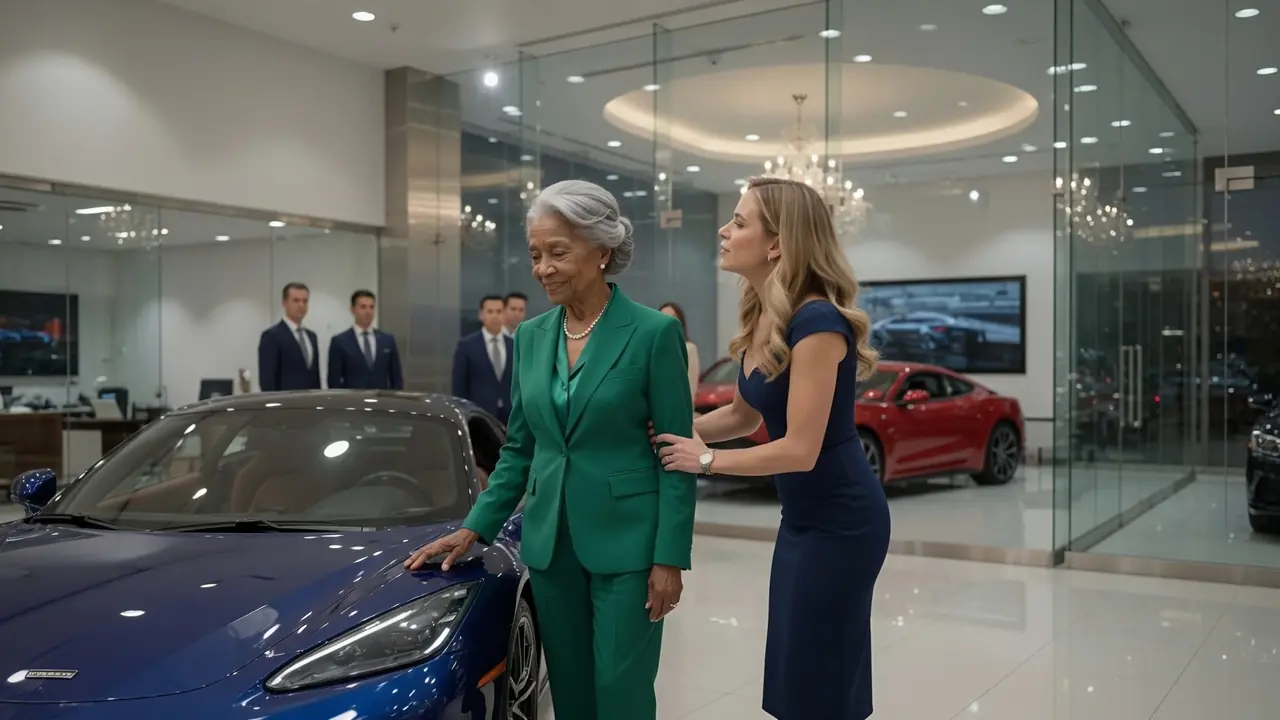
Evelyn lifted her hand from the car. “Of course.”
Tiffany’s smile sharpened. “These cars are very expensive. Even small fingerprints require detailing.”
Evelyn looked at the polished hood, then back at Tiffany. “A fingerprint can be cleaned.”
Tiffany gave a short laugh. “That isn’t really the point.”
Evelyn studied the young woman’s face. She saw impatience, judgment, and something worse: confidence that nobody important would object. Tiffany was not flustered. She was comfortable. That told Evelyn this was not the first time she had spoken this way to someone she considered out of place.
“I came to look at the Portofino,” Evelyn said.
“Yes.”
“Do you have an appointment?”
“No.”
Tiffany glanced toward the managers’ office, then back at Evelyn. “Most of our serious clients schedule private viewings.”
“Do they?”
“Yes,” Tiffany said. “It helps us avoid wasting time.”
The words landed softly, but the insult beneath them was not hidden. Evelyn felt it, but she did not react. She had heard sharper things from men in bank offices who smiled while calling her “girl” when she was already managing payroll for thirty employees. Tiffany Reed did not have enough years behind her cruelty to surprise Evelyn Brooks.
“I see,” Evelyn said.
Tiffany stepped closer and lowered her voice, though not enough to hide the tone from nearby customers. “Ma’am, this is a Ferrari showroom. If you’re waiting for a ride or looking for the restroom, I can point you in the right direction.”
A man near the coffee counter looked over, then quickly looked away. One of the managers behind the glass office paused, watched for a second, and returned to his conversation. Evelyn’s hand tightened once around her small handbag, then relaxed. She had come for truth, and truth had arrived quickly.
“I’m not waiting for a ride,” Evelyn said. “I’m interested in the car.”
Tiffany smiled like she was speaking to a child. “The red one starts at more than most homes cost.”
Evelyn nodded. “I know what it costs.”
“Then you understand why we have to be careful.”
“With the car,” Evelyn said quietly, “or with who stands beside it?”
Tiffany’s face changed. Not with shame, but irritation. She was not used to being answered with dignity. People she dismissed usually walked away embarrassed, which allowed her to mistake cruelty for authority. Evelyn did not move, and that made Tiffany feel challenged.
“Ma’am,” Tiffany said, firmer now, “I need you to step away from the vehicle.”
“I already removed my hand.”
“I mean step away completely.”
Evelyn looked past Tiffany toward the office. The general manager, Victor Hall, saw her looking and lowered his eyes to a folder on the table. That was the second truth of the morning. A rude employee was one problem. A manager who watched and did nothing was a culture.
Tiffany reached out and touched Evelyn’s arm. It was not a hard grab at first, but it was possessive, dismissive, and careless. Evelyn looked down at Tiffany’s fingers resting on the sleeve of her cream suit. The entire showroom seemed to narrow around that hand.
“Young lady,” Evelyn said, her voice calm, “remove your hand.”
Tiffany’s lips tightened. “I’m trying to help you avoid embarrassment.”
“No,” Evelyn said. “You are creating it.”
The words were quiet, but several people heard them. A couple near the black Roma turned fully now. The receptionist at the front desk stopped typing. Victor Hall looked up again, his face tense, but still he did not come out.
Tiffany’s cheeks flushed. “You need to leave.”
Evelyn lifted her eyes. “Do I?”
“Yes,” Tiffany said. “You can’t just walk in here, touch cars, and act like you belong.”
There it was. The sentence beneath every smaller sentence before it. Act like you belong. Evelyn felt a deep sadness move through her, not because Tiffany had wounded her, but because so many people had likely heard some version of those words in a place Evelyn owned.
“I belong wherever I choose to stand,” Evelyn said.
Tiffany laughed under her breath. “Not here.”
Evelyn slowly reached for her phone.
Tiffany mistook the movement for weakness. “Are you calling someone?”
“Yes.”
“Good,” Tiffany said. “Maybe someone can come pick you up.”
The customer near the coffee counter muttered, “Come on,” under his breath, but still did nothing. Evelyn noticed him too. Silence often wore respectable shoes.
She opened her phone, selected one saved contact, and typed a message with one thumb.
Showroom floor. Miami Ferrari. Come now.
Then she pressed send.
Tiffany crossed her arms. “If you don’t get out of here, I’ll call security to throw you out.”
Evelyn looked at her with eyes that had survived too many rooms like this to tremble now. “Call them,” she said. “Then ask who signs your paycheck.”
Tiffany stared at her for half a second, then laughed too loudly. “Oh, that’s cute.”
The showroom doors near the side office opened thirty seconds later.
First came Victor Hall, moving fast now, his face pale. Behind him came Martin Price, the regional operations director, who had been upstairs in a private meeting. Two department managers followed, then the finance director, all suddenly alert, all suddenly aware that the elderly woman in cream was not a lost visitor.
Tiffany turned, confused by the rush of polished shoes across the floor.
Martin Price reached Evelyn first and stopped with both hands slightly raised, as if afraid even his approach might be too late. “Mrs. Brooks,” he said, breathless. “I’m so sorry. I didn’t know you had arrived.”
The showroom went silent.
Tiffany’s face emptied.
Evelyn did not look away from her. “That was the point, Martin.”
Victor Hall swallowed hard. “Mrs. Brooks, please, we can take this into my office.”
“No,” Evelyn said. “We will stay exactly where this happened.”
Tiffany’s mouth opened, but no words came out. She looked from Evelyn to Martin, then to Victor, waiting for someone to explain a reality she suddenly understood too well. The woman she had grabbed, mocked, and threatened was not a customer with no power. She was the reason the dealership existed.
Martin turned toward Tiffany slowly. “Do you understand who this is?”
Tiffany’s voice came out thin. “I… I didn’t know.”
Evelyn finally turned fully toward her. “That is the problem.”
Tiffany blinked quickly. “Mrs. Brooks, I’m so sorry. I thought—”
“You thought I was poor,” Evelyn said.
Tiffany flinched.
“You thought I did not belong,” Evelyn continued. “You thought my presence lowered the room. You thought touching my arm was acceptable because you believed nobody important would punish you for it.”
Tiffany’s eyes filled. “I made a mistake.”
“No,” Evelyn said. “A mistake is entering the wrong number on a form. What you did was reveal your training, your assumptions, and your character.”
Victor stepped forward. “Mrs. Brooks, I take full responsibility for the floor staff.”
Evelyn turned to him then, and Victor seemed to shrink beneath her calm gaze. “You watched.”
His face reddened. “I didn’t realize it had escalated.”
“You saw enough to stand up,” Evelyn said. “But you waited until my name forced you to move.”
The words struck harder than shouting would have. Victor lowered his eyes. The finance director stared at the floor. Martin’s jaw tightened because he understood that this was no longer about one employee being rude. This was about leadership failing before witnesses.
Evelyn looked around the showroom. “How many customers have walked out of here with this feeling and no name powerful enough to bring you running?”
Nobody answered.
That silence answered for them.
Tiffany wiped at her eyes. “Please, Mrs. Brooks. I need this job.”
“So did every person you dismissed before they could become a client,” Evelyn said. “Need does not excuse humiliation.”
A security guard appeared near the front entrance, summoned by Tiffany before she understood who she had threatened. He stopped when he saw the managers gathered around Evelyn. His hand fell away from his radio. The moment would have been almost funny if it had not been so ugly.
Evelyn looked at him. “Were you called to remove me?”
The guard looked at Victor, then back at Evelyn. “Ma’am, I was told there was a disturbance.”
“There was,” Evelyn said. “But I did not create it.”
“No, ma’am,” he said quickly.
Evelyn turned back to Martin. “Bring Tiffany’s employment file, the complaint records from this location, and the last six months of customer walkout reports to the conference room.”
Martin nodded immediately. “Yes, Mrs. Brooks.”
Tiffany’s face crumpled. “Am I fired?”
Evelyn looked at her for a long moment. The easy answer was yes. Everyone expected it. Tiffany expected it too, which was why fear had finally found her voice. But Evelyn had not built her company by making decisions only for emotional satisfaction.
“You are suspended pending review,” Evelyn said. “And if the record shows what I believe it will show, your employment here ends today.”
Tiffany pressed one hand to her mouth.
Evelyn stepped closer, lowering her voice enough that only Tiffany and those nearest could hear. “But whether you work here or not, I want you to remember this. You did not lose your future because an old woman walked into Ferrari. You lost it because you could not see a human being until someone told you she was powerful.”
Tiffany began to cry then, not elegantly, not strategically, but with the shock of someone discovering consequences after years of believing consequences were for other people.
Evelyn did not comfort her.
She turned toward the red Ferrari again and rested her hand lightly on the hood, exactly where it had been before. Nobody told her to move it now. That made the whole room feel worse. The car had not changed. Only the perceived power of the hand touching it had changed.
“Martin,” Evelyn said.
“Yes, Mrs. Brooks.”
“I want every employee in this building in training by Monday morning. Not a video. Not a form they click through. Real training. Real accountability. Real consequences.”
“Yes, ma’am.”
“And I want mystery visits across every dealership we own.”
Martin nodded. “I’ll arrange it.”
“No,” Evelyn said. “I will arrange it. You will cooperate.”
He swallowed. “Of course.”
Victor stood motionless, his face still pale. Evelyn looked at him again. “You and I will speak separately.”
“Yes, Mrs. Brooks,” he said.
The customers in the showroom had gone quiet in the way people become quiet when they realize they have witnessed something they will repeat later with their own version of shame or admiration. A man near the black Roma finally stepped forward. He was older, perhaps in his sixties, with a silver watch and a nervous expression.
“Mrs. Brooks,” he said, “for what it’s worth, I should have said something.”
Evelyn looked at him, not unkindly. “Yes. You should have.”
He nodded, accepting the correction. “I’m sorry.”
“Use that feeling better next time,” she said.
He lowered his head.
That was Evelyn’s way. She did not waste truth by softening it until it became harmless. She also did not confuse people’s discomfort with her responsibility. For too many years, people like Tiffany had depended on polite silence to protect impolite behavior. Evelyn had not come to protect anyone’s comfort.
An hour later, the conference room table was covered in documents. Tiffany’s employment file showed two prior warnings for tone with customers, both written vaguely and closed without follow-up. Customer walkout reports showed patterns Victor had failed to address. Complaint emails contained phrases that now sounded painfully familiar: “made to feel unwelcome,” “ignored,” “treated like I couldn’t afford it,” “asked if I was lost.”
Evelyn read each one slowly.
Victor sat across from her, sweating beneath his suit jacket. Martin stood near the wall, taking notes. Tiffany was no longer in the room. She had been escorted to collect her things after Martin confirmed the prior complaints and the severity of the incident. Her final tears had echoed down the hallway, but Evelyn had kept reading.
“This did not begin today,” Evelyn said.
Victor nodded weakly. “No, ma’am.”
“You had warnings.”
“Yes.”
“You protected sales numbers instead of customers.”
Victor’s eyes lifted. “Tiffany was one of our top junior performers.”
“And how many people did she drive away to get those numbers?”
He had no answer.
Evelyn closed the folder. “Profit earned by disrespect is not profit. It is debt. Eventually someone pays it.”
Victor looked down.
“You are removed from customer-facing operations effective immediately,” Evelyn said. “Martin will review whether there is another place in the company for you. But you will not manage this floor again.”
Victor’s shoulders sank. “I understand.”
“I hope you do more than understand,” Evelyn said. “I hope you remember.”
By late afternoon, word had already begun moving through the company. Employees at other dealerships heard that Mrs. Brooks had walked into Miami Ferrari unannounced and exposed a culture problem from the showroom floor. Some were nervous. Some were defensive. Some were relieved, because they had complained quietly for years and felt ignored.
Evelyn did not leave immediately.
She stood once more beside the red Ferrari before going home. The showroom felt different now, though she knew one afternoon could not fix everything. Culture was not repaired with one firing or one apology. It was repaired by repetition, by standards enforced when nobody famous was watching, by managers who moved before power demanded it.
Martin approached her carefully. “Mrs. Brooks, your car is ready outside.”
Evelyn smiled faintly. “The Bentley?”
“Yes, ma’am.”
“Leave it there for a moment.”
She looked through the glass wall at the employees gathered near the service hallway, speaking in lowered voices. Some looked ashamed. Some looked scared. Evelyn hoped a few looked changed.
“My husband used to say a dealership has two showrooms,” she said.
Martin listened.
“One is where the cars shine. The other is how people are treated when they walk in.” She touched the Ferrari hood once more. “Today, this showroom failed.”
Martin’s voice was quiet. “We’ll fix it.”
Evelyn turned to him. “No. We will prove it. Fixing is a word. Proof is behavior.”
He nodded. “Yes, Mrs. Brooks.”
As Evelyn walked toward the exit, the receptionist stood quickly. “Mrs. Brooks?”
Evelyn paused.
The young woman looked nervous but determined. “I’m sorry I didn’t greet you when you came in. I saw you. I should have said something.”
Evelyn studied her. “What is your name?”
“Alana.”
“Alana,” Evelyn said, “next time, greet the person before you decide whether they matter.”
The receptionist nodded, eyes wet. “Yes, ma’am.”
Evelyn stepped into the warm Miami afternoon. Her Bentley waited near the entrance, black paint gleaming in the sun, but for a moment she did not get inside. She looked back through the showroom glass at the red Ferrari, the managers, the employees, and the polished floor where Tiffany had grabbed her arm.
She thought of Walter then.
He had once stood beside her on a used-car lot after a banker denied them financing and told her, “One day, we’ll own rooms they think we don’t belong in.” She had laughed at the time because the dream sounded too large for the little office they rented beside a tire shop. But Walter had been right. They had owned the room.
The harder lesson was making sure they did not become the people who once kept them out.
That evening, Evelyn returned home to a quiet house overlooking Biscayne Bay. She removed her pearl earrings, hung her cream jacket carefully, and sat at her desk. Darius called before dinner, already briefed by Martin and worried by the tone of the report.
“Mom,” he said, “are you okay?”
“I am.”
“Why didn’t you tell me you were going?”
“Because then everyone would have behaved.”
He sighed. “What happened today was unacceptable.”
“Yes,” Evelyn said. “And it was useful.”
“Useful?”
“It showed us where the rot was visible.”
Darius was quiet for a moment. “I’ll support whatever changes you want.”
“I know you will,” she said. “But support is not enough. I want leadership measured by who feels safe walking through our doors, not just by who signs purchase agreements.”
“You’ll have it.”
Evelyn looked at the faint mark on her sleeve where Tiffany’s hand had gripped her. It would brush out. The larger mark would take longer. But she was patient. She had built too much over too many years to let arrogance turn her company into the kind of place that would have rejected her younger self.
The following Monday, every Brooks Luxury Automotive location began mandatory in-person training. New policies required managers to document and respond to customer treatment complaints within forty-eight hours. Mystery visits began within two weeks. Promotions were tied not only to sales volume, but to verified customer dignity standards.
Some employees complained privately that the company had become too strict. Those employees did not last long. Others understood the message clearly: everyone who walked in mattered before anyone knew what they could afford. That became the line printed at the top of every training folder.
Six months later, Evelyn returned to the Miami Ferrari showroom again.
This time she arrived in the same cream suit.
The red Ferrari had been sold, replaced by a silver model near the front windows. A new sales associate named Marcus Hill greeted her before she had taken five steps inside. He did not know who she was. He simply smiled warmly and said, “Good afternoon. Welcome in. Let me know how I can make your visit comfortable.”
Evelyn looked at him for a moment.
Then she smiled.
That was proof.
Not perfect proof. Not permanent proof. But proof enough for one afternoon that the room had begun learning the lesson Tiffany never understood. Respect given after power is revealed is not respect. It is fear. Real respect is what a person offers before they know the name, the money, or the signature behind the door.
Evelyn walked to the silver Ferrari and stood beside it quietly.
Marcus did not rush her. He did not judge her. He did not guard the car from her presence. He simply stood nearby, available without being dismissive.
Evelyn rested one hand lightly on the hood.
No one told her she did not belong.