“Step away from the glass, old man. That necklace costs more than your whole life looks worth.”
Madison Cole said it loudly enough for the entire Beverly Hills boutique to hear. Her palm rose between Robert Hale and the glass display case as if she were stopping a thief, not an elderly man holding a little girl’s hand. The white marble floor reflected the lights above, and diamonds glittered inside polished cases like frozen stars. Beside Robert, nine-year-old Sophie lowered her head, her small fingers tightening around his.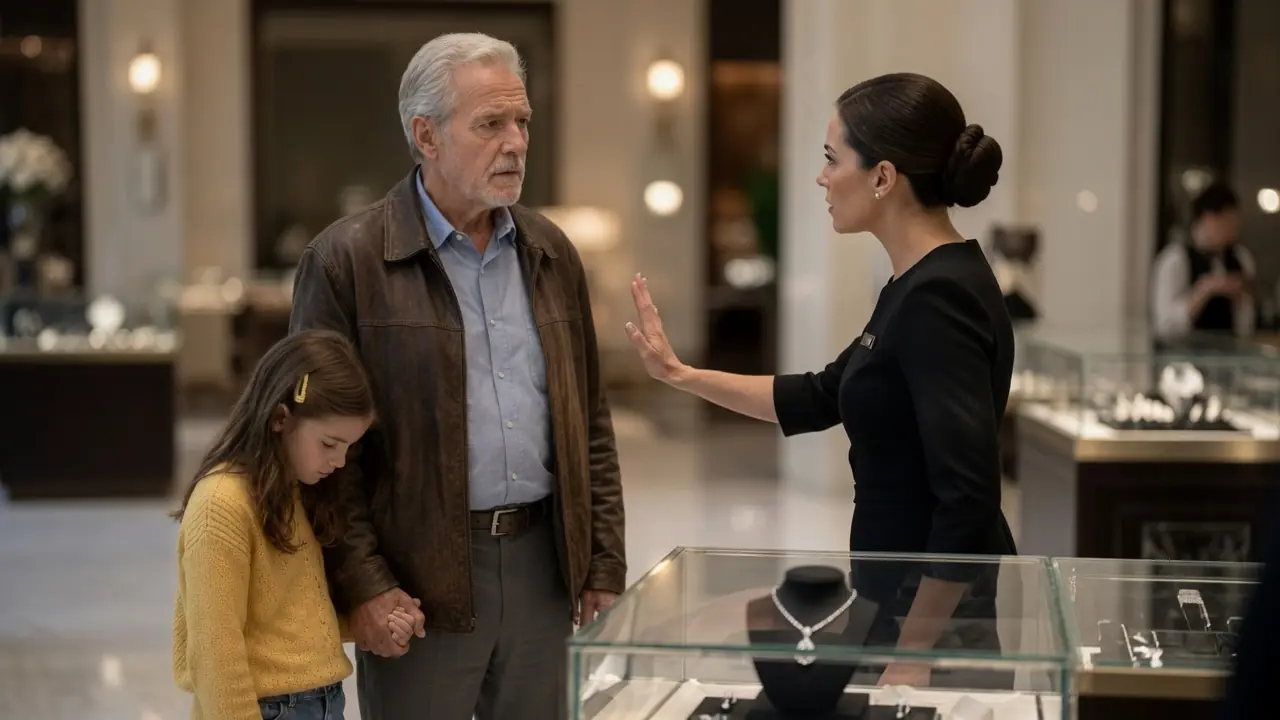
Robert did not move at first. He stood in his worn brown leather jacket, pale blue shirt, gray slacks, and old shoes that had crossed more sidewalks than red carpets. His hair was silver, his face lined, and his body carried the slow stiffness of a man who had outlived too many people he loved. To Madison, that was all he seemed to be: an old man in tired clothes who had wandered into the wrong room.
Sophie had only wanted to look at the necklace. It rested on black velvet inside the nearest case, a delicate silver chain with a teardrop diamond surrounded by smaller stones. It was not the largest piece in the boutique, not the loudest or most expensive, but it held the kind of quiet beauty that makes a child forget where she is standing. Sophie had stopped in front of it with wide eyes.
“Grandpa,” she whispered, “one day I’m going to buy that for Mom.”
Robert had smiled when she said it, though the words struck a tender place inside him. Sophie’s mother, Emily, had once looked at diamonds the same way. When Emily was a child, she would sit on the floor behind the counter of Robert’s first tiny jewelry shop, drawing necklaces on the backs of receipts. She believed every stone had a story, and every story belonged to someone.
Now Madison had turned Sophie’s wonder into shame.
A woman in a white designer jacket near the private lounge raised one hand to her mouth. She was not hiding shock. She was hiding a laugh. A man beside the engagement-ring counter gave Robert’s jacket a slow glance and smirked.
“Grandpa,” Sophie whispered. “Did we do something wrong?”
Robert looked down at her. His face softened immediately. “No, sweetheart. We were just looking.”
Madison’s smile was sharp and empty. Her name tag gleamed against her black dress, and her hair was pinned so perfectly it seemed no strand had ever escaped permission. She stood between them and the display case with the confidence of someone who believed luxury belonged to people who looked expensive before they spoke. “Looking is one thing,” she said. “Leaning near high-value pieces is another.”
“She didn’t touch the glass,” Robert replied.
“She came close enough.”
Robert held her gaze. “May we see the necklace?”
Madison blinked, as though the request itself insulted her. “Excuse me?”
“The teardrop necklace,” Robert said calmly. “My granddaughter likes it.”
A ripple of laughter moved through the showroom.
Madison folded her arms. “Sir, this is a private luxury showroom. We do not remove high-value pieces unless the client is serious.”
Robert nodded once. “How do you decide who is serious?”
“Experience,” she said.
Sophie’s head lowered further.
That word brought Robert backward nearly fifty years. Experience. People used it when they wanted prejudice to sound professional. They used it to protect cruelty from being named. Robert had heard men say it when banks denied him a loan in 1978, when landlords refused him a storefront, and when suppliers doubted he could sell fine jewelry from a narrow shop with a cracked ceiling.
He had built Hale & Co. anyway.
Not alone. Never alone. His wife Lillian had worked the counter during the day while he repaired jewelry at night. They had started with three rings, one glass case, and a rented room that leaked when it rained. Their first customers were nurses, teachers, mechanics, waitresses, widows, and young couples who counted bills twice before choosing a ring.
Lillian always said, “Luxury should make a moment special. It should never make a person feel small.”
Robert had promised never to forget that.
For a long time, he had kept the promise. Then the company grew. Stores opened in Los Angeles, Dallas, Chicago, New York, Miami, and Seattle. Executives arrived with better suits and worse instincts. Robert got older, Lillian got sick, and after she died, he stepped back because every diamond case reminded him of her hands.
The company kept his name.
But he had stopped checking whether it still kept his heart.
Madison slid the protective display cover shut. The click made Sophie flinch.
Robert’s jaw tightened. “You didn’t have to do that.”
“Yes,” Madison replied. “I did.”
A security guard near the entrance shifted his weight. He was a tall man in a black suit with an earpiece and a careful expression. Robert had noticed him the moment he and Sophie entered. The guard had been watching them too closely, but not cruelly. Uncertainly.
Madison glanced toward him. “Daniel, escort them outside.”
The guard walked toward them slowly.
Sophie pulled closer to Robert’s side. “Grandpa?”
“It’s all right,” Robert said.
But it was not all right.
Robert did not care about Madison insulting his jacket. He had worn that jacket because Lillian had bought it for him when they were still poor enough to argue over heating bills. It meant more to him than half the diamonds in the room. What mattered was Sophie, standing in a place built from her family’s sacrifice, learning that beauty had guards at the door.
The guard stopped beside them. “Sir,” he said quietly, “I’m going to have to ask you to leave.”
Robert looked at him. “On what grounds?”
Daniel hesitated.
Madison answered first. “We reserve the right to refuse service.”
Robert kept his eyes on the guard. “What is your name?”
The man swallowed. “Daniel Ortiz, sir.”
“Daniel,” Madison snapped, “do your job.”
Daniel did not move.
His eyes were fixed on Robert’s face now. Something had changed. Confusion first. Then recognition. His gaze flicked toward a brass plaque mounted beside the private viewing lounge, the one most customers ignored because it looked decorative.
The plaque listed the founders of Hale & Co.
At the top was one name.
Robert Elias Hale.
Below it was a small black-and-white photograph taken almost fifty years earlier. The young man in the photo had thicker hair, darker eyes, and fewer lines around his mouth. But the expression was the same: calm, watchful, unshaken.
Daniel looked back at Robert, and his face lost color.
“Mr. Hale?” he whispered.
The laughter disappeared.
Madison turned sharply. “What did you call him?”
Daniel straightened. “Mr. Robert Hale.”
Robert said nothing.
Silence spread through the boutique like a curtain falling. The woman in the white jacket lowered her hand. The man at the engagement counter stopped smiling. Madison looked from Daniel to the brass plaque, then from the photograph to Robert’s face.
“That isn’t possible,” she said.
Robert reached inside his brown jacket.
Daniel tensed for only a fraction of a second, then caught himself. Robert withdrew a worn leather wallet and opened it slowly. From inside, he removed a simple metal card, gold-edged and heavy, marked with the Hale family crest and a single engraved number.
One.
Daniel recognized it immediately. Every employee had seen its image during orientation. Only the founder possessed card number one.
Robert held it where Madison could see.
Her face turned pale.
“You’re Robert Hale?” she asked.
“I was the last time I checked.”
One customer released a nervous laugh. Nobody joined him.
Madison’s lips parted. “Mr. Hale, I didn’t realize who you were.”
Robert’s eyes hardened. “That is the problem.”
She took a step back. “No, sir, I mean if I had known—”
“If you had known I was important,” Robert said, “you would have treated me better.”
Her face flushed.
“That does not defend you,” he continued. “It exposes you.”
Sophie stared up at him. “Grandpa, you own this store?”
Robert crouched carefully until he was level with her. “I started it a long time ago.”
“With the diamonds?”
“With three rings and a leaking roof.”
Sophie looked around the massive showroom, at the chandeliers, marble, mirrors, and glass cases. “You built all this?”
“Not alone,” Robert said softly. “Your grandmother built it with me.”
He stood again and faced Madison.
“My wife worked the counter while I repaired rings at night,” he said. “People came into our first shop wearing uniforms, scrubs, factory boots, old coats, and sometimes clothes that had seen better years.”
Madison looked down.
“Some could afford diamonds,” Robert continued. “Some could not. We treated them the same.”
“I was protecting the merchandise,” Madison said weakly.
Robert’s voice sharpened. “She never touched the glass.”
“The necklace is extremely valuable.”
Robert looked at Sophie. “So is she.”
The sentence landed harder than a shout.
Sophie looked up, her eyes shining.
Madison glanced toward the customers as if someone might rescue her, but nobody moved. The room had enjoyed her cruelty when it seemed safe. Now that power had changed sides, everyone suddenly discovered silence.
Robert turned toward Daniel. “Did she tell you to watch us when we entered?”
Daniel’s jaw tightened. “Yes, sir.”
Madison spun toward him. “Daniel.”
He kept speaking. “She said you looked suspicious.”
“That is standard procedure,” Madison said.
Daniel’s voice firmed. “No, ma’am. It isn’t.”
Robert studied him. “Why didn’t you stop her sooner?”
Daniel lowered his eyes. “I was afraid.”
“Of what?”
“My wife is recovering from surgery,” Daniel said. “I need the medical insurance.”
The honesty quieted Robert’s anger in one place and sharpened it in another. Fear had made Daniel slow, but it had not made him cruel. That mattered. Weakness could be corrected. Malice usually defended itself.
“You should have stopped sooner,” Robert said.
“Yes, sir,” Daniel replied.
“But you told the truth when it became dangerous.”
Daniel nodded once.
Footsteps sounded from the private lounge. A silver-haired man in a navy suit stepped out with two younger executives behind him. Charles Whitmore, regional director, had been entertaining wealthy clients behind frosted glass. He looked irritated at first, then saw Robert and went still.
“Mr. Hale,” Charles said.
Robert did not offer his hand.
“We weren’t informed you would be visiting.”
“I know.”
Charles looked around the room. He saw Sophie’s bowed head, Madison’s pale face, Daniel’s rigid posture, the closed necklace case, and the customers pretending they had never laughed. His expression tightened.
“What happened?”
“You will review the camera recording,” Robert said.
“Of course.”
“You will also review every complaint involving this showroom for the last two years.”
Madison stepped forward. “Mr. Whitmore, this was a misunderstanding.”
Robert turned to her. “No. A misunderstanding happens when two people interpret the same moment differently. You intended to shame a child.”
Madison’s face collapsed.
Charles cleared his throat. “Madison, go to my office.”
She did not move. “I’ve worked here for six years.”
Robert nodded slowly. “Then this was not your first opportunity to learn decency.”
Her eyes widened.
Charles motioned toward the hallway. “Now.”
Madison walked away, her heels clicking against the marble. No one laughed now. The office door closed behind her with a quiet finality.
Robert turned to Charles. “Who hired her?”
“I approved the final interview.”
“Who evaluated her?”
“I did.”
“Then her conduct is also your responsibility.”
Charles lowered his head. “Yes, sir.”
“You will not sacrifice one employee and pretend the culture appeared by accident.”
Several employees had gathered near the counters. Some looked embarrassed. Others looked frightened. Robert saw in their faces that Madison was not the only problem. She had simply said aloud what the room had been trained to believe quietly.
Robert looked around the boutique. “This company was not created to make ordinary people feel small.”
No one answered.
“Our first serious client wore a coat with tape on both elbows,” he said. “He saved for three years to buy his wife a small diamond. I nearly refused his money because I knew what that sacrifice meant.”
Sophie listened closely.
“My wife stopped me,” Robert continued. “She said pride can live inside an empty wallet.”
The words changed the air.
Robert turned toward the display case. “Open it.”
Charles entered the code with trembling fingers. The glass cover lifted silently, and the teardrop necklace shimmered under the light.
Sophie stepped closer, but this time no one stopped her.
Robert stared at the necklace with an expression no one expected. Not triumph. Not anger. Grief.
“This necklace was never meant for display,” he said.
Charles looked startled. “It came from the archive three months ago. Catalog believed it was an unreleased heritage design.”
“It was not unreleased,” Robert said. “It was unfinished.”
Sophie looked up. “What does that mean?”
Robert took a slow breath. “Your mother drew this necklace when she was seven years old.”
Sophie’s mouth opened slightly. “Mom did?”
“Yes.”
He pointed gently toward the center stone. “She drew a raindrop surrounded by little stars. She said it was a tear that became beautiful because people loved the person who cried it.”
The child leaned closer. “Did you make it for her?”
“I started,” Robert said.
His voice roughened.
“Then life became busy. Stores opened. Meetings piled up. Your grandmother became sick. I kept telling myself I would finish it after the next problem was solved.”
Sophie slipped her small hand into his. “But you didn’t.”
“No,” Robert said. “I didn’t.”
There was no excuse in his voice. Only truth.
He looked at the diamond again. “After Lillian died, I retired. I could not look at this piece without remembering a promise I delayed too long.”
Sophie squeezed his hand. “You can finish it now.”
Robert looked down at her, and for the first time that day, his eyes filled. Children often forgave before adults knew how to ask. It was one of their most dangerous and beautiful gifts.
He turned to Charles. “Contact the archive. Find Emily’s original drawing.”
“Yes, sir.”
“There should be an empty setting behind the center stone. It was meant to hold a small yellow diamond.”
Sophie smiled. “Yellow is Mom’s favorite color.”
Robert nodded. “I remember.”
Charles took notes quickly.
“Call Evelyn Park,” Robert said. “She retired last year, but she will answer me. Tell her I am finally ready to finish Emily’s design.”
“Yes, sir.”
The woman in the white designer jacket approached slowly. Her face no longer held amusement. “Mr. Hale,” she said, “I owe your granddaughter an apology.”
Robert looked at Sophie. “That apology belongs to you.”
The woman crouched slightly. “I laughed when that employee embarrassed you. That was unkind, and I am sorry.”
Sophie studied her. “You made me feel poor.”
The woman’s eyes filled with shame. “I know.”
“My grandpa says poor isn’t the same as bad.”
“He is right.”
Sophie considered that, then nodded once. “I accept your apology.”
The woman whispered thank you and stepped away.
Robert watched her go. Forgiveness did not erase cruelty. It only prevented cruelty from owning the whole story.
Within twenty minutes, Robert ordered the boutique closed for the rest of the day. Private appointments were rescheduled. Champagne was cleared from the lounge. Customers were escorted out politely, though several left with faces red from embarrassment.
The staff gathered in the showroom.
Robert sat beside Sophie near the diamond case and told them the beginning of Hale & Co. He spoke of the cracked ceiling, the single glass case, Lillian warming soup on a jewelry repair lamp, and customers who counted small bills with shaking hands. He told them luxury was not supposed to be a wall. It was supposed to be a light placed carefully on an important moment.
“If someone cannot afford a necklace,” he said, “you may still explain its craftsmanship.”
The employees listened without moving.
“If a child wants to look at a diamond, let her look.”
Charles wrote everything down.
Robert looked toward Daniel Ortiz. “Remove your earpiece.”
Daniel obeyed.
“Sit with us.”
“Sir?”
“You have been standing at the door while others decided who belonged. Today you will listen from inside the room.”
Daniel sat down slowly.
For the next two hours, employees spoke honestly. Some admitted Madison had mocked customers before. Others described quiet pressure to spend less time with people who did not seem likely to buy. A young associate confessed that managers tracked sales conversion so aggressively that staff began judging customers before greeting them.
Robert listened.
Then he dismantled the system that rewarded the judgment.
Sales would still matter, but customer dignity would be measured separately. Security staff could refuse improper removal orders. Complaints would bypass local managers and go to an independent review committee. Every employee would be retrained, not with polished slogans, but with the company’s real history.
Madison was suspended that day and later terminated after investigators found multiple similar complaints. Charles remained regional director, but under board supervision. Daniel Ortiz was transferred into a new customer protection role because Robert believed honesty under pressure was worth developing. The boutique changed, though not perfectly and not overnight.
Three weeks later, Robert returned with Sophie.
This time, the employees greeted them warmly, but Robert watched carefully to see how they treated the family entering behind them. The father wore a delivery uniform. The mother carried a sleeping baby. Their little boy pressed his face near a case of silver pendants.
A sales associate approached, knelt beside the boy, and explained how jewelers shaped metal by hand.
Robert said nothing.
Sophie noticed his smile.
Charles met them near the private lounge with a dark blue jewelry box. “Evelyn completed it yesterday,” he said.
Robert’s hands trembled as he opened the box. The teardrop necklace rested inside, now finished with a tiny yellow diamond behind the center stone. Beneath it lay the original drawing, yellowed with age, showing a blue teardrop surrounded by crooked little stars.
At the bottom, seven-year-old Emily had written four words.
For when people cry.
Sophie touched the paper. “Mom wrote that?”
“She did,” Robert said.
The front doors opened again.
Emily Hale walked into the boutique, confused at first, then still when she saw the box in her father’s hands. She was in her early forties now, but Robert could still see the little girl behind the counter, drawing stars around diamonds while Lillian laughed.
“Dad?” Emily said.
Robert stood. “I should have finished this decades ago.”
Emily’s eyes fell on the drawing. “I thought it was lost.”
“I kept it.”
Her gaze moved to the necklace, and tears gathered before she could stop them.
Robert’s voice shook. “I spent years building beautiful things for strangers. I left too many promises unfinished at home.”
Emily looked at him. “I was angry with you for a long time.”
“I know.”
“I thought the company mattered more than us.”
Robert lowered his head. “Sometimes I behaved as though it did.”
No one filled the silence with easy comfort.
Then Sophie lifted the necklace from the box. “Mom, I told Grandpa I wanted to buy this for you one day.”
Emily laughed through tears. “It looks expensive.”
Sophie shook her head. “That isn’t what makes it valuable.”
Robert closed his eyes.
She had remembered.
With Robert’s help, Sophie fastened the necklace around her mother’s neck. The teardrop diamond rested above Emily’s heart, and the tiny yellow stone caught the afternoon light like a star that had waited a very long time to shine.
Emily touched it gently. “Yellow was always my favorite.”
“I remember,” Robert whispered.
For a quiet moment, three generations stood before the case.
The humiliation Sophie had endured did not disappear, but it had not been wasted. It had exposed what the boutique had become. It had brought Robert back to the company he had neglected. It had finished a promise that grief and pride had buried for years.
Later, Robert placed a new inscription beside the founder’s plaque.
Pride can live inside an empty wallet.
Below it, he added one more line.
Beauty belongs to anyone capable of seeing it.
Sophie read those words every time she visited. She would always remember the day a saleswoman mocked her shoes and shamed her grandfather. But she would also remember what came after: the founder’s card, the apology, the necklace, and the moment her mother cried because an old promise finally became real.
Years later, when Sophie passed that same boutique window as a young woman, she stopped whenever she saw a child staring at diamonds through the glass.
And if the child looked unsure, Sophie smiled and opened the door.