Every Tuesday morning, before most of Holt County had finished its first coffee, a flatbed truck turned off Route 9 and rumbled down the narrow gravel path behind Nora Callahan's property.
The truck usually appeared sometime between 6:40 and 7:15.
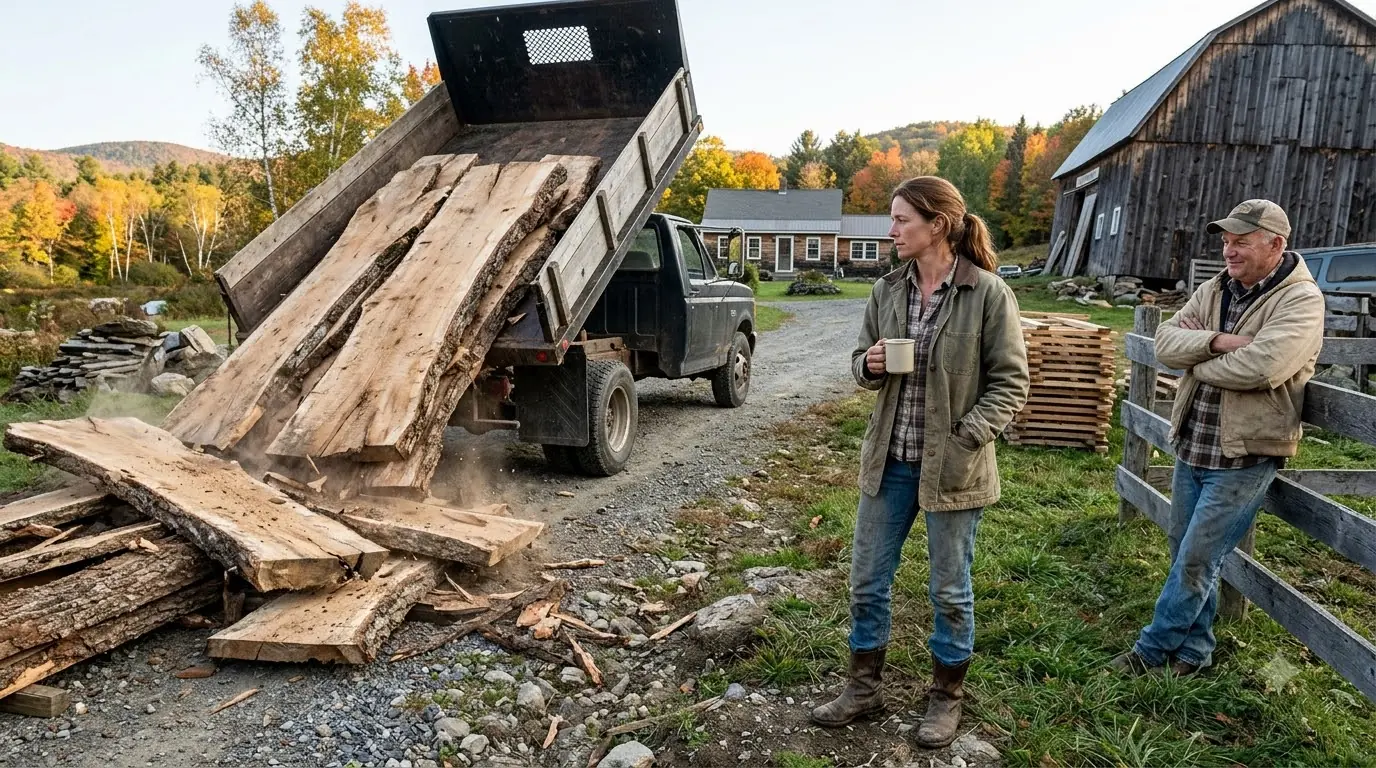
Nora could hear it before she could see it.
Diesel engine.
Loose gravel beneath heavy tires.
The faint metallic rattle of chains against the flatbed.
Then the truck would emerge past the eastern tree line and cross the back section of the twelve acres she had inherited without ever quite understanding why she had agreed to keep them.
The driver rarely stayed longer than fifteen minutes.
He would back toward a cleared patch beside the old barn, climb down, release the straps, and operate the hydraulic bed.
Then gravity did the rest.
Huge maple slabs slid backward.
Some were six feet long.
Others eight or nine.
A few were so wide they looked less like lumber than pieces of tree that had somehow been persuaded to become flat.
Bark still clung to their live edges.
Dark mineral streaks ran through some boards.
Wormholes appeared in others.
Knots disrupted otherwise straight grain.
The commercial flooring buyers did not want those imperfections.
Cabinet factories did not want widths that changed unpredictably from one end to the other.
Standard milling equipment preferred predictable boards.
Nora's maple was almost never predictable.
The slabs hit the ground with a heavy sound that traveled across the field.
Then the driver raised the flatbed, waved once, and disappeared back toward Route 9.
Nora would walk out with coffee in one hand.
Worn barn boots.
Canvas coat.
Hair tied carelessly behind her head.
Sometimes still wearing the clothes she had slept in beneath the coat.
She would stand beside the fresh delivery and look.
That was all.
At least, that was what the neighbors saw.
She never appeared angry about the growing stacks.
Never seemed worried.
Never asked anyone to remove them.
She simply studied them.
Frank Oberg, who lived on the adjoining property and had spent thirty-six years as a county surveyor, eventually developed a habit of slowing his truck every Tuesday morning.
He would look across the fence.
Another load.
Then another.
By midsummer, the stacks had become impossible to ignore.
By autumn, they filled most of one back corner.
By winter, snow gathered across wide maple surfaces in uneven white ridges.
The following spring, the deliveries continued.
Then summer.
Then another autumn.
Small-town curiosity became small-town speculation.
At the hardware store, people asked Frank whether Nora was starting a firewood business.
At the diner, someone suggested the sawmill was using her property as an illegal dump.
Someone else insisted she must have been paid enough to make it worthwhile.
A man named Wade Cormier said she probably had no idea what she was doing because she had spent too many years in Boston.
That explanation satisfied several people.
What none of them understood was why Nora Callahan appeared more settled with every new pile.
When she first inherited the property, she had seemed temporary.
A city woman staying in an old house while deciding what to sell.
Three years later, she stood among hundreds of maple slabs as though she had finally figured out why she was there.
The answer had begun much earlier.
Almost thirty years earlier.
Long before Grantham Sawmill.
Long before Calder Mills.
Long before Nora knew what moisture content meant or could identify curly maple from ten feet away.
It began in her grandfather's workshop.
Nora grew up in Medford, Vermont, in a family where very little useful material was thrown away.
Broken chairs went into basements until someone repaired them.
Old screws lived in coffee cans.
Glass jars became hardware containers.
Bent hinges waited for another purpose.
Her maternal grandfather, Delbert Ames, lived across the New Hampshire line in a farmhouse with a long, low workshop behind it.
Delbert was not famous.
He did not call himself an artisan.
He repaired furniture.
That was how he described his work.
People brought him dining chairs with loose joints, tables missing leaves, dressers with damaged drawers, cabinets with broken doors.
He restored some pieces for money.
Others for neighbors.
A few because he simply could not tolerate seeing useful wood discarded.
Nora spent several weeks with him every summer.
At eight, she swept.
At nine, she sorted screws.
At ten, she learned sandpaper grits.
At eleven, she made the mistake of telling Delbert that one of his projects was ugly.
The table had been left beside a road.
Its top was warped.
One corner was black from water damage.
The legs did not match.
Someone had painted it a strange yellow years earlier, then partially stripped the paint and abandoned the effort.
Delbert spent nearly an hour studying it before beginning work.
Nora sat on a stool.
“Why are you wasting time on that?”
Delbert kept sanding.
“On what?”
“That table.”
“What about it?”
“It’s ugly.”
He stopped.
Not offended.
Thinking.
Then he placed the sanding block down.
He ran one hand slowly along the exposed grain.
“Ugly is usually just uninformed.”
Nora frowned.
“That doesn't make sense.”
“It will.”
He traced a dark line beneath the old finish.
“Wood doesn't care what we think.”
He tapped the tabletop.
“The question is whether you can see past what it looks like now to what it could be.”
Nora looked at the warped, half-yellow table.
“I still think it's ugly.”
Delbert smiled.
“That's fine.”
He picked the sanding block up again.
“Most people can't see it.”
“See what?”
“Material.”
He sanded.
“Potential.”
Another stroke.
“What isn't obvious yet.”
Then he said the sentence Nora would remember almost thirty years later.
“The ones who pay attention never run out of material.”
At eleven, she thought he was talking about furniture.
At thirty-eight, she discovered he had been talking about nearly everything.
Nora left Medford for college in Burlington.
She studied communications and marketing because she was good at both and because, at eighteen, she believed careers were supposed to be selected according to what you could successfully do.
After graduation, she took a job with a regional advertising company.
Then another.
By twenty-seven, she moved to Boston.
Her career improved steadily.
Campaign strategy.
Brand development.
Product launches.
Corporate accounts.
By thirty-two, she was earning more money than either of her parents had at her age.
By thirty-five, she managed a team.
She had a good apartment.
Good insurance.
A retirement account.
Expensive coffee near the office.
An impressive title.
Almost no idea what any of it was for.
Her work was not terrible.
That was part of the problem.
Nothing dramatic pushed her away.
No cruel boss.
No bankruptcy.
No public humiliation.
She simply became increasingly aware that she spent most weeks convincing people to care about products she herself forgot about within months.
Monday meetings.
Tuesday presentations.
Quarterly metrics.
Brand sentiment.
Engagement.
Market penetration.
Then another campaign replaced the previous one.
Nora became good enough at the work that fewer things surprised her.
She learned how to predict clients.
How to shape a pitch before objections appeared.
How to make mediocre ideas sound strategic.
The more competent she became, the less alive she felt doing it.
She did not resign.
Responsible people rarely explode their lives simply because they are bored.
She stayed.
Then her great-uncle Raymond Callahan died.
Raymond was her father's uncle.
Widowed.
No children.
A quiet man who had spent most of his life repairing agricultural equipment and living alone on twelve acres outside Calder Mills.
Nora had visited perhaps six times in fifteen years.
They were not especially close.
That was why the attorney's call surprised her.
“He left you the property.”
“Me?”
“Yes.”
“Why?”
“I don't know.”
The estate included a small farmhouse.
Leaning barn.
Twelve acres.
Old tools.
A tractor that had not started in nine years.
No significant cash.
No mortgage.
The taxes were manageable.
Nora drove north expecting to sell.
She arrived in February.
The land did not make a persuasive first impression.
Snow.
Gray trees.
Rocky fields.
Barn leaning six degrees farther than a barn should.
The farmhouse smelled like old wood, radiator heat, and closed rooms.
Her first night, Nora sat at Raymond's kitchen table wearing a winter coat because she had not figured out the heating system properly.
She thought:
I will sell this in spring.
Then spring arrived.
The property changed.
Maples leafed out along the edges.
Wildflowers appeared beside the gravel lane.
The barn looked less depressing in sunlight.
The house remained small but felt peaceful.
Nora returned to Boston.
Then started visiting every other weekend.
She repaired the back steps.
Cleared brush.
Found Raymond's old hand tools.
Eventually her visits became long weekends.
Then remote-work weeks.
By autumn, she had not listed the property.
Her mother asked:
“What exactly are you doing with Uncle Ray’s place?”
“Nothing.”
“Then why keep it?”
“I don't know.”
That was the honest answer.
The following February, Nora gave notice at the agency.
Her director stared at her.
“Where are you going?”
“Vermont.”