Rain had stopped sometime before dawn, but the dead mill yard still looked as though it were bleeding rust into the Kentucky mud.
Twenty-four-year-old Margaret Howerin walked slowly between abandoned machines, her boots sinking where gravel had disappeared beneath years of runoff. Wet dark-chestnut hair had escaped her braid and stuck to her cheeks, and freckles stood sharply across a face pink from the cold. A brass pocket caliper hung from the chest of her mud-stained overalls, and every dozen steps she stopped, knelt beside another rusted circular blade, measured its thickness, and wrote a number into a small notebook with a pencil worn almost to the ferrule.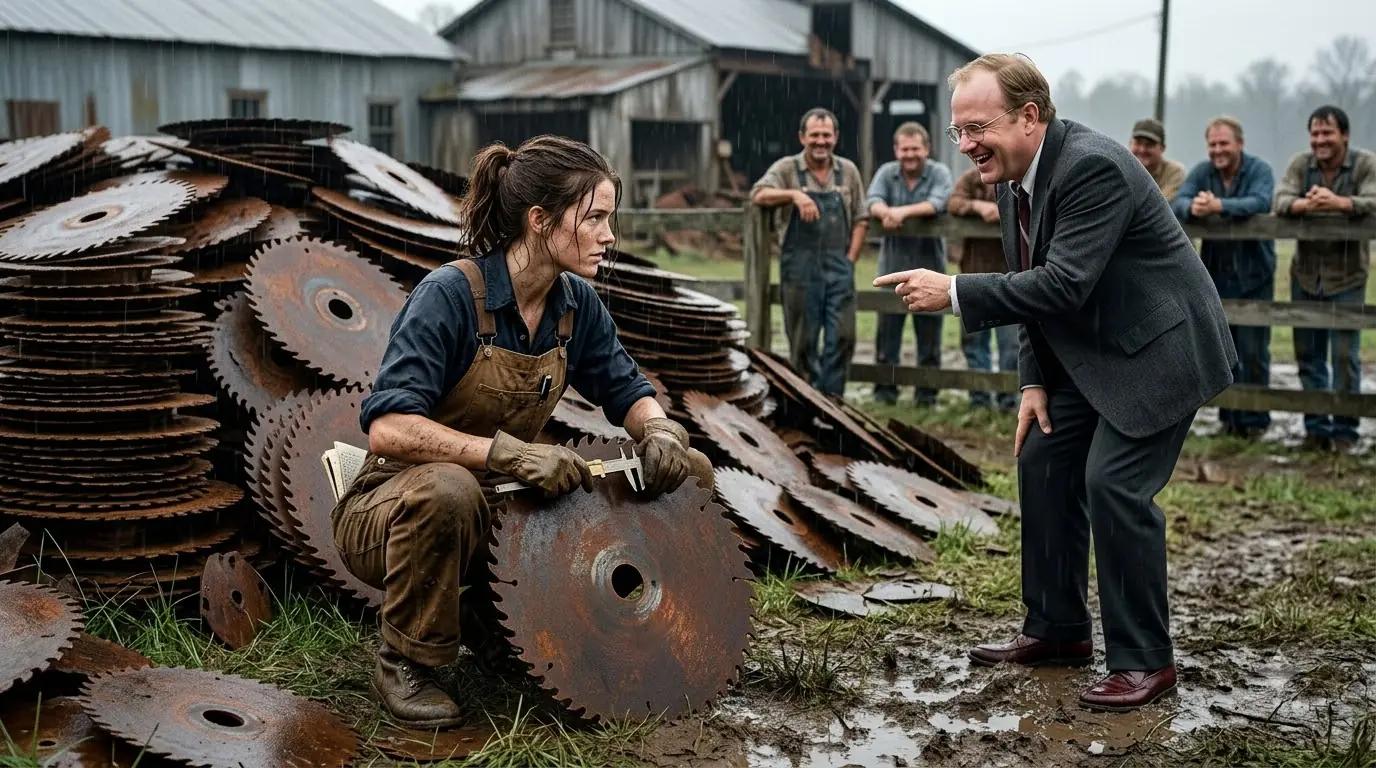
Behind her, the gate of Voss Ridge Sawmill carried a closure notice stapled crookedly to damp wood.
Sixty-one years of cutting white oak and yellow poplar had ended on a Tuesday.
The padlock had come three days later.
Most people in Marlo County saw a failed mill.
Margaret saw inventory nobody had bothered to understand.
The blades were everywhere.
Large head-rig saws nearly five feet across leaned against posts beneath a collapsed sheet-metal roof. Smaller edger blades lay half-buried in blackberry canes. Gang saw plates stood in leaning stacks, some with teeth burned away, some chipped, some ground almost smooth after decades of sharpening.
Margaret counted twice.
Roughly eleven hundred.
Nearly eighteen tons of steel.
And every person connected to the mill called them garbage.
Six weeks earlier, Margaret’s grandfather Howard Howerin had died sitting on a stool beside his forge, a cup of coffee cooling untouched at his elbow.
He left Margaret four acres, a house with a failing roof, a coal forge, a 280-pound Peter Wright anvil, a shop full of worn tools, and forty-one leather-bound journals arranged by year.
Margaret had slept perhaps four hours a night since the funeral.
She read eleven journals in six weeks.
She was not reading for comfort.
She was trying to learn everything Howard had assumed he would eventually teach her himself.
One line in the 1948 volume had lodged itself in her mind.
Steel remembers every hand that ever worked it.
No explanation followed.
Howard simply moved on to quench temperatures.
Margaret initially assumed it was one of his sayings.
Then she began examining the Voss Ridge blades.
On the second morning in the mill yard, she scrubbed rust from one circular plate with kerosene and a wire brush. Beneath decades of corrosion, a faint symbol emerged.
A crown.
Below it were worn foreign letters.
Margaret tilted the steel toward daylight.
Her breathing changed.
She had seen marks like that in Howard’s journals.
She copied them into the notebook.
Then she said nothing.
Margaret had already learned one useful truth about being underestimated.
People talked more freely when they thought you did not understand what you were seeing.
She walked into the mill office.
Dale Voss stood behind the counter.
He was forty-six, soft around the middle, with thinning sandy hair, rimless glasses, a charcoal jacket, clean trousers, and polished oxblood loafers that looked almost ridiculous beside a muddy industrial yard.
Four recently laid-off mill workers stood in the doorway.
Dale looked Margaret over quickly.
Her mud.
Her braid.
Her freckles.
Her grandfather’s old jacket.
Then he smiled.
“You’re Howard’s granddaughter.”
“Yes.”
“Sorry about the old man.”
His tone contained no grief.
Margaret nodded.
“I want to make an offer on the saw blades.”
Dale paused.
“The scrap?”
“All of it.”
“What kind of offer?”
“Three hundred dollars.”
For one second nobody moved.
Then Dale laughed.
Not a polite chuckle.
He threw his head back and laughed hard enough that he wiped one eye with a knuckle.
The men in the doorway shifted.
One, Merl Blevens, broad-shouldered in a worn canvas work coat, snorted openly.
Margaret waited.
Eventually Dale looked at her again.
“Three hundred dollars for eighteen tons of garbage?”
“Yes.”
“Sweetheart, I’ve got a disposal problem out there and you want to pay me for it.”
“Yes.”
Dale tapped his clipboard against one palm.
“You understand there’s nothing in that pile?”
“Then write it up.”
That made him laugh again.
“This is the best call I’ll make all week. My tonnage drops, my closeout report looks cleaner, and some little girl from Cedar Fork hauls away my rust so I don’t have to pay for it.”
Margaret’s cheeks heated.
Her voice did not.
“Write it up.”
Dale leaned closer.
“Your grandfather spent forty years banging on scrap in a shed and died broke doing it. Don’t take this wrong, honey, but some families just don’t have much sense.”
Margaret said nothing.
That silence irritated him more than an argument would have.
Dale finally pulled out a salvage form.
He listed the blades as scrap.
He marked the entire pile sold to Margaret Howerin for $300.
Then he signed.
Margaret read every line.
She signed beneath him.
Before she could fold the paper, Dale added one more condition.
“Hauling is yours. Seventy-five dollars a ton if you want the contracted rigs. Yard has to be cleared in eleven days.”
“I’ll move it.”
“With what?”
“My problem.”
Merl laughed behind her.
Margaret folded the title into the inside pocket of her jacket.
Then she walked through the doorway.
Nobody stopped her.
Eleven days later, the entire pile sat beside Howard’s forge.
Getting it there nearly destroyed Margaret’s hands.
She borrowed an aging Ford flatbed for forty dollars and a promise to return it full of gasoline. She made twenty-two trips between the mill and Cedar Fork, stacking roughly fifty blades at a time, placing cardboard between layers, and chaining everything down before crawling home over broken rural roads.
Nobody at Voss Ridge helped.
Workers drank coffee and watched.
On the third day, Merl called across the yard.
“Forklift’s right here, honey. All you gotta do is say please.”
Margaret did not look at him.
She dragged another forty-pound plate up the wooden ramp herself.
By the fifth blade, her braid had come undone.
By noon, her gloves were wet through.
By dusk, the skin beneath both palms had torn.
She continued.
Every trip carried the same humiliation.
Dale occasionally stood behind the office window with coffee in one hand, watching her like a man observing a foolish animal struggle with something too large for it.
Margaret never explained the maker’s marks.
She never mentioned Howard’s journals.
She never told them that the entire drive home each evening she was thinking not about rust, but about carbon.
On the fourth night, she dragged a thirty-inch edger blade beneath the porch light.
She soaked a rag in kerosene.
The rust came away gradually.
Then she found the mark again.
A raised cartouche.
A crown.
Letters beneath it.
A second maker’s shield beside them.
Margaret went inside.
She opened Howard’s 1948 journal.
There it was.
Howard had written about Swedish steel imported before the war.
Low sulfur.
Low phosphorus.
Extremely clean iron.
Small-batch crucible production.
Then Margaret found a later pencil note beneath the main entry.
They dumped forty years of it at Voss when the war ended. Nobody there ever knew what they had.
Margaret read the sentence three times.
Then she remembered another thing Howard once told her at a county fair.
Keep your head down and let people decide for you what you are. It’s the cheapest lesson you’ll ever get.
She finally understood him.
He did not mean accepting their judgment.
He meant using it.
By the eleventh day, all eighteen tons of blades were gone from Voss Ridge.
Dale stood in the office doorway during the final trip.
“Some people collect other folks’ failures,” he called.
Margaret secured the last chain.
She did not answer.
That night, eleven hundred pieces of steel sat stacked four feet high beside the forge.
They made sounds as the temperature changed.
Ticks.
Pops.
Soft metallic groans.
Margaret lay awake listening.
Mine now, she thought.
The entire county soon knew about the pile.
Pickup trucks began slowing near Margaret’s mailbox.
Not stopping.
Just slowing enough for drivers to stare.
People talked at the feed store.
At church.
At Kesner Hardware.
Howard’s orphaned granddaughter had spent $300 on scrap steel and hauled it home herself.
Some called it grief.
Others called it stupidity.
Margaret called it raw material.
Two weeks after the final load, she walked into Kesner Hardware carrying a list.
Behind the counter stood Ruth Kesner, sixty years old, narrow as a fence post, with cropped steel-gray hair, gold wire-rim glasses, and a pencil permanently tucked behind one ear.
Ruth read Margaret’s list.
Charcoal.
Fire brick.
Borax.
Files.
Neatsfoot oil.
Then she looked up.
“You know what they’re calling you.”
Margaret placed money on the counter.
“I need a receipt.”
“Howard was a good man.”
Margaret waited.
“But that shop’s been cold four years. Steel doesn’t improve sitting in mud.”
“I need a receipt.”
Ruth pushed her glasses higher.
“Somebody at Voss saw you coming a mile away and sold you their landfill.”
Margaret said nothing.
Two men entered.
One was Merl Blevens.
The corner of his mouth moved when he saw Margaret.
Ruth finally wrote the receipt.
Margaret loaded the materials into the Ford.
Behind her, she heard Merl say, “You ought to charge her storage too, Ruth. That pile’ll still be there next winter.”
Margaret drove home.
Snow began before she reached Cedar Fork.
Her first knife broke in two.
Margaret had cut a six-inch drop-point blank from a planer blade. She heated it, checked critical temperature, and quenched it in oil exactly as Howard’s notes suggested.
The blade cracked lengthwise.
The sound was sharp and final.
Margaret stood staring at the two pieces.
Then she sat on the shop floor.
For twenty minutes she did nothing.
Finally she opened her own notebook.
Blade One. Cracked at quench. Torch heat. My fault.