Sergeant Garrett Caldwell wanted to know why Marcus Reed was standing.
Not whom he had come to see. Not whether the woman at the front desk had finished checking him in.
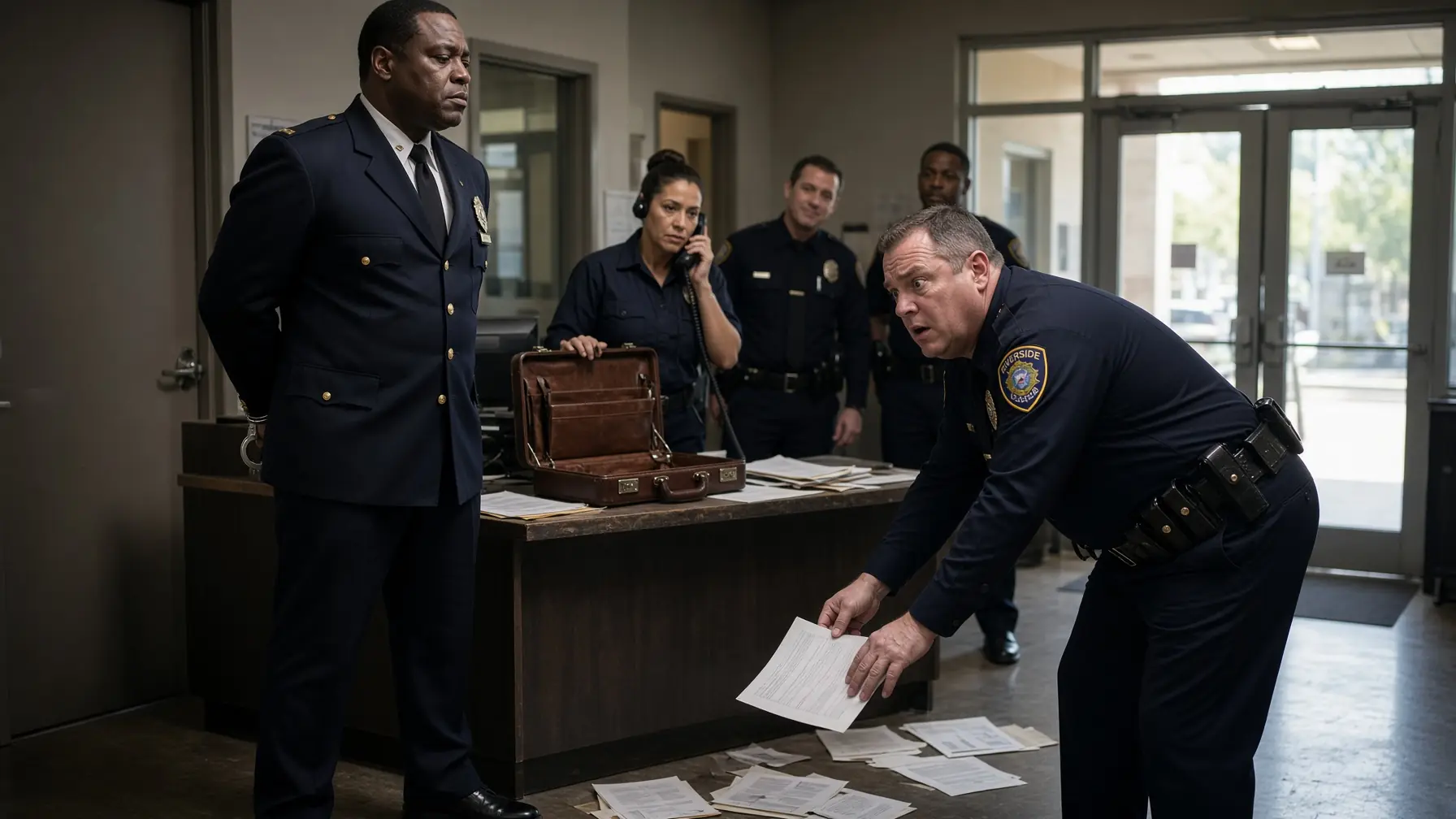
Why he was standing.
Marcus looked toward the visitor chairs along the wall, then back at the counter. The dispatcher had asked him to remain there while she confirmed his appointment, and he had done exactly that.
“I was told to stay by the desk.”
Caldwell glanced at the woman behind the computer. She looked up, her fingers resting motionless above the keyboard.
“Well,” the sergeant said, “now you’re being told something else.”
Marcus shifted his brown leather briefcase into his other hand. He kept the movement slow, though he had not yet been given a reason to worry about moving at an ordinary speed.
“Then tell me what you need.”
Neither Caldwell nor the two officers behind the counter answered.
Beyond the glass entrance doors, a man walked past carrying a folded newspaper. Morning light followed him across the narrow view of the sidewalk, then the lobby held only its own reflection again.
Marcus had arrived early to avoid a difficult entrance.
He was beginning to understand that punctuality could not prevent every kind.
Before leaving home, he had checked the briefcase twice.
The first time was practical. He opened it on the table, confirmed that the documents were together, and ran a hand beneath the edge of the folder to make sure nothing had slipped out of sight.
The second time was unnecessary.
He knew that while he was doing it.
Still, he preferred a needless check to discovering a missing page at a public counter, where someone else would have to interrupt their morning because he had failed to prepare.
The briefcase was old enough to have softened at the handle. Its corners had darkened, and there was a shallow crease near one clasp that no amount of careful treatment would remove.
Marcus liked it.
It protected what he carried. It closed properly. Nothing about its appearance interfered with its purpose.
He placed it near the door while finishing with his uniform.
At forty-five, he had long since stopped expecting an important morning to feel important all the way through. Usually, it contained the same small frustrations as any other: a collar that would not sit right, a missing key found exactly where it belonged, a tie knot that looked acceptable until he stepped back from the mirror.
He tied the knot twice.
On the second attempt, it sat straight against the shirt.
His navy police dress uniform was immaculate. His shoes were polished, his clothes properly arranged, and the papers in the case complete.
He had done what was within his control.
That mattered to him.
On the drive to Riverside, Marcus thought about the first conversation he expected to have.
He would introduce himself. Explain why he had come. Let the person at the desk determine where he needed to go.
He did not intend to arrive with the assumption that everyone had been waiting for him. Public buildings were full of people whose urgent mornings overlapped, and a person answering a telephone might be dealing with something he could not see.
He wanted to make the exchange easy.
Outside the station, he paused long enough to confirm that he had found the public entrance.
Through the glass, he could see a front counter, a row of visitor chairs, and a woman seated beside a telephone and computer. The corner of the entrance mat had curled slightly upward, exposing a pale triangle of tile.