Sergeant Garrett Caldwell’s first question was not who Marcus Reed had come to see.
It was why he was standing.
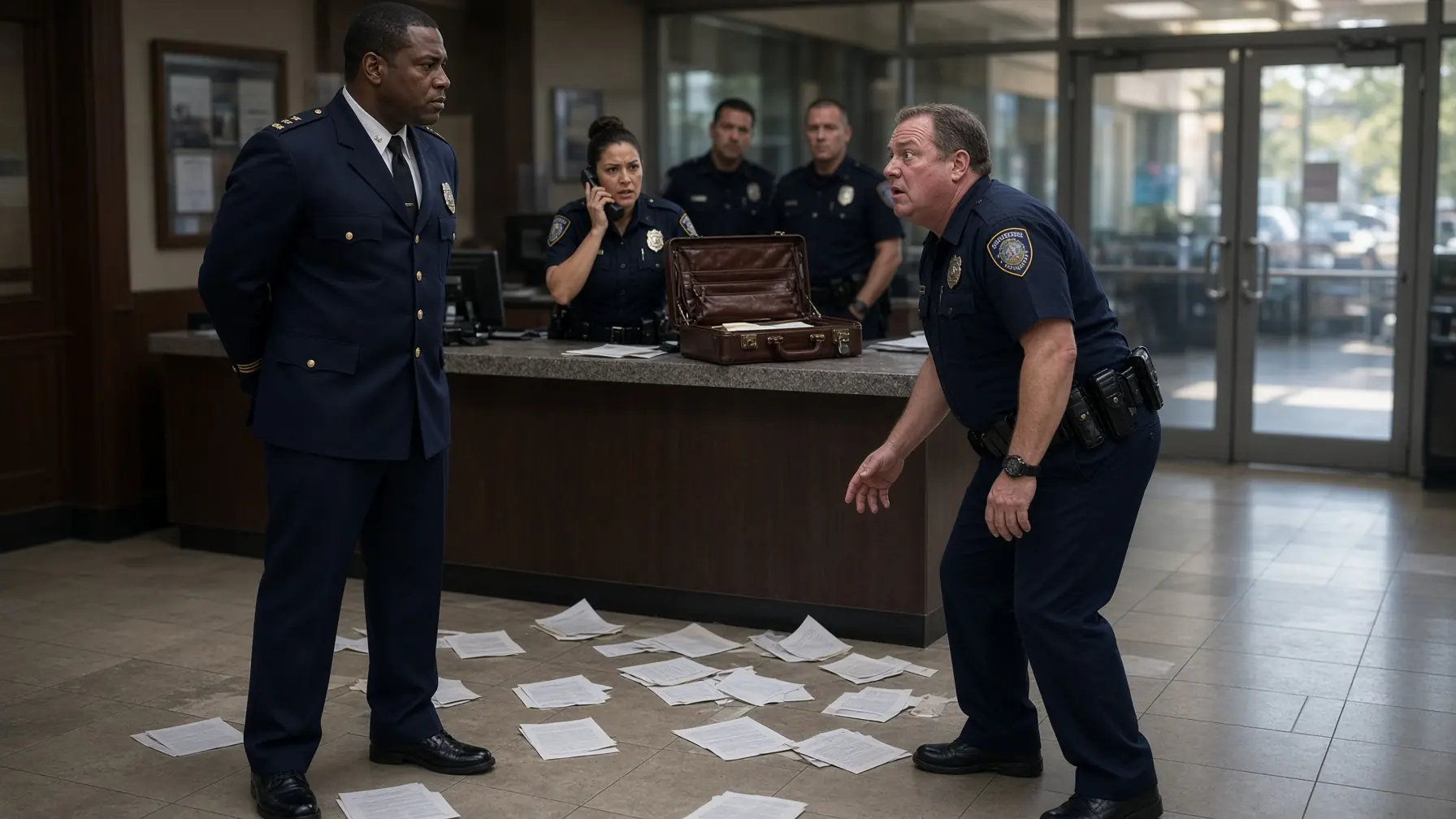
Marcus looked from the sergeant to the visitor chairs along the wall, then back to the front counter. The dispatcher had asked him to wait there while she checked something.
“I was told to stay by the desk.”
Caldwell glanced toward her.
She was looking at her computer, one hand resting near the keyboard, her attention divided between the screen and the exchange beginning in front of it.
“Well, now you’re being told something else.”
Marcus kept his expression restrained.
He was forty-five, tall and broad-shouldered, dressed in an immaculate navy police dress uniform. His black tie lay straight against his shirt, and his polished shoes reflected a pale strip of window light.
The care he had taken that morning suddenly seemed to be irritating the wrong person.
He shifted his brown leather briefcase to his other hand.
“Then tell me what you need.”
Caldwell studied him for a moment.
Behind the counter, one of the two watching officers leaned slightly against a cabinet.
Nobody answered Marcus’s question.
Outside the glass entrance doors, the weekday morning continued without interruption. People passed beyond the narrow view from the lobby, unaware that inside Riverside Police Department, a man was already being treated as difficult for following an instruction someone else had given him.
Marcus had arrived early.
Not dramatically early.
Enough to allow for finding the entrance, checking in, and discovering that a reasonable plan had overlooked something ordinary.
He disliked making people hurry because he had failed to leave himself time.
That morning, he had done the opposite.
He checked the briefcase before leaving, making sure the documents were together and that nothing had slipped beneath the lining. He had already checked them the previous evening, but familiarity was not a substitute for looking.
A page left behind could turn an uncomplicated arrival into a needless return trip.
He wanted no such complication.
The case was old enough to have softened at the handle and darkened at the corners. Marcus could have replaced it.
He had not seen a reason.
It closed properly.
It protected what he carried.
The leather bore the ordinary evidence of use without looking neglected.
He set it near the door while finishing with the uniform.
The tie required two attempts.
The first knot sat slightly off-center, and for a moment he considered leaving it.
Then he loosened it and began again.
Nobody else would know the effort.
That was not the point.
Marcus believed there was value in doing small things properly when they were within his control. He had lived through enough days governed by other people’s decisions to appreciate the ones that were not.
A straight tie.
A complete set of papers.
Enough time to reach the destination without bringing the journey’s irritation through the door.
Those were modest ambitions.
He fulfilled them.
Before leaving, he looked once more at the case.
Then he picked it up and went.
On the way to Riverside, he thought less about what he would say than about what he hoped not to do.
He did not want to arrive speaking over someone who was trying to help.
He did not want to mistake a busy person’s short answer for disrespect.
And he did not want the fact that the morning mattered to him to become pressure everyone around him had to absorb.
Institutions were full of ordinary people working through ordinary interruptions.
A person at a counter might have three tasks waiting and a fourth arriving.
Marcus knew that.
He intended to make the first conversation easy.
At the station, he paused outside the glass doors to check the entrance.
Public lobby.
Front counter visible.
Visitor chairs along the pale wall.
A telephone beside a computer where a woman in a navy uniform sat with dark hair secured in a bun.
He opened the door.
The sound of the lobby reached him in layers.
Typing.
A faint conversation farther inside.
A chair shifting somewhere behind the counter.
Nothing unusual.
Marcus let the entrance close behind him and approached the desk.
“Good morning.”
The dispatcher looked up.
“Morning.”
She appeared to be around forty, with a tired concentration that did not prevent courtesy. Her eyes moved briefly over the uniform, then to Marcus’s face.
“How can I help you?”
He explained that he had arrived for an appointment.
She asked for his name.
“Marcus Reed.”
The dispatcher repeated it as she turned toward the computer.
Marcus waited.
One officer stood farther behind the counter.
Another was near a doorway leading into the station.
Both glanced toward him.
Neither greeted him.
That did not concern Marcus.
He had not come to collect greetings from everyone in the building.
He set the briefcase against his leg and watched the dispatcher work.