Special Agent Maya Bennett had been inside the Jackson Central Police Station for less than ninety seconds when Sergeant Robert Kessler decided she was a joke. He stood behind the front counter laughing loudly enough to draw three other officers from their desks, while pieces of a federal search warrant rested beneath his hands like confetti. Maya remained perfectly still in her dark navy field jacket, black trousers, and polished boots, watching him finish tearing the final page in half. “Federal warrant?” Kessler laughed. “Take that fake badge act somewhere else.”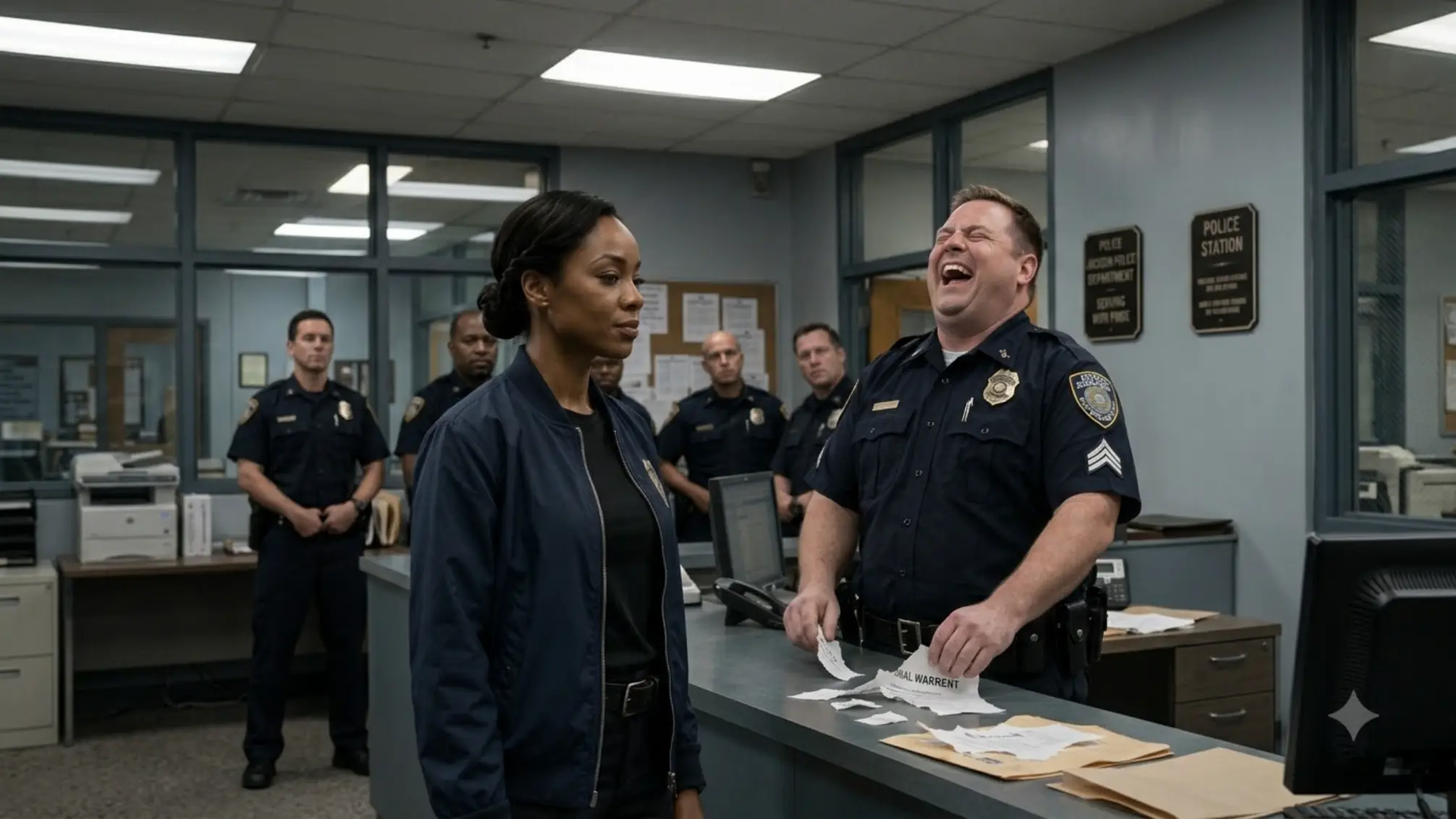
Maya glanced down at the torn document. “You just destroyed a federal order inside a recorded police station.” Her voice contained no anger, which somehow amused him even more. Kessler leaned across the counter until his badge nearly touched the edge. “I run this building, sweetheart. Nobody here answers to you.”
Maya raised her eyes toward the camera mounted above the front desk. Then she looked at the electronic clock on the wall. It read 10:02 a.m. “Then look up, Sergeant,” she said. “Every door just locked because they do now.”
A metallic click echoed from the hallway.
Then another.
Then five more.
The laughter stopped.
Behind Kessler, an officer walked toward the records-room door and pulled the handle. It did not move. Another officer tried the hallway leading toward the evidence unit. A red indicator glowed above the electronic access pad.
“What the hell?” someone whispered.
Kessler stared at Maya.
She had not moved.
Outside the glass entrance, two black government SUVs rolled slowly into the parking lot.
Kessler’s face changed.
Three months earlier, Maya Bennett had been sitting inside a conference room in Washington reviewing a spreadsheet that should never have existed.
The file contained evidence numbers from twelve criminal cases processed through Jackson Central over a period of thirty-one months. At first glance, nothing connected them. Different defendants, different arresting officers, different neighborhoods, different charges.
But the evidence had moved through the same police station.
And in every case, something had gone wrong.
A handgun listed as destroyed appeared six months later in another investigation.
Cash seized during a narcotics arrest was short by $18,400 when audited.
Two bags of pills changed weight between intake and laboratory submission.
A body-camera drive vanished.
A vehicle forfeiture document contained a signature from a property clerk who had been on medical leave that entire week.
Any single discrepancy could have been incompetence.
Twelve were a pattern.
Then a thirteenth case appeared.
That one involved a nineteen-year-old warehouse worker named Devon Richards, arrested after officers claimed they discovered narcotics beneath the passenger seat of his car.
Devon insisted the drugs were not his.
His public defender requested the original evidence-room entry footage.
The station reported the video had been corrupted.
The prosecutor dropped the charge quietly.
Three weeks later, Devon filed a complaint.
It disappeared.
That disappearance was what eventually brought Maya into the case.
She worked for a federal civil-rights and public-corruption task force combining attorneys, investigators, financial analysts, and forensic specialists. Maya was thirty-three, patient by temperament and methodical by training. She did not believe dramatic theories until documents forced her to.
The documents were beginning to force her.
She requested Jackson Central’s evidence-access logs.
The city produced incomplete records.
She requested backup logs.
The department claimed they no longer existed.
She requested maintenance reports for the evidence-room security system.
Those reports showed the supposedly missing logs had been mirrored automatically to an external municipal server.
Somebody had lied.
Maya requested the mirrored records.
That was when one name started appearing repeatedly.
Sergeant Robert Kessler.
Kessler was not assigned to property and evidence. He supervised overnight patrol operations. Yet his badge accessed the evidence corridor thirty-seven times in one year.
Twenty-two visits occurred after midnight.
Nine happened while he was officially off duty.
Four coincided with evidence discrepancies.
Maya enlarged the spreadsheet on the conference-room screen.
Her supervisor, Assistant Special Agent in Charge Daniel Reed, studied it.
“You think he’s moving evidence?”
“I think he’s accessing a room he has no operational reason to enter.”
“That’s not enough for a warrant.”
“No.”
Maya changed slides.
A financial report appeared.
Kessler earned a comfortable but ordinary police salary.
Yet within three years, he had paid off a $74,000 home-equity loan, purchased a bass boat in cash, and made repeated deposits just beneath his bank’s automatic reporting thresholds.
Reed leaned forward.
“That’s better.”
“It gets worse.”
Maya displayed the finances of Lieutenant Charles Mercer, who supervised property control.
Similar unexplained deposits.
Then Captain Eric Doyle.
Another pattern.
Three officers.
Same station.
Overlapping dates.
Reed stopped smiling.
“How deep?”
“I don’t know yet.”
That was why they needed the warrant.
For six weeks, Maya’s team built the application carefully.
They interviewed former evidence technicians.
One woman, Lisa Moreno, admitted that Kessler routinely entered secure storage claiming he was retrieving items for detectives.
“Did you challenge him?” Maya asked.
Lisa looked embarrassed.
“He was a sergeant.”
“That wasn’t my question.”
Lisa swallowed.
“No.”
Another former employee described an unofficial phrase used inside the station.
Blue shelf.
Items placed on the blue shelf were supposedly awaiting administrative review.
But the shelf was not part of any written evidence procedure.
Maya asked what happened to those items.
The former employee shook his head.
“You didn’t ask.”
“Why?”
“Because people who asked stopped getting overtime.”
That statement changed the investigation.
Now there was possible retaliation.
A federal magistrate approved the search warrant on Monday evening.
The warrant authorized seizure of evidence-room records, access logs, specific digital systems, financial documentation, internal complaint files, and communications involving designated personnel.
Maya expected resistance.
She did not expect a sergeant to tear the warrant apart in front of her.
That morning, the operation had been designed to minimize disruption.
Maya would enter first with one federal attorney and present the warrant to the ranking officer.
A federal evidence team waited two blocks away.
City officials outside the suspected chain had been notified shortly before execution.
Jackson Central’s electronic security system had also been placed under temporary independent control because investigators had reason to believe evidence could be destroyed if suspects gained unrestricted movement once the search began.
The moment Maya entered, the building’s secure areas remained normal.
That was deliberate.
If officers cooperated, the search would proceed calmly.
Then Kessler saw her.
His first mistake was assuming she belonged to Internal Affairs.
His second was assuming she was bluffing.
His third was asking to see the warrant, reading the first page, recognizing his own name, and immediately deciding humiliation was safer than fear.
He tore it.
Now the doors were locked.
Kessler looked toward the entrance as six federal agents stepped through.
Daniel Reed came first.
Behind him walked Assistant U.S. Attorney Catherine Monroe and two digital forensic specialists carrying sealed equipment cases.
Kessler pointed at Maya.
“She came in here threatening officers with fake paperwork.”
Monroe looked at the pieces on the counter.
“Fake paperwork?”
Kessler’s mouth opened.
Monroe picked up half a page.
The federal court seal was plainly visible.
She looked at him.
“You tore a certified copy of a federal search warrant?”
Kessler recovered quickly.
“Anybody can print something.”
Maya reached into her jacket and removed another copy.
“Good thing the court gave us more than one.”
An officer in the background lowered his head, hiding what might have been a smile.
Kessler did not notice.
He was watching the hallways.
“Unlock my station.”
Reed answered.
“It isn’t your station.”
“I’m the ranking supervisor on site.”
“Not anymore.”
Kessler stared.
Reed handed him a document.
It was a federal preservation and security notice identifying Kessler as a subject whose access to designated areas had been suspended during execution of the warrant.
The color left his face.
“You can’t do this.”
Maya finally moved closer to the counter.
“Sergeant, the warrant already did.”
Kessler’s laugh returned, but weaker.
“You people think you found something because of paperwork mistakes?”
Maya said nothing.
That bothered him.
He leaned closer.
“This department handles thousands of evidence items.”
Still nothing.
“You know how many things get mislabeled?”
Maya watched him.
Then Kessler made another mistake.
“You’re building a conspiracy out of one missing gun and some cash.”
Daniel Reed turned toward Maya.
She turned toward him.
Neither spoke.
Kessler noticed.
“What?”
Maya folded her arms.
“We never told you about the missing gun.”
Silence spread across the room.
Kessler’s mouth tightened.
“That was in the warrant.”
“No,” Maya said. “It wasn’t.”
Monroe slowly placed the torn page onto the counter.
Kessler looked down.
The first page listed categories of evidence but no specific missing firearm.
He had just disclosed knowledge he should not have possessed.
Officer Nathan Ellis, standing beside the bulletin board, stared at his sergeant.
Kessler noticed him.
“What are you looking at?”
Ellis immediately looked away.
Maya saw it.
Another crack.
The search began.
Federal teams secured the evidence room first.
Lieutenant Mercer arrived ten minutes later demanding access.
He was denied.
Captain Doyle appeared next.
He demanded to call the chief.
Maya told him he was free to make the call from the front office but could not enter restricted areas.
Doyle stared at her.
“You’re enjoying this.”
“No.”
“Sure looks like it.”
Maya shook her head.
“If I enjoyed finding this much evidence of possible corruption, I’d need a different job.”
Doyle walked away.
Inside the evidence unit, investigators discovered the blue shelf within fifteen minutes.
It was exactly where witnesses described.
There was no official label.
Just a metal shelving unit behind a partition.
Seven sealed evidence bags rested there.
None appeared in the current inventory system.
One contained cash.
Another contained prescription pills.
A third contained a handgun.
A technician photographed everything before touching it.
Then a digital analyst called Maya over.
“You need to see this.”
The station’s local access database contained gaps.
But the municipal backup server did not.
Someone had manually deleted entries from the local system.
The deleted records showed Kessler entering the evidence room repeatedly.
Mercer too.
Doyle less frequently.
Then the analyst found something more serious.
A hidden administrator account.
Username: JSADMIN2.
The account had permission to edit evidence status, modify timestamps, and remove access history.
“Who owns it?” Maya asked.
“We’re tracing.”
An hour later they had the answer.
The administrator credentials had been created from Captain Doyle’s workstation.
Doyle denied knowing anything about them.
That denial lasted until forensic examiners found an encrypted spreadsheet on his office computer.
The spreadsheet listed case numbers.
Amounts.
Initials.
Dates.
Beside several entries were percentages.
Maya read one line twice.
DR-2194 — 26,000 — RK 30 / CM 30 / ED 40
RK.
Robert Kessler.
CM.
Charles Mercer.
ED.
Eric Doyle.
The twenty-six thousand dollars matched cash seized in a trafficking investigation eleven months earlier.
Official evidence records said only $7,600 had been recovered.
Maya felt something cold settle in her stomach.
This was not careless bookkeeping.
Someone had been stealing.
The station grew quieter as the search continued.
Officers who had laughed when Kessler tore the warrant now avoided him.
Kessler remained behind the front desk under supervision.
He could leave only if investigators determined he was not being detained, but his access badge had been suspended, and everywhere he walked required escort.
The symbolism was impossible to miss.
The man who had announced that he ran the building could no longer open a single secure door inside it.
Around noon, Officer Nathan Ellis approached Maya.
“Can I talk to you?”
“About?”
“Kessler.”
Maya studied him.
“Privately?”
Ellis nodded.
They used a conference room.
Ellis closed the door.
For several seconds, he said nothing.
Then he took out his phone.
“I have something.”
He opened a photograph.
It showed Kessler standing inside the evidence room at 1:13 a.m.
Beside him was Lieutenant Mercer.
Between them sat an open evidence box.
“When was this?”
“Eight months ago.”
“Why do you have it?”
Ellis looked down.
“I was working overtime. I saw them go in.”
“Did they see you?”
“No.”
“Why photograph it?”
“Because it felt wrong.”
Maya waited.
“Why didn’t you report it?”
Ellis gave a bitter smile.
“To who?”
That answer was becoming familiar.
He continued.
“Kessler was my supervisor. Mercer ran property. Doyle ran the division. Who exactly was I supposed to tell?”
“Internal Affairs.”
Ellis laughed once.
“Doyle’s brother-in-law supervised Internal Affairs last year.”
Maya stopped writing.
That was new.
Ellis handed her the phone.
“There are more.”
Photographs.
Dates.
Messages.
He had saved pieces for months but never assembled them.
One text from Kessler read:
Blue shelf cleared tonight. Nobody downstairs after 0100.
Another:
Mercer handles paperwork. Don’t ask.
Maya looked at Ellis.
“These matter.”
“I know that now.”
“You knew then.”
Ellis looked ashamed.
“Yes.”
The investigation expanded before sunset.
A second warrant targeted personal financial records.
A third preserved Internal Affairs data.
Federal prosecutors contacted defense attorneys in cases tied to compromised evidence.
By evening, the number of potentially affected prosecutions had grown from thirteen to forty-one.
Then sixty-three.
Then ninety-two.
The consequences spread far beyond the station.
One defendant had already served eighteen months in prison.
Another had lost custody of his daughter after a drug conviction.
A third had been deported following a plea agreement.
Evidence corruption did not stop at a shelf.
It moved through courtrooms.
Families.
Jobs.
Lives.
Maya understood the responsibility immediately.
She stood inside the evidence room at 8:40 that night while technicians cataloged every questionable item.
Daniel Reed approached.
“You alright?”
“No.”
He nodded.
“Same.”
Maya looked toward the blue shelf.
“I thought we were finding theft.”
“We did.”
“This is worse.”
“Yes.”
The missing evidence could invalidate legitimate cases as well as false ones.
Victims could lose convictions against people who had actually harmed them because corrupt officers contaminated the chain of custody.
There would be no clean ending.
Real corruption rarely offered one.
At 9:15, Kessler asked to leave.
Investigators allowed him to go because he had not yet been arrested.
He walked toward the front entrance.
The doors remained electronically controlled.
He pushed.
Nothing happened.
An agent had to release the lock.
Kessler turned toward Maya.
For the first time all day, he looked small.
“You planned that whole door thing to embarrass me.”
Maya stared at him.
“No.”
“You wanted everybody watching.”
“The doors were secured to preserve evidence.”
“Same difference.”
“No, Sergeant.”
She stepped closer.
“You still think this was about you.”
He left without answering.
Two days later, Kessler was arrested.
Mercer followed.
Doyle surrendered through counsel.
Charges eventually included conspiracy, theft of government property, evidence tampering, obstruction, falsification of records, and civil-rights offenses connected to cases investigators could prove had been deliberately manipulated.
The investigation into Internal Affairs exposed another layer.
Complaints against Kessler had repeatedly been reclassified.
“Evidence integrity concern” became “procedural misunderstanding.”
“Threatened officer after questioning missing property” became “interpersonal conflict.”
A complaint submitted by Lisa Moreno had vanished entirely.
For years, the system had not failed because no warning existed.
It failed because warnings were edited until they stopped sounding dangerous.
The federal court ordered an independent review of every affected case.
Prosecutors voluntarily dismissed charges where evidence could no longer be trusted.
Several convictions were vacated.
Others survived because independent evidence proved guilt beyond the compromised items.
Maya insisted on that distinction.
The scandal was not an excuse to rewrite reality in either direction.
Evidence had to decide.
Months later, Sergeant Kessler sat at a defense table in federal court.
The man who once laughed at Maya’s warrant now listened silently while prosecutors displayed photographs of the blue shelf.
Then came bank records.
Messages.
Access logs.
The hidden spreadsheet.
Finally, the front desk security video played.
Kessler appeared on screen laughing.
He tore the warrant.
“Federal warrant? Take that fake badge act somewhere else.”
Jurors watched Maya stand perfectly still.
Then the doors clicked shut.
The courtroom remained silent when the video ended.
Kessler’s attorney argued the torn copy had been meaningless theatrics and should not be treated as evidence of the larger conspiracy.
The prosecutor agreed on one point.
Tearing paper had not destroyed the warrant.
Then she turned toward the jury.
“That is exactly what matters.”
She held up an intact certified copy.
“Authority does not disappear because someone arrogant enough refuses to recognize it.”
The line stayed with Maya.
Kessler was convicted on several major counts.
Mercer entered a plea agreement and cooperated.
Doyle fought longer but eventually faced conviction as well.
The police department underwent federal monitoring.
A new evidence-management system required dual authorization for after-hours entry.
No administrator could delete access logs locally.
Every alteration created an immutable external record.
Internal Affairs was reorganized.
Complaints remained permanently preserved in their original wording.
The blue shelf was removed.
Maya visited Jackson Central almost a year later.
The station looked similar.
Same fluorescent lights.
Same front counter.
Same gray-blue walls.
But something had changed.
A new sergeant stood behind the desk.
He recognized Maya immediately.
“Agent Bennett.”
“Maya is fine.”
He smiled.
“I heard the story.”
She looked at the counter.
“What version?”
“The warrant.”
She sighed.
“Of course.”
The sergeant laughed.
“Don’t worry. I’m not tearing anything.”
“That puts you ahead already.”
Officer Nathan Ellis walked from a hallway.
He remained with the department after cooperating fully.
His promotion had been delayed during the investigation because nobody wanted cooperation itself to become a reward that excused years of silence.
Eventually, after completing additional training and receiving strong evaluations, he became a detective.
He stopped beside Maya.
“They replaced the doors.”
She looked toward the hallway.
“Why?”
“Old locking system was unreliable.”
Maya smiled.
“That day it worked beautifully.”
Ellis laughed.
Then his expression grew serious.
“I still think about how long I waited.”
“So do I.”
“I could’ve said something earlier.”
“Yes.”
He looked surprised by her bluntness.
Maya continued.
“But you eventually did.”
“Does that make it okay?”
“No.”
She shook her head.
“It makes it useful.”
That distinction mattered to her.
Accountability was not about dividing everyone into heroes and villains.
Most institutional failures survived because ordinary people made small compromises.
A technician looked away.
A supervisor softened language.
An officer stayed quiet.
A prosecutor trusted a chain of custody without asking one more question.
Kessler had exploited those compromises.
Doyle had organized them.
Mercer had maintained them.
But the institution had allowed them.
Before leaving, Maya stopped beside the front counter.
There was no trace of the torn warrant.
No dramatic plaque.
No photograph.
Good.
She had never wanted the station turned into a monument to her.
The important thing was what came afterward.
Reliable evidence.
Reviewable decisions.
Preserved complaints.
Doors that opened for people with proper authority and closed when evidence required protection.
Outside, Daniel Reed waited beside a government sedan.
“You done?”
Maya nodded.
He looked toward the building.
“Still weird?”
“A little.”
“You know what everyone remembers?”
“The doors.”
“The doors.”
Maya laughed quietly.
“That wasn’t even the important part.”
Reed opened the car door.
“What was?”
Maya looked back through the glass entrance.
A woman stood at the front counter speaking with an officer.
The officer listened.
Wrote something down.
Did not laugh.
Did not dismiss her.
Did not tear anything apart.
Maya smiled.
“That.”
She climbed into the vehicle.
A year earlier, Sergeant Robert Kessler had looked at a Black woman carrying a warrant and decided her authority could not possibly exceed his own.
He tore the paper because he believed the paper created her power.
It did not.
The court created the warrant.
The evidence created the investigation.
And Kessler’s own choices created what followed.
The moment every door locked was not when he lost control.
He had lost control several seconds earlier.
The instant he saw his own name on a federal warrant—
and chose to laugh instead of read.