“You wanna play lawyer, let’s grow up and handle this.”
Sheriff Cole Mercer stood inches from Sierra Maddox in the center aisle of the Grayson County courthouse, his weathered face tight with irritation and his brown uniform stretched across broad shoulders. Sierra, twenty-six, elegant in a deep green suit and crisp white blouse, did not move backward. Her dark eyes remained fixed on him while spectators turned in their seats, waiting for the young Black woman to lose her nerve.
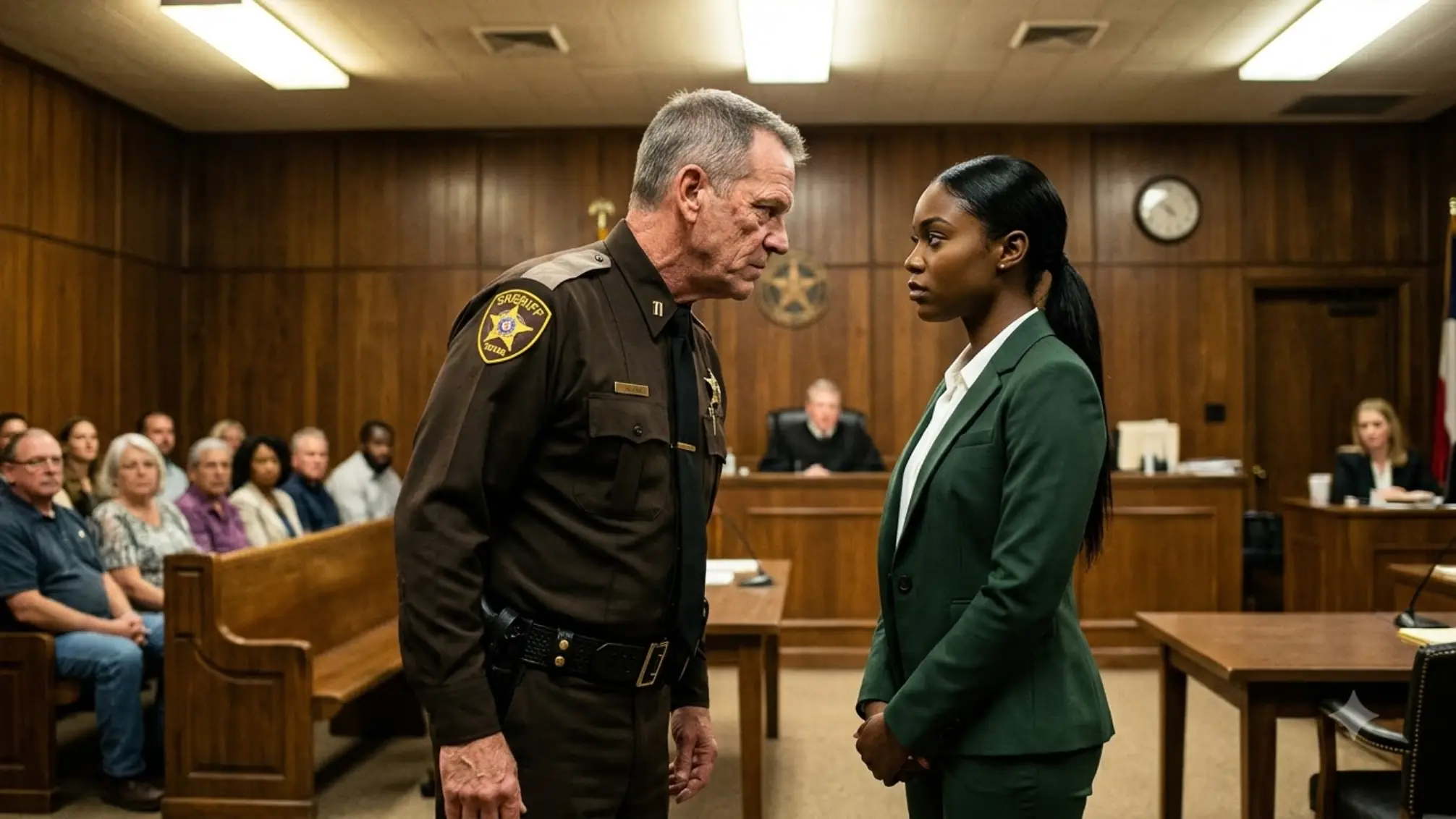
“Then step aside,” Sierra said quietly, “and explain why you’re blocking evidence the court hasn’t seen.”
Mercer’s jaw tightened. “One more stunt and I’ll have you removed before your father hears the verdict.”
Sierra glanced toward the judge’s bench.
“Try it,” she said. “Then everyone here gets to ask why the sheriff is more afraid of my evidence than the prosecution is.”
The courtroom went silent.
Behind Sierra, her father sat alone at the defense table.
Grant Maddox was fifty-seven years old, a broad-shouldered Black mechanic with gray beginning to show in his beard and permanent grease stains worked so deeply into his hands that even three days in county custody had not removed them. For twenty-eight years he had operated Maddox Auto & Restoration from a metal building outside Pine Hollow, Texas.
People brought him broken transmissions, old farm trucks, wrecked pickups, and classic cars everyone else had given up on.
Grant rarely advertised.
He did not need to.
His reputation had traveled farther than any billboard could.
Then six months earlier, deputies had entered his repair yard with a warrant.
They claimed six stolen vehicles had been discovered behind his shop.
By sunset, Grant was in custody.
By the next morning, Sheriff Mercer was standing before television cameras describing the case as one of the largest vehicle-theft operations Grayson County had seen in years.
The photographs looked devastating.
Luxury SUVs.
A restored Ford pickup.
Two late-model trucks.
A black Dodge Charger.
All parked behind Grant’s locked storage fence.
Three had altered identification plates.
One appeared on a statewide stolen-vehicle list.
The county prosecutor called it overwhelming evidence.
Grant called it impossible.
“I never worked on those cars.”
Nobody listened.
For the first few weeks, Sierra barely understood what had happened.
She had recently joined a small civil litigation firm in Dallas after passing the Texas bar. She was young enough that judges occasionally asked which attorney she was assisting before realizing she was the attorney.
Grant had been proud beyond reason.
He carried one of her business cards in his wallet.
Yet when his own case began, he refused to let her represent him.
“You’re building your career,” he told her through the glass during a jail visit. “I’m not letting this drag you down with me.”
A court-appointed attorney named Nathan Crawford took the case instead.
Crawford was tired, overloaded, and convinced the prosecution had Grant trapped.
He pushed for a plea agreement.
Grant refused.
“They weren’t mine.”
Crawford rubbed his forehead. “Six vehicles were sitting on your property.”
“Then somebody put them there.”
“Behind a locked fence?”
Grant leaned forward.
“I’m telling you the truth.”
Crawford looked away.
That was the moment Sierra stopped waiting for someone else to save her father.
She began with the evidence list.
The prosecution had logged all six vehicles at 6:14 a.m. on March 12.
The warrant had supposedly been executed at 5:47.
Sheriff Mercer’s report stated that deputies entered the property after cutting a chain on the rear gate.
Sierra knew that gate.
She had helped her father install it.
Grant never chained it.
The rear gate used an electronic keypad.
She drove to the shop after the county released the property.
The keypad was still there.
The chain shown in police photographs had been wrapped around the gate afterward.
That alone did not prove Grant innocent.
But it was the first thing that did not fit.
Then Sierra found the security system.
The prosecution claimed Grant’s cameras had not been operating during the week of the search.
That was technically true.
The cameras had not been storing video locally.
But Grant’s security company maintained cloud event logs.
Sierra obtained them through a civil preservation request.
At 1:43 a.m. on March 12, the rear motion sensor activated.
At 1:51, it activated again.
At 2:08, again.
No video remained.
But someone had entered Grant’s yard hours before deputies supposedly discovered the vehicles.
Sierra sent the logs to Crawford.
He barely reacted.
“Could’ve been your father.”
“He was home.”
“You know that?”
“Yes.”
“Can you prove it?”
She could.
Grant’s home alarm system recorded him opening his refrigerator at 1:52 a.m.
His smart electric meter showed normal household usage.
His phone remained connected to his home Wi-Fi until 4:36.
The evidence was not perfect.
But it was accumulating.
Crawford still wanted the plea.
That was when Sierra entered the case herself.
Grant signed the substitution form two days before trial.
Judge Harrison Blackwood denied it.
His written order claimed changing counsel so late would create unnecessary delay.
Sierra filed a renewed motion stating she was ready to proceed on the existing date.
Blackwood denied that too.
Then Crawford did something nobody expected.
He withdrew.
He cited an “irreparable breakdown in attorney-client trust.”
Grant was suddenly standing at trial without effective representation.
Sierra filed an emergency appearance.
That was how she ended up standing in a wood-paneled courtroom while Sheriff Mercer told her to stop playing lawyer.
Judge Blackwood finally looked over his glasses.
“Ms. Maddox.”
Sierra turned.
The sixty-three-year-old judge had silver hair, a polished courtroom manner, and a reputation for moving criminal cases quickly.
Too quickly, Sierra had begun to suspect.
“You have already been told this court will not turn a straightforward criminal matter into a family performance.”
Sierra kept her voice even.
“My father has discharged prior counsel. I am licensed in this state. I am prepared to proceed today.”
Blackwood smiled.
Not warmly.
“Sweetheart, this isn’t debate club.”
A few spectators laughed.
Grant lowered his head.
Sierra did not.
“Your Honor, under Texas criminal procedure, a competent defendant has a right to counsel of his choosing when substitution does not require delay. I have filed my appearance, waived continuance, reviewed discovery, and am prepared to proceed.”
The laughter stopped.
Blackwood’s smile faded.
Sheriff Mercer shifted beside her.
Sierra continued.
“If the court denies representation anyway, I would like the exact legal basis entered into the record.”
For the first time that morning, Judge Blackwood sat straighter.
“You seem very confident.”
“I’m asking for a record.”
The prosecutor looked uncomfortable.
Blackwood stared at Sierra for several seconds.
Then he granted the appearance.
Not because he wanted to.
Because denying it now would create a problem larger than allowing it.
Sierra took her place beside her father.
Grant whispered, “You shouldn’t be doing this.”
She opened her trial notebook.
“You should’ve told me that before paying for law school.”
Despite everything, Grant almost smiled.
The prosecution began with photographs.
Vehicles.
Altered plates.
The locked yard.
Deputy testimony.
Then Sheriff Mercer took the stand.
He described receiving an anonymous tip about stolen vehicles being hidden behind Maddox Auto.
He claimed deputies verified several plates before requesting a search warrant.
Sierra listened without interrupting.
When cross-examination began, she approached with one folder.
“Sheriff Mercer, who received the anonymous tip?”
“I did.”
“Directly?”
“Yes.”
“Phone call?”
“Yes.”
“What time?”
“Around midnight.”
“Recorded line?”
Mercer hesitated.
“No.”
“Dispatch line?”
“My office line.”
“Do you keep incoming call records?”
“Usually.”
“Was this call preserved?”
“No.”
“Why not?”
“It wasn’t relevant after we confirmed the vehicles.”
Sierra nodded.
“Who confirmed them?”
“My deputies.”
“Before obtaining the warrant?”
Mercer looked toward the prosecutor.
“We observed vehicles consistent with stolen property from outside the fence.”
Sierra displayed a photograph.
Grant’s rear fence stood nearly eight feet high and was covered by metal privacy panels.
“From where?”
Mercer said nothing.
Sierra stepped closer.
“Where did your deputies stand when they saw through an opaque eight-foot fence?”
The courtroom murmured.
Judge Blackwood struck his gavel.
“Move along, counsel.”
Sierra did.
She showed the jury the photograph containing the chain.
“Sheriff, you testified deputies cut this chain to enter?”
“Yes.”
“Did you collect the chain as evidence?”
“No.”
“Did you photograph the cut ends?”
“I don’t remember.”
“You didn’t.”
Mercer’s eyes narrowed.
Sierra produced another photograph.
“This is the gate three days after the search. Electronic keypad. No chain damage. No cut marks. No damaged lock.”
Mercer leaned back.
“Maybe your father repaired it.”
“He was in county custody.”
Silence.
Sierra returned to the table.
She was not trying to win with one contradiction.
She needed the jury to see the pattern.
The next witness was a state vehicle-identification specialist.
He testified that three vehicles contained altered VIN plates.
Sierra asked whether he had examined the hidden manufacturer identifiers stamped into frames and engine components.
“Yes.”
“Did those match the visible plates?”
“No.”
“Were the hidden numbers intact?”
“Yes.”
“Meaning someone changed the easy identifiers but left the permanent ones untouched?”
“Correct.”
“Is that sophisticated vehicle theft?”
The prosecutor objected.
Sustained.
Sierra changed direction.
“Would a professional mechanic know those hidden identifiers existed?”
“Probably.”
Grant had spent twenty-eight years rebuilding vehicles.
If he were running a theft operation, he had supposedly made the easiest mistake imaginable six times.
The jury noticed.
Then Sierra introduced service records.
None of the six vehicles appeared in Grant’s scheduling software.
No customer intake forms.
No invoices.
No parts orders.
No diagnostic scans.
No fingerprints of Grant’s were recovered from the interiors.
The state argued thieves did not issue invoices.
Sierra responded by showing that Grant documented even cash repair jobs because every vehicle entering his yard received a numbered windshield tag.
None of the six had one.
By the second afternoon, Judge Blackwood was visibly irritated.
He sustained objections before prosecutors finished making them.
He interrupted Sierra’s questions.
At one point, he called a ten-minute recess immediately after she requested permission to introduce the security event logs.
During the recess, Sheriff Mercer approached her in the hallway.
“You think you’re clever.”
Sierra closed her folder.
“I think my father’s innocent.”
Mercer leaned closer.
“People who keep digging eventually find something they wish they hadn’t.”
Sierra looked at his badge.
“Is that advice?”
“It’s experience.”
She smiled slightly.
“Good. Say it again.”
Mercer frowned.
Sierra lifted her phone.
The recording indicator was glowing.
He walked away without another word.
That evening, Sierra received an email from a woman named Teresa Vaughn.
You don’t know me. I worked county impound until last year. Ask about Lot 47.
Sierra called immediately.
Teresa refused to speak by phone.
They met in a twenty-four-hour diner outside Sherman.
Teresa arrived carrying a flash drive.
For eleven years she had handled vehicle inventory at the Grayson County impound yard.
Lot 47 was not actually one parking space.
It was an informal label used for vehicles held outside normal digital intake.
“Sheriff Mercer called them administrative holds,” Teresa explained.
“Why wouldn’t they be entered?”
“He said ongoing investigations.”
“How many?”
Teresa looked down.
“Dozens.”
Sierra felt her pulse increase.
“Were any of my father’s six vehicles there?”
Teresa nodded.
“Four of them.”
Sierra froze.
“Before they were found at his shop?”
“Three weeks before.”
Teresa slid the flash drive across the table.
“I copied the old inventory photos before they deleted my access.”
Sierra opened the files.
There they were.
The black Charger.
The silver SUV.
The restored pickup.
The blue truck.
Photographed inside county impound.
Each image contained embedded timestamps.
All weeks before deputies supposedly discovered them behind Grant’s shop.
Sierra barely slept.
The next morning, she filed an emergency motion alleging evidence contamination and requested an evidentiary hearing.
Judge Blackwood denied it within twenty minutes.
Too fast.
Sierra read the order twice.
Then she noticed something she had missed.
The denial referenced arguments the prosecutor had not yet filed.
Someone had prepared the order in advance.
She examined the document metadata.
The original file creator was not court staff.
It was Blackwood Holdings LLC.
Sierra searched Texas corporate records.
Blackwood Holdings belonged to Elaine Blackwood.
Judge Harrison Blackwood’s wife.
That alone was strange.
Then Sierra searched property filings.
Blackwood Holdings owned forty percent of Red Mesa Recovery & Salvage, the county’s largest contracted towing and impound company.
The company receiving thousands of dollars every month to tow vehicles seized by Sheriff Mercer.
Sierra stared at the screen.
She searched deeper.
Red Mesa had also purchased twenty-three forfeited vehicles through county auctions in the previous four years.
Several were later resold for substantial profits.
Judge Blackwood had presided over nineteen of the forfeiture cases.
Now the case changed.
This was no longer simply about somebody planting six cars.
There was a system.
Sierra subpoenaed county towing records.
Judge Blackwood quashed the subpoena.
She issued a narrower one.
He quashed that too.
So Sierra did something different.
She contacted the Texas Department of Motor Vehicles and requested title histories for the six vehicles through discovery already available to the defense.
The results arrived Friday morning.
Two vehicles had been previously seized in unrelated arrests.
One had been forfeited.
Another had been awaiting disposition.
Four had passed through Red Mesa’s custody.
Sierra called Teresa.
“Why put them on my father’s property?”
“Because he complained.”
“About what?”
Teresa sounded surprised.
“You don’t know?”
Grant had never told Sierra.
Three months before his arrest, Grant repaired a truck belonging to a customer who had recently recovered it from county impound.
Grant discovered expensive original parts had been removed and replaced with cheaper components.
The catalytic converter was different.
The wheels had been changed.
The customer reported it.
Grant provided a written statement.
The complaint went nowhere.
Then another customer came in with the same problem.
Then a third.
Grant began documenting serial numbers.
He intended to send everything to the state.
Before he could, six stolen vehicles appeared behind his shop.
Sierra confronted her father during the lunch recess.
“You knew.”
Grant looked down.
“I suspected.”
“You knew this was connected to Red Mesa.”
“I didn’t know how deep.”
“Why didn’t you tell me?”
“Because Mercer came to the shop.”
Sierra became still.
“When?”
“A week before the raid.”
“What did he say?”
Grant met his daughter’s eyes.
“He told me good mechanics know when a problem isn’t theirs.”
Sierra closed her eyes briefly.
Her father had remained silent because he believed he was protecting her.
Instead, his silence had almost buried him.
That afternoon, Sierra requested permission to recall Sheriff Mercer.
Judge Blackwood refused.
She requested to place the Red Mesa conflict on the record.
Blackwood’s face changed.
“What conflict?”
Sierra looked toward the jury.
“Your Honor, perhaps we should excuse the jury first.”
The judge stared at her.
Then ordered the jury out.
The doors closed.
Sierra stood.
“Blackwood Holdings LLC owns forty percent of Red Mesa Recovery & Salvage.”
No one moved.
The prosecutor slowly turned toward the judge.
Sierra continued.
“Blackwood Holdings is registered to your wife.”
Blackwood’s complexion changed.
“That company is managed independently.”
“Red Mesa profits from county towing and forfeiture matters.”
“I have no operational involvement.”
“You signed nineteen forfeiture orders involving vehicles later purchased by Red Mesa.”
Judge Blackwood leaned forward.
“Careful, Ms. Maddox.”
Sierra did not stop.
“And yesterday’s order denying my motion was created on a computer registered to Blackwood Holdings.”
That landed harder.
The prosecutor stood.
“Your Honor, I was not aware of this.”
Blackwood looked at him.
“Sit down.”
The prosecutor remained standing.
“I believe the state needs a recess.”
Sheriff Mercer moved toward Sierra.
She stepped back.
“Stay where you are.”
Mercer stopped.
Not because she outranked him.
Because every phone in the gallery was pointed toward them.
The courtroom doors suddenly opened.
Two investigators from the Texas Attorney General’s Office entered with a state ranger.
Sierra had sent Teresa’s evidence the previous night.
They had moved faster than she expected.
The lead investigator approached the clerk.
“We have an order from the administrative judge preserving all records associated with Grayson County vehicle forfeitures, Red Mesa Recovery & Salvage, and the Maddox prosecution.”
Judge Blackwood stared down from the bench.
“You have no authority to interrupt my courtroom.”
The investigator placed a document on the clerk’s desk.
“Respectfully, Judge, the presiding regional judge disagrees.”
Blackwood’s certainty disappeared.
The trial was suspended.
Within forty-eight hours, another judge took control of Grant’s case.
An independent forensic review confirmed that four vehicles discovered at Maddox Auto had previously been stored at county impound.
Traffic-camera footage showed a Red Mesa tow vehicle traveling toward Grant’s property in the early morning hours before the raid.
A fuel-card record placed one of Mercer’s deputies at the Red Mesa yard shortly before midnight.
Then investigators found the missing piece.
Red Mesa’s own internal camera system had automatically backed up footage to a vendor cloud account.
Someone had deleted local copies.
The cloud archive remained.
At 12:37 a.m. on March 12, two trucks left Red Mesa carrying vehicles later “discovered” at Grant’s repair shop.
Sheriff Mercer was visible speaking with the drivers.
The criminal charges against Grant collapsed.
But Sierra insisted the evidence be presented in open court rather than quietly dismissed.
Three weeks later, Grant returned to the same courtroom.
Different judge.
Same wooden walls.
Sierra stood beside him in the deep green suit.
The special prosecutor addressed the court.
“The state moves to dismiss all charges against Grant Maddox with prejudice based on evidence demonstrating substantial misconduct affecting the integrity of the investigation.”
Grant closed his eyes.
For months he had heard words like thief, criminal and trafficker.
Now only one mattered.
Dismissed.
Outside the courthouse, reporters surrounded Sierra.
She refused to celebrate immediately.
“My father gets to go home,” she said. “But this does not end with one innocent man being cleared.”
It did not.
The state investigation expanded.
Red Mesa’s contracts were suspended.
Financial records showed inflated towing bills, suspicious auction purchases, and vehicles moved between county custody and private storage without proper documentation.
Several employees cooperated.
Teresa Vaughn became a key witness.
Sheriff Mercer resigned before disciplinary proceedings concluded and later faced charges arising from the investigation.
Judge Harrison Blackwood was removed from cases involving county forfeitures while judicial authorities examined his undisclosed financial connections.
Nathan Crawford, Grant’s former attorney, voluntarily turned over emails showing repeated pressure from courthouse officials to settle certain vehicle cases quickly.
The scandal spread far beyond Maddox Auto.
Seventeen prior forfeiture cases were reopened.
Families received vehicles or compensation.
Several convictions were reviewed where impound evidence had played a central role.
Grant finally returned to his shop two months later.
Dust covered the workbenches.
Unfinished jobs waited beneath tarps.
Someone from the community had repainted the sign while he was gone.
MADDOX AUTO & RESTORATION
Grant stood beneath it for a long time.
Sierra joined him.
“You okay?”
He nodded.
Then shook his head.
Then laughed quietly.
“I don’t know.”
She understood.
Winning did not erase the months he had spent wondering whether anyone would believe him.
Grant looked toward her green suit.
“You ruined a good jacket in that courthouse.”
“You mean when the sheriff got in my face?”
“No. When you spilled coffee on it during closing arguments.”
Sierra smiled.
“That too.”
Grant became serious.
“I should’ve trusted you earlier.”
“Yes.”
He stared at her.
“That’s all?”
“You want me to lie?”
He laughed.
Sierra placed her briefcase on the hood of an unfinished truck.
“I didn’t save you because I was smarter than everyone in that courtroom.”
Grant raised an eyebrow.
“No?”
“I saved you because you kept records.”
She opened the briefcase.
Inside were his old repair logs.
Serial numbers.
Customer complaints.
Dates.
Receipts.
Small pieces of boring information that had survived while powerful people tried to control the story.
“You taught me that,” she said. “If something matters, document it.”
Grant looked at the papers.
“I was talking about carburetors.”
“Same principle.”
Months later, Sierra left her Dallas firm.
She opened a small practice in Grayson County focused on wrongful seizures, small-business disputes, and public accountability cases.
Her first office occupied two rooms above a pharmacy.
Grant built her desk himself.
On the wall behind it, Sierra framed one document.
Not her law degree.
Not a newspaper headline.
Not the dismissal order.
It was the first page of the sheriff’s original evidence report.
Across the bottom she had written one sentence in green ink:
Always ask who benefits from the obvious answer.
One afternoon, a young mechanic arrived carrying a stack of towing notices.
He looked embarrassed.
“I don’t know if this is something a real lawyer handles.”
Sierra looked up.
She remembered Sheriff Mercer standing inches from her in the courtroom.
You wanna play lawyer.
She smiled.
“You found one.”
Years later, people in Grayson County would remember the Maddox case as the scandal that exposed a corrupted vehicle-forfeiture network.
Some remembered the sheriff.
Others remembered Judge Blackwood.
Many remembered the courtroom moment when investigators walked through the doors.
Grant remembered something simpler.
He remembered his daughter standing beside him when almost everyone else had already decided what kind of man he was.
And Sierra remembered exactly when the case changed.
It was not when the state arrived.
It was not when the hidden footage appeared.
It was not when the charges were dismissed.
The case changed when a sheriff looked at a young Black attorney, saw only someone he believed he could intimidate, and told her to grow up.
Sierra had done exactly that years earlier.
She had studied.
Passed the bar.
Learned the rules.
Learned the evidence.
And when the courtroom finally gave her a chance to speak, she did not need to shout.
She simply placed the truth on the record—
and made everyone who had buried it answer for what came next.