Sheriff Clayton Rusk slammed his palm so hard onto my table that hot coffee jumped out of the mug and streaked across the scratched varnish between us. Half the diner flinched. The other half did what people in frightened towns always do when the local lawman starts performing cruelty in public—they looked down at their plates and pretended not to hear.
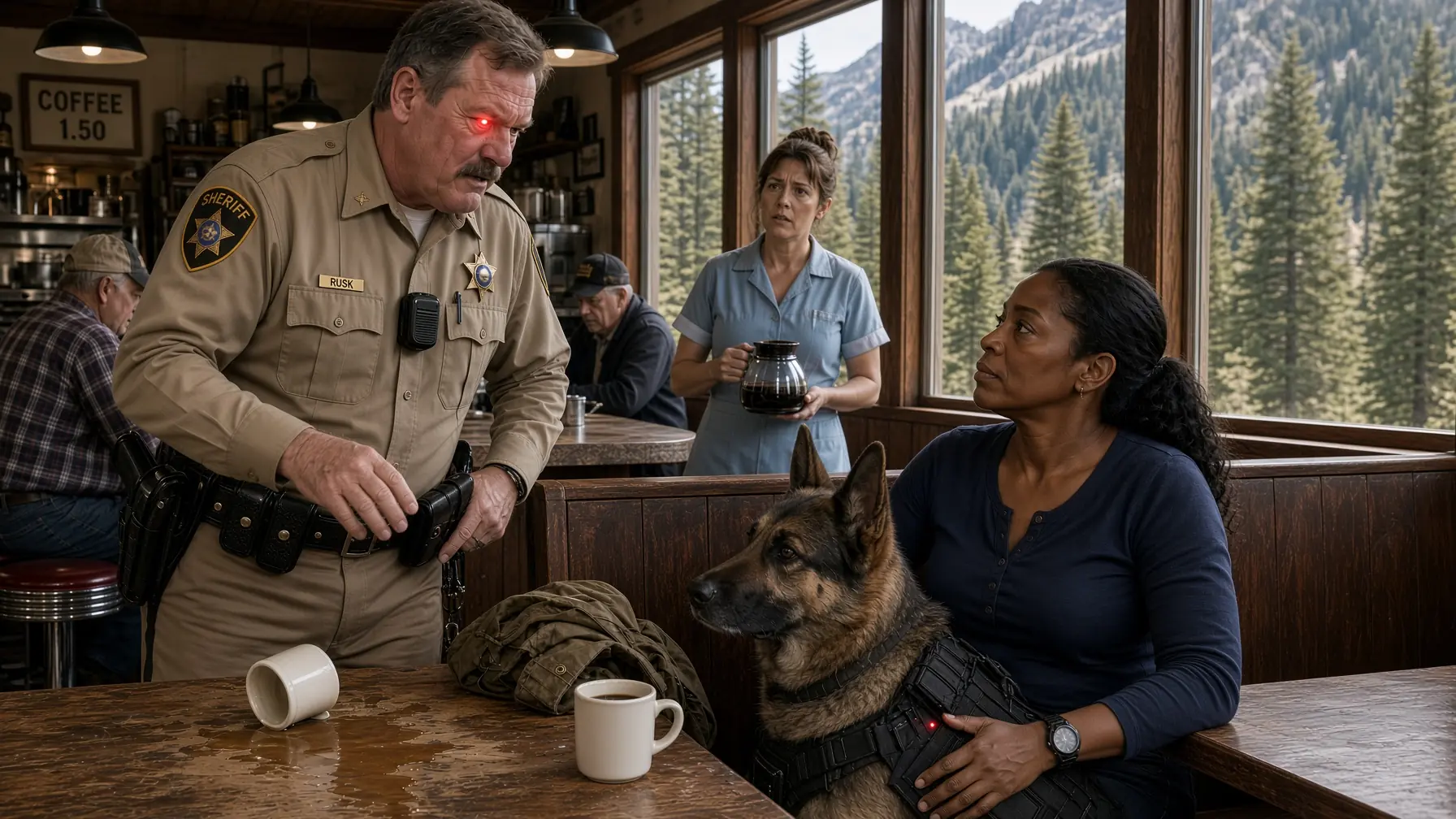
“Get that dog out of my diner,” Rusk growled, pointing toward the front door as if he owned the building, the road outside, and every soul breathing inside. “Or I’ll drag both of you out myself.”
Kodiak did not move. He sat beside my booth exactly the way he had been trained to sit years earlier in louder places than this one, in hotter places, in places where men with rifles hid behind broken walls and calm was the only thing separating the living from the dead. His ears stayed forward, his spine straight, his dark eyes alert and unreadable.
I kept one hand on the harness at his shoulders and looked up at Rusk. “You’re sure you want to say that again?”
That only made him smile wider. He was a heavy man in his early fifties, broad through the chest and thick through the middle, with a tan sheriff’s uniform stretched tight over the kind of body that had stopped chasing suspects years ago and settled into bullying waitresses and motorists instead. His mustache twitched when he grinned, and there was something rotten in the confidence of his face, the kind that comes from a long habit of never being told no.
He hooked a thumb under the strap of his handcuffs. “You think that vest makes either of you untouchable?”
I glanced down once. My thumb brushed the underside of one reinforced flap stitched into Kodiak’s black service vest, and a tiny hidden recording indicator glowed to life beneath the fabric.
Rusk saw it. His hand froze on the cuffs.
I looked back up at him and said, very quietly, “No. But what’s inside it means you should choose your next words very carefully.”
For the first time since he had marched into that diner, the room went truly silent.
My name is Renee Lawson. I am forty-eight years old, Black, retired Navy, and very hard to scare. I spent twenty-two years in uniform, much of it learning how to listen to men who believed volume was power and threats were intelligence. I learned something useful in those years: people like Clayton Rusk almost always tell on themselves if you are patient enough to let them think they still control the room.
Kodiak came into my life in my final years of service. He was a retired military working dog, a dark sable German Shepherd with nerves of steel, ears like radar dishes, and a stare so steady it had made grown men confess to things no one had even accused them of yet. After retirement he became my partner in a different kind of work. Not combat. Not patrol. Documentation.
Three months before I rolled into Black Pine County, a former Navy corpsman named Daniel Reeves mailed me a padded envelope from this exact town. Daniel had served under me once, years earlier, and I remembered him as the sort of medic who kept extra gauze in his cargo pockets and always noticed who was bleeding before anyone else did. The envelope he sent me contained two things: a flash drive and a handwritten note.
The note read, If anything happens to me, don’t let them bury this. Sheriff Rusk is running this county like a private business. He’s taking property, threatening people, fixing reports, and everybody’s too scared to say it out loud. If you come, don’t come blind.
The flash drive was worse. Grainy phone videos. Photos of seized trucks that never appeared in county inventory. Statements typed in rough block letters from people too frightened to sign their names. Audio clips of Rusk threatening a rancher with zoning violations if he did not “cooperate.” A deputy laughing while someone cried in the background. And one clip that bothered me most: Daniel’s own voice, low and urgent, saying he thought Rusk had men inside county dispatch warning him anytime state officials got curious.
Two weeks after mailing that envelope, Daniel Reeves died in what the sheriff’s office called a single-vehicle accident on a canyon road. The local paper called it tragic. Nobody in town called it suspicious on the record.
I did.
I no longer wore a uniform, but retirement does not erase the instinct to finish what duty puts in front of you. I contacted an attorney I trusted, then a former JAG officer who now worked with the state inspector general, and then a civil-rights investigator in Denver who owed me a favor from a case five years earlier. We agreed on one thing quickly: if Black Pine County was as controlled as Daniel believed, the only way to get the truth was to walk into it quietly and let the right people underestimate me.
That was why I was sitting in Maggie’s Mountain Diner at midday with a dog at my feet and a plate of untouched eggs going cold in front of me.
The diner sat along a two-lane road beneath a line of pine-covered slopes, all rough timber beams and chrome stools and sun-faded booths. A bell over the door gave a tired jingle every time someone came in. The waitress, a narrow woman named Elise with red knuckles and the exhausted eyes of someone raising kids on tips, had served me coffee without asking questions. But when I mentioned Daniel Reeves and asked if he had spent time here, something in her face changed.
Fear first. Then recognition. Then the quick, practiced blankness of a woman who knew walls had ears.
She had only managed to say, “He used to sit in Booth Six,” before the diner door opened and Sheriff Clayton Rusk filled the frame.
He did not come in like a man stopping for lunch. He came in like a man answering an alarm. His eyes moved across the room once, found me at the corner booth, dropped to Kodiak, and hardened. Behind him, one of his deputies lingered near the entrance, young, nervous, and suddenly fascinated by a gum rack beside the register.
Rusk walked straight to my table.
“Pets don’t eat in here,” he said.
“He’s not a pet,” I answered.
“I don’t care what you call him.”
“He’s retired military,” I said. “And he’s lying under my booth minding his business better than most people in this county seem capable of.”
That was when the waitress stopped moving. That was when the old rancher at the counter pretended to study his pie. That was when the couple by the windows went quiet halfway through a conversation. The whole room knew the weather had changed.