Marcus Hale pulled his coat tighter as the November rain hammered against the windows of Murphy’s Roadside Diner outside Columbus, Ohio. Across from him, his six-year-old daughter Lily swung her legs beneath the booth while coloring a smiling sun on a paper placemat. Friday dinner was their tradition, though lately it had become less a celebration and more a promise Marcus was struggling to keep. No matter how difficult the week became, Lily deserved one evening when she did not hear words like overdue, layoffs, or eviction.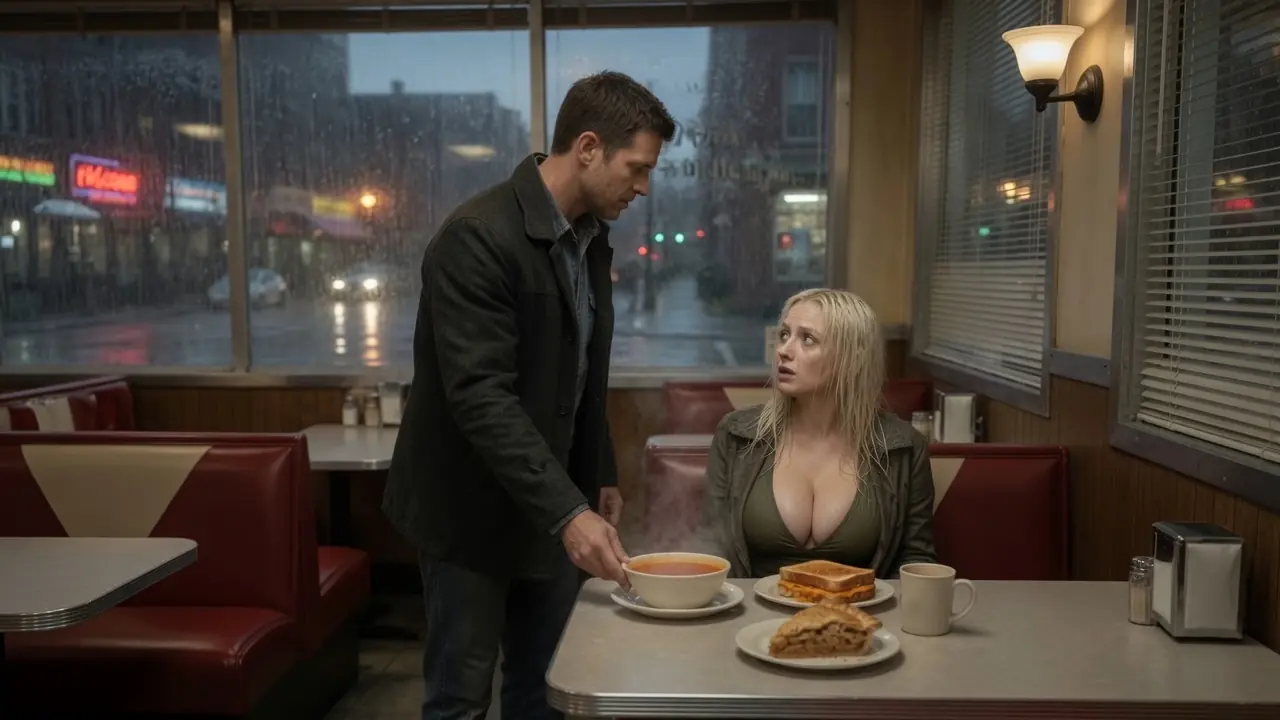
“Daddy, can I get the pancakes with the smiley face?” Lily asked.
Marcus studied the menu even though he already knew every price. He had twenty-three dollars in his wallet, and the pancakes cost seven after tax. His coffee and the cheapest sandwich would take another nine, leaving barely enough for the bus ride to Lily’s Saturday dance class.
“You can have the smiley pancakes,” he said.
“With strawberries?”
“Two strawberries.”
“Three.”
“You negotiate like your mother.”
Lily grinned. “Did Mommy always win?”
“Almost always.”
The smile remained on Marcus’s face only until Lily looked back at her drawing. His wife, Rebecca, had died three years earlier after a sudden illness that moved too quickly for either of them to prepare. Medical bills consumed their savings, and Marcus lost his apartment when the auto-repair garage where he worked closed without warning. He and Lily now lived in a narrow rental house with a leaking bathroom ceiling and a landlord who had stopped pretending to be patient.
Marcus was thirty-six, trained as a mechanic, and willing to work. What he lacked was luck and someone willing to ignore the four-month gap in his employment history. He repaired cars from his driveway, delivered groceries at night, and accepted temporary warehouse shifts whenever they appeared. Most weeks, he earned enough to keep disaster waiting outside the door.
The diner entrance opened.
Cold rain swept across the tiled floor before the door closed behind a woman. She appeared to be in her mid-thirties, though exhaustion made her look older. Her blonde hair was soaked against her cheeks, mud stained the knees of her dark trousers, and she wore a thin jacket with one torn sleeve.
She stood near the entrance without moving.
The cashier looked up, recognized immediately that the woman carried no umbrella or proper bag, and returned to the register. A waitress passed while holding two plates but did not ask whether she needed help. Several customers glanced at the stranger and then lowered their eyes with the practiced speed of people protecting themselves from responsibility.
The woman took one step toward an empty booth.
Manager Victor Shaw emerged from behind the counter. “Customers only.”
“I only need to get dry for a few minutes,” she said.
“This is not a shelter.”
“I understand.”
“Then you understand why you need to leave.”
Marcus watched the woman’s hands. They trembled at her sides, and one hand was swollen near the wrist. She looked toward the steaming plates moving through the diner before quickly turning away.
Lily noticed too.
“Daddy, is she hungry?”
Marcus lowered his voice. “Probably.”
“Does she have pancakes?”
“I don’t think she has anything.”
Lily looked at her plate, which had not yet arrived. “She can have one of my strawberries.”
The woman turned toward the door.
Marcus stood before he could calculate whether kindness fit inside the twenty-three dollars in his wallet. He crossed the diner and stopped several feet from her, careful not to block her path. She looked at him with immediate suspicion.
“My daughter and I have an empty seat,” he said. “You can sit until the rain slows.”
Victor folded his arms. “If she sits, someone pays.”
Marcus looked toward him. “Then someone will.”
The woman shook her head. “I don’t want trouble.”
“Neither do I.”
“You don’t know me.”
“I know you’re soaked.”
She glanced toward Lily, who waved from the booth. Something softened in the woman’s expression. After several seconds, she followed Marcus across the diner and sat at the far end of the booth.
“My name is Marcus,” he said. “That is Lily.”
“I’m Claire.”
“Just Claire?”
“For now.”
Lily pushed a blue crayon toward her. “You can color if you’re sad.”
Claire stared at the crayon and almost smiled. “Thank you.”
The waitress arrived with Lily’s pancakes and Marcus’s coffee. She looked at Claire but placed no menu before her. Marcus asked for tomato soup, a grilled cheese sandwich, another coffee, and whatever pie remained from the afternoon.
Claire’s head lifted sharply. “No.”
“You don’t like tomato soup?”
“I cannot pay.”
“I did not ask you to.”
“Then cancel it.”
Marcus leaned closer. “When did you last eat?”
She looked away.
“Yesterday?” he asked.
Claire said nothing.
“Two days?”
Her eyes filled.
Lily stopped cutting her pancakes.
Claire lowered her voice. “Two mornings ago.”
Marcus felt the twenty-three dollars inside his wallet becoming smaller. He had promised to buy milk, needed bus fare, and still owed twelve dollars for Lily’s school field trip. None of those facts changed the woman sitting before him.
He looked toward the waitress. “Bring the food.”
Claire gripped the edge of the table. “Please don’t.”
“Why?”
“Because your daughter needs that money.”
“My daughter needs to eat, and she is eating.”
“You are taking food from yourself.”
“I have had worse dinners than coffee.”
Claire looked at Lily. “Your father should not spend his last money on a stranger.”
Lily cut one strawberry into two pieces. “Daddy says people aren’t strangers after they tell us their names.”
Marcus smiled despite himself. “Apparently, I say many things.”
The food arrived.
Steam rose from the soup, and melted cheese pressed between the toasted bread. Claire stared at the plate as though it might disappear if she reached too quickly. Then she pushed it away.
“Please take it back,” she whispered. “I haven’t eaten in two days, but I cannot pay you.”
Marcus returned the plate gently.
“Then tonight, you eat for free.”
Claire looked toward Lily. “You are taking food from yourself and your little girl for someone you met five minutes ago.”
“My daughter already has what matters.”
“What is that?”
“A father who will not teach her to ignore someone hungry.”
Claire covered her mouth.
For several seconds, she could not speak. Then she lifted the spoon, tasted the soup, and closed her eyes. She ate slowly at first, but hunger soon defeated the dignity she was trying to protect.
Marcus pretended not to notice.
Lily told Claire about school, dance class, and the class hamster who bit their teacher. Claire listened while eating, occasionally asking questions. By the time she reached the pie, some color had returned to her face.
Victor approached with the bill.
“Twenty-seven forty.”
Marcus looked at the total. “That includes three meals?”
“And the pie.”
He counted his cash. Twenty-three dollars, plus four dollars and twelve cents in coins. Not enough after tax.
“I can leave my driver’s license and return tomorrow with the rest.”
Victor laughed. “This is a diner, not a bank.”
The waitress, Maria Torres, stepped behind him. “I’ll cover the difference.”
Victor turned. “Stay out of it.”
“It is four dollars.”
“It is the principle.”
Claire reached inside her torn jacket and removed a small silver bracelet. “Take this.”
Marcus stopped her. “No.”
“It is worth more than the meal.”
“I said no.”
Victor held out his hand. “Jewelry works.”
Marcus stood.
The manager was taller, but Marcus had spent years lifting engines and heavy equipment. He did not threaten Victor or raise his voice. He simply stepped between the man and Claire.
“You will not take her bracelet.”
“Then pay the bill.”
Maria placed five dollars on the table. “It is paid.”
Victor looked at her for a long moment before taking the money.
“You will regret encouraging this,” he said.
Maria collected the plates. “I regret many things. Feeding someone is not one of them.”
After Victor left, Claire removed the silver bracelet anyway. It was engraved with two letters.
E.B.
Marcus looked at it. “Who is E.B.?”
“My mother.”
“Keep it.”
“She gave it to me before she died.”
“Then you should never have offered it.”
Claire slid it back beneath her sleeve. “I have learned that survival makes people trade things they once believed were untouchable.”
Marcus understood more than she knew. He had sold Rebecca’s car, wedding jewelry, and most of the furniture she chose for their first home. The only things he had refused to sell were her photographs and the music box she gave Lily before entering the hospital.
“Where will you sleep tonight?” he asked.
Claire looked toward the rain.
“There is a bus station.”
“It closes at midnight.”
“I know.”
“Do you have anyone to call?”
“No one safe.”
The final word changed the question.
Marcus glanced toward Lily. Bringing an unknown adult home was not responsible, especially with his daughter present. Leaving Claire outside in the storm did not feel responsible either.
Maria overheard them.
“My sister volunteers at a women’s shelter on Franklin Avenue,” she said. “They sometimes keep one emergency bed.”
She called.
The shelter was nearly full but agreed to accept Claire for the night if she arrived within an hour. Marcus had enough money for only one bus fare after paying the bill, so Maria found an old umbrella behind the counter and called a rideshare using her own account.
Claire stood beside the booth holding the umbrella and a paper bag containing half her sandwich.
“You did not need to do this,” she told Marcus.
“I know.”
“Why did you?”
He looked at Lily, who was placing the unused crayons inside Claire’s bag.
“Because three years ago, people helped us when I had no idea how to ask.”
Claire studied his face. “What happened?”
“My wife died.”
“I’m sorry.”
“So am I.”
Lily took Marcus’s hand.
Claire knelt carefully in front of her. “Thank you for the crayons.”
“You need them more.”
“Why?”
“So you can draw a sun when it rains.”
Claire’s face broke.
She embraced Lily only after the child opened her arms first. Then she stood and looked at Marcus with tears moving down her cheeks.
“What is your last name?”
“Hale.”
“Where do you live?”
Marcus became cautious.
Claire seemed to understand. “You are right. Do not tell me.”
She removed a napkin and wrote something before folding it twice.
“If anyone ever comes asking about me, call this number first.”
Marcus opened the napkin after she left.
It contained the name Evelyn Grant, followed by a law office telephone number.
No explanation.
During the following week, Marcus called the shelter twice. Staff refused to reveal private information but confirmed that Claire had arrived safely. On the third call, they said she was no longer there.
Marcus dialed Evelyn Grant’s office.
A receptionist asked for his name, placed him on hold, and returned several minutes later.
“Ms. Grant cannot discuss Claire Bennett.”
“I only want to know whether she is safe.”
Another pause followed.
“She is receiving assistance.”
“Can you tell her Marcus and Lily called?”
“We will deliver the message.”
The line ended.
Marcus searched Claire Bennett online that night. The name produced hundreds of results, but one photograph made him stop.
The woman looked healthier, professionally dressed, and nearly unrecognizable. Yet the eyes were the same.
Claire Bennett, Acting Chairwoman of Bennett Family Hospitality, Missing During Estate Dispute.
The article was six weeks old.
Claire was the daughter of Eleanor Bennett, founder of a national group of diners, hotels, and food-distribution businesses. After Eleanor died, Claire inherited controlling shares through a trust. Her cousin, Grant Bennett, publicly claimed she had experienced a breakdown and disappeared after financial irregularities were discovered.
Another article described her as unstable.
A third claimed she stole company money before vanishing.
Marcus read until nearly two in the morning.
Something felt wrong.
The woman who counted every bite and offered her mother’s bracelet for four dollars had not looked like someone hiding stolen millions. She looked like someone who had been stripped of everything and was afraid the people responsible might find her.
Two days later, Victor fired Marcus from a temporary delivery job connected to the diner. Victor had learned that Marcus worked occasional shifts unloading restaurant supplies and told the owner Marcus had brought a dangerous fugitive into the building.
The claim was false, but fear moved faster than facts.
Marcus lost another source of income.
His landlord delivered a seven-day notice the same afternoon.
“Daddy,” Lily asked that evening, “are we moving again?”
Marcus taped plastic beneath the leaking bathroom ceiling. “Maybe.”
“Did we do something bad?”
“No.”
“Then why do bad things happen?”
He lowered the tape and looked at her.
“Sometimes people make choices that hurt us. Sometimes life is simply difficult.”
“Is Claire okay?”
“I hope so.”
“Maybe she is drawing a sun.”
Marcus smiled. “Maybe.”
Three weeks passed.
No one called.
Marcus found another temporary job at a tire warehouse, but the hours were inconsistent. He sold his remaining professional tools to pay part of the rent, keeping only one socket set that had belonged to his father.
On a cold Monday morning, someone knocked on the front door.
Marcus looked through the window and saw a black sedan parked beside the curb. Two women stood on the porch wearing dark coats and carrying leather cases. One was in her fifties with silver-streaked hair, while the other appeared younger and held a thick folder.
Lily looked up from the kitchen table. “Are they police?”
“I don’t think so.”
Marcus opened the door but kept one hand on the frame.
“Mr. Marcus Hale?” the older woman asked.
“Yes.”
“My name is Evelyn Grant. This is my associate, Rebecca Sloan. We represent Claire Bennett.”
Marcus recognized the name from the napkin.
“Is she alive?”
Evelyn’s expression softened. “Yes.”
He released a breath he had not realized he was holding.
“May we come inside?”
Marcus looked at Lily, then stepped aside.
The house seemed smaller with the two attorneys seated at the kitchen table. Evelyn noticed the bucket beneath the leaking ceiling but made no comment. Rebecca placed several documents on the table while Lily watched from the hallway.
“Claire asked us to tell you the complete truth,” Evelyn began.
Claire had not stolen company money.
After her mother died, Claire discovered that Grant Bennett and several executives had been diverting funds through false vendor contracts. When she attempted to freeze the accounts, Grant used forged medical reports and manipulated trust documents to challenge her legal capacity.
“He controlled her phones, vehicles, and security team,” Evelyn explained. “Claire escaped before he could have her placed under involuntary supervision.”
“How did she become homeless?”
“Her cards were canceled. Her accounts were frozen. People she trusted reported her location.”
Claire spent twenty-seven days moving between shelters, stations, and public buildings while Evelyn’s team sought an emergency court order. She avoided contacting friends because Grant’s investigators monitored them.
The night Marcus found her, she had been assaulted by two men attempting to recover a storage key containing financial evidence. The swollen wrist and torn jacket came from that struggle.
“Why didn’t she tell me?” Marcus asked.
“Because telling you could have placed you and Lily at risk.”
“Where is she now?”
“Safe.”
“Has she recovered the company?”
Evelyn opened the folder.
A court had restored Claire’s authority, frozen Grant Bennett’s assets, and appointed independent investigators. Evidence from the storage unit confirmed years of embezzlement. Grant and two executives now faced criminal charges.
Marcus leaned back in his chair.
“So why are you here?”
Rebecca placed a sealed envelope before him.
“Claire prepared this.”
Marcus did not touch it. “Is it money?”
“Partly.”
“Then I don’t want it.”
Evelyn smiled faintly. “She expected that response.”
“I bought her dinner.”
“You lost employment because you helped her.”
“That was Victor’s choice.”
“You also used your last money when your daughter needed it.”
Marcus looked toward Lily.
“I will not accept a fortune because I bought soup.”
“It is not a fortune.”
“That depends on the number.”
Rebecca opened another document. “Claire purchased the building containing Murphy’s Roadside Diner.”
Marcus stared at her.
“Why?”
“Bennett Family Hospitality owned the original diner chain before selling several locations years ago. Claire wants to reopen Murphy’s as the first location of a new community dining program.”
“I am a mechanic.”
“You are also the person she wants as operations supervisor.”
Marcus laughed in disbelief. “She met me once.”
“She investigated you thoroughly.”
“That is not comforting.”
Evelyn acknowledged the point with a nod.
Claire’s team confirmed his work history, references, caregiving record, and financial struggles. They also interviewed Maria, shelter employees, and customers who witnessed the diner incident.
“Claire is not offering you ownership without conditions,” Evelyn said. “She is offering paid training, stable employment, health insurance, and housing assistance included in the standard relocation package.”
Marcus looked at the leaking ceiling.
“And if I refuse?”
“Nothing happens.”
“She does not demand repayment?”
“No.”
“Then what is inside the envelope?”
“A letter.”
Marcus opened it.
The handwriting was careful but uneven.
Marcus,
The night we met, I believed every person eventually asked what my name could buy them. You fed me before you knew whether I was useful, wealthy, innocent, or even honest. You did not rescue me. You reminded me I was still someone worth rescuing myself.
I cannot repay kindness because doing so would turn it into a transaction. I can only place a door where you may choose to walk through it. The job is real. The salary is fair. The house belongs to the company and remains available only while you decide whether this future fits your family.
Lily told me to draw a sun. I did. It is still on my desk.
Claire
A small drawing slipped from the envelope.
It showed a yellow sun above three figures standing outside a diner. One tall, one small, and one with blonde hair.
Lily ran from the hallway and picked it up.
“She remembered.”
Marcus rubbed one hand over his face.
“Can we see her?” Lily asked Evelyn.
“Soon, if your father agrees.”
Marcus looked toward the employment documents. He had spent years refusing help because every favor seemed to create a hook someone could pull later. Yet Claire’s offer had been structured to preserve choice rather than purchase gratitude.
“I need to read everything,” he said.
Evelyn smiled. “Claire insisted you would.”
He reviewed the contract over three days with an independent attorney provided through a workers’ assistance organization. He changed two clauses, rejected a signing bonus he considered excessive, and requested training before accepting responsibility for employees.
Claire approved every change.
Marcus accepted.
Murphy’s closed for renovation one month later. Victor’s employment ended after an audit found wage violations, missing inventory, and manipulated staff records. Maria Torres became dining-room manager, while her brother Miguel took control of the kitchen.
The new restaurant reopened as Bennett’s Open Table.
One meal during every shift was reserved for anyone who could not pay. The system required no public explanation or proof of hardship. Employees simply entered a code and served the meal with the same plates, portions, and respect given to every other customer.
Claire returned on opening night.
She wore a simple navy dress and carried no security display, though two plainclothes officers waited nearby. She stopped just inside the entrance when she saw Marcus and Lily standing beside the first booth.
Lily ran to her.
Claire knelt and held the child tightly.
“You drew the sun,” Lily said.
“I did.”
“Was it hard?”
“At first.”
Marcus waited until Claire stood.
“You look different.”
“I have slept.”
“That helps.”
They smiled awkwardly.
Marcus extended his hand. Claire looked at it, then stepped forward and embraced him instead. The hug was brief, careful, and filled with everything neither could say in front of the crowded diner.
“You did not have to rebuild my life,” Marcus whispered.
“I rebuilt a restaurant.”
“With my name on the payroll.”
“You work very hard.”
“You checked.”
“I checked everything.”
He laughed.
Their relationship grew slowly over the following year.
Claire remained busy repairing the company and facing the public consequences of her family’s betrayal. Marcus learned restaurant management, hired several single parents, and created a vehicle-maintenance program that reduced delivery costs enough to impress executives who had initially doubted him.
He never became wealthy overnight.
He earned a salary, paid his debts, and moved Lily into a safe company-owned house near a good school. Claire established no secret inheritance and demanded no gratitude. She simply kept the door open.
On the first anniversary of their meeting, rain struck the diner windows again.
Claire sat in the same booth where Marcus had first placed soup before her. Lily, now seven, delivered a plate containing tomato soup, grilled cheese, coffee, and pie.
“That will be twenty-seven forty,” Lily announced.
Claire looked toward Marcus. “Prices have not changed?”
“Your company approved the menu.”
“I should review management.”
Marcus sat across from her.
“You could have gone anywhere that night,” he said.
“I had nowhere.”
“You could have asked for help.”
“I had forgotten how.”
“And now?”
Claire looked around the diner.
Maria greeted a tired nurse without rushing her. Miguel passed food through the kitchen window, while an elderly man ate quietly beneath the suspended-meal sign. Nobody asked whether he could pay before bringing water.
“Now I know some doors open before a person explains why they need them.”
Marcus reached across the table.
Claire placed her hand inside his.
The lawyers had arrived carrying documents, but the papers were never the greatest truth they revealed. Claire had possessed wealth before becoming homeless, and Marcus had possessed dignity before becoming stable.
Neither saved the other with money.
He reminded her that kindness could exist without desire for power.
She reminded him that accepting an honest opportunity was not the same as surrendering independence.
Lily watched their joined hands and smiled.
“Are you going to kiss?”
Marcus nearly dropped his coffee.
Claire laughed for the first time without fear.
“Finish your homework,” he told Lily.
“That means yes.”
When Lily returned to the counter, Claire leaned closer.
“Your daughter negotiates like you.”
“No. She wins like her mother.”
Claire touched his cheek.
Their first kiss was soft, unhurried, and chosen long after debt, gratitude, and rescue had been removed from the space between them.
Outside, November rain continued falling.
Inside, the soup remained hot, the door remained open, and no hungry person was required to prove they were important before receiving a place at the table.