Clare Donovan had spent most of her adult life proving that she did not need anyone to rescue her. At thirty-four, she was the founder and chief executive officer of Donovan Enterprises, a company that had begun in a cramped Denver office with two borrowed laptops and grown into a national logistics business with offices in six cities. Business magazines described her as disciplined, fearless, and impossible to distract. None of them knew that those qualities had been built around an old wound she refused to name.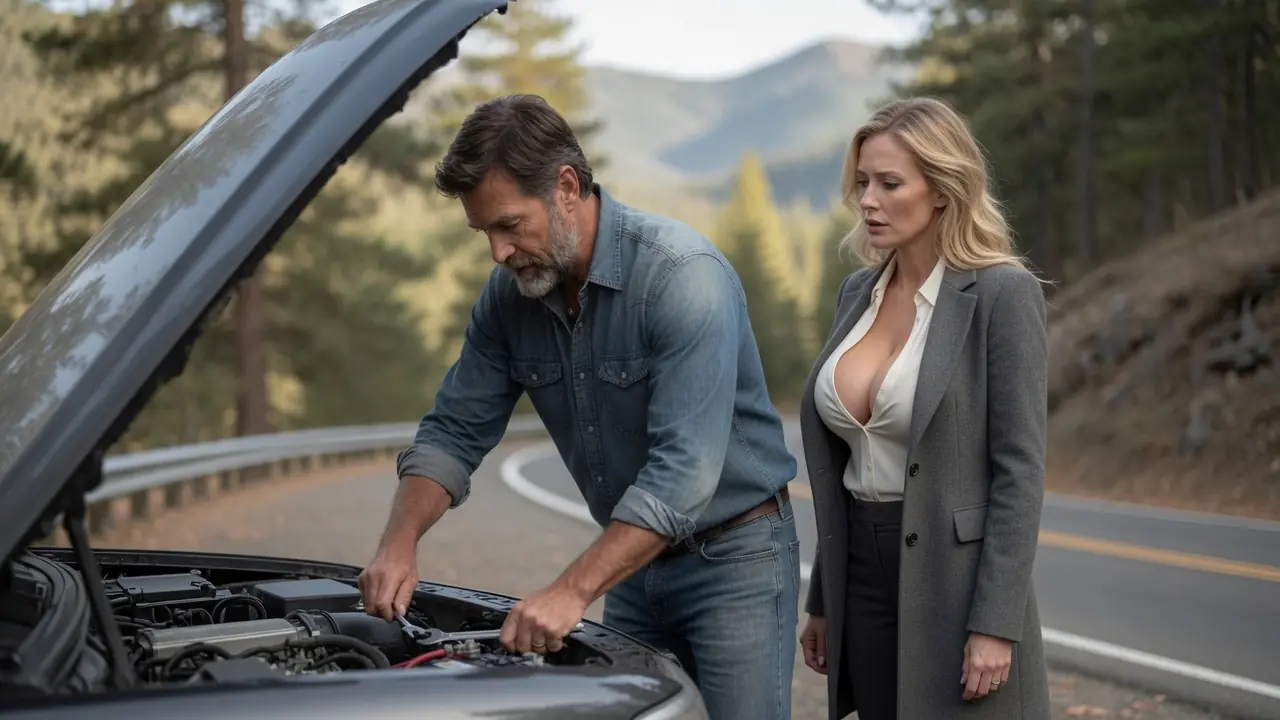
On a clear October morning, Clare left Denver before sunrise for an investor retreat outside Aspen. Her executive assistant had offered to accompany her, but Clare wanted the three-hour drive alone before spending the weekend surrounded by people asking about expansion, profits, and acquisitions. She wore a gray coat over a white blouse and black trousers, with a cream designer suit hanging inside a garment bag in the rear seat. For the first hour, the quiet felt like freedom.
The highway narrowed as it climbed into the mountains. Pine trees covered the slopes, their dark green broken by the yellow leaves of aspens trembling in the wind. Clare was twenty miles from the resort when the temperature gauge on her dashboard began rising. A warning light flashed, and seconds later, the engine lost power.
She guided the black sedan onto the gravel shoulder before it stopped completely. Steam curled from beneath the hood, disappearing into the cold mountain air. Clare remained behind the wheel for several seconds, staring at the dashboard as though determination alone might restart the engine. Then she reached for her phone and discovered there was almost no signal.
She stepped outside and raised the hood, though she understood very little about engines. The road was quiet except for wind moving through the trees. She tried calling roadside assistance, but the call failed twice before disconnecting. The third attempt placed her on hold and then vanished when the signal disappeared again.
Clare looked at her watch. The investors expected her by noon, and the first private meeting was scheduled for twelve-thirty. Missing it would not destroy the company, but lateness made her feel powerless. She had spent fifteen years arranging her life so that nothing unexpected could ever control her again.
An old blue pickup appeared around the bend.
It slowed as it approached and pulled onto the shoulder behind her sedan. A man stepped out wearing faded jeans, work boots, and a denim shirt with the sleeves rolled to his elbows. His dark hair had begun turning gray near the temples, and a short beard covered the face Clare had once known better than her own.
She did not recognize him immediately.
The man walked toward the open hood carrying a metal toolbox. His movements were calm and practiced, without the uncertainty of someone stopping only to offer directions. He nodded toward the engine.
“Trouble?”
“The temperature warning came on, and then it lost power,” Clare replied. “Roadside assistance isn’t answering.”
“I have some tools. Let me look.”
Clare stepped aside. “Are you a mechanic?”
“Most days.”
He leaned beneath the hood, checking the coolant reservoir and the battery connections. Clare watched his hands move across the engine, strong and grease-marked, with a thin white scar near his right thumb. Something about that scar stirred an old memory of a teenage boy cutting his hand while repairing a broken fence behind her parents’ house.
The man glanced at her again.
His eyes were blue.
Clare’s breath caught, but her mind rejected what her heart recognized. Fifteen years had passed. The boy she remembered had been leaner, clean-shaven, and always smiling as though the world had not yet taught him how easily it could take something away.
“Please hurry,” Clare said, using impatience to cover the sudden trembling in her voice. “I can’t lose another meeting because of a broken car.”
The man tightened a battery cable and looked down.
“You used to care more about people than meetings, Clare-bear.”
The mountain road seemed to become completely silent.
Only one person had ever called her that. Noah Bennett had invented the nickname when they were seventeen, after Clare admitted she hated being called Claire because teachers always added the extra letter. He had laughed, pulled her close beneath the bleachers, and told her he would call her something no one else could steal.
“Noah?” she whispered.
He slowly straightened.
The years between them remained visible in his face, but they no longer hid him. His eyes still narrowed slightly when he was hurt. His left shoulder still rested lower than the right. Even the way he pressed his lips together before speaking was painfully familiar.
“Hello, Clare.”
She took one step closer, then stopped. “I thought you left Colorado.”
“I did for a while.”
“You disappeared.”
Noah looked toward the engine. “That’s not how I remember it.”
Clare felt the old anger rise before she could control it. “You stopped calling. You never came to the train station. I waited until midnight.”
“I was there.”
“No, you weren’t.”
“I stood across the street for almost two hours.”
Her voice sharpened. “Then why didn’t you come to me?”
Noah picked up a wrench, though the car no longer held his attention. “Because your father’s driver was beside you, and two men were watching my truck.”
Clare stared at him. “What are you talking about?”
He shook his head. “This isn’t the place.”
“You called me by that name after fifteen years. You don’t get to decide this isn’t the place.”
A gust of wind swept leaves across the shoulder. Noah looked down the road, then back at her. His expression carried something deeper than anger. It looked like exhaustion from carrying a truth too long.
“I wrote to you every week,” he said.
Clare’s hands became cold. “I never received a single letter.”
“I know that now.”
“You knew where I was living.”
“I mailed them to your college dorm, your parents’ house, and your aunt’s place in Boulder. Every letter came back or disappeared.”
“That’s impossible.”
“Your father made sure it happened.”
Clare shook her head, but the movement felt weak. “My father told me you had decided college wasn’t for you. He said you left with friends and didn’t want me following.”
Noah laughed once, without humor. “Your father told me you were embarrassed by me and wanted a clean beginning.”
“I never said that.”
“I know.”
Clare moved closer and touched his grease-stained hand before she realized what she was doing. Noah froze beneath her fingers. The contact was small, but it opened something she had locked away for half her life.
“Noah,” she whispered, “I would’ve waited.”
His fingers slowly closed around hers. “I wrote every week.”
Tears burned behind her eyes. Clare lifted her free hand and touched the gray beginning in his beard, searching his face for the boy she had loved and the man she had lost. “Then don’t disappear again.”
Noah covered her hand with his. “I never stopped loving you.”
The words should have brought relief. Instead, they exposed how much had happened while they were apart. Clare withdrew slowly, suddenly aware that Noah might have a wife, a family, and a life that had nothing to do with the girl he once loved.
“You have a ring mark,” she said, looking at his left hand.
Noah followed her gaze. “I took it off four years ago.”
“I’m sorry.”
“Don’t be. The marriage ended before my daughter was born.”
“You have a daughter?”
“Emma. She’s nine.”
Clare nodded, though the news unsettled her more than she expected. Noah had become a father while Clare was building a company and refusing every relationship that threatened to become important. She had attended awards ceremonies, negotiated acquisitions, and purchased a glass apartment overlooking Denver. Noah had taught a child to read, ride a bicycle, and trust him to return home.
“Where is Emma now?” Clare asked.
“At school in Pine Ridge. I was driving back from a service call when I saw you.”
“You live nearby?”
“My shop is seven miles down the road.”
Clare looked toward his pickup and noticed the faded lettering on the door: Bennett Mobile Repair and Recovery. Beneath it was a phone number and the words Family Owned Since 1987. The sight brought another memory of Noah’s father teaching them to change a tire while Clare’s expensive shoes sank into the dirt.
Noah returned to the engine. “Your radiator hose split. I can patch it well enough to reach my shop, but you shouldn’t drive to Aspen until I replace it.”
“I have a meeting.”
“You have an engine that won’t survive the climb.”
“I can send another car.”
“That would be smarter.”
Clare watched him work. “You always hated when I tried to argue with machinery.”
“I hated when you believed money could frighten a broken engine into obedience.”
Despite herself, she smiled.
Noah glanced at her, and for one brief second, fifteen years vanished. Then his expression closed again. He finished the temporary repair and told Clare to follow him slowly to Pine Ridge.
The town consisted of a gas station, a diner, a school, and several blocks of weathered houses gathered beneath the mountains. Bennett Repair stood near the edge of town in a converted service station with two garage bays and a small office. An old red bicycle leaned against the wall beside a row of carefully organized tools.
A girl sat at a desk inside the office, completing homework beneath a fluorescent light. She had Noah’s blue eyes and dark hair pulled into a messy ponytail. When the vehicles arrived, she dropped her pencil and ran outside.
“Dad, Mrs. Turner said school closed early because the heater broke.”
Noah opened his arms, and Emma stepped into them without embarrassment. He kissed the top of her head before introducing Clare. “Emma, this is an old friend.”
Emma studied Clare’s coat, polished shoes, and disabled sedan. “Did Dad rescue you?”
“My car needed rescuing,” Clare answered.
“Dad says cars are easier than people because they tell you where they hurt.”
Noah gave his daughter a warning look. “I also say not to repeat everything I tell you.”
Emma smiled. “Only the good things.”
Clare felt something tighten in her chest. Noah had always wanted children. At nineteen, he had once told her he imagined a noisy house, a dog, and a kitchen table covered with homework. Clare had imagined it with him until the night she believed he had chosen another life.
Noah ordered the correct hose from a parts supplier and said it would arrive the next morning. Clare called her assistant from the office phone and postponed the investor meeting. A driver could reach Pine Ridge in two hours, but the mountain road would close after sunset because of an approaching storm.
“You can wait at the diner,” Noah suggested. “Your driver can meet you there.”
Clare looked through the office window at him working beneath her hood. “I’ll stay here.”
Emma glanced between them. “How old is this friendship?”
“Very old,” Noah said.
“How old?”
“Older than you.”
“That’s not very old.”
Clare laughed, surprising herself. She could not remember the last time laughter had come without effort. Emma invited her to sit at the desk and showed her a school project about family history.
One page contained a photograph of Noah at eighteen.
He stood beside the same blue pickup parked outside, though the paint had been brighter then. His arm rested around a girl whose face had been carefully cut from the photograph. Clare recognized her own white summer dress and the silver bracelet around her wrist.
“What happened to the other person?” Clare asked.
Emma looked toward the garage bay. “Dad said someone cut her out before I was born.”
Noah appeared in the doorway. “Homework, Emma.”
“I’m doing family history.”
“Then use pictures that still have a family in them.”
The words were not cruel, but they struck Clare deeply.
When Emma returned to her assignment, Clare followed Noah into the garage. “Who cut me out of that photograph?”
“My ex-wife.”
“Why did you keep it?”
“Because it was the last picture taken before everything changed.”
Clare folded her arms against the cold. “Tell me exactly what my father did.”
Noah placed his wrench on the workbench.
Two weeks before they were supposed to leave together for college, Martin Donovan arrived at Bennett Repair in a black car. He carried copies of Noah’s application papers, his mother’s medical debt, and inspection reports connected to the family shop. Martin claimed he could make the debts disappear or use his influence to have the garage condemned.
“He said you deserved someone who could help build your future,” Noah said. “Not a mechanic’s son with a sick mother and a failing shop.”
“My father had no right.”
“He had money, lawyers, and people willing to do what he asked. At nineteen, that looked a lot like a right.”
“Why didn’t you tell me?”
“I tried.”
Noah explained that he called Clare’s home repeatedly, but her number was changed. When he drove to the train station, Martin’s men were waiting. One showed him photographs of Noah’s mother entering the hospital and warned that her insurance dispute could become much worse.
“I was afraid,” Noah admitted. “I told myself I was protecting my family.”
“And you believed I rejected you?”
“Your father showed me a letter with your signature.”
Clare’s face went pale. “What did it say?”
“That you had outgrown me. That you didn’t want me following you to Boulder.”
“I never wrote it.”
“I know that now, too.”
Clare stepped away from him. Her father had not merely hidden letters. He had forged her words and used them to break a boy who had trusted her.
“Do you still have it?”
Noah hesitated. “Yes.”
He walked into a storage room and returned carrying a dented metal box. Inside were photographs, train tickets, dried flowers, and letters tied together with a faded blue ribbon. Some envelopes bore Clare’s college address. Others had been marked Return to Sender despite being written correctly.
At the bottom lay the forged letter.
Clare recognized the imitation of her teenage signature immediately. It was close enough to deceive someone who wanted to believe it, but the final stroke curved in the wrong direction. She read the first paragraph, then stopped because the false words were too cruel.
“I would never have written this.”
“I know.”
“How?”
Noah looked at her. “Because even when I hated you, I couldn’t make the girl I loved sound like the person who wrote it.”
Clare pressed the letter against her chest. “Why keep all of this?”
“Because throwing it away felt like agreeing that it never happened.”
She reached for his hand again. This time, Noah did not move away. They stood in the cold garage while Emma quietly completed her homework in the office.
The storm arrived before Clare’s driver reached Pine Ridge. Snow began covering the mountain road, and authorities closed the pass. The town’s only motel had no vacancies because several travelers had already stopped there.
“You can take my room,” Emma announced. “I’ll sleep on the couch.”
Clare looked at Noah. “I can stay in the office.”
“The office heater barely works,” he said. “Our house is behind the shop. You can stay there.”
The small house was nothing like Clare’s Denver apartment. Its floors creaked, the furniture did not match, and children’s drawings covered the refrigerator. Yet the rooms felt lived in rather than displayed.
Emma made grilled cheese sandwiches while Noah heated tomato soup. Clare tried to help, but Emma moved her away from the stove after discovering she had never cooked grilled cheese. Noah leaned against the counter, watching with an expression that was almost amused.
“You run six offices but can’t make a sandwich?” he asked.
“I employ people with specialized skills.”
“Bread and cheese are specialized?”
“In this kitchen, apparently.”
Emma laughed so hard she nearly dropped the spatula.
After dinner, the electricity flickered. Noah lit two candles and found extra blankets. Emma asked Clare to tell a story about her father when he was young.
Clare described the night Noah climbed through the window of her parents’ guesthouse because she had been grounded for failing a chemistry test. He brought chocolate cookies and stayed until dawn helping her study. Noah interrupted to point out that Clare had received an A on the retest only because he copied answers from a textbook.
Emma stared at him. “You broke into a house?”
“I entered through an available opening.”
“You always tell me never to climb through windows.”
“That is because I gained wisdom.”
Clare looked at Noah across the candlelit room. “No. You became afraid of getting caught.”
The laughter faded.
Emma eventually fell asleep on the couch with her head against Clare’s shoulder. Clare remained still, afraid to disturb the unfamiliar trust. Noah lifted his daughter carefully and carried her to bed.
When he returned, Clare stood beside the kitchen window watching snow cover the yard.
“I’m sorry,” she said.
“For what?”
“For believing the worst of you.”
“You were nineteen.”
“So were you.”
“We were both told exactly what would hurt us most.”
Clare turned toward him. “I built my whole life on the belief that depending on someone made me weak.”
Noah leaned against the counter. “You built something extraordinary.”
“I built walls and called them offices.”
He moved closer. “Clare, finding out the truth doesn’t erase fifteen years.”
“I know.”
“You have a company, and I have Emma. We aren’t two teenagers waiting for a train anymore.”
“I know that too.”
She touched his cheek gently. “But when I saw you today, every part of me that had gone quiet started speaking again.”
Noah closed his eyes beneath her touch.
When he opened them, the distance between them had nearly disappeared. He placed one hand around her wrist, not pulling her closer and not letting her go. Clare waited, allowing him the choice her father had once stolen.
Noah kissed her softly.
It was not the desperate reunion Clare had imagined during lonely nights years earlier. It was careful, uncertain, and full of all the life they had lived apart. When they separated, Noah rested his forehead against hers.
“I’m scared,” he admitted.
“So am I.”
“That may be the first honest thing we’ve agreed on today.”
The next morning, Clare’s car was repaired, but she did not drive to Aspen. Instead, she called an emergency meeting in Denver and asked her father to attend. Martin Donovan had retired from daily business, but he remained an honorary board adviser and controlled a family investment fund connected to the company.
Clare arrived carrying the metal box.
Martin sat at the head of the conference table, silver-haired and perfectly composed. He smiled when Clare entered, but the expression vanished when she placed the forged letter in front of him.
“Where did you get this?”
“From Noah Bennett.”
Her father leaned back. “I haven’t heard that name in years.”
“I heard it yesterday.”
Martin looked toward the windows. “Clare, whatever he told you—”
“He told me you threatened his mother, his family’s shop, and his future.”
“I protected you.”
“You forged my signature.”
“You were young.”
“So was he.”
Martin’s voice hardened. “Noah Bennett would have tied you to a small town and a failing garage. You had the ability to become what you are now.”
“You decided love and ambition could not exist together because you never understood either one.”
“I gave you opportunities.”
“You stole my choice.”
The board members remained silent. Clare had asked them to attend because her father’s actions had involved company lawyers, private investigators, and financial pressure tied to early Donovan business interests. What Martin considered a private family decision had used corporate resources.
Clare placed copies of the letters on the table.
“Effective today, Martin Donovan will no longer serve as a board adviser,” she said. “The company will conduct an independent review of every employee and contractor involved in this interference.”
Martin stared at her. “You would humiliate your father for a mechanic?”
“No. I am holding a powerful man accountable for abusing that power.”
“You will regret this.”
Clare met his eyes. “My greatest regret was believing you knew what was best for my heart.”
Martin left without apologizing.
The investigation later confirmed that he had paid an employee at Clare’s college to redirect her mail. He had also pressured the Bennett family’s bank and contacted the hospital managing Noah’s mother’s debt. Several people had obeyed because Martin Donovan was wealthy enough to make cruelty look administrative.
Clare did not ask Noah to forgive him.
She also did not offer to solve Noah’s life with money. When she learned the repair shop was struggling, she asked to see his business plan rather than presenting him with a check. Noah showed her records proving that his mobile service was profitable but limited by outdated equipment and inconsistent commercial contracts.
Donovan Enterprises needed a reliable maintenance provider for vehicles operating throughout western Colorado.
Noah submitted a bid alongside six larger companies. Clare removed herself from the selection process. Three months later, Bennett Mobile Repair won the contract because it offered faster response times, lower overhead, and mechanics who already understood mountain conditions.
Noah hired two additional technicians.
Clare began visiting Pine Ridge on weekends. She continued leading her company from Denver, while Noah refused every suggestion that he relocate immediately. They learned to stop treating compromise as surrender.
Emma accepted Clare slowly.
At first, she worried the elegant woman in the cream suit would eventually decide the small house was not enough. Clare never promised she would stay forever. Instead, she returned when she said she would, attended Emma’s school concert, and learned to make grilled cheese without burning it.
One year after the breakdown, Clare and Noah drove back to the place where her car had stopped.
The mountain road was bright beneath the autumn sun. Noah parked the blue pickup on the shoulder, and they stood beside the trees as leaves moved in the wind. Clare carried the final letter Noah had written fifteen years earlier.
“I never opened this one,” she said.
“It was returned before it reached you.”
“Read it to me.”
Noah unfolded the paper.
The letter contained no grand promises. Nineteen-year-old Noah had written that he was frightened, that he did not understand why Clare had stopped answering, and that he would wait at the train station one final time. At the end, he had written that loving her was not something another person could command him to stop doing.
Clare wiped tears from her face.
“I’m sorry you waited alone,” she said.
Noah took her hand. “I’m sorry it took me fifteen years to find the road back.”
Clare leaned against his chest. “You didn’t find it.”
“No?”
“My car broke down in front of you.”
He laughed softly. “Then I suppose the engine deserves some credit.”
Clare looked up at him. “Can you fix what we lost?”
Noah touched her cheek. “No.”
Her expression fell slightly.
“But we can build something that doesn’t need to pretend those years never happened.”
Clare nodded.
He kissed her beside the repaired car, on the road where neither of them had expected to find the person they had buried inside the past. Noah could repair engines, but he could not return the time stolen from them.
What he could do was stay.
And for the first time in fifteen years, Clare allowed herself to believe that staying could be stronger than surviving alone.