Garrett Wade Morrison should have been home forty minutes earlier.
His seven-year-old daughter, Lucy, was waiting at his sister’s farmhouse with paper crowns, sparkling apple cider, and a handwritten list of New Year’s resolutions she had insisted they read together before midnight. Garrett had promised he would arrive before nine, carrying the chocolate pie she loved and the small wooden birdhouse he had secretly built for her during quiet hours at the garage. Yet the snow had started falling much faster than the forecast predicted, turning the mountain road into a narrow white corridor between dark Vermont pines.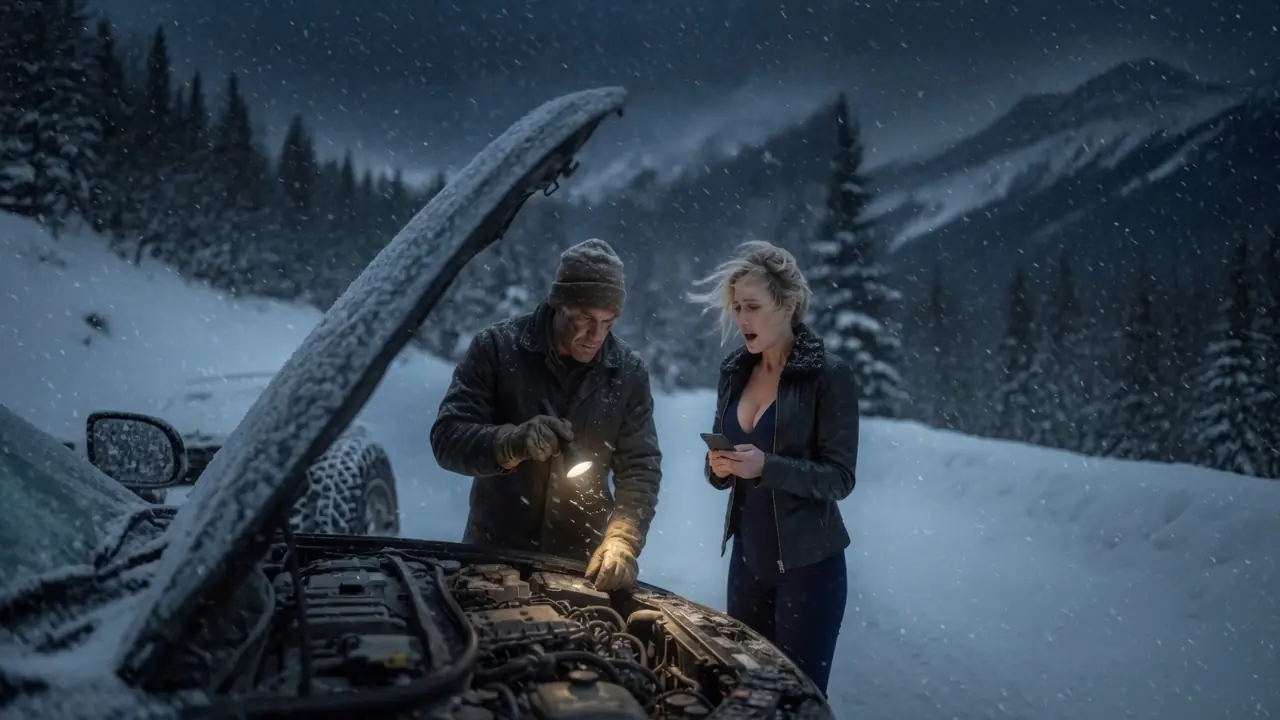
Garrett leaned forward over the steering wheel of his aging pickup and watched the headlights struggle against the storm. Snow pressed across the glass faster than the wipers could remove it, while wind pushed against the truck hard enough to make the body tremble. He had lived near Stowe most of his thirty-eight years and understood how quickly a harmless winter evening could become dangerous. Every sensible person should already have been indoors.
Then he saw the black car.
It sat partly across the shoulder near a curve, its emergency lights blinking weakly through the snow. The hood was raised, and a woman stood beside it wearing a dark coat over a burgundy dress that belonged inside a restaurant rather than on a frozen mountain road. Her blonde hair blew across her face as she held a phone toward the sky, apparently searching for a signal.
Garrett slowed.
For one second, he thought about Lucy waiting beside the window.
Then he remembered the temperature was falling, the road was nearly empty, and the woman could freeze before professional help reached her. He pulled ahead of the disabled car, positioned his truck as a barrier from approaching traffic, and switched on the roof light he used for roadside repairs. The woman turned sharply as he climbed out.
“Are you injured?” Garrett shouted over the wind.
“No,” she answered. “But I’ve already called roadside assistance.”
“Did they give you an arrival time?”
“Two hours.”
Garrett looked toward the dark road. “They won’t reach you in two hours.”
Her expression tightened. “That is what their application says.”
“The application isn’t driving through this storm.”
He stopped several feet away so she would not feel cornered. Up close, he noticed she was probably in her mid-thirties, with expensive gloves, polished boots, and the controlled posture of someone accustomed to being obeyed. She was visibly frightened but working hard to hide it.
“My name is Garrett Morrison,” he said. “I own Morrison Auto and Farm Repair down in Bellweather.”
Her eyes moved toward his weathered jacket and snow-covered pickup. “You’re a mechanic?”
“Yes.”
“This isn’t an ordinary car.”
Garrett glanced at the luxury sedan. “It still has an engine, battery, and wiring.”
Her tone cooled. “It has a highly integrated electrical system. The dealership warned me not to let an unauthorized shop work on it.”
Garrett almost returned to his truck.
He was tired, cold, and already late for the only person who cared where he spent New Year’s Eve. The woman had not thanked him for stopping and seemed more concerned about protecting the prestige of her vehicle than surviving the storm. Yet he saw her fingers trembling around the phone.
“What happened before it stopped?” he asked.
“The dashboard flashed several warnings. Then the steering became heavy, the lights dimmed, and the engine died.”
“Did you hear a belt snap?”
“No.”
“Any burning smell?”
She hesitated. “Something electrical, perhaps.”
Garrett nodded toward the hood. “May I look?”
She stared at him as snow gathered on her shoulders. “You understand that vehicle is worth more than most small repair shops.”
He met her eyes. “Then it’s fortunate the car doesn’t care how much money either of us has.”
The woman looked surprised.
Garrett waited.
Finally, she moved aside. “Do not damage anything.”
“I generally try not to.”
He returned to his pickup for gloves, an insulated work light, a multimeter, and a compact tool case. When he came back, the woman remained near the passenger side, still attempting to send messages. Garrett examined the engine compartment without touching anything at first.
The battery connections appeared secure. The main belt remained intact, and no obvious hose or component had failed. Garrett attached the meter, checked voltage, and found the battery nearly dead despite being relatively new.
“Try starting it,” he said.
She climbed behind the wheel.
The starter clicked once, then silence returned.
Garrett followed the main charging cable toward the alternator, checking each accessible connection. The fault did not appear immediately. Snow landed inside the engine compartment, and the wind repeatedly pushed his work light against the hood.
The woman stepped outside again. “Can you fix it?”
“I need to know what failed first.”
“My driver said the car was serviced two weeks ago.”
“Your driver?”
“Yes.”
“Then why are you driving alone through a blizzard?”
“That is not relevant.”
“It might be if the car has a recurring problem he noticed.”
She lowered her phone. “I gave the staff the evening off.”
Garrett looked toward her. “That was decent.”
Her expression softened slightly. “They have families.”
“So do mechanics.”
She understood the reminder. “Your family is waiting?”
“My daughter.”
“How old?”
“Seven.”
“And you stopped anyway?”
Garrett returned to the wiring. “I’d want somebody to stop for her.”
The answer silenced her.
He removed a battery cover and discovered discoloration near the main power-distribution connector. The plastic housing appeared intact from above, but when Garrett moved the cable, the connection shifted more than it should have.
“There you are,” he whispered.
“What?”
“The main charging connector overheated.”
“Why?”
“Loose internal contact, most likely. Vibration creates resistance, resistance creates heat, and eventually the connector burns enough to stop carrying current.”
“Can you replace it here?”
“Not with the correct factory part.”
She crossed her arms. “Then we are wasting time.”
“I said I can’t replace it. I didn’t say I can’t get you off this mountain.”
Garrett removed the damaged connection, cleaned the metal contact, and created a temporary bypass using a heavy-gauge repair lead from his emergency kit. It was not beautiful, but it would carry enough current to restart the vehicle and operate the charging system until she reached safety. He protected the connection from moisture, secured it away from moving components, and tested the circuit again.
The voltage stabilized.
“Start it now.”
The engine turned over immediately.
The woman’s mouth opened slightly as the dashboard lights returned. Garrett checked the alternator output, watched the reading remain steady, and then closed the hood carefully.
“This is temporary,” he said. “Do not drive farther than necessary. Keep the heater moderate, avoid unnecessary electrical loads, and have the connector replaced before using the car again.”
She stepped toward him. “You repaired it.”
“I made it mobile.”
She opened her handbag and removed several large bills. “What do I owe you?”
“Nothing.”
“Do not be ridiculous.”
“I was already traveling this road.”
“You used equipment and parts.”
“The repair lead cost less than dinner.”
She held out the money. “Take it.”
Garrett shook his head.
The woman looked almost offended by the refusal. “I can pay whatever you normally charge.”
“I’m not charging you.”
“Why?”
He turned toward the dark shape of his pickup. “Because someday my daughter may be the woman standing alone beside a dead car, and I hope whoever finds her cares more about getting her home than calculating an invoice.”
Something changed in the woman’s face.
For the first time, the authority disappeared. She looked less like an executive and more like a frightened person who had nearly been stranded alone in dangerous weather.
“What is your daughter’s name?”
“Lucy.”
“And yours is Garrett Morrison?”
“Yes.”
She glanced at the faded lettering on his truck. “Morrison Auto and Farm Repair.”
“That’s the place.”
“My name is Claire Whitmore.”
Garrett recognized the surname but could not immediately remember why. He extended his hand, and she shook it.
“Drive behind me until we reach the state road,” he said. “There’s a lodge about six miles down. You can wait there until the storm improves.”
“You’ve already done enough.”
“I know this road. Stay behind me.”
Claire did.
They moved slowly through the storm, Garrett’s pickup clearing a path while her sedan followed several car lengths behind. Twice, he stopped to move fallen branches. When they finally reached the Mountain Pine Lodge, Claire parked beneath the covered entrance.
She approached his window before he could leave.
“Your daughter is still waiting,” she said.
“Yes.”
“You should go.”
“That was the plan.”
“Garrett.”
He looked at her.
“I am sorry for the way I spoke to you.”
“You were scared.”
“I was also arrogant.”
He appreciated that she did not hide behind an excuse. “Then don’t repeat it.”
Claire nodded.
Garrett drove away.
By the time he reached his sister’s farmhouse, it was nearly eleven. Lucy ran across the living room wearing a silver paper crown and wrapped both arms around his waist.
“You’re late!”
“I know.”
“Aunt Beth said the road was dangerous.”
“It was.”
“Did you fix somebody’s car again?”
Garrett looked toward his sister, who smiled knowingly from the kitchen.
“Yes.”
Lucy sighed with the exhaustion of a child burdened by an unnecessarily helpful father. “Was it at least an interesting car?”
“Very expensive.”
“Did they pay you?”
“No.”
“Dad.”
Beth laughed.
Garrett lifted Lucy into his arms. “She was stranded in a blizzard.”
“That means she should pay extra.”
“You are becoming a very strict business manager.”
“I’m saving the garage.”
The joke hurt more than Lucy realized.
Morrison Auto and Farm Repair was in serious trouble.
The garage had belonged to Garrett’s father, Wade Morrison, who opened it beside the old family house in 1988. For years, local farmers, delivery companies, and residents brought everything from tractors to pickup trucks through its doors. Wade had been trusted because he repaired only what needed repairing and treated every customer as though losing their business would matter.
Garrett followed the same rules.
But Bellweather had changed.
Two farms were sold to developers, a regional dealership opened a large service center near the interstate, and several fleet customers signed maintenance contracts Garrett could not match. The garage roof needed replacement, one lift required major repairs, and Garrett still owed money from the medical expenses that followed his wife’s illness.
Megan Morrison had died four years earlier.
Lucy remembered only fragments of her mother: a song before bed, the smell of lavender soap, and the red scarf Megan wore in winter. Garrett remembered everything. He remembered the hospital bills, the promises they made, and the terrible silence after bringing Lucy home without her.
Since then, every decision had been built around keeping his daughter safe.
The garage was their income, their history, and the only property Garrett owned outright. Yet the bank had given him until February to bring the commercial loan current. Without a major contract, Morrison Auto might close before spring.
Garrett told no one except Beth.
He certainly did not tell Claire Whitmore.
On New Year’s Day, Claire sat inside a private conference room at Whitmore Mobility headquarters in Burlington. She had slept less than three hours, yet her mind remained fixed on the damaged connector Garrett found beneath her car’s battery housing.
Whitmore Mobility managed premium transportation services for corporate clients, hotels, medical networks, and private airports across New England. The company operated nearly eight hundred vehicles and maintained contracts with authorized dealerships throughout the region. Claire had become chief executive after her father retired and had spent two years modernizing an organization built on reputation and expensive promises.
Her car was part of a newly purchased executive fleet.
If one connector had failed after a recent service, others might fail too.
Claire called fleet director Martin Cole and asked for the maintenance history. He attempted to reassure her that the sedan had passed every scheduled inspection. Claire asked whether any similar cars had reported charging faults.
Martin said no.
She requested the complete records anyway.
By afternoon, the answer changed.
Seven vehicles had experienced battery failures during the previous two months. Three received new batteries, two had alternators replaced, and one required roadside towing after its electrical system failed. Each repair had been treated as an isolated problem.
Claire sent photographs of Garrett’s temporary bypass to the company’s engineering consultant.
The consultant called within twenty minutes.
“Who found this?”
“A mechanic in Bellweather.”
“Which dealership?”
“An independent garage.”
The consultant enlarged the image. “That mechanic found the cause the authorized service network missed.”
An inspection began.
Technicians examined twelve vehicles from the same production group and discovered heat damage inside five charging connectors. The supplier had used an internal contact with insufficient tension, creating resistance after repeated vibration. The defect could disable a vehicle without warning.
Claire thought about the mountain road.
She also thought about Garrett kneeling in snow while she warned him not to touch anything expensive.
The manufacturer issued a service campaign after Whitmore Mobility presented the findings. Claire’s company avoided potentially dangerous breakdowns across its fleet, and the dealership responsible for recent inspections faced serious questions about why technicians repeatedly replaced batteries without identifying the root cause.
Claire requested information about Morrison Auto and Farm Repair.
The report arrived two days later.
Garrett held advanced certifications in electrical diagnosis, diesel repair, and agricultural equipment service. He had once supervised twelve technicians at a regional fleet company but left after Megan became ill. After her death, he returned to Bellweather and reopened his father’s garage full-time.
Customer reviews were unusually strong.
So were his financial problems.
Claire did not enjoy investigating his personal circumstances, but her fleet decision required proof that his garage could handle professional work. The records showed outstanding loan payments, aging equipment, and declining revenue. They also showed no complaints, no fraudulent invoices, and no safety violations in eighteen years.
She visited the garage the following Tuesday.
Garrett was beneath an old delivery van when a black sport utility vehicle stopped outside. Lucy sat at a desk near the office doing homework because school had closed early for weather. She saw Claire first.
“Dad, a rich person is here.”
Garrett rolled out from beneath the van. “Lucy.”
“What? Look at the car.”
Claire entered carrying a leather folder and wearing a dark wool coat. She recognized Garrett immediately, though grease across his face made him look different from the man on the mountain.
“You returned,” he said.
“I said I would remember the garage.”
“You didn’t say that.”
“I thought it.”
Lucy approached.
Claire smiled. “You must be Lucy.”
The girl looked suspicious. “Are you the woman Dad rescued?”
“I am the woman whose car he repaired.”
“He didn’t rescue you?”
Claire considered the question. “He probably did.”
Lucy turned toward Garrett. “See? You should have charged extra.”
Garrett gave Claire an apologetic look. “My business consultant is aggressive.”
“She may be correct.”
Claire placed the folder on the counter. “May we talk?”
Garrett led her into the small office. The room contained old service manuals, framed photographs of his father, and a picture of Megan holding newborn Lucy. Claire noticed the water stain across one ceiling corner and the bank envelope partly hidden beneath an invoice stack.
“I had your repair inspected,” she began.
“And?”
“You were right.”
“That happens occasionally.”
“The connector was defective, and the failure may affect part of our fleet.”
Garrett’s expression became serious. “How many vehicles?”
“Potentially sixty-four.”
“Take them off the road until they’re inspected.”
“We already have.”
“Good.”
Claire opened the folder. “Our authorized service provider missed the defect in seven vehicles.”
“They replaced symptoms.”
“That is what our consultant said.”
“What do you want from me?”
“I want Morrison Auto to inspect the remaining vehicles and perform approved connector replacements where necessary.”
Garrett looked at the contract.
The number printed on the first page was larger than any single agreement his garage had received in ten years.
“This is too much work for one person,” he said.
“You may hire technicians.”
“I don’t have the cash to carry payroll before the first payment.”
“We will provide an advance for equipment and staffing.”
“That sounds like charity.”
“It is standard contract mobilization.”
“You researched the garage.”
“Yes.”
“You know about the loan.”
Claire did not insult him by pretending otherwise. “I know your business needs work.”
Garrett closed the folder. “Then you also know I cannot accept a contract designed only to repay what happened on the mountain.”
“It is not repayment.”
“You would not be here if I had not stopped.”
“I would not know your name, but the vehicles would still need repair.”
“You have larger service centers.”
“They missed the defect.”
“They can follow a repair bulletin now.”
Claire leaned forward. “Garrett, I am not offering money because you were kind. I am offering work because you identified an electrical failure trained dealership technicians overlooked.”
He said nothing.
She continued. “My company needs someone who investigates causes instead of replacing the first component named by a diagnostic screen. Your garage needs a contract. Those facts can exist without either one becoming charity.”
Garrett reopened the folder.
The agreement covered inspections, repairs, documentation, and ongoing maintenance for twenty regional vehicles after the service campaign ended. It included equipment funding, insurance requirements, and a performance review after six months. Claire had structured the terms professionally.
“You did not guarantee renewal,” he observed.
“No.”
“You can terminate for poor performance.”
“Yes.”
“You negotiate hard.”
“I have been told.”
Garrett looked through the office window toward Lucy, who was drawing beside the heater.
“When do you need an answer?”
“Friday.”
He signed Thursday afternoon after having a local attorney review every page.
The first Whitmore vehicles arrived the following week.
Garrett hired two former colleagues, repaired the disabled lift, and rented temporary space from the neighboring farm-equipment warehouse. He created an inspection process that photographed every connector, recorded voltage-drop readings, and documented heat damage before replacement. Claire’s fleet managers initially considered the procedure excessive.
Then Garrett found three vehicles with damaged wiring beyond the connector itself.
Had technicians replaced only the visible part, those vehicles could have failed again.
Claire visited repeatedly during the project. At first, she came for reports and inspections. Later, she began arriving near closing time with coffee, dinner, or questions that had nothing to do with vehicles.
Lucy became comfortable with her first.
She showed Claire school projects, demanded help with multiplication, and asked whether CEOs received recess. Claire admitted she did not, which Lucy considered evidence of terrible management.
Garrett remained cautious.
He liked Claire, but their lives occupied opposite ends of nearly every measurement. She lived in a modern house overlooking Lake Champlain. He lived above a garage whose furnace sometimes failed. She attended meetings with investors and government officials. He ate lunch beside a toolbox and calculated whether he could afford new snow tires.
Claire never treated those differences as shameful.
She listened when he explained mechanical systems and admitted when she did not understand. Garrett learned that her confidence often hid exhaustion. She had inherited responsibility for hundreds of employees and spent years fearing that one bad decision would damage families she would never meet.
One evening, they stood inside the garage after the final fleet car left.
Claire touched the burned connector Garrett had mounted on a small board for training. “This piece almost ended the worst year of my life on a mountain road.”
Garrett looked at her. “It would have ended your evening.”
“You didn’t know how cold it would become.”
“I knew enough.”
“You also lost New Year’s Eve with Lucy.”
“I reached her before midnight.”
“Because you drove through a storm after helping someone who insulted you.”
Garrett smiled slightly. “You did insult me.”
“I was frightened.”
“You were arrogant.”
“That too.”
She laughed softly.
Then her expression became serious. “Why did you really refuse the money?”
“I told you.”
“Because of Lucy?”
“Yes.”
Garrett sat on the edge of the workbench. “After Megan died, people helped us. Some brought food. Some repaired the porch. My sister kept Lucy whenever I couldn’t stand up straight, much less be a father. None of them asked whether we could repay them.”
Claire stood beside him.
“I began believing kindness was the only thing that kept the world from becoming unbearable,” he said. “So when I can give it, I do.”
Claire touched his hand.
The gesture was careful, giving him time to move away.
He did not.
The fleet project finished ahead of schedule.
Every affected vehicle was repaired, documented, and returned to service without another electrical failure. Whitmore Mobility expanded Morrison Auto’s contract from twenty regional vehicles to one hundred twelve across northern Vermont. Garrett hired three permanent technicians and created an apprenticeship position for students from the technical high school.
The bank loan became current.
The roof was replaced.
Lucy received a new desk in the office, though she continued doing homework on the counter because she preferred hearing the mechanics argue about engines.
Claire refused public credit for saving the garage.
When a local newspaper asked Garrett how his business had recovered so quickly, he described the fleet contract and the defect he discovered. He did not mention the private financial details or the storm beyond what was necessary.
Claire appreciated that.
Garrett appreciated that her offer had never required gratitude.
Their first official date happened three months after the blizzard. Claire chose a small restaurant in Bellweather rather than Burlington, and Garrett arrived fifteen minutes early because Lucy threatened to call him every five minutes if he was late. They talked until the staff began stacking chairs.
The relationship grew slowly.
Claire learned how to replace brake pads, though Garrett refused to let her claim she was now a mechanic. Garrett attended a corporate charity dinner and used the wrong fork deliberately after she whispered which one was correct. Lucy taught Claire how to build snow forts and declared her acceptable after Claire allowed herself to be buried to the shoulders.
There were difficult moments too.
Garrett feared Claire would eventually tire of his small-town life. Claire feared Garrett would always suspect that her money created an imbalance between them. They argued once after she offered to pay for a new diagnostic system without a formal business agreement.
“I am not one of your projects,” he told her.
“I know.”
“Then stop trying to solve every problem with money.”
Claire became quiet. “Money is the tool I know how to use.”
“Sometimes people need you, not your tools.”
The words hurt her.
But she listened.
Weeks later, when Lucy became ill and Garrett spent two nights beside her hospital bed, Claire did not send assistants, gifts, or private doctors. She arrived with clean clothes for Garrett, a book for Lucy, and coffee. Then she sat silently until morning.
That was when Garrett understood she had learned.
One year after the blizzard, snow began falling over the same mountain road.
Garrett drove Claire and Lucy toward the Mountain Pine Lodge for a New Year’s Eve dinner. Halfway there, he pulled onto the shoulder near the curve where her car had failed.
Claire looked toward him. “Did something break?”
“No.”
“Then why are we stopping?”
Lucy grinned from the back seat.
Garrett stepped outside and walked around to Claire’s door. Snow fell gently this time, and the road remained clear beneath the plows. He led her toward the front of the truck, where a small work light illuminated the hood.
“This is suspiciously familiar,” Claire said.
“I considered setting the truck on fire for realism.”
“Please don’t.”
Garrett removed a small box from his jacket.
Claire stopped breathing.
“I thought you were an arrogant stranger with an expensive car,” he said.
“I was.”
“You thought I was an unqualified small-town mechanic.”
“You were much more annoying than that.”
He smiled.
Then his voice softened. “I stopped because I hoped someone would do the same for Lucy. I did not know that helping you would save my father’s garage, protect your employees, and bring someone into our lives who finally made the future feel larger than survival.”
Claire’s eyes filled with tears.
Garrett opened the box.
“I cannot promise nothing will break,” he said. “That would violate everything I know about machines and people.”
She laughed through her tears.
“But I promise I will stay when it does. Claire Whitmore, will you marry me?”
Lucy pushed open the truck door. “Say yes before we freeze!”
Claire looked toward her, then back at Garrett.
“Yes.”
He placed the ring on her finger and kissed her while snow gathered across their coats. Lucy ran toward them, wrapping both arms around their waists and nearly knocking them into the snowbank.
A year earlier, Claire had believed Garrett’s garage was too small to matter and his skills too ordinary to trust. Garrett had believed a woman like Claire belonged to a world that would never make room for him or his daughter.
They had both judged too quickly.
The broken connector brought Claire’s car to a stop, but it also forced two guarded people to stand beside the same open hood long enough to see beyond money, titles, grief, and fear.
Garrett saved her from the storm.
Claire returned with an honest opportunity that saved his garage.
And together, they built something neither kindness nor wealth could have created alone—a family in which help was never a debt, love was never charity, and no one had to face the next blizzard by themselves.