Riley Hargrove stepped into Carter’s Auto and Cycle just after midnight, carrying her helmet in one hand and whatever remained of her pride in the other. The garage sat on the edge of Denver, half-hidden behind a row of closed warehouses, with one yellow sign above the bay door and a row of old motorcycles resting under fluorescent lights. She wore a black lace dress with a low neckline beneath an open leather jacket, the kind of dress that belonged under chandeliers, not beside oil stains and hanging engine chains. Her vintage Triumph sat silent behind her, dead from some problem she did not understand, and for the first time all night, nobody was clapping for her, photographing her, or pretending to love her.
Daniel Carter looked up from a workbench covered in tools, grease dark on his hands and forearms. He was tall, tired-eyed, and dressed in a faded gray shirt that had clearly survived more repairs than some vehicles. A little girl’s drawing was taped near the office window, showing a man, a child, and a red motorcycle with hearts around it. Daniel noticed Riley’s expensive dress, but his eyes did not stay there, and that alone made her pause.
“My bike died three blocks from here,” Riley said, trying to sound more confident than she felt. “It coughed twice, lost power, and then nothing. I saw your light on.” Daniel wiped his hands on a rag and walked past her to the motorcycle. He did not ask why she was dressed like that, why she was alone, or whether she could pay. He simply crouched beside the engine and said, “Let’s see what she’s trying to tell us.”
Riley stood near the bay door, embarrassed by how out of place she felt. An hour earlier, she had been inside the Meridian Club at a charity gala, surrounded by investors, executives, photographers, and men in tuxedos who spoke to her like every sentence was part of a negotiation. Everyone knew the name Riley Hargrove. Thirty-two years old, founder of Hargrove Analytics, billionaire before thirty-one, a woman magazines called ruthless, elegant, untouchable, and “married to the machine she built.” None of them knew she had walked out of her own gala because she could not breathe.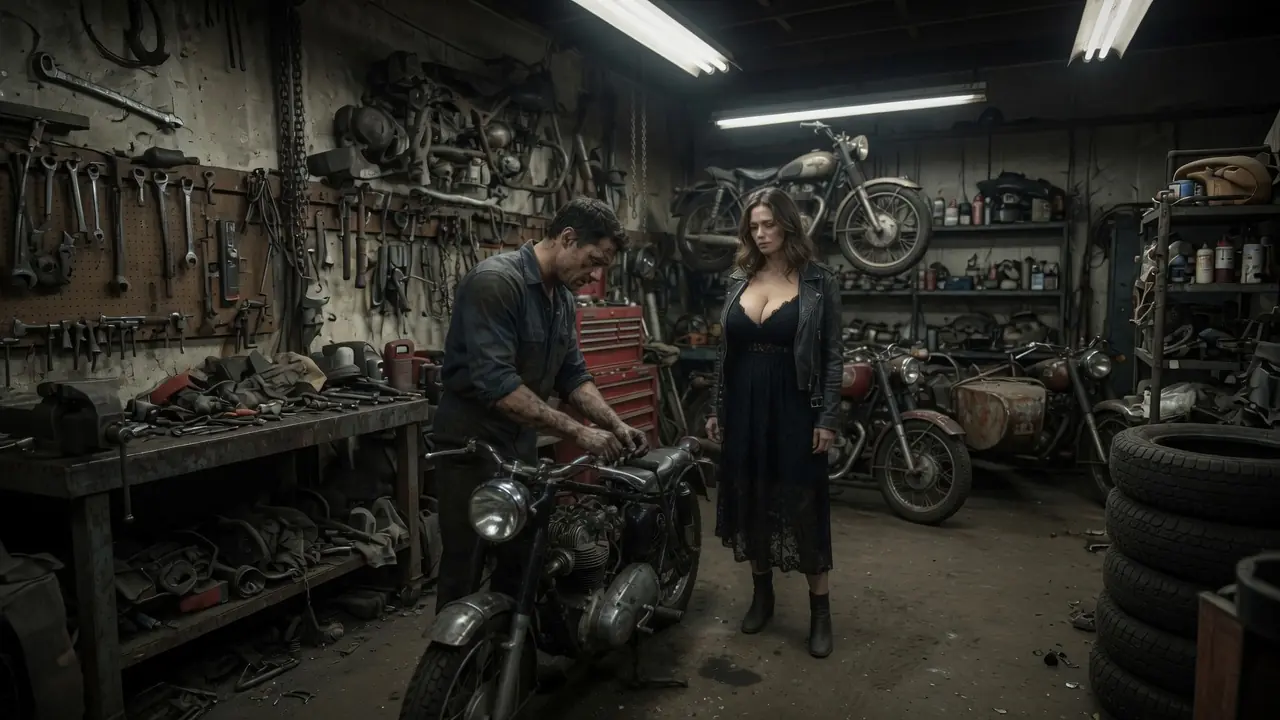
Daniel rolled the Triumph beneath a brighter light and checked the fuel line with steady concentration. His movements were slow, precise, and oddly comforting, as if machines had rules that people did not. Riley hugged her leather jacket around herself and watched him work. She was used to being watched. She was not used to watching someone else and feeling her own heartbeat slow.
After a few minutes, Daniel tapped a thin rubber line near the engine. “Here’s your problem.” Riley stepped closer. “What happened?” He angled the light so she could see the split. “Fuel line cracked. Gas wasn’t feeding properly, then the carburetor ran dry. That’s why it coughed and died instead of cutting out all at once.”
Riley looked at the small broken part as if it had betrayed her. “Can you fix it tonight?” Daniel glanced at the clock, then at the bike. “Yes.” She blinked. “Just like that?” He shrugged slightly. “It’s not just like that. It’s the right part, the right cut, the right clamp, and about an hour of attention.”
The office door opened, and a little girl appeared in pink pajamas with cartoon moons on them. She had dark hair in uneven pigtails and sleepy eyes that became wide when she saw Riley. In one hand, she held a stuffed rabbit by the ear. “Dad,” the girl said, “there’s a lady in a fancy dress in the garage.”
Daniel did not turn from the bike. “I noticed, Sophie.” The girl walked closer and studied Riley with the blunt honesty only children had. “Are you famous?” Riley hesitated. “Not tonight.” Sophie considered that answer, then nodded like it was acceptable. “Do you want hot chocolate? Dad says people who look tired need hot chocolate.”
Riley’s throat tightened unexpectedly. “I’d love some.” Sophie looked proud of herself and disappeared into the office. Daniel tightened one clamp and said nothing, but the corner of his mouth moved slightly. Riley looked toward the little drawing on the wall again. “Your daughter?” she asked.
“Sophie,” Daniel said. “Seven years old. Chief inspector, hot chocolate director, and emotional consultant whether I ask or not.” Riley laughed softly. It surprised her because it sounded real. “She seems very qualified.” Daniel nodded. “Overqualified, most days.”
Sophie returned with two mugs, carrying them so carefully that her whole body moved like the floor might betray her. She handed Riley one with both hands. The mug was chipped near the handle, white with blue flowers around the rim, and the hot chocolate had too many marshmallows. Riley took it like it was something fragile. “Thank you, Sophie.”
“You looked sad,” Sophie said.
Riley froze. Adults had spent the entire evening complimenting her dress, praising her speech, mentioning her company’s valuation, and asking about her next acquisition. Not one had asked whether she was sad. A seven-year-old in pajamas saw it in ten seconds. Riley looked down into the mug because she did not trust her face.
Daniel glanced at Sophie. “Bed.” Sophie sighed with theatrical suffering. “But the fancy lady just got here.” “Bed,” Daniel repeated, softer but firm. Sophie looked at Riley. “If he charges too much, tell me. I do the accounting with stickers.” Riley smiled. “I’ll remember that.”
After Sophie disappeared, the garage became quiet again except for the small sounds of repair. Riley sipped the hot chocolate and felt warmth spread through her chest. It tasted too sweet, unevenly mixed, and better than anything served at the gala. The dress under her jacket suddenly felt less like armor and more like a costume she wanted to take off.
Daniel replaced the cracked fuel line with practiced care. He did not fill silence with questions. He did not compliment her body, make a joke about her outfit, or ask if she had a boyfriend. He treated her presence the way he treated the motorcycle: something real in front of him, deserving attention without performance.
“So,” Riley said eventually, “you always work this late?” Daniel kept his eyes on the engine. “Single dad schedule. I do the customer repairs after Sophie sleeps, paperwork before she wakes, school drop-off when the world is still pretending mornings are peaceful.” Riley leaned against the workbench. “That sounds exhausting.” Daniel gave a quiet breath that was almost a laugh. “It is. But she’s worth every tired bone.”
Something in Riley softened and hurt at the same time. She had built a company people envied, a life people admired, and a public image so polished that strangers thought she had won some secret game. But nobody had ever spoken about her with that kind of simple certainty. Worth every tired bone. She wondered what it would feel like to be someone’s reason instead of everyone’s opportunity.
“How much do I owe you?” she asked when he finally stood and started the bike. The Triumph came alive with a low, steady sound that filled the garage. Daniel shut it off, wiped his hands, and wrote on an invoice pad. “Fuel line, clamp, labor. Sixty dollars.”
Riley stared at him. “Sixty?” Daniel handed her the invoice. “That’s what it costs.” She almost laughed. “I’ve paid four hundred dollars just for someone to tell me they couldn’t find the problem.” “Then they overcharged you for bad listening,” Daniel said.
Riley opened her small black clutch and pulled out cash. She had no reason to tell him who she was. No reason to explain that sixty dollars was less than the wine poured at one table of tonight’s gala. But as he took only what he had written and pushed the extra bills back toward her, she felt a strange guilt twist inside her.
“You don’t want more?” she asked.
Daniel shook his head. “I want fair.” Riley looked at him then, really looked. “Most people want as much as they can get.” Daniel leaned against the workbench. “Most people confuse taking with earning.”
The garage door rattled slightly in the night wind. Riley did not move toward the bike. Her phone was buzzing again inside her clutch, probably Marcus, her assistant, or one of the board members trying to find out where she had gone. She ignored it. Daniel noticed, but did not comment.
“Why are you still helping me this late?” Riley asked, her voice softer than she intended. Daniel looked at the bike, then back at her. “Because your fuel line cracked, and I couldn’t let you ride away broken.” The words were about the Triumph, but neither of them fully believed that was all they meant. Riley lowered her eyes. “Most men only see the dress, not the woman inside it.”
Daniel’s expression changed. Not pity. Not desire. Something gentler and more dangerous. “Then let me be the first who stays for her,” he said quietly.
The sentence should have frightened her enough to leave. Instead, it made the garage feel warmer. Riley turned away first because she had spent years learning how not to let people see when something reached her. “I should go,” she said, but she did not sound convinced.
Daniel looked toward the glass office door, where Sophie’s stuffed rabbit sat on a chair like a guard. “You can sit for a while if you need to. I’m finishing inventory anyway.” Riley gave a small, defensive smile. “Do you offer that to all women who appear in evening dresses with broken motorcycles?” “Only the ones who look like they ran away from something louder than an engine.”
That hit too close. Riley placed the mug on the workbench and said nothing. Daniel did not apologize for seeing her. He simply turned back to the shelves and began counting parts, giving her room to decide whether to stay or disappear. That room, that absence of pressure, was what made her sit.
She stayed for thirty-eight minutes. They talked about the Triumph, old engines, bad coffee, Denver traffic, and Sophie’s belief that rabbits understood secrets. Daniel told her he had owned the garage for nine years and had learned more from stubborn machines than from most people. Riley told him she worked in software, which was true but incomplete. She did not say billionaire, founder, CEO, valuation, acquisition, or Forbes.
When she finally left, Daniel walked her to the bay door. The night outside was dry and cold, city lights glowing beyond the industrial lots. Riley put on her helmet, then paused. “Thank you for not asking too many questions.” Daniel lifted one shoulder. “People tell the truth when they’re ready.” Riley looked at him through the helmet visor. “That can be dangerous.” Daniel smiled faintly. “So can riding with a cracked fuel line.”
She returned three days later.
She told herself the bike was making a noise. It was not. Daniel noticed immediately but played along, listening to the engine with a seriousness that made Sophie giggle from the office. “Very serious noise,” Sophie announced. “It sounds like Riley wanted hot chocolate.” Daniel looked at his daughter. “That diagnosis is premature.” Sophie folded her arms. “My sticker accounting says I’m right.”
Riley laughed so hard she had to cover her mouth. Daniel looked at her then, and something passed between them that was small but undeniable. A beginning, maybe. Or a mistake. Riley was no longer sure she knew the difference.
Over the next two weeks, she came by three more times. Once, she brought a bag of pastries from a bakery Sophie liked, claiming she had bought too many. Once, she helped Sophie paint a cardboard castle in the office while Daniel changed brake pads on a truck. Once, she sat on the garage floor in jeans and an oversized sweater, learning how to clean a carburetor while Sophie explained that Gerald the rabbit trusted her now.
Riley’s life in Denver continued calling. Board meetings, investor calls, a pending merger, speeches, interviews, and a luxury apartment that looked beautiful and felt like a waiting room. She handled what she had to, delegated what she could, and ignored the rest longer than she should have. For the first time since building Hargrove Analytics, she cared about being somewhere more than being needed everywhere.
The truth came out because of a television in the corner of the garage office. Daniel was making coffee. Sophie was doing homework at the desk. Riley was helping sort bolts into jars when a business news segment flashed across the screen.
“Hargrove Analytics founder Riley Hargrove is expected to announce whether the company will proceed with the Caldwell merger after weeks of silence from the billionaire CEO.”
The room went still.
Sophie looked from the television to Riley. “That lady has your name.” Daniel slowly set down the coffee pot. Riley closed her eyes for one second. She had imagined telling him, but not like this. Not with a news anchor saying the word billionaire like it was the most important part of her.
Daniel turned to her. “Riley.”
She stood, brushing her hands on her jeans though they were not dirty. “I should have told you.” His face did not harden, but it closed a little, and somehow that was worse. “Yes,” he said. “You should have.”
Sophie looked confused. “Is being on TV bad?” Riley’s heart twisted. “No, sweetheart. But hiding things from people who trust you can hurt them.” Daniel looked away at that. The small office suddenly felt too small for all the words unsaid.
Riley followed him into the garage. “I didn’t lie about who I am,” she said, then hated how weak it sounded. Daniel turned. “You let me believe I was talking to someone whose life was smaller than it is.” “You were talking to me,” she said, voice breaking. “Daniel, you know more of me than most people who have worked beside me for years.”
He ran a hand over his face, leaving a faint grease mark near his temple. “I don’t care about the money.” “I know.” “I care that you decided for me what I could handle.” That silenced her because it was true. Riley had hidden behind the excuse of wanting to be seen as a person, but she had also been afraid that if Daniel knew the scale of her world, he would either step back or start looking at her differently.
“I was scared,” she admitted. “Every man in my life lately has either wanted the woman in the magazine or the company behind her. You didn’t. I wanted to keep one place where I was just Riley.”
Daniel’s jaw tightened. “And I wanted one person who wasn’t going to vanish when things got real.” The words struck both of them. Sophie’s mother, Lauren, had died two years earlier. Riley knew only pieces, but enough to understand why leaving felt like a wound in this house.
“I’m sorry,” Riley whispered. “I never wanted to hurt you.” Daniel nodded once, not forgiving her, only hearing her. “I need time.” She swallowed the ache in her throat. “Okay.” Then she picked up her jacket and left before she begged him to stop her.
She went back to her Denver apartment, where the skyline looked expensive and lifeless through the glass. Marcus, her assistant, arrived the next morning with documents, merger notes, and the careful expression of someone who had been worried for days. “The board needs an answer,” he said. Riley looked at the thick folder. “The board always needs an answer.”
“What do you need?” Marcus asked.
The question surprised her. She almost told him not to be sentimental, then realized he deserved better. “I need my life to stop being an acquisition strategy.” Marcus sat across from her. “Then make a different decision.” Riley laughed softly. “You make it sound simple.” He looked at her. “Simple doesn’t mean careless.”
The echo of Daniel’s words almost broke her.
That afternoon, Riley called the board and declined the Caldwell merger under the current terms. She appointed a chief operating officer she should have hired a year earlier, restructured her role, and announced she would no longer be available for every crisis that other people created because they knew she would solve it. There was outrage, confusion, and then reluctant respect when she explained the numbers better than anyone expected. Riley Hargrove had not become a billionaire by being careless. She knew exactly what she was worth, and for once, she was not selling herself with the company.
But changing her company did not fix the ache in her chest. She missed the garage. She missed Sophie’s brutal honesty, Daniel’s quiet, the smell of oil and coffee, and the feeling of being useful without being important. She wrote three messages to Daniel and deleted all of them. Then, on the fourth night, the call came from a number she did not recognize.
It was Sophie’s school.
Daniel had listed Riley as an emergency contact two days before the fight, and nobody had changed the form yet. Sophie had fallen during an after-school program, hit her head on a metal bench, and Daniel was unreachable under a car with his phone on silent. Riley did not think. She grabbed her keys and drove.
At the hospital, Daniel was already there when she arrived, sitting outside the exam room with both hands locked together. His face looked stripped of every defense. When he saw Riley, relief crossed it before he could hide it. “She’s awake,” he said. “Mild concussion. They’re monitoring her.”
Riley sat beside him. “Okay.” For a long moment, neither of them spoke. Then Daniel said, “They called you.” Riley nodded. “I came.” His voice was rough. “Even after I pushed you away.” She looked at him. “Sophie needed someone. So did you.”
Daniel covered his face with one hand. “I was scared,” he said. “When I found out who you were, I made it about trust because that was easier than admitting I was terrified you’d outgrow this place. Outgrow us.” Riley’s eyes filled. “Daniel, I was drowning in big rooms before I ever walked into your garage. You and Sophie are the first place that felt like air.”
He looked at her then, exhausted and open. “I don’t know how to fit in your world.” Riley reached for his hand. “I don’t want you to fit into that world. I’m trying to build a life that has room for this one.”
Sophie came home the next day with a bandage, a headache, and strong opinions about hospital pudding. She insisted Riley stay for dinner because “people who come to hospitals are family helpers.” Daniel did not correct her. Riley helped make grilled cheese while Sophie supervised from the couch like a tiny queen. Gerald the rabbit sat beside her, apparently also recovering from stress.
Weeks passed differently after that. Riley did not hide anymore. Daniel did not pretend he was unafraid. Sophie treated both of them like adults who were taking too long to admit the obvious. Riley bought a small house ten minutes from the garage, not a mansion, not a showpiece, just a warm place with a porch, a kitchen, and enough room for Sophie’s art supplies.
Daniel helped her move one Saturday. He carried boxes marked books, mugs, motorcycle parts, and one box Marcus had labeled “probably expensive stuff.” Sophie arranged the mugs by color and declared one cabinet emotionally wrong. Riley let her fix it. Daniel watched from the doorway, smiling in the barely visible way that had become her favorite kind.
That evening, after Sophie fell asleep on the couch under a blanket, Riley and Daniel stood in the garage beside the Triumph. The same bike. The same bay light. The same smell of oil and metal. Riley ran her hand over the fuel tank and smiled.
“This bike ruined my life,” she said.
Daniel leaned against the workbench. “Looks more like it repaired it.” She looked at him. “You charged only sixty dollars for a repair that changed everything.” Daniel stepped closer. “I still think the labor was fair.” Riley laughed quietly. “And the rest?” He looked at her face, not the dress, not the money, not the name. “The rest was worth staying for.”
Riley took his hand, grease and all.
She had walked into Carter’s Auto and Cycle wearing a black lace dress and a broken expression, hoping only to get her motorcycle running again. She had not expected a single dad with tired eyes, a daughter with hot chocolate, and a garage full of honest silence to expose everything she had been missing. She had spent years being valued by investors, admired by strangers, and desired by men who never saw her clearly.
But Daniel Carter had looked at her in the middle of his garage and seen the woman beneath the fortune.
And Riley Hargrove, who once owned everything except a reason to come home, finally found one waiting under fluorescent lights beside a repaired motorcycle.