James Walker noticed the snow before he noticed how quiet his daughter had become. It fell slowly over the old brick apartment courtyard, soft enough to look peaceful and steady enough to cover every footprint within minutes. The lamps along the walkway glowed pale yellow against the winter evening, lighting the bare trees and the benches half buried in white. Beside him, seven-year-old Lily Walker walked with her mitten tucked tightly inside his gloved hand.
They were coming home from the public library, where Lily had insisted on borrowing three picture books even though James had reminded her they still had two at home. She said books got lonely if they stayed on the shelf too long, and James did not have the heart to argue with logic like that. He carried her backpack over one shoulder, his own work coat buttoned to his throat, his scarf pulled high against the wind. It had been a long day, the kind where every bill seemed to be waiting for him at the kitchen table.
James was thirty-four, a single father, and tired in a way sleep never fully fixed. He worked maintenance at an old apartment building on the south side of Chicago, took small repair jobs when neighbors needed help, and stretched every dollar until it almost complained. Lily was the reason he kept going without letting bitterness take over. She had her mother’s soft curls, his stubborn chin, and a heart that noticed things adults trained themselves to ignore.
They were halfway through the courtyard when Lily stopped so suddenly that James almost tugged her forward. “Daddy,” she whispered.
James looked down. “What is it?”
Lily lifted her mitten and pointed toward the bench under the bare maple tree. At first, James saw only a gray blanket dusted with snow. Then the blanket moved, barely, and he realized someone was curled beneath it. A young woman sat slumped against the iron armrest, her blonde hair partly hidden by a red scarf, her face pale, her hands tucked weakly against her chest.
James’s first thought was that she might be sleeping. His second thought was sharper and colder. Nobody slept like that in the snow unless something had gone terribly wrong. He let go of Lily’s hand only long enough to kneel beside the bench, keeping his body between his daughter and the worst of the wind.
“Ma’am,” he said gently. “Can you hear me?”
The woman’s eyelids fluttered. Her lips moved, but no clear words came out. Snow clung to her coat and scarf, and her fingers trembled so faintly James almost missed it. Lily stepped closer, tears already rising in her eyes.
“She’s so cold,” Lily said.
“I know, baby.” James pulled off his scarf and wrapped it around the woman’s hands. “Stay right beside me, okay? Don’t run. Don’t touch the street.”
The woman opened her eyes a little wider. They were light blue, unfocused, full of fear and exhaustion. “Please,” she whispered. “Don’t call him.”
James froze. “Don’t call who?”
She tried to answer, but only a shaky breath came out. James took out his phone and dialed emergency services anyway, giving the dispatcher the address, the courtyard entrance, and the woman’s condition. The dispatcher told him to keep her awake, keep her covered, and wait for help.
James removed his coat and placed it over the blanket. The cold hit him immediately through his sweater, but he ignored it. Lily leaned against his side, holding the backpack with both hands like it was the only useful thing she could do. The woman’s eyes moved from James to Lily, and something in her expression softened.
“Your daughter?” she whispered.
“Yes,” James said. “Her name is Lily.”
The woman tried to smile. “Pretty name.”
Lily sniffed. “What’s yours?”
A long pause passed before the woman answered. “Clara.”
Her eyes filled with panic at the word help. “No hospital. He’ll find me.”
James looked over his shoulder toward the dark street beyond the courtyard. There were no flashing lights yet, no footsteps, no vehicles pulling in. Still, the way Clara said he made the air feel different. This was not only a woman who had gotten lost in the snow.
“Who are you afraid of?” James asked.
Clara closed her eyes. “Richard.”
Before James could ask more, headlights swept across the courtyard. A black luxury SUV turned in too fast, tires crunching over the snow. It stopped near the curb, and a tall man in a dark overcoat stepped out with a phone pressed in one hand. His hair was neat, his shoes polished, his face sharp with anger that pretended to be concern.
Behind him, another man in a suit stepped out, scanning the courtyard like hired security. The first man spotted Clara on the bench, then saw James kneeling beside her with his coat draped over her body. His expression changed instantly.
“Step away from her,” the man snapped. “Men like you don’t touch women like Clara without wanting something.”
James rose slowly, hands open, jaw tight. Lily grabbed the back of his sweater, frightened by the stranger’s voice. Clara stirred beneath the coat, trying weakly to sit up.
“I found her freezing on this bench,” James said. “I called for help.”
The man walked closer, eyes moving over James’s worn sweater, work boots, and the old backpack in Lily’s hand. His lip curled slightly. “How convenient. A rich woman helpless in the snow, and a broke stranger suddenly plays hero.”
James felt Lily flinch behind him. That was the part that cut deepest. Insults aimed at him were familiar enough, but letting his daughter hear them felt like allowing dirt into clean water.
“You can insult me later,” James said. “Right now, she needs to stay warm.”
The man looked at Clara. “Clara, what did he take?”
Clara’s eyes opened, weak but furious. “Nothing.”
“Don’t protect him.”
“I said nothing.” Her voice shook, but it carried. “He saved me.”
The man’s face hardened. “You’re confused.”
Lily stepped out from behind James, her small face wet with tears. “My daddy helped her because she was cold.”
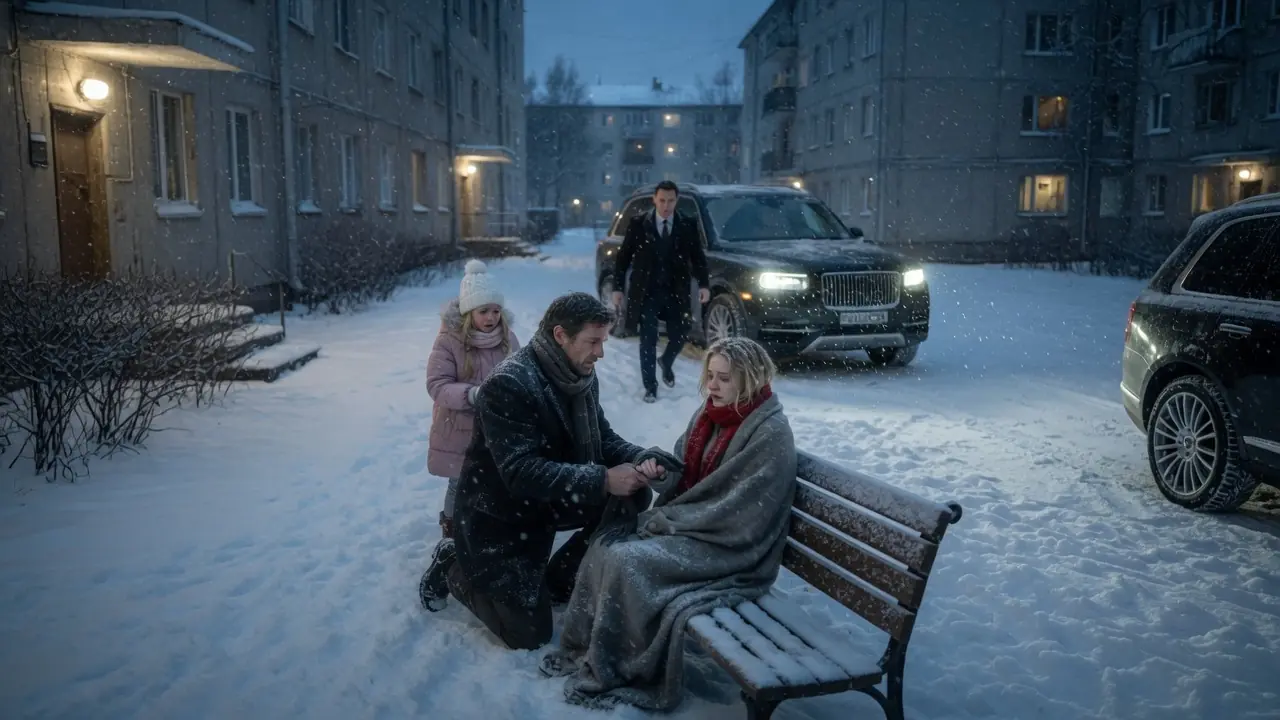
The stranger looked down at Lily, then away, as if the child’s truth embarrassed him more than James’s anger would have. Sirens sounded in the distance, growing closer. James turned back toward Clara and adjusted the coat around her shoulders.
The man stepped forward. “I said move.”
James did not. “She asked me not to call you.”
That sentence stopped him. The sharp-dressed man’s eyes narrowed. “You don’t know what she needs.”
“No,” James said. “But I know what she said.”
The ambulance arrived before the argument could grow worse. Two paramedics hurried across the snow with a medical bag and a thermal blanket. James stepped back immediately, guiding Lily away from the bench, but Clara reached out and caught his wrist with weak fingers.
“Don’t leave,” she whispered.
James looked at the paramedic, then at Clara. “I’m right here.”
The rich man tried to follow as the paramedics checked Clara, but she turned her face away from him. “I don’t want Richard in the ambulance.”
Richard’s expression cracked. “Clara, don’t be ridiculous.”
The female paramedic looked at Clara. “Is he your emergency contact?”
Clara hesitated. “Not anymore.”
That seemed to land harder than the cold. Richard stood rigid beside the bench while the paramedics helped Clara onto the stretcher. As they lifted her, Clara looked at James again.
“Thank you,” she said.
James nodded. “Just get warm.”
Richard watched the exchange with barely hidden contempt. “This isn’t over.”
James pulled Lily close. “For me, it is.”
But it was not.
The next morning, James woke before dawn on the couch because Lily had crawled into his bed sometime after midnight, and he did not want to wake her. His coat still hung damp over the kitchen chair. His scarf was gone, left with Clara or the paramedics, and he told himself it did not matter. A scarf was replaceable. A person was not.
Still, the night replayed in his mind while he made coffee. Clara’s fear. Richard’s accusation. Lily’s little voice saying, “My daddy helped her because she was cold.” James had tried to keep the world gentle for his daughter, but the world kept speaking loudly in front of her.
At breakfast, Lily looked unusually quiet over her cereal. “Was that man bad?”
James sat across from her. “He was scared and angry.”
“He was mean.”
“Yes,” James admitted. “He was mean.”
“He thought you were bad because we don’t have fancy clothes.”
James looked down at his hands. They were rough, cracked near the knuckles, marked by years of work that never looked elegant. “Some people judge too fast.”
Lily stirred her cereal. “But Clara knew.”
James smiled faintly. “Yes. Clara knew.”
By noon, James had returned to work at the apartment building. He patched a ceiling leak, replaced a hallway bulb, and fixed a tenant’s cabinet hinge without mentioning the woman on the bench. He was under a sink in unit 3B when his phone buzzed. The number was unknown.
He almost ignored it. Then he answered.
“Mr. Walker?” a woman’s voice asked.
“Yes.”
“This is Clara Whitmore.”
James hit his head lightly on the underside of the sink.
“Are you okay?” she asked.
“I’m fine.” He slid out, rubbing the back of his head. “How are you?”
“Warm,” she said softly. “Because of you.”
He sat back on the tile floor, suddenly unsure what to do with the gratitude in her voice. “Anyone would have stopped.”
“No,” Clara said. “They didn’t. You did.”
James had no answer for that.
Clara continued, “I’d like to return your coat and scarf. And I’d like to thank your daughter.”
“That’s not necessary.”
“It is to me.”
James hesitated. “Are you safe?”
There was a pause. “Safer than I was.”
That answer told him enough to worry.
They agreed to meet that afternoon in the lobby of James’s apartment building, a public place with cameras, mailboxes, and neighbors coming in and out. James told himself that was practical. The truth was, Richard’s voice had stayed in his head, and he did not want Lily anywhere near another confrontation.
Clara arrived at four wearing a long gray coat, her blonde hair tied back, her face still tired but no longer pale from the cold. She carried James’s folded coat and scarf in her arms. Lily, who had insisted on coming downstairs, hid behind James’s leg until Clara smiled at her.
“Hi, Lily,” Clara said. “You helped save me.”
Lily looked up. “Daddy did most of it.”
Clara crouched slightly. “Sometimes standing beside someone brave is brave too.”
Lily considered that and came forward. Clara handed her a small paper bag from a bakery nearby. “Hot chocolate cookies. Your dad said no gifts, so this is technically emotional support.”
James sighed. “That is not how that works.”
“It worked on me,” Clara said.
For the first time, he saw her smile fully. It changed her face completely, turning the fragile woman from the bench into someone with warmth, humor, and a quiet sadness underneath both. James noticed then that her gloves were expensive, her coat tailored, her earrings small but clearly costly. She carried wealth the way some people carried perfume, subtle until you stood close.
“Can we talk?” she asked.
James glanced at Lily. “Baby, sit by the mailboxes and eat one cookie. One.”
Lily nodded with serious obedience that guaranteed nothing.
Clara stood with James near the lobby window. Snow was falling again outside, lighter now. For a moment, neither spoke.
“I owe you the truth,” Clara said.
“You don’t owe me anything.”
“I do.” She folded her hands around the scarf. “My full name is Clara Whitmore. My family owns Whitmore Hospitality Group.”
James blinked. Even he knew that name. Hotels, restaurants, historic properties, event spaces across the Midwest. A company with gold-letter signs in downtown buildings and magazine articles about legacy wealth.
“You’re that Clara Whitmore?”
“I’m afraid so.”
James glanced toward Lily, who was already eating the second cookie. “And Richard?”
“Richard Vale. My fiancé until last night.” Clara looked down. “He and my uncle were pressuring me to sign voting control of my trust into a new management structure. They said it was for business stability. I found out it would have given Richard influence over assets my mother left me.”
James listened quietly.
“I left a private dinner after the argument,” Clara continued. “I didn’t take my coat. My phone died. I thought I could walk to a hotel I knew, but I got turned around in the snow. By the time I reached that bench, I couldn’t think clearly anymore.”
James felt a coldness that had nothing to do with the weather. “And he came looking for you only after?”
“After he realized I hadn’t signed.” Her mouth twisted. “Or maybe after he was worried how it would look.”
Lily wandered over with crumbs on her coat. “Are you still cold?”
Clara’s eyes softened. “Not now.”
“My daddy gave you his coat.”
“Yes, he did.”
“He does that,” Lily said proudly. “He gives people stuff even when he needs it.”
James looked down at her. “Lily.”
“What? You do.”
Clara looked at him carefully, and James felt more exposed than he had in the snow. He was used to people seeing what he lacked. He was not used to someone seeing what he gave away.
Clara reached into her purse and pulled out an envelope. James stepped back before she could offer it.
“No.”
“You haven’t seen what it is.”
“I don’t need to.”
“It’s not charity.”
“Then what is it?”
Clara took a breath. “An invitation.”
James frowned.
“My family foundation owns a vacant community house three blocks from here. It was supposed to become a winter outreach center, but the project stalled because nobody involved understood the neighborhood. They hired consultants, held meetings, made renderings, and nothing opened.” She held out the envelope again. “I want you to look at the building with me.”
James stared at her. “Why?”
“Because last night, when everyone else was busy protecting money, appearances, or themselves, you protected a stranger. I need someone who understands what warmth means before it becomes a brand slogan.”
James almost laughed, but her face was serious. “Clara, I’m a maintenance worker.”
“You are a father who noticed a person freezing on a bench. You are a man who knows old buildings, tenants, repairs, heating systems, and what people need when they have nowhere safe to wait.” She paused. “That matters.”
James looked at the envelope but did not take it yet. “And what are you offering?”
“A paid consulting role to assess the building. After that, if you want it, facilities director for the outreach center.”
The lobby seemed to tilt. James thought of overdue bills, Lily’s winter boots getting too small, the unstable hours, the constant math of survival. Then he thought of Richard’s voice: Men like you don’t touch women like Clara without wanting something.
He stepped back again. “I didn’t help you for a job.”
“I know,” Clara said. “That is why I’m offering it.”
The words left him silent.
A week later, James stood with Clara inside the vacant community house. It was an old brick building with boarded windows, a broken boiler, peeling paint, and a large main room that still had good bones. Lily came too, wearing a hard hat Clara had found for her, though it was too big and kept slipping over one eye. Clara watched James move through the building, checking pipes, vents, electrical panels, door frames, and water damage.
He forgot to be self-conscious once the work began. He made notes, asked direct questions, pointed out hazards, and explained what needed to happen first. Clara listened without interrupting. Her assistant, a nervous man named Ben, typed everything into a tablet and looked increasingly impressed.
“This place can work,” James said finally. “But not if you make it pretty before you make it warm.”
Clara nodded. “Warm first.”
“Safe first,” he corrected.
“Safe first,” she repeated.
Lily raised her hand. “Can there be books?”
James smiled. “It’s not school, baby.”
“It should still have books.”
Clara looked around the dusty main room. “Then it will have books.”
The project moved faster than James expected. Clara had money, but more importantly, she had decided to use it without asking permission from the people who had tried to control her. Richard called. She did not answer. Her uncle sent formal letters. She sent them to her lawyer. The engagement ended quietly in public and loudly behind closed doors, but Clara never went back to being the woman on the bench.
James took the consulting job, then the director position after three weeks of arguing with himself. He kept his maintenance work part-time until the outreach center opened, unwilling to trust good fortune too quickly. Clara never pushed him. She only gave him clear contracts, fair pay, and the respect of letting him read everything twice.
By February, the Whitmore Winter House opened its doors. It had a heated waiting room, showers, lockers, a small medical partner office, children’s bookshelves, and a kitchen that served soup every evening. James hired two men from the neighborhood for maintenance and security, both people he knew would treat visitors like human beings. Lily painted a sign for the reading corner that said, “Warm books live here.”
On opening night, Clara stood near the entrance in a simple blue coat, watching people come inside from the snow. No cameras had been invited. No donors stood at a podium. James had insisted that if the place was for people who needed warmth, the first night should belong to them.
Clara found him near the boiler room. “You were right.”
“About what?”
“Safe first.”
James gave a small smile. “Usually am.”
“Don’t get carried away.”
They stood together in comfortable silence. Across the room, Lily was helping a little boy choose a book. An older woman warmed her hands around a paper cup of tea. A young man slept in a chair near the radiator, his face relaxed for the first time in who knew how long.
Clara’s eyes shone. “I almost didn’t survive one night outside.”
James looked at her.
“I keep thinking about how many people have to survive many,” she said.
“That’s why this place matters.”
She nodded. “That’s why you matter.”
James looked away, pretending to check the hallway. Praise still made him uncomfortable. Clara had learned that and only smiled.
Months passed, and the story of the bench became something people in the neighborhood repeated softly. The single dad who stopped. The millionaire who had been saved. The building that opened because of it. James disliked the way people tried to make him sound heroic, but Lily loved it until he told her heroes still had to take out the trash.
Clara became part of their lives slowly. She attended Lily’s school reading night. She brought soup when James caught a winter cold. She learned that Lily hated peas, loved maps, and asked questions that made adults reconsider their life choices. She also learned that James was careful with every kindness he received, as if expecting someone to send an invoice later.
One evening in spring, after the snow had melted and the trees showed the first green, Clara and James walked past the bench where he had found her. Lily ran ahead, chasing pigeons with the seriousness of a detective. The bench was clean now, the iron arms no longer rimmed with ice.
Clara stopped beside it. “I was so ashamed.”
James turned. “Of what?”
“Being found like that. Helpless. Afraid. The girl with all the money and nowhere safe to go.”
James looked at the bench. “Money doesn’t keep people warm by itself.”
“No,” she said. “People do.”
Lily came running back and slipped her hand into James’s. Clara watched them together, and the expression on her face was softer than gratitude now. It was belonging, though none of them said that out loud.
A black car passed slowly near the curb. For a second, James stiffened, remembering Richard’s SUV. Clara noticed.
“He can’t touch the trust anymore,” she said. “Or the foundation. Or me.”
James nodded. “Good.”
Clara looked at him. “I’m not that woman on the bench anymore.”
“No,” James said. “You’re not.”
“But I’m glad you found her.”
Lily looked up. “Me too.”
James squeezed his daughter’s hand. The courtyard lights began to glow as evening settled. For once, the cold was gone, but he could still remember that first night clearly: Lily pointing, Clara barely moving, the snow, the fear, the cruel voice telling him to step away.
Richard had seen a poor single father kneeling beside a rich woman and assumed the worst.
Clara had opened her eyes and seen the truth.
And James had learned that sometimes one small refusal to walk past someone could change more than a single life. It could open a door, warm a room, build a shelter, protect a child, and remind a millionaire that being saved by kindness was not weakness.
That night, as they walked home together, Lily reached for Clara’s hand too.
Clara looked surprised for half a second, then held on.
James saw it and smiled.
In the snow, he had found a stranger freezing on a bench.
By spring, that stranger had helped him build a place where nobody had to be left outside alone.