The headlights cut through the falling snow like a blade through darkness. William Harrison leaned closer to the windshield, trying to see beyond the white curtain swallowing the narrow residential road outside Boston. His ten-year-old daughter, Sophie, slept beneath a thick blanket in the back seat, her head resting against a backpack filled with schoolbooks and a half-finished science project. They were fifteen minutes from home when a figure appeared beside the road.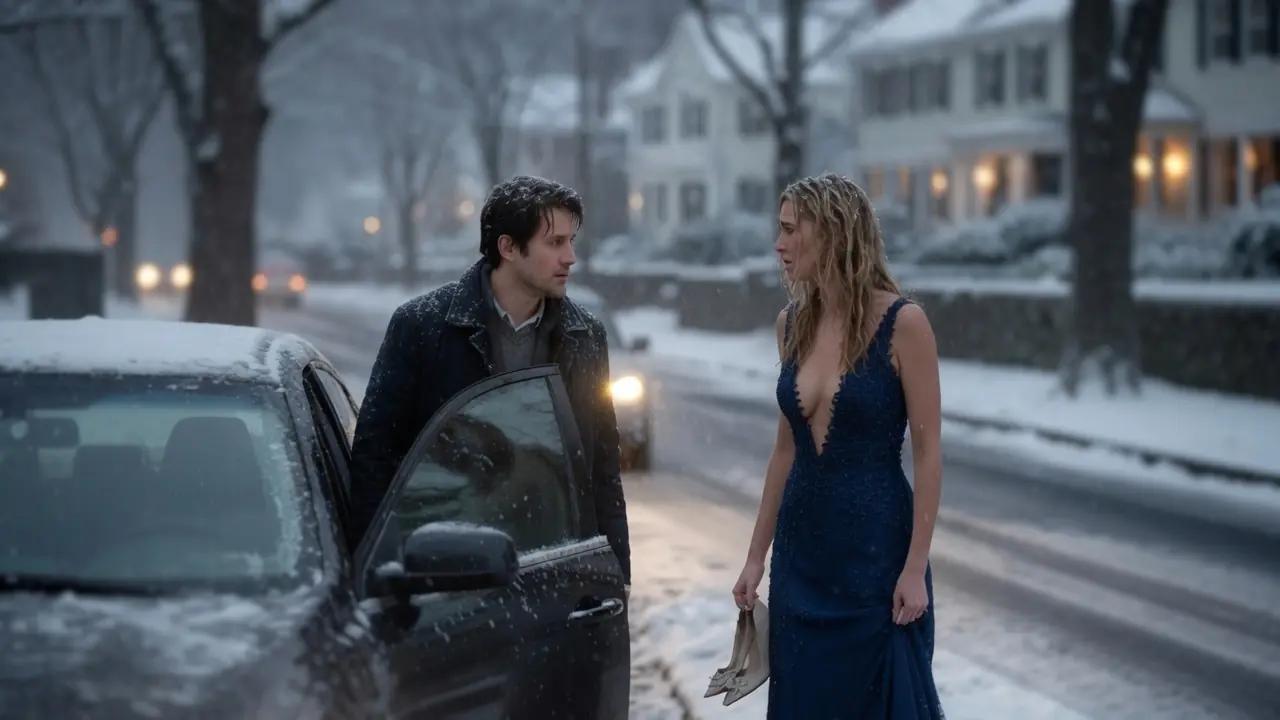
At first, William thought the woman was part of a strange winter advertisement. She wore a white wedding gown, but the expensive fabric was torn along the hem and stained with mud from the wet asphalt. Her blonde hair hung in damp strands around her face, and she carried one broken high heel in her right hand while the other foot was completely bare. She walked as though stopping would allow something behind her to catch up.
William slowed the car.
The woman turned sharply when the headlights moved across her. Fear changed her face before he had even stopped, and she stepped backward toward the snow-covered sidewalk as if preparing to run. William lowered his window but kept both hands where she could see them. He had learned through years of raising Sophie alone that frightened people listened to actions before words.
“Ma’am,” he called gently, “are you hurt?”
The woman stared at him without answering. Her gaze moved past his shoulder toward the empty road, then toward the sleeping child in the back seat. That detail seemed to calm her slightly, though she still held the broken heel like a weapon. William noticed dark marks around her wrist where someone’s fingers had gripped her too tightly.
“I can call the police,” he said.
“No.” The word came out too quickly. “Please don’t call anyone.”
William opened the driver’s door but remained behind it. “Then tell me what you need.”
The woman looked toward the curve in the road. Distant headlights appeared through the snowfall, moving slowly in their direction. Her expression collapsed.
“My groom’s men are searching for me.”
William removed his winter coat and held it toward her. “Get inside. No one touches you while my daughter is watching.”
She hesitated for only a second.
Then she rushed around the car, pulled open the passenger door, and climbed inside. William wrapped the coat around her shoulders before closing the door. Her hands shook so badly that she could not fasten the seat belt, so he reached toward it and stopped before touching her.
“May I?”
She nodded.
William secured the belt, returned to the driver’s seat, and pulled away just as the approaching vehicle rounded the curve. A black SUV slowed near the place where the woman had been standing. William did not look directly toward it, but he saw two men inside studying every passing car.
The woman sank lower beneath his coat.
“What is your name?” William asked.
“Claire.”
“Claire what?”
She did not answer.
“That’s fine,” he said. “I’m William, and the girl in the back is Sophie.”
Sophie stirred at the sound of her name. Her eyes opened slowly, and she stared at the woman in the torn wedding dress sitting beside her father. William expected fear or confusion. Instead, Sophie sat upright and pulled the blanket closer around her shoulders.
“Dad,” she whispered, “did you find a bride?”
Claire released a sound that was half sob and half laugh.
“I think the bride found us,” William said.
Sophie looked at the bruises on Claire’s wrist. “Are you running away from the wedding?”
Claire glanced toward William, uncertain how much to say in front of a child. Sophie had always noticed more than adults expected, especially after losing her mother when she was six. William rarely lied to her, but he protected her from truths too heavy for young shoulders.
“The wedding was not safe,” Claire said carefully.
Sophie nodded as though that explanation was enough. “Then running was smart.”
William turned onto a smaller road leading away from the main highway. “Do you have somewhere safe to go?”
Claire shook her head.
“Family?”
“My mother is dead. My father lives in Florida, but he cannot help me.”
“Friends?”
“They will check every friend I have.”
William looked toward the rearview mirror. The black SUV had turned onto the same road behind them, though it remained several hundred feet away. He increased his speed slightly but did not want to draw attention on the icy pavement. Sophie noticed the vehicle too.
“Dad,” she said quietly, “that car is following us.”
Claire turned in her seat.
The SUV accelerated.
William took the next right without signaling. The tires slipped briefly before catching the road. Claire grabbed the door handle, and Sophie pulled the blanket over her lap.
“Who are they?” William asked.
“My fiancé’s security men.”
“Why would a groom need security men to chase his bride?”
Claire reached inside the torn bodice of her dress and removed several folded pages. The document was creased, damp, and stained near the edge. A signature line appeared at the bottom beneath the name Claire Elizabeth Whitmore.
“He wasn’t marrying me,” she said. “He needed my signature before midnight.”
William glanced at the papers. “Signature for what?”
“Control of Whitmore Medical Logistics.”
The name was familiar. Whitmore Medical Logistics operated hundreds of emergency supply vehicles throughout New England and held major contracts with hospitals, pharmaceutical companies, and government agencies. William had once applied for a maintenance position at one of its distribution centers. He was rejected before receiving an interview.
“My mother founded the company,” Claire continued. “When she died, she left me fifty-one percent of the voting shares through a trust.”
“And your groom wanted them.”
“He wanted me to sign a marital asset agreement during the reception. The papers would have transferred temporary voting authority to him as my husband.”
“Temporary?”
“That is what he called it.”
William looked at the road ahead. “What did the real language say?”
Claire pressed the document against her chest. “Irrevocable proxy control, with the right to appoint directors, remove officers, and sell company assets.”
Sophie frowned from the back seat. “That sounds like stealing.”
“It was,” Claire said.
The black SUV appeared again at the end of the street.
William turned toward a row of older houses, then into an alley between two apartment buildings. His car was a twelve-year-old sedan with rust near the rear wheel, but he knew the neighborhood better than the men behind them. He had driven these roads every day while delivering heating equipment before losing his job four months earlier.
The alley narrowed near a construction barrier.
William stopped beside a dumpster, turned off the headlights, and instructed everyone to remain silent. Snow collected against the windshield while the engine ticked softly beneath the hood. Claire’s breathing became fast and shallow.
“You’re safe for this moment,” William said.
“You don’t understand.”
“Then help me understand.”
Claire looked at Sophie, who was watching her with wide but steady eyes. “My fiancé is Adrian Vale.”
William recognized that name too. Adrian Vale was the polished chief financial officer of Whitmore Medical Logistics and the son of a wealthy investment banker. Business articles described him as disciplined, visionary, and perfectly suited to modernize the family company.
“They announced our engagement six months ago,” Claire said. “Everyone thought it was romantic because we worked together.”
“But it wasn’t?”
“I believed it was.”
The admission carried more shame than anger.
Adrian had been charming after Claire’s mother died. He helped manage the company through the crisis, attended every funeral meeting, and sat beside Claire during board presentations when grief made concentration difficult. He told her that protecting the business would honor her mother’s legacy.
Claire trusted him because grief had made trust feel like oxygen.
Three weeks before the wedding, Adrian began pressing her to sign several new corporate documents. He said investors were worried about leadership stability and needed reassurance that he could act during their honeymoon. Claire delayed because the language seemed unnecessarily broad.
That evening, just before the ceremony, Claire overheard Adrian speaking with board vice chairman Malcolm Voss inside the hotel library.
They were not discussing marriage.
They were discussing liquidation.
Adrian planned to transfer voting control, remove two loyal directors, sell the company’s emergency fleet contracts to a private investment fund, and close several regional warehouses. Thousands of employees would lose their jobs, while Adrian and Malcolm would divide a payout worth more than one hundred million dollars.
“They said I would be too embarrassed to challenge the papers after the wedding,” Claire whispered. “If I accused my husband publicly, everyone would call me unstable.”
“How did your dress tear?” William asked.
“I tried to leave through the service corridor.”
Adrian found her near the hotel kitchen. He grabbed her wrist and demanded to know what she had heard. When Claire refused to return to the ballroom, one of his security men blocked the door while Adrian pushed the agreement into her hands.
“He told me to sign before midnight,” Claire said. “He said after we were married, no one would believe he forced me.”
Sophie moved closer to the edge of her seat. “Did he hurt you?”
Claire looked down. “I escaped before he could do worse.”
A hotel server entered the corridor carrying a tray. Claire shoved the papers beneath her dress, ran through the kitchen, and climbed through a delivery entrance. Her gown caught on a metal cart and tore from the knee downward.
She walked almost two miles through the snow before William found her.
The black SUV passed the alley entrance without stopping.
William waited another minute before restarting the car. “We need the police.”
“No.”
“Claire, these men chased you through a storm.”
“Adrian has friends in the department.”
“Every officer?”
“I don’t know.”
William understood the fear. His late wife, Rachel, had once reported harassment from a supervisor at work. The supervisor played golf with the company lawyer, and Rachel’s complaint disappeared before reaching anyone willing to listen. Power did not need control over everyone.
It needed enough people in the right places.
“Do you trust your company attorney?” he asked.
“Not anymore.”
“Any board member?”
“Margaret Sloan.”
“Where is she?”
“Cambridge, perhaps. I left my phone at the hotel.”
William considered his options. He could take Claire home, but the men had seen his car well enough to remember it. He could drive to a hospital, yet Adrian’s men might search emergency rooms. A crowded police station still seemed safer than the road, but Claire’s fear was too strong to ignore.
“What happens at midnight?” Sophie asked.
Claire looked at the dashboard clock.
10:42 p.m.
“The proxy agreement expires,” Claire said. “Adrian needed it signed before the marriage license was officially recorded at midnight.”
William turned toward her. “Then why are they still searching if you can simply refuse?”
“Because I took more than the agreement.”
She unfolded the final page.
Beneath the legal text was a handwritten note in Adrian’s writing. It listed payments to Malcolm Voss, two board members, a private security company, and a city official. Claire had torn the page from Adrian’s private folder before escaping.
“This proves bribery,” William said.
“It suggests it. Margaret can connect the names to the financial records.”
“And if Adrian gets it back?”
“He destroys the only link.”
The old sedan continued through the storm.
William’s phone rang.
The number was unfamiliar.
He did not answer.
It rang again, then a text message appeared.
Mr. Harrison, you have picked up someone who is mentally unwell. Return her safely and you will be compensated.
Claire read the message from beside him.
“How do they know your name?”
William looked toward the dashboard. The registration documents were inside the glove compartment, but no one had opened it. Then he remembered the black SUV driving close behind them at the first intersection. Its camera may have captured his license plate.
Another message appeared.
Your daughter does not need to become involved.
William’s jaw tightened.
Sophie read his face. “What did it say?”
“Nothing you need to worry about.”
“That means something bad.”
William pulled into a gas station beneath bright overhead lights. Several customers stood inside the convenience store, and cameras covered the parking area. He stopped near the entrance where everyone could see them.
“Claire, take Sophie inside.”
“What are you going to do?”
“Change the way they see the car.”
William opened the trunk and removed a magnetic advertising panel used during his old delivery job. It covered part of the rear door and changed the vehicle’s recognizable profile. Then he scraped snow across the license plate until only the first two letters remained visible.
Claire returned from the store carrying coffee, food, and a pair of inexpensive sweatpants purchased by Sophie with her emergency school money.
“You didn’t have to buy these,” Claire told her.
“You can’t run in a wedding dress,” Sophie replied.
Inside the gas station bathroom, Claire changed into the sweatpants beneath the torn gown and removed the heaviest outer layers. She folded the wedding dress into a plastic trash bag, keeping only the documents beneath William’s coat.
When she returned, she looked less like a missing bride.
More like a frightened woman trying to survive.
William called his older brother, Daniel, who worked as an emergency dispatcher in Worcester. He explained only that a woman needed to contact someone safely without revealing her location.
Daniel gave him the number for a federal public-corruption hotline and recommended a state police barracks led by a commander with no local political connections.
Claire called the hotline from the gas station phone.
At first, the agent sounded skeptical. Then Claire read the names from Adrian’s handwritten payment list. The tone changed immediately.
She was instructed to preserve the original document and meet federal agents at a courthouse security entrance in Boston. The location was forty minutes away under normal conditions, but the storm had worsened.
William checked the road.
“We can make it.”
Claire looked toward Sophie. “I can’t let you endanger your daughter.”
William followed her gaze.
Sophie stood near the candy aisle, trying to appear braver than she felt. She had already lost one parent. William knew he had no right to make her fear losing another.
He walked over and knelt beside her.
“Sophie, I need to ask you something difficult.”
“You’re helping her.”
“Yes.”
“And the bad men might follow us.”
“Yes.”
Sophie looked toward Claire. “Mom always said people should help when it’s scary, because that’s when help matters.”
William swallowed.
Rachel had said that often.
“Do you want me to call Uncle Daniel and have him pick you up?” he asked.
Sophie considered the question. “Would that make Claire safer?”
“It would make you safer.”
“That’s not what I asked.”
William smiled despite the fear inside him. “You sound like your mother.”
“I know.”
Sophie agreed to meet Daniel at a fire station six miles away. William drove there using side streets while Claire watched constantly for the black SUV. Daniel arrived in an emergency communications vehicle and embraced Sophie before listening to the full story.
“You’re taking this to the courthouse?” he asked.
William nodded.
Daniel looked toward Claire. “Are the documents worth people threatening a child?”
Claire’s face filled with guilt. “No document is worth that.”
“That isn’t what I meant.”
Daniel studied her carefully. “Are they real?”
“Yes.”
“Then go.”
Sophie hugged her father.
“Come back,” she whispered.
“I will.”
“You always say that.”
“And I always do.”
She released him and turned toward Claire. “Don’t let him drive too fast. He thinks old cars are race cars.”
Claire managed a small smile. “I’ll protect him.”
After Sophie left with Daniel, the car felt unnaturally quiet.
William entered the highway toward Boston. Snowplows moved slowly across the outer lane, and traffic crawled behind flashing hazard lights. Claire stared at the folded pages in her hands.
“You are a good father,” she said.
“I make mistakes every day.”
“That does not change what I said.”
William tightened his grip on the steering wheel. “Rachel was the good parent.”
“Your wife?”
“She died four years ago.”
“I’m sorry.”
“Cancer.”
Claire looked toward the dark road. “My mother died from a heart attack in her office. I spent years believing the company killed her because she never rested.”
“Did it?”
“I think loneliness did more damage than work.”
William understood that kind of loneliness. After Rachel died, the house became a place where every object remembered someone missing. Sophie’s laughter kept him moving, but grief waited in the quiet after bedtime.
“Why were you marrying Adrian?” he asked.
Claire did not appear offended.
“Because he made decisions when I could not,” she answered. “After my mother died, everyone wanted something from me. Adrian made me believe control was the same as safety.”
“And now?”
“Now I think safety is someone asking before they decide for you.”
William glanced at her.
Neither spoke for several miles.
The phone rang again.
This time, Claire asked him to answer.
William placed it on speaker.
Adrian’s calm voice filled the car.
“Claire, you have frightened everyone.”
She went rigid.
“The wedding guests are still waiting,” Adrian continued. “Your father has been told you experienced a panic episode.”
“I heard you in the library.”
A pause followed.
Then Adrian’s voice changed.
“You misunderstood a financial conversation.”
“I read the agreement.”
“You are not trained in corporate law.”
“My mother was.”
“Your mother is dead.”
The cruelty landed exactly as intended.
William looked toward Claire, but she raised one hand to stop him from speaking.
“The proxy expires at midnight,” she said.
“It does not have to.”
“I will never sign it.”
Adrian sighed. “You are sitting beside a stranger in a broken car during a blizzard, wearing a destroyed wedding dress. Think about how this will look.”
“It will look like I escaped.”
“It will look like instability.”
Claire’s eyes filled, but her voice remained steady. “The payment list will look worse.”
Silence.
Then Adrian said, “Give me the page, and the man helping you walks away unharmed.”
William reached for the phone.
Claire stopped him again.
“If anything happens to William or his daughter,” she said, “the document becomes evidence of why.”
Adrian’s tone hardened. “You do not know this man.”
“I know he opened his car door when you locked every other one.”
She ended the call.
William looked at her. “That was brave.”
“No,” Claire said. “That was overdue.”
The courthouse appeared twenty minutes later through the storm, but the entrance designated by the agent was blocked by a stalled bus. William turned down a side street and saw two black SUVs approaching from opposite directions.
“They found us,” Claire whispered.
William reversed into a narrow parking lane, but another vehicle blocked the rear exit. Three men stepped into the snow.
One was Adrian.
He wore a black overcoat over his formal wedding suit, and snow gathered across his shoulders. His expression remained controlled, almost gentle, as though he were arriving to calm an unreasonable bride.
William locked the doors.
“Federal agents are inside,” he said.
“They may not know we are here.”
Adrian approached the passenger side.
“Claire,” he called, “open the door.”
She held the papers against her chest.
“You are making this worse,” he continued.
William lowered his window less than an inch. “Step away from the car.”
Adrian looked past him. “You must be William.”
“You threatened my daughter.”
“I warned you not to involve her.”
“You involved her when you used her name.”
One of the security men moved toward the rear door. William pressed the horn continuously, filling the street with noise. Lights appeared in nearby windows.
Adrian’s calm expression cracked.
“Give me the paper,” he said.
Claire opened the passenger door.
William grabbed her arm instinctively, then immediately released it when she looked at him. She stepped into the snow wearing his coat over the borrowed sweatpants.
Adrian smiled.
“That’s better.”
Claire held up the folded agreement.
“You wanted my signature.”
“We can still fix this.”
“No.”
She tore the unsigned proxy agreement down the middle.
Adrian lunged forward.
The security men moved at the same time, but courthouse officers emerged from the side entrance with weapons drawn. Federal agents followed, shouting commands.
Adrian stopped inches from Claire.
She still held the handwritten payment page untouched inside her coat.
The agents separated everyone and took the document into evidence. Adrian protested that the situation was a private marital dispute until Claire reminded him that the ceremony had never been completed.
They were not legally married.
The officiant had not filed the license.
Adrian had no husband’s rights, no proxy authority, and no control over her company.
By morning, Malcolm Voss and two board members were under investigation. Financial records confirmed payments connected to the planned corporate takeover. Adrian’s security firm had used illegal tracking software to locate William’s car through traffic-camera access provided by a bribed city employee.
The scandal reached the news before sunrise.
Claire gave her statement for nearly six hours. William remained in the waiting area, refusing to leave until she was finished. When she finally emerged, she looked exhausted but no longer hunted.
“Where is Sophie?” she asked.
“With Daniel.”
“Take me to her.”
Sophie ran toward them when they entered Daniel’s apartment. She hugged William first, then Claire. No one mentioned the wedding dress until Sophie pointed toward the plastic bag.
“Are you keeping it?”
Claire looked at the torn fabric. “No.”
“You should keep one piece,” Sophie said. “Not because of the wedding. Because you escaped in it.”
Claire cut a small strip from the hem before throwing the rest away.
Over the following months, Claire fought to protect Whitmore Medical Logistics. The board removed Adrian and Malcolm, canceled the proposed asset sale, and opened an independent investigation. Employees who had feared losing warehouses and jobs learned how close the company had come to being dismantled.
Claire became chief executive officer.
Her first major policy required that no executive receive unchecked proxy authority over another person’s shares. Her second created an employee reporting system outside management control.
William expected their connection to end after the investigation.
Instead, Claire called him two weeks later.
His old sedan needed repairs after the chase, and she offered to pay. William refused until she reminded him that his vehicle had saved the controlling owner of a multimillion-dollar company.
“You cannot call it charity,” she said. “It is emergency transportation compensation.”
He laughed and accepted only the repair cost.
Claire later discovered that William had lost his job when his employer closed during restructuring. Whitmore Medical Logistics needed a regional fleet maintenance coordinator, but she refused to hand him the position privately.
William applied.
He interviewed against twelve candidates and earned the job through experience, reliability, and an emergency repair plan that reduced vehicle downtime across the company. Claire removed herself from the hiring decision.
Sophie became the first person to tell him he had won.
One year after the snowy night, Claire invited William and Sophie to a company event honoring employees who protected others during emergencies. Claire wore a simple blue dress rather than white.
The torn strip from the wedding gown rested inside a glass frame in her office.
Beneath it was one sentence.
The night I stopped being carried toward someone else’s future and began walking toward my own.
After the ceremony, Claire found William standing outside beneath falling snow.
“You always meet me in terrible weather,” she said.
“You dress more practically now.”
“Usually.”
Sophie had gone inside for hot chocolate, leaving them alone beside the entrance. Claire looked toward William, no longer frightened by what kindness might demand.
“You opened your car door for a stranger,” she said.
“You looked cold.”
“I looked dangerous.”
“You looked like someone needed to ask what happened before deciding who you were.”
Claire stepped closer.
“That was the first safe decision anyone had allowed me to make in years.”
William touched her cheek carefully, waiting until she leaned into his hand. Their first kiss was gentle, not because either lacked feeling, but because both understood that love without choice was only another kind of control.
Inside, Sophie watched through the glass and smiled.
A year earlier, William had stopped for a bride in a torn dress.
What he found was not a helpless woman waiting to be rescued.
He found someone brave enough to run from a stolen future, carrying the truth beneath ruined fabric while an entire system chased her through the snow.
William gave her a ride.
Claire gave him a reason to believe that opening one door could change more than a single night.
Sometimes it could change every road that followed.