Snow fell quietly over the deserted North Road bus stop, each flake glowing beneath the pale streetlight before disappearing into the deep white drift. Lily Hartman sat motionless in her wheelchair, the red fabric of her dress visible beneath a cream winter coat that had not been designed for hours in the cold. An old leather bag rested against one wheel, while her hands remained folded tightly in her lap to hide their shaking. Three hours earlier, her fiancé had called her damaged goods and driven away.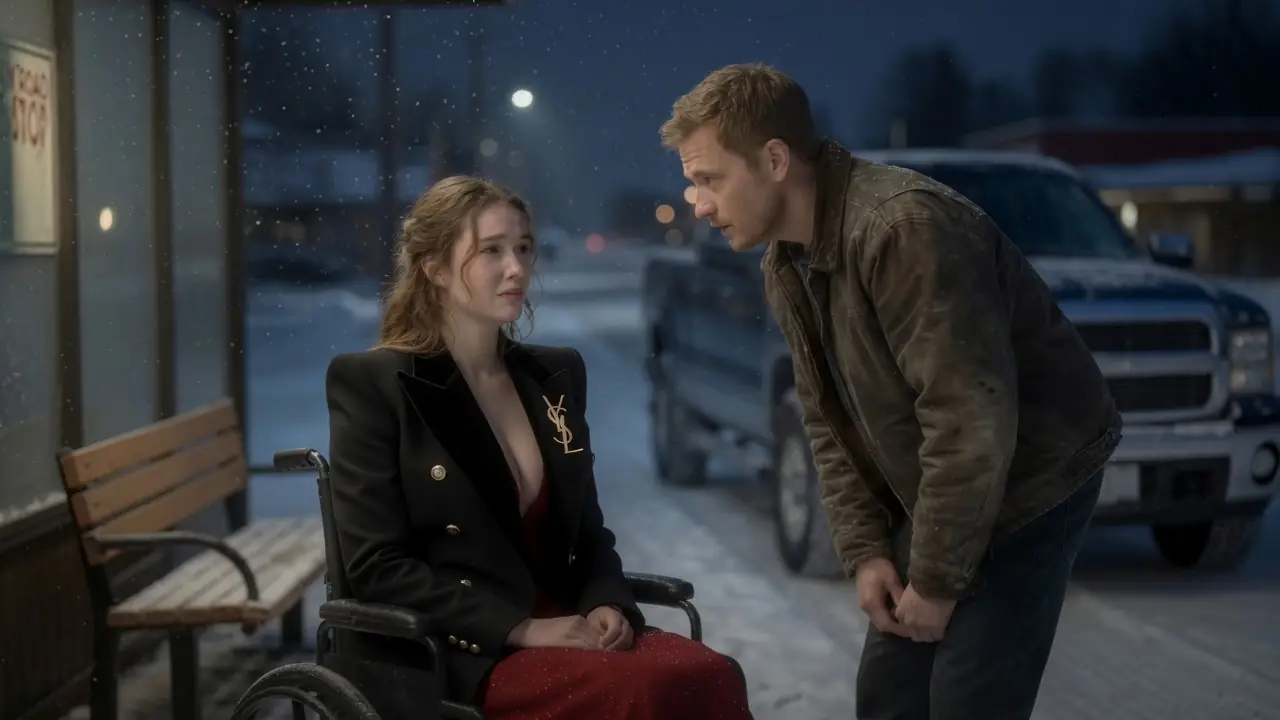
The words remained sharper than the wind. Adrian Cole had not shouted them during an argument or lost control after drinking. He had spoken calmly while standing beside his black sedan, as though announcing a business conclusion he had reached after careful study. He told Lily that marrying a woman in a wheelchair would make the rest of his life feel like unpaid nursing work.
Then he had placed her bag beside the bus shelter and left.
Lily had watched his taillights disappear through the snow without asking him to return. Pride kept her upright for the first hour, anger sustained her through the second, and numbness carried her into the third. The final bus had never arrived because the county canceled service after the weather worsened. Her wheelchair battery had fallen below twelve percent, her phone was dead, and the nearest open business was more than two miles away.
The dark road seemed endless in both directions. Several vehicles passed without slowing, their headlights briefly illuminating the woman alone beneath the shelter before darkness returned. Lily told herself she preferred their indifference to pity, though the lie became harder to believe as the cold entered her gloves. She had built an entire company around mobility and independence, yet she could not move another mile without help.
Daniel Brooks nearly passed her too.
He was driving home from a late shift at the Hartman Mobility repair facility with his nine-year-old daughter Emma asleep beneath a blanket in the back seat. His old pickup struggled against the snow, and the heater produced more noise than warmth. Daniel saw the wheelchair only after the headlights crossed the bus shelter, revealing Lily’s pale face and wet hair.
He slowed immediately.
Emma woke when the truck stopped. “Are we home?”
“Not yet.”
She rubbed her eyes and leaned toward the window. “There’s a lady outside.”
“I see her.”
Daniel parked several feet from the shelter and told Emma to remain inside until he understood what was happening. He approached slowly with both hands visible, stopping far enough away that Lily would not feel surrounded. She looked at him with the guarded expression of someone who had already endured too much from one man that evening.
“Ma’am, do you need assistance?”
“No.”
Daniel glanced toward the road sign announcing the canceled bus schedule. “The last bus isn’t coming.”
“I know.”
“Do you have someone on the way?”
Lily looked toward the snow collecting over her shoes. “No.”
Daniel removed his brown jacket and held it toward her. “May I put this around your shoulders?”
She almost refused.
The cold finally defeated pride. Lily nodded, and Daniel stepped close enough to place the jacket over her without touching her neck or arms. He moved carefully, waiting each time she tensed, and then returned to his original distance.
“My name is Daniel Brooks,” he said. “My daughter Emma is in the truck.”
“I’m Lily.”
“Do you have somewhere safe to go, Lily?”
She hesitated. “A hotel in Westfield.”
“That’s nearly twenty miles.”
“I know where it is.”
“That wasn’t my concern.”
Lily looked up sharply.
Daniel pointed toward the wheelchair controls. “Your battery light is flashing.”
She covered the display with one hand. “It has enough charge.”
“For twenty miles?”
“I wasn’t planning to drive the chair along the highway.”
A faint smile crossed his face. “Good. That would make my job more complicated.”
“What job?”
“I repair mobility equipment.”
The answer surprised her. Daniel crouched several feet from the front wheel and examined the battery housing without touching it. He asked permission before checking the cable, then explained that the snow and moisture might have weakened the connector. Lily watched his hands move with practical confidence rather than uncomfortable fascination.
“Can you fix it?” she asked.
“Not properly out here.”
“Then I’ll wait.”
“For what?”
She had no answer.
Daniel looked toward the pickup. “I have a portable ramp in the truck because our facility was testing one this afternoon. I can take you to the hotel or somewhere warmer.”
“I don’t have money with me.”
“I didn’t ask.”
“People always ask eventually.”
Daniel stood slowly. “Then you can decide what to do when eventually arrives.”
Emma opened the rear door before her father could stop her. She stepped into the snow wearing a purple coat and boots that were one size too large because Daniel had purchased them to last two winters. The girl carried the blanket from the back seat.
“You forgot this,” she told him.
Daniel took the blanket. “I told you to stay inside.”
“She looks colder than me.”
Emma walked toward Lily before Daniel could answer. She stopped beside the wheelchair and held out the blanket without staring at the chair, the wheels, or Lily’s legs.
“Do you want it?”
Lily’s eyes filled unexpectedly. “Yes. Thank you.”
Emma tucked the blanket over Lily’s lap. “Dad fixes everything except toast.”
“I repair toast badly,” Daniel said.
“You burn it.”
“That is a type of repair.”
For the first time that night, Lily laughed.
The sound surprised her so much that she covered her mouth. Daniel lowered the portable ramp from the truck, secured the wheelchair, and asked Lily to guide him while he attached the safety straps. He never grabbed the chair without warning or spoke to Emma instead of addressing Lily directly.
When everything was secured, they drove toward Westfield.
Emma remained awake in the back seat, asking Lily whether the red dress came from a party. Lily looked down at the torn hem, where the fabric had caught against the bus shelter after Adrian left. She did not want to explain humiliation to a child, but Emma seemed to understand silence better than most adults.
“It was supposed to be an engagement dinner,” Lily said.
“Did you get engaged?”
“I thought I already was.”
Emma frowned. “That sounds confusing.”
“It became confusing.”
Daniel kept his eyes on the road. “You don’t have to tell us anything.”
Lily looked toward him. “He left me because of the wheelchair.”
Daniel’s jaw tightened.
“He said no man should have to carry a broken woman,” she continued. “Those were his exact words.”
Emma leaned forward between the seats. “You’re not broken.”
Lily swallowed. “You don’t know me.”
“I can see you.”
Daniel glanced toward his daughter in the mirror. “Sit back and fasten the belt properly.”
Emma obeyed, but she continued speaking. “A broken thing can’t tell my dad what it wants. You told him where to put the straps.”
Lily turned toward the side window so neither of them would see her cry.
The storm closed the highway twelve miles from Westfield.
A state vehicle blocked the entrance, and an officer directed everyone toward local shelters until morning. The nearest hotel was full because stranded travelers had taken every available room. Daniel called three motels from his phone, but none had an accessible vacancy.
“My house is fifteen minutes away,” he said carefully. “There’s a ramp because my wife used one during her last year.”
Lily noticed the past tense. “Your wife?”
“Rachel died five years ago.”
“I’m sorry.”
“So am I.”
Daniel explained that the house had an accessible bathroom and a wide downstairs guest room. He made clear that Lily could lock the door from inside and that Mrs. Alvarez, their elderly neighbor, would know she was there. Lily listened for pressure in his voice but heard only an offer.
“I can stay in the truck,” she said.
“No,” Emma answered.
Daniel looked toward his daughter. “Emma.”
“The truck heater stops when the engine stops.”
“That is true.”
Emma turned toward Lily. “You can use my room.”
“You have school tomorrow.”
“Probably not.”
Daniel’s phone sounded with an automated school closure notice.
Emma smiled. “See?”
Lily accepted because refusing had become more dangerous than trusting them.
The Brooks home stood on a narrow street lined with small houses and snow-covered porches. It was modest but carefully maintained, with a wooden ramp beside the front steps and a handmade sign near the door reading Emma’s Workshop, though no workshop existed behind it. Daniel explained that his daughter believed every home should contain one room where impossible ideas were allowed.
Inside, the kitchen smelled faintly of coffee and cinnamon.
Emma heated soup while Daniel carried Lily’s bag and connected the wheelchair to a charger near the dining table. He removed the battery cover and discovered a damaged wire inside the connector. Lily watched from the doorway as he cleaned the contact and added temporary insulation.
“You know that model well,” she said.
“We service them at the facility.”
“What do you think of it?”
Daniel paused. “Do you want the polite answer?”
“No.”
“The frame is excellent. The controls respond well, and the battery housing is easier to access than older designs. But this connector is too exposed to moisture.”
Lily studied him. “That problem was supposedly corrected.”
“On the premium line.”
“This is a premium model.”
Daniel looked at the serial number. “Then someone installed the standard connector.”
The statement disturbed her more than he realized.
Lily had approved the premium model personally. Hartman Mobility advertised every chair as weather-resistant and reliable in difficult conditions. If replacement connectors were being downgraded during service, the company was violating its own quality promise.
“Where was it last serviced?” Daniel asked.
“Our corporate center.”
He raised an eyebrow. “They should have known better.”
“They should have.”
Daniel repaired the connection well enough to restore the charge. Then he rolled backward and allowed Lily to test the controls herself. The battery indicator stabilized, and the chair moved smoothly across the kitchen floor.
“You fixed it,” Emma said.
“Temporarily,” Daniel corrected.
Lily looked at him. “You could have charged me a great deal for that repair.”
“I could also charge Emma every time I repair her bicycle.”
“You usually do,” Emma said. “You make me clean the garage.”
“That is labor, not currency.”
Lily smiled.
During supper, she learned that Daniel worked at the Westfield repair and assembly facility owned by Hartman Mobility. He had been employed there for eleven years, first as a mechanical technician and later as a quality-control supervisor. Rachel had worked in the accounting office before becoming ill.
“The facility may close,” Daniel said.
Lily kept her expression still. “Why?”
“Corporate says the numbers are weak.”
“Are they?”
“Depends which numbers matter.”
Daniel explained that the factory handled specialized repairs other centers refused because the work took too long. Employees modified chairs for children with unusual spinal conditions, rebuilt older models for families without replacement coverage, and kept loan equipment available for people waiting on insurance decisions.
“Those jobs don’t produce the highest margins,” he said. “But they keep people moving.”
“And management wants to close it?”
“The final decision is supposed to happen tomorrow.”
Lily set down her spoon.
She knew about the closure.
The recommendation had been prepared by Adrian Cole, Hartman Mobility’s chief financial officer and the man who had abandoned her at the bus stop. He argued that Westfield cost too much to operate and that outsourcing repairs to a national contractor would improve quarterly results.
Lily had approved the preliminary review without visiting the facility.
Adrian assured her that workers were careless, equipment was outdated, and customers would experience no interruption. She had trusted the reports because grief and exhaustion had made delegation feel necessary. Her father founded Hartman Mobility after Lily’s childhood accident, but since his death two years earlier, Adrian had gradually taken control of more decisions.
Daniel was describing a facility entirely different from the one in Adrian’s presentations.
“How many people work there?” she asked.
“One hundred and eighty-six.”
“And closing it affects the town?”
“The school, local stores, landlords, everyone.”
“Why not fight the decision?”
“We tried.”
Daniel told her that employees submitted proposals, efficiency plans, and customer testimonials. None reached the executive committee. Their regional director claimed the owner had already decided that the factory was sentimental waste.
Lily felt heat rise beneath her skin. “Who said that?”
“Martin Vale.”
She knew Martin well. He was Adrian’s closest executive ally and had led the closure review.
Emma looked between them. “Dad says companies forget workers have children.”
Daniel lowered his eyes. “That was private.”
“It was true.”
Lily looked around the small kitchen.
A stack of overdue bills sat partly hidden beneath a grocery flyer. Daniel’s work boots had been repaired with dark thread, and Emma’s backpack carried two different zippers. Closing the facility would not reduce an abstract expense.
It would change this table.
After supper, Emma brought Lily a clean sweater and a pair of soft pants that had belonged to Rachel. Daniel asked before offering them because he understood that another woman’s clothing could carry complicated emotions. Lily accepted and changed inside the locked guest room.
She found framed photographs on the dresser.
One showed Daniel beside a smiling woman seated in a wheelchair during a charity race. Another showed Rachel standing with crutches at a lakeside picnic before her health declined. Emma appeared in every photograph, sometimes laughing and sometimes looking toward her mother with solemn attention.
Daniel had not built the ramp for convenience.
He had built it for someone he loved.
When Lily returned to the kitchen, Daniel was packing her wet dress into a clean garment bag. He immediately stopped when he saw her.
“I should have asked before touching it.”
“It’s all right.”
“No. It belongs to you.”
Lily looked toward the red fabric. “I don’t want it anymore.”
“Then you decide when it leaves.”
The words struck her deeply.
Adrian had made decisions for her while pretending to protect her. He selected accessible restaurants without asking where she wanted to eat, answered questions directed toward her, and treated every disagreement as evidence that she was overwhelmed. Daniel, a stranger with far less power, kept returning choices to her.
“Why did you stop tonight?” Lily asked.
He folded the garment bag carefully. “Because you were alone.”
“Most people kept driving.”
“I almost did.”
“But you didn’t.”
Daniel looked toward Emma, who had fallen asleep on the sofa. “My daughter watches what I do more closely than what I say.”
“You told me that at the bus stop.”
“It keeps me honest.”
Lily’s voice softened. “And if she hadn’t been there?”
“I would still have stopped.”
The answer remained between them.
Daniel made coffee and sat across the table. Lily told him part of the truth, saying only that she worked for Hartman Mobility and had been involved in strategic decisions. She did not reveal her title because she wanted to hear what he believed before power changed his words.
“Do you hate the owner?” she asked.
“No.”
“Why not?”
“I’ve never met her.”
“You must have an opinion.”
Daniel considered the question. “I think she’s been protected from bad news.”
Lily’s throat tightened. “That sounds generous.”
“It isn’t.”
“What does it mean?”
“It means she chose people who tell her what she wants to hear.”
The judgment was fair.
Lily looked toward the wheelchair. “Maybe she trusted the wrong man.”
“Trust explains the first mistake.”
“And the rest?”
“Depends what she does after learning the truth.”
She slept only briefly.
At dawn, snow still covered the street, but the roads had reopened. Daniel prepared breakfast and insisted on driving Lily wherever she needed to go. She gave him the address of the Westfield facility.
He looked surprised. “Why there?”
“I need to attend the closure meeting.”
“You said you worked for the company.”
“I do.”
They reached the factory shortly before nine.
Employees gathered near the entrance carrying boxes, folders, and thermoses. Many believed the closure announcement was already final. Daniel parked near the accessible entrance and lowered the ramp.
“Do you need me to come inside?” he asked.
“Yes.”
He searched her face. “Is something wrong?”
“Several things.”
Emma had remained with Mrs. Alvarez, so the two entered alone. Workers greeted Daniel by name and glanced curiously at Lily. He guided her toward the conference area without touching the wheelchair, allowing her to set the pace.
Martin Vale stood near the main doors with two corporate lawyers.
His expression changed when he saw her.
“Ms. Hartman.”
Daniel stopped walking.
The entire corridor became quiet.
Lily removed Daniel’s brown jacket from her shoulders and placed it across her lap. “Good morning, Martin.”
Daniel stared at her. “Hartman?”
“Lily Hartman,” she said quietly. “Chief executive officer and majority owner.”
He stepped backward as though the floor had shifted beneath him.
Martin approached quickly. “We were told you were resting after last night.”
“Who told you that?”
“Adrian.”
“Adrian abandoned me at a bus stop.”
Several employees exchanged shocked looks.
Martin lowered his voice. “This is not the place.”
“It is exactly the place.”
The closure meeting began in the factory’s central assembly room. Lily asked every employee to remain, then ordered the corporate lawyers to display the full financial report instead of the summary slides. Martin attempted to object, claiming operational details would confuse the workforce.
Lily looked directly at Daniel.
“I have learned to be suspicious of summaries.”
The full report revealed several facts excluded from Adrian’s presentation. Westfield completed specialized repairs at a lower long-term cost than outside contractors. Customer satisfaction was the highest in the company, and the facility prevented millions in warranty replacements by rebuilding equipment instead of discarding it.
The apparent losses came from internal accounting transfers.
Adrian had reassigned profitable service contracts to another division while leaving Westfield responsible for labor and warranty expenses. The national contractor proposed to replace the facility was partially owned by an investment fund connected to Martin’s brother.
Daniel watched Lily read each page.
Her face remained controlled, but anger sharpened every question. She asked Martin why premium wheelchair connectors had been replaced with standard components during corporate servicing. He claimed the change saved money and met minimum requirements.
“Minimum requirements left me stranded in the snow,” Lily said.
The room became silent.
She described the failed connector, Daniel’s repair, and the difference between what corporate reports promised and what a customer experienced. Then she placed the preliminary closure authorization on the table.
“I approved this review,” she said. “That was my failure.”
Martin looked relieved, believing the admission would protect the decision.
Lily tore the authorization in half.
“The Westfield facility will remain open.”
A sound moved through the room, not yet celebration but the first release of breath after weeks of fear. Daniel lowered his head, while several employees began crying quietly.
Lily continued.
“An independent investigation will review the contractor agreement, component substitutions, financial transfers, and every executive involved. Martin Vale is suspended effective immediately.”
Martin’s face hardened. “Adrian will never allow this.”
“Adrian no longer controls anything in my company.”
Security escorted Martin from the room.
Lily turned toward the workers. She did not promise that every process would remain unchanged or that mistakes had not occurred. Instead, she asked them to show her what the reports had ignored.
For six hours, Daniel guided her through repair stations, testing rooms, and storage areas. Lily met technicians who had built custom controls for children unable to use their hands. She saw the loan equipment program, the handwritten customer letters, and shelves of salvaged parts that kept older wheelchairs operating for people who could not afford new ones.
At one station, Daniel opened a drawer containing rejected premium connectors.
“These arrived from corporate service centers,” he explained. “We replaced them before returning the chairs.”
“You reported it?”
“Three times.”
“Where are the reports?”
“Martin’s office claimed the issue was resolved.”
Lily understood that resolved had become another word for buried.
Adrian arrived shortly before sunset.
He entered the factory wearing the same expensive coat from the night before. He appeared confident until he saw federal accountants, company attorneys, and board members already examining the records.
“You embarrassed me,” he told Lily privately.
She looked at him without fear. “You abandoned me in a snowstorm.”
“You were emotional.”
“You called me damaged goods.”
“I was angry.”
“You were honest.”
Adrian stepped closer. “I built this company with you.”
“My father built it. The workers sustained it. You redirected it toward people who paid you.”
He denied every accusation until Lily showed him the contractor ownership records and internal messages recovered that afternoon. Adrian had expected the Westfield closure to increase the value of his private investment by millions.
He was removed as chief financial officer.
The board later terminated him, and investigators opened a case involving fraud, conflicts of interest, and misuse of company assets. Lily returned his engagement ring through an attorney.
Daniel expected nothing after the factory was saved.
He returned to work the next morning, repaired equipment, supervised testing, and avoided conversations about his part in the owner’s rescue. When Lily asked to meet him, he arrived wearing a clean work shirt and carrying the damaged wheelchair connector in a plastic evidence bag.
“I thought you might need this,” he said.
“You could have asked for anything.”
“I am asking you to fix the design.”
Lily smiled. “We will.”
She offered him a position leading a new field-quality program that allowed repair technicians to report safety problems directly to the executive office. Daniel hesitated because the salary was nearly twice his current pay and required occasional travel.
“What about Emma?” Lily asked.
“She is the reason I hesitate.”
“Then the program will be designed around fathers who keep promises to their children.”
Daniel accepted only after reading the entire contract.
Over the next year, Hartman Mobility changed.
The Westfield facility expanded its specialized repair work and hired thirty additional technicians. Lily created a customer council composed of wheelchair users, parents, caregivers, and repair workers. No design could be labeled accessible until people who relied on it had tested it outside perfect laboratory conditions.
Daniel became one of Lily’s most trusted advisers.
He still disagreed with her publicly, sometimes in rooms filled with executives who expected quiet approval. Lily valued him because his respect never depended on obedience. He valued her because she stopped treating correction as betrayal.
Emma became part of Lily’s life slowly.
She visited the factory after school, covered Lily’s office whiteboard with impossible wheelchair designs, and insisted that every model include a hidden compartment for snacks. Lily attended Emma’s science fair and helped her build a miniature ramp system that adjusted to uneven ground.
Their relationship with Daniel changed more carefully.
Neither wanted gratitude mistaken for love. Lily spent months learning to live without Adrian’s voice defining her worth, while Daniel carried loyalty to Rachel without treating grief as a locked door.
One winter evening, exactly a year after the bus stop, snow began falling over Westfield again.
Daniel drove Lily and Emma along North Road. The old shelter had been replaced through a Hartman Mobility community project with an enclosed accessible station, emergency charging outlets, heated seating, and a working call system.
A small plaque stood near the entrance.
No one should lose freedom because the road became difficult.
Emma read it aloud. “You wrote that.”
Lily looked at Daniel. “Your father inspired it.”
Emma grinned. “He inspires lots of things by being stubborn.”
Daniel opened Lily’s door and lowered the ramp. She moved beside the shelter, then looked toward the place where he had found her the previous year.
“I believed him,” she said.
Daniel knew whom she meant. “Adrian?”
“When he called me broken.”
“You knew he was wrong.”
“I knew what I wanted to believe.”
Snow gathered across Daniel’s shoulders.
Lily reached for his hand.
“Why did you really stop?” she asked.
He looked toward Emma, who was studying the charging station several feet away. “Because leaving you there would have changed who I was.”
“And helping me?”
Daniel closed his fingers around hers. “That changed my life too.”
Lily pulled him closer and kissed him beneath the bus shelter light.
It was gentle, patient, and chosen without rescue, debt, or fear. Emma noticed from the charging station and immediately pretended to examine a sign in the opposite direction.
Daniel laughed softly when they separated.
One year earlier, Lily Hartman had sat alone in the snow believing the wheelchair made her unworthy of love. Daniel Brooks had believed his life could hold only work, fatherhood, and memories of the woman he had lost.
Neither was waiting for a miracle.
They were simply waiting beside the road when one ordinary act of kindness gave both of them somewhere new to go.