Caleb Whitmore did not know how many miles were left when the rain began. He only knew that the road beneath his boots had turned soft, the sky had gone black over the Montana ridge, and his five-year-old daughter, Emma, had stopped lifting her head when he whispered her name. She was curled against his chest inside his worn coat, too light for a child her age and far too still for a father’s heart to bear. Somewhere ahead, if the old drifter at the last town had told the truth, there was a ranch called Blackwood, run by a widow who paid fair wages and did not ask too many questions.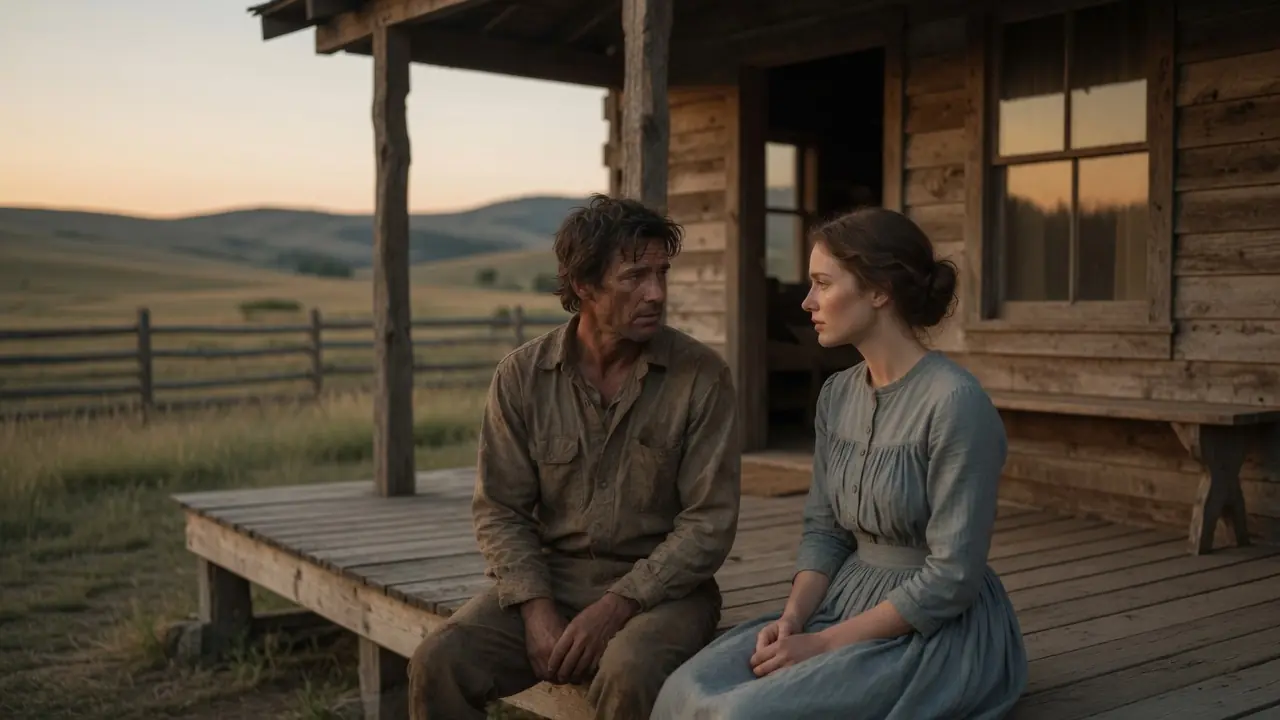
Caleb had spent the last six months living on rumors like that. A man at a feed store would say there might be work two towns west, so he walked west. A woman outside a church would say a rancher needed fence hands beyond the river, so he crossed the river. Most rumors died by sunset, but Caleb kept following them because stopping meant admitting there was nowhere left to go.
He had once owned land in Kansas, two hundred acres of wheat that turned gold under the summer sun and made him proud every time the wind moved through it. His wife, Mary, used to stand at the porch rail in the evenings with flour on her hands and sing while she watched Emma chase grasshoppers along the fence line. Back then, Caleb believed hard work was a kind of promise the world had to honor. He believed a man who loved his family and kept his fields straight could not lose everything at once.
The drought proved him wrong slowly. The first dry summer hurt, but it did not kill the farm. The second year cracked the soil open, thinned the wheat, and sent Caleb to the bank with his hat in his hand and shame sitting heavy on his shoulders. By the third, the land looked less like a living thing and more like an old table left too long in the sun.
Mary never blamed him. That hurt more than blame would have. She stretched flour, beans, and cornmeal until every meal felt like a miracle performed by tired hands. At night, when Caleb sat at the kitchen table with bank papers spread in front of him, she would place one hand on his shoulder and tell him they would get through one more season.
Then winter came, and Mary got sick.
The fever started as a chill she laughed about while kneading bread. By the end of the week, she could not stand without Caleb’s arm around her. The doctor came once, spoke softly, left medicine Caleb could barely afford, and rode away through snow that seemed to erase every track behind him.
Mary died before the thaw.
Caleb held her hand until the warmth left it and promised what every husband and father promises when grief has him by the throat. He promised he would take care of Emma. He promised their little girl would never go without. Mary, already fading toward whatever mercy waited beyond that cold room, only looked at him and whispered, “Don’t let her forget how to laugh.”
He buried Mary on a Tuesday under a cottonwood tree at the edge of the farm. Emma stood beside him in a black dress that had been taken in twice and still hung loose on her small frame. She did not cry during the service, not until everyone left and Caleb knelt to smooth the dirt with his bare hands. Then she climbed into his lap and asked if Mama could still hear them.
“I hope so,” Caleb had said.
Emma looked at the grave, her face serious in the gray afternoon. “Then we should say goodnight.”
So they did.
Three days later, the bank nailed the notice to the front door.
Caleb read it twice, then a third time, though the meaning did not change. The farm was gone. The fields his father had never owned but Caleb had fought to keep, the house Mary had turned into a home, the barn with Emma’s chalk marks on the inside wall measuring how tall she had grown each birthday, all of it would belong to men who had never stood in that soil.
He tried to sell what he could. A mule went first, then the wagon, then tools he had held in his hands for years. The money covered less than he hoped and vanished faster than he could understand. By the time he packed Emma’s clothes into a flour sack and closed the farmhouse door for the last time, he had less than twelve dollars and a promise already breaking in his chest.
Emma carried her mother’s sewing thimble in one pocket and a rag doll in the crook of her arm. She turned back once to look at the house. “Will we come back when the rain comes?”
Caleb could not answer quickly enough.
She looked up at him. “Papa?”
He forced his mouth into something that almost resembled a smile. “We’ll find a better place, sweetheart.”
Emma believed him because she was five.
That was the cruelest kindness left in the world. His daughter still trusted his voice even when he no longer trusted the words coming out of it. For weeks, Caleb survived on day labor, splitting wood, carrying feed sacks, mending gates, and taking any work that paid in bread, stew, or a night inside a barn. He gave Emma the soft parts of biscuits and told her he had already eaten.
She began to notice anyway. Children noticed more than grown men wanted them to. One evening, after a farmer’s wife handed them two bowls of soup and turned away before Caleb could thank her properly, Emma pushed half of hers toward him. “You can have some, Papa. I’m not very hungry.”
He knew she was lying.
He pushed it back gently. “You eat, Em. I had plenty earlier.”
Her eyes, too much like Mary’s, stayed on his face. “No, you didn’t.”
He almost broke then. Not in front of strangers, not in the yard of a man who had given him only one night’s shelter and expected him gone by dawn, but in front of his child and a bowl of soup. Instead, he took one spoonful from her bowl and made a great show of enjoying it. Emma smiled, satisfied that she had taken care of him.
By late summer, the money was gone.
By early autumn, Caleb had started measuring distance not by miles, but by how long Emma could walk before he had to carry her. At first, she rode on his shoulders and laughed when he pretended to stumble. Then she rode on his back, arms looped around his neck. Then, more and more often, he carried her in both arms while she slept against his chest.
Montana territory opened around them in wide, lonely stretches. The sky seemed too large, the roads too empty, and the nights too cold for a man with a child and no roof. Caleb asked for work at every ranch, stable, and mill he passed. Some men turned him away before he finished speaking because desperate fathers were common enough to be inconvenient.
Others offered one day, maybe two. He took them all. He chopped wood until his hands cramped, repaired a corral gate for a meal, cleaned stalls for a place in the hayloft, and once spent an entire day helping move cattle for a rancher who paid him with a sack of oats and three potatoes. Caleb thanked him like it was gold.
Emma kept asking when they would find the good place.
At first, the question came every morning. Then every few days. Then only when she was very tired. Caleb feared the silence that came after she stopped asking because it meant she had begun learning what the road taught too well: hope was expensive, and children often paid for grown men’s failures.
The fever came after a cold night in a half-collapsed shed.
Caleb woke before dawn to Emma shivering beside him under his coat. Her forehead burned under his palm while her hands felt cold and small in his. He whispered her name, and she opened her eyes, but they looked cloudy with exhaustion. By noon, she was too weak to walk.
He carried her into the next town and asked for a doctor. The doctor’s office was closed, and the woman sweeping the porch next door said he had ridden out to a ranch miles away and would not return until morning. Caleb asked if there was medicine he could buy, and her eyes moved over his torn coat, hollow cheeks, and empty hands before she answered.
“There’s a mercantile.”
“I don’t have much money.”
Her face softened, but not enough to change anything. “Then I don’t know what to tell you.”
At the mercantile, Caleb sold Mary’s silver hair comb. He had kept it wrapped in cloth at the bottom of his pack because it was one of the last beautiful things left from their life. The storekeeper gave him far less than it was worth, and Caleb knew it, but Emma was leaning against his leg, trembling. He bought dried bread, a small paper packet of bitter tea, and a tin cup.
That night, Emma could not keep the tea down.
Caleb sat behind the store under an overhang, shielding her from the wind with his body. He held the cup to her mouth again and again, coaxing tiny sips while whispering Mary’s songs under his breath. He could not sing the way Mary had. His voice was rough, cracked by dust and grief, but Emma’s fingers curled weakly around his sleeve as if she knew what he was trying to give her.
The next morning, he heard about Blackwood Ranch.
The man who told him was old, half-toothless, and leaning beside the feed store with a pipe clamped between his teeth. He watched Caleb adjust Emma’s weight in his arms and said, “You looking for work or a grave?”
Caleb stared at him. “Work.”
“Then you’re walking the wrong road.”
“I’ve walked every road they told me to.”
The old man squinted toward the distant ridge. “There’s a cattle outfit past there. Blackwood Ranch. Widow runs it.”
“A widow?”
“Clara Bennett. Big woman. Stubborn woman. Folks said she’d lose the place after her husband died. She didn’t.” He scratched his jaw. “Pays fair, if she hires you. Doesn’t much care for fools.”
Caleb looked toward the ridge. “How far?”
“Fifteen miles, maybe more if you lose the trail.”
Emma stirred against his chest. Her lips moved, but no sound came out.
The old man looked at the child and then back at Caleb. His expression changed in the way faces sometimes changed when pity arrived too late to become useful. “Rain’s coming tonight.”
“I know.”
“You got a horse?”
“No.”
“Wagon?”
“No.”
The old man was quiet for a long moment. Then he reached into his coat pocket and pulled out a strip of dried meat wrapped in paper. He handed it to Caleb without looking at him. “Road bends north after the cottonwoods. Don’t take the lower trail. It floods.”
Caleb took the food. “Thank you.”
“Don’t thank me. Get the child somewhere warm.”
So Caleb walked.
The first miles were manageable because hope had returned with a name attached to it. Blackwood Ranch. Clara Bennett. Work. Warmth. Maybe a bed for Emma and a roof that did not belong to strangers who watched the door until morning.
Emma woke around midday and looked up at him. “Papa?”
“I’m here.”
“Are we going to the good place?”
Caleb swallowed. “Yes.”
“Does it have bread?”
“I reckon so.”
“Does it have a fire?”
“I hope it has the biggest fire in Montana.”
Her eyes closed, and a faint smile touched her mouth. “Mama liked fires.”
“I know.”
“She said houses with fires don’t feel lonely.”
Caleb’s throat tightened until he could barely breathe around it. “Your mama knew a lot of things.”
The trail grew rougher after the cottonwoods. Ruts cut deep into the ground, and Caleb stumbled more than once, twisting his ankle hard enough to make light flash behind his eyes. Each time, he tightened his hold on Emma and kept moving. He had learned during the last six months that pain was not always a warning to stop; sometimes it was only proof that he had not stopped yet.
By late afternoon, clouds gathered low over the ridge. The air smelled of wet dust and grass. Caleb found a shallow stream and knelt carefully to fill the tin cup, then lifted Emma enough to wet her lips. She swallowed once, then coughed weakly and turned her face into his coat.
“Just a little more,” he whispered.
“No.”
“Please, Em.”
She opened her eyes, and for one awful second he saw Mary there, not in the color or shape, but in the quiet suffering. “Papa, are you mad?”
The question struck him harder than any hunger had.
“No,” he said quickly. “No, sweetheart. Never.”
“Because I can’t walk.”
He sat back on his heels with her in his arms, the cup forgotten beside him. “Emma Whitmore, you listen to me. You don’t ever apologize for needing your papa. Carrying you is the only thing I’m still any good at.”
Her fingers touched his rough cheek. “You’re good at stories.”
He gave a broken laugh. “Am I?”
“You told me about the purple cow.”
“That was your mama’s story.”
“You tell it wrong.”
“I know.”
She closed her eyes again. “Tell it wrong.”
So he did.
He told her about a purple cow that lived on a hill and refused to give milk unless someone complimented her hat. He forgot half the story, invented the rest, and stumbled through it while the first rain began to fall in fine needles around them. Emma did not laugh, but one corner of her mouth moved as if she remembered how.
The rain hardened near dusk.
Caleb wrapped Emma tighter inside his coat and pushed on. The trail narrowed, rising toward the ridge, and mud clung to his boots until each step felt like dragging chains. He had not eaten since morning. His arms had gone numb from holding Emma, then passed beyond numb into a deep trembling ache.
More than once, he thought he saw lantern light and then realized it was only water shining on stone. More than once, he heard a voice in the wind and stopped, heart pounding, only to find the road empty ahead. The world had reduced itself to rain, mud, breath, and the weight of his daughter.
Near full dark, Emma stopped responding.
Caleb said her name once, then again. Her head rested against his shoulder. Her breathing was shallow, warm against his neck but too faint, too far away. Panic rose inside him so violently that he nearly dropped to his knees right there in the mud.
“No,” he whispered. “No, Emma. Not here.”
He shifted her higher, pressing his cheek to her forehead. “You stay with me. You hear me? You stay with me.”
The road bent sharply around a stand of wind-bent pines. Caleb stumbled through the turn, half blind from rain streaming down his face, and then he saw it. Not a house. Not yet. A sign nailed crooked to a post beside a wooden gate.
Blackwood Ranch.
For several seconds, Caleb only stared. The letters blurred in the rain. Behind the gate, far up the dark drive, one lantern burned on a porch, small and yellow and impossible. It was the first light he had seen all night that did not vanish when he looked at it.
He tried to call out, but his voice failed.
The gate was barred from the inside.
Caleb set one hand against the wet wood, still holding Emma with the other arm. He pushed. The gate did not move. He pushed again, harder, and a sound came out of him that was not quite a sob and not quite a prayer.
“Please,” he said.
No one answered.
He looked down at Emma. Her face was pale in the darkness, her hair plastered damply to her cheek. Something inside Caleb broke open, not softly, but with the sudden force of a dam giving way. Every mile, every hunger, every lie he had told her about things getting better, every promise made at Mary’s bedside came crashing into that one locked gate.
He lowered himself to his knees in the mud because his legs finally refused to hold him.
Then he struck the gate with his fist.
Once.
Twice.
Again.
“Somebody!” His voice tore through the rain. “Please, somebody help me!”
A dog barked somewhere beyond the house.
Caleb hit the gate again, not caring about the pain in his hands, not caring whether he sounded like a madman, not caring whether the widow inside came out with a rifle or a curse. “My daughter’s sick! I need help! I’ll work, I’ll sleep in the barn, I’ll do anything you ask, but please open this gate!”
The dog barked louder.
A shape moved on the far porch.
Caleb saw the lantern lift. For one terrifying moment, he thought it might turn away. Then the light began moving toward him, swinging in a wide, bright arc through the rain.
Emma stirred faintly in his arms. “Papa?”
He bent over her, shaking. “I’m here.”
“Is it the good place?”
Caleb looked at the approaching lantern, at the shadow of a tall woman coming through the storm with something long held in the crook of her arm. He did not know her face yet. He did not know her name would one day mean safety, work, courage, and home. He only knew the gate had not opened yet, and the light was still coming.
“I don’t know,” he whispered. “But it’s a place with a light.”
The woman’s voice cut through the rain, sharp and strong. “Who’s out there? State your business or get off my land.”
Caleb gathered what little strength he had left and lifted Emma higher so the lantern could see her. “My little girl,” he called back, his voice breaking. “She’s burning up. I’ve got nowhere else. Please, ma’am… I’m begging you.”
The lantern stopped just beyond the gate.
Caleb held his breath.
The woman looked at him first, hard and suspicious. Then the lantern lowered, and its light fell across Emma’s still face. Caleb saw the exact moment the woman changed. Her shoulders tightened, her eyes widened, and whatever suspicion had brought her armed into the rain gave way to something older, deeper, and more powerful.
“Lord above,” she breathed.
The bar lifted.
The gate opened.
And Caleb Whitmore, who had walked out of Kansas with a broken promise and carried his daughter through six months of hunger, loss, and rain, finally crossed the threshold of the place that would become their home.