Rain hammered the private runway outside Seattle like the sky had been split open. Water streamed across the polished concrete, flashing under the hangar lights while wind dragged loose sheets of rain against the side of a grounded Gulfstream jet. Adelaide Monroe stood beside the aircraft in a red dress and black coat, her phone gripped so tightly her knuckles had gone pale. Three elite engineers had already failed, and the clock above the hangar office showed she had less than two hours before the flight window closed.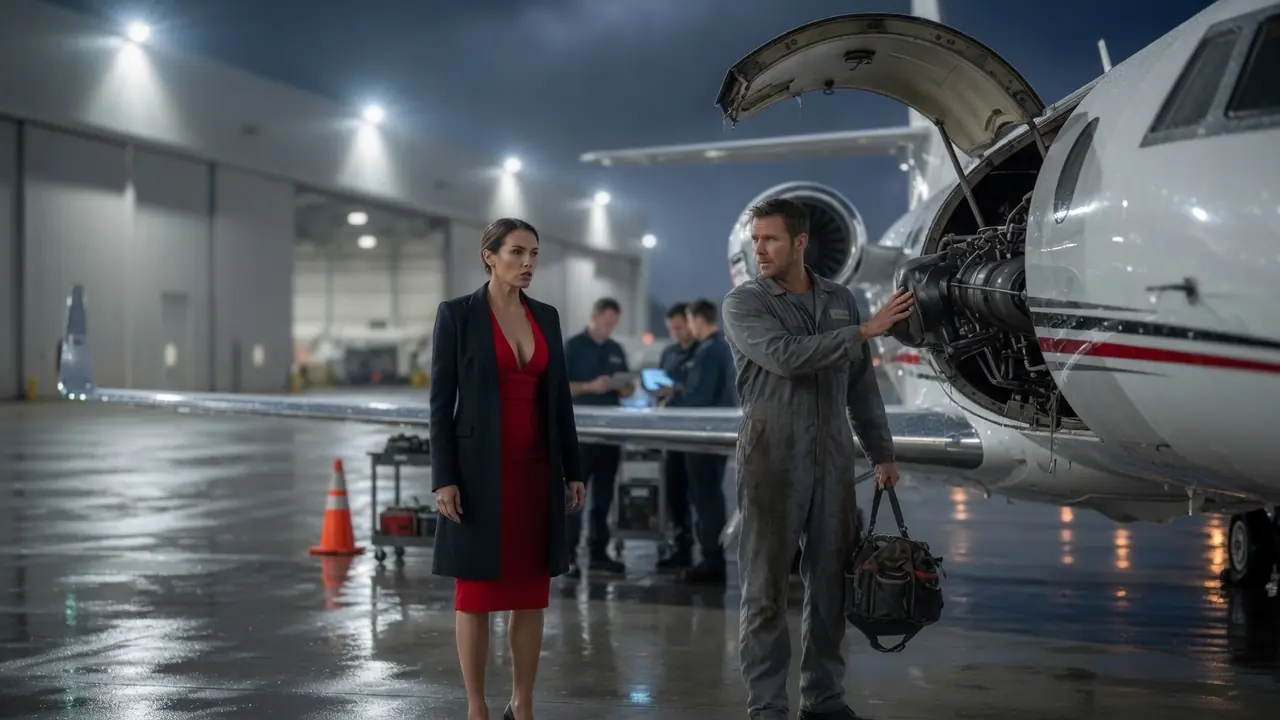
“This summit cannot wait,” Adelaide said, her voice cutting through the storm.
One of the engineers lowered his tablet. “Miss Monroe, we have run every diagnostic the system allows. The avionics are rejecting startup authorization, and the engine control sequence is unstable.”
“That is not an answer.”
“It is the only answer we have.”
Adelaide turned away before she said something she could not take back. She was not used to helplessness, and she hated the taste of it. Monroe Global Logistics moved relief supplies, medical equipment, and reconstruction materials through some of the most difficult regions in the world. That night, she was supposed to fly to Vancouver for a private peace summit that could secure a humanitarian corridor for three countries on the edge of collapse.
Her jet sat dead in the rain.
Behind her, the engineers spoke in low voices, all expensive coats, sealed laptops, and careful excuses. They had flown in from Los Angeles and New York because her private aviation director insisted the problem required specialists. They had checked software, panels, sensors, codes, and power cycles. Every test produced a different warning, and every warning gave them another reason to stop.
Then the hangar side door opened.
A man stepped in from the rain wearing a soaked gray mechanic’s jumpsuit and carrying a tool bag in one hand. His dark hair was plastered to his forehead, and water ran from his sleeves onto the concrete. He looked tired, underpaid, and out of place beside a 120-million-dollar aircraft and a team of polished aviation experts. Adelaide looked him over once and felt her patience break.
“Who is this?” she demanded.
The hangar supervisor cleared his throat. “Jack Turner. Local maintenance. He knows older Gulfstream electrical systems better than anyone on night shift.”
Adelaide stared at him. “Three elite engineers failed, and you expect me to trust a soaked mechanic with my jet?”
Jack Turner looked at her, then at the open engine panel. His expression did not change. “No, ma’am. I expect you to stop trusting suits who stare at screens and start trusting the man who actually heard the fault.”
The engineers went still.
Adelaide’s eyes sharpened. “If you’re wrong, I lose a billion-dollar summit tonight.”
Jack walked past her toward the aircraft. “Then watch closely, because if I’m right, a ten-dollar part just embarrassed every expert you paid to overlook it.”
No one spoke for several seconds.
Jack set his tool bag down and crouched beneath the open access panel. He did not reach for a laptop first. He placed one hand against the casing, leaned close, and listened as the auxiliary power system cycled weakly. The rain outside rattled the hangar doors, but inside the machine, something clicked once, paused too long, then clicked again.
Adelaide noticed the difference between him and the others immediately. The engineers had acted as though the jet was a locked courtroom and only their software could speak. Jack treated it like a wounded animal that still knew how to tell the truth. His hands were rough, steady, and careful.
“What are you doing?” one engineer asked.
Jack did not look back. “Listening.”
“We already ran diagnostics.”
“I heard.”
The engineer’s face tightened. “And?”
Jack glanced over his shoulder. “The jet didn’t.”
A few mechanics near the far wall looked down to hide smiles.
Adelaide folded her arms, but she did not interrupt again. She was too desperate and too curious. Jack removed a narrow relay housing, checked the contacts with a handheld meter, then frowned. He asked for the startup sequence to be repeated.
The engineer protested. “There is no point cycling again.”
Jack’s voice hardened. “There is if you want to know whether the relay fails before or after load.”
Adelaide turned to the engineer. “Run it.”
The sequence started. Lights flickered across the panel. The relay clicked, sparked faintly, then died in Jack’s hand. The smell of burned metal rose sharp and unmistakable.
Jack held up the small part.
“There,” he said. “This relay is sticking under load. It’s feeding bad timing to the control chain, and your diagnostics are chasing the ghosts it creates.”
The engineers stared at the burned relay in silence.
Adelaide stepped closer. “Can you replace it?”
Jack looked at the part number. “Not with a new one tonight.”
Her face fell.
“But,” he continued, “there’s an older spare module in Bay Four from a decommissioned aircraft. If the relay matches and the board is clean, I can rebuild this circuit enough to get you safely airborne.”
One engineer snapped, “That’s not approved field protocol.”
Jack stood and looked him in the eye. “Neither is missing a burned relay for three hours.”
Adelaide’s head turned slowly toward the engineer. He had no answer.
“How long?” she asked Jack.
“Forty minutes if the spare is good. An hour if it fights me.”
“You have thirty-five.”
Jack picked up his tool bag. “Then stop talking.”
The words should have offended her. Instead, Adelaide almost respected him for them. Everyone around her had spent the night softening the truth, afraid of her money, her temper, or her reputation. Jack Turner did not seem afraid of any of it. He was afraid only of wasted time.
He disappeared into Bay Four with two mechanics following him. Adelaide watched through the glass wall as he pulled an old module from a marked storage shelf, opened it on a workbench, and inspected the board under a lamp. His movements were efficient but not rushed. He looked like a man who had spent years fixing impossible things with too little money and no applause.
The hangar supervisor stepped beside Adelaide. “He’s good.”
“You should have called him first.”
“We tried to call the corporate team first.”
“That was not what I said.”
The supervisor wisely said nothing.
Adelaide’s phone buzzed again. The summit coordinator wanted confirmation. The prime minister’s office wanted confirmation. Her own board wanted confirmation. If she missed the meeting, months of negotiation might collapse into blame, and every rival who had called her too ambitious would celebrate before dawn.
She looked back through the glass.
Jack Turner had opened both relay housings. He was transferring a component with a soldering iron, steady despite the storm shaking the metal building. His jumpsuit was still wet. His jaw was dark with stubble. A small plastic keychain hung from his tool bag, shaped like a cartoon rocket.
Adelaide noticed it because everything else about him was practical.
“Does he have children?” she asked.
The supervisor blinked. “One son. Ben. Eight years old, I think.”
“Where is the child tonight?”
“In Jack’s truck, probably. Or with dispatch. He brings him sometimes when childcare falls through.”
Adelaide turned sharply. “There is a child here in this storm?”
The supervisor looked embarrassed. “Jack’s a single dad. He doesn’t complain.”
Adelaide hated that sentence.
People often said someone “doesn’t complain” when they meant they had learned nobody would help. She walked toward the dispatch office without another word. Inside, under the fluorescent light, a little boy sat asleep across two chairs with a backpack under his head and a book open on his chest. His coat was too thin for the weather.
Adelaide stopped in the doorway.
The boy’s hair was the same dark brown as Jack’s, and one hand rested on the plastic rocket keychain’s matching twin clipped to his backpack. Someone had placed a vending-machine blanket over him, the kind used for emergency passengers. It barely covered his legs.
The dispatcher whispered, “That’s Ben.”
Adelaide looked at the child, then toward the hangar where Jack was saving her jet. The man fixing her 120-million-dollar aircraft had not asked for a lounge, a bonus, or even dry clothes. His son was sleeping in a chair while powerful people argued about protocol.
That knowledge changed something in her.
When Adelaide returned to the aircraft, Jack was installing the rebuilt relay assembly. He wiped moisture and grease from his hand before tightening the final connection. The engineers stood behind him, quieter now.
“Run the sequence,” Jack said.
The cockpit crew followed his instruction.
The startup lights moved across the panel in order. No flicker. No hesitation. The engine control system accepted the chain, and one of the jet’s systems came alive with a low rising hum. A green authorization light blinked.
The hangar erupted in relieved exclamations.
Jack held up one hand. “Not done.”
Everyone stopped.
He ran the sequence two more times. Then he checked heat at the relay, voltage stability, and backup circuit response. Only after the third clean run did he close the panel and step back.
“You can fly,” he said. “But I want the module replaced fully at destination before the return.”
Adelaide looked at the jet, then at him. “You saved the flight.”
Jack reached for his tool bag. “I fixed a relay.”
“No,” she said. “You saw what everyone else missed.”
He glanced toward the engineers. “That’s not my problem.”
“It became mine.”
Jack finally looked at her properly. His eyes were blue-gray, tired, and guarded. “Then you should hire people who listen to machines before invoices.”
The engineers stiffened again.
Adelaide almost smiled. “You speak to every billionaire that way?”
“No. Just the ones standing between me and finishing paperwork.”
The hangar supervisor coughed into his hand.
Adelaide stepped closer. “What do I owe you?”
Jack’s face closed immediately. “Standard emergency maintenance rate. Dispatch will bill it.”
“That is not what I asked.”
“It’s what I answered.”
She studied him. “You have a son sleeping in the dispatch office.”
His expression changed fast. Not embarrassment. Protection. “He’s fine.”
“He is sleeping under a thin emergency blanket while you repair aircraft in a storm.”
“He’s safe.”
“That is a low standard for a child.”
Jack’s jaw tightened. “Careful.”
The warning in his voice was quiet, but real. Adelaide recognized it. She had spent years negotiating with men who threatened companies and governments, but this was different. Jack Turner was not defending pride. He was defending the only thing in his life that mattered.
“I’m not criticizing you,” she said.
“Yes, you are.”
“No. I am criticizing a world where a man skilled enough to save my flight has to bring his child to night shift because help is treated like weakness.”
Jack looked away first.
Adelaide softened her voice. “What happened to his mother?”
The question hung there. For a moment, Jack looked like he might tell her to mind her own business. Then his anger drained into something older.
“Cancer,” he said. “Three years ago.”
“I’m sorry.”
“So is everyone.”
The words were not cruel. They were exhausted. Adelaide had heard condolences delivered like receipts, passed across quickly so the speaker could feel decent and leave. Jack had clearly collected too many.
He lifted his tool bag. “Your jet is ready, Miss Monroe.”
She nodded slowly. “Come with me.”
“No.”
That surprised her. “No?”
“I have reports to file, and my son needs to go home.”
“I want to make you an offer.”
“I don’t want one.”
“You haven’t heard it.”
“I’ve heard enough offers.” He looked directly at her. “They usually mean more hours, more travel, and some executive explaining why missing my kid’s school play is the price of opportunity.”
Adelaide had no immediate answer.
Because he was right.
Her world had rewarded people who treated family as an obstacle to ambition. She had often been one of them. She had missed birthdays, funerals, anniversaries, and quiet afternoons that never returned, all because something urgent wore an expensive suit.
Jack saw her silence and gave a short nod. “Good luck at your summit.”
He walked away before she could stop him.
The flight departed forty minutes later. Adelaide sat alone in the cabin, the repaired system humming beneath her, and found herself thinking less about the summit than about the boy asleep in the dispatch office. She also thought about Jack’s words. A ten-dollar part had embarrassed her experts. A single father had embarrassed her assumptions.
The summit succeeded.
By noon the next day, Monroe Global Logistics secured the humanitarian corridor. Cameras flashed, leaders shook hands, and Adelaide’s team celebrated what they called a strategic victory. She accepted congratulations, delivered polished remarks, and smiled exactly when she was supposed to smile.
But on the flight home, she opened her laptop and did not review the summit brief.
She searched Jack Turner.
He had been an Air Force aircraft systems technician for twelve years. Later, he worked in private aviation maintenance until his wife became ill. After her death, he stepped away from higher-paying jobs because they required travel and unpredictable deployment. His current role at the airport paid less than his skill deserved, but it kept him close to Ben’s school.
Adelaide closed the file and looked out the window.
Opportunity, she realized, had a cruel habit of demanding that people abandon the thing they loved most before it called them successful.
She returned to Seattle that evening, but she did not send an assistant. She went to the maintenance bay herself.
Jack was under a smaller private aircraft, one arm reaching into an open panel. Ben sat at a folding table nearby doing homework with a pencil between his teeth. The boy looked up first.
“Dad,” Ben said, “the jet lady is here.”
Jack slid out from beneath the aircraft and sat up. “Miss Monroe.”
“Mr. Turner.”
“If this is about the relay report, I filed it.”
“It’s not.”
He stood slowly and wiped his hands on a rag. “Then what?”
Adelaide glanced at Ben. “May I speak with your father?”
Ben looked at Jack, who nodded.
The boy gathered his homework and moved to the vending machines, though he stayed close enough to watch. Jack noticed. Adelaide did too.
“I want to offer you a position,” she said.
“I told you no.”
“You told me no before hearing it.”
“Because I know how these go.”
“This one is different.”
“They all say that.”
Adelaide opened a folder. “Director of Emergency Mechanical Response for Monroe Aviation Operations. Based here in Seattle. No mandatory travel without seven days’ notice unless you accept it. School-hour flexibility. On-site childcare stipend. Full medical, full dental, education fund for Ben, and authority to override outside engineering contractors when safety depends on diagnosis rather than politics.”
Jack stared at her.
She continued, “You would build a team of mechanics who think like you. People who listen before replacing. People who do not worship laptops or ignore them either. Your job would be to stop expensive mistakes before they become dangerous ones.”
Jack said nothing for a long moment.
Then he laughed once, without humor. “That sounds like a job for somebody with a degree.”
“It sounds like a job for the man who saved my aircraft.”
“I fixed a relay.”
“You keep saying that as if small things cannot change large outcomes.”
His expression shifted slightly.
Adelaide lowered the folder. “You told me last night that offers usually cost you your son. This one is designed not to.”
Jack looked toward Ben, who was pretending not to listen while very clearly listening.
“What’s the catch?” Jack asked.
“No catch.”
“There’s always a catch.”
Adelaide nodded. “Then here is the truth. I need people around me who tell the truth before the bill becomes catastrophic. You did that. I also need to stop building systems that only work for people with wives at home, paid help, or no children waiting.”
Jack’s guarded expression weakened.
“My company moves supplies into crisis zones,” Adelaide said. “But last night, I nearly missed the crisis in my own hangar. Your son sleeping in dispatch while you saved my flight is not a success story. It is a warning.”
Jack swallowed.
“I cannot fix your grief,” she said. “I cannot replace what you lost. But I can offer work that does not punish you for being a father.”
The hangar noise seemed to fade.
Ben slowly walked back over. “Dad?”
Jack looked down at him. “What?”
“Does this mean you wouldn’t have to work nights all the time?”
Jack’s face changed in a way that hurt to watch. He crouched in front of his son. “Maybe.”
“Could you come to the science fair?”
Jack closed his eyes briefly.
Adelaide looked away, giving them the privacy of not being observed too closely.
When Jack stood again, his voice was rough. “I need time.”
“Take it.”
“How long?”
“As long as you need.”
He almost smiled. “That’s not a billionaire answer.”
“It is now.”
Three days later, Jack came to Adelaide’s office in a clean shirt and the same guarded eyes. Ben was at school. Jack had brought a notebook full of questions: schedule, authority, pay structure, team hiring, safety liability, travel rules, emergency clauses, and what happened if Adelaide’s board changed its mind.
Adelaide answered every one.
When she did not know, she wrote it down and called legal.
That impressed him more than any speech.
“You’re serious,” he said finally.
“I try not to waste paper.”
He tapped the offer letter. “This salary is too high.”
“No, your old one was too low.”
“I don’t need charity.”
“Good. I’m not offering charity. I’m buying competence.”
He looked at her for a long time. “And if I tell you your expensive consultants are wrong again?”
“I expect you to.”
“And if your executives hate me?”
“They can file a complaint with the relay you replaced.”
Despite himself, Jack smiled.
He signed.
Six months later, Monroe Aviation Operations looked different. Jack hired mechanics from places executives rarely searched: military maintenance crews, rural airport shops, cargo repair teams, community college programs, and older technicians who had been pushed aside because they lacked the right polish. He built a diagnostic culture around one rule written on a whiteboard in the main hangar.
The machine gets to speak before the money does.
Adelaide visited often, at first to monitor progress, then because the hangar became one of the few places in her company where people told her the truth without dressing it up. Jack challenged budgets, rejected unnecessary replacements, and once told a senior vice president that his maintenance plan “looked like it was written by someone who thought torque was a brand of cologne.”
Adelaide laughed so hard she had to leave the room.
Ben came by after school on Wednesdays. The company set up a study room beside the maintenance office, though Jack insisted it not become “some rich-person showpiece.” Ben did homework there, built model planes, and once corrected Adelaide’s math during a paper-airplane distance contest. She accepted defeat with dignity.
The job did not make Jack’s life perfect. Grief still arrived without invitation. Some nights, he still sat in his truck after dropping Ben at school, missing his wife with a force that made breathing feel manual. But now he made it to the science fair. He made it to the school play. He made it home for dinner more often than not.
That mattered more than the title.
One year after the storm, Adelaide’s jet entered the hangar for a scheduled inspection. The relay system had long been fully replaced, but Jack kept the burned ten-dollar part in a small plastic case on his desk. Adelaide noticed it during a visit.
“You kept it,” she said.
Jack looked up from a report. “Reminder.”
“Of what?”
“That expensive people can miss cheap problems.”
She smiled. “Anything else?”
He leaned back. “That one night can change a whole life if the right person decides not to walk past the hangar.”
Adelaide grew quiet.
“I almost did,” she admitted.
“Walk past?”
“Dismiss you.”
Jack nodded. “I know.”
“That does not bother you?”
“It did.” He closed the report. “But you came back.”
Outside the office window, Ben was showing a younger child how to fold a paper airplane. Two mechanics argued cheerfully near an engine cart. Rain tapped lightly against the hangar roof, softer than the storm that had started everything.
Adelaide looked at the repaired jet, then at the team Jack had built. “You saved more than that flight.”
Jack followed her gaze. “So did you.”
She shook her head. “I made an offer.”
“No,” he said. “You listened after being wrong. That’s rarer.”
For once, Adelaide Monroe had no sharp answer.
The burned relay remained on Jack’s desk for years. New hires asked about it during orientation, and Jack told the story without making himself sound heroic. He told them about three engineers, one grounded jet, one storm, one billionaire with too much pressure on her shoulders, and one tiny part that nearly stopped a summit.
Then he told them the real lesson.
“Never assume the person in the cleanest coat knows the most. Never assume the person holding the wrench knows the least. And never forget that small failures become disasters when proud people refuse to listen.”
By then, everyone in Monroe Aviation knew the story.
They knew a single dad mechanic walked through the rain and fixed what experts missed.
They knew a billionaire almost dismissed him.
They knew she came back with an offer designed around his son instead of against him.
And they knew that somewhere inside a plastic case on Jack Turner’s desk sat the ten-dollar part that changed the future of an entire company.