Every Friday at exactly 6:15 p.m., Daniel Mercer entered Harlow’s Diner and requested the window table in the far corner. He never needed to speak the number because every waitress knew it, and no regular customer dared occupy it after six. Daniel removed his faded work jacket, placed it across the back of one chair, and sat opposite an empty seat. Then he ordered two meals.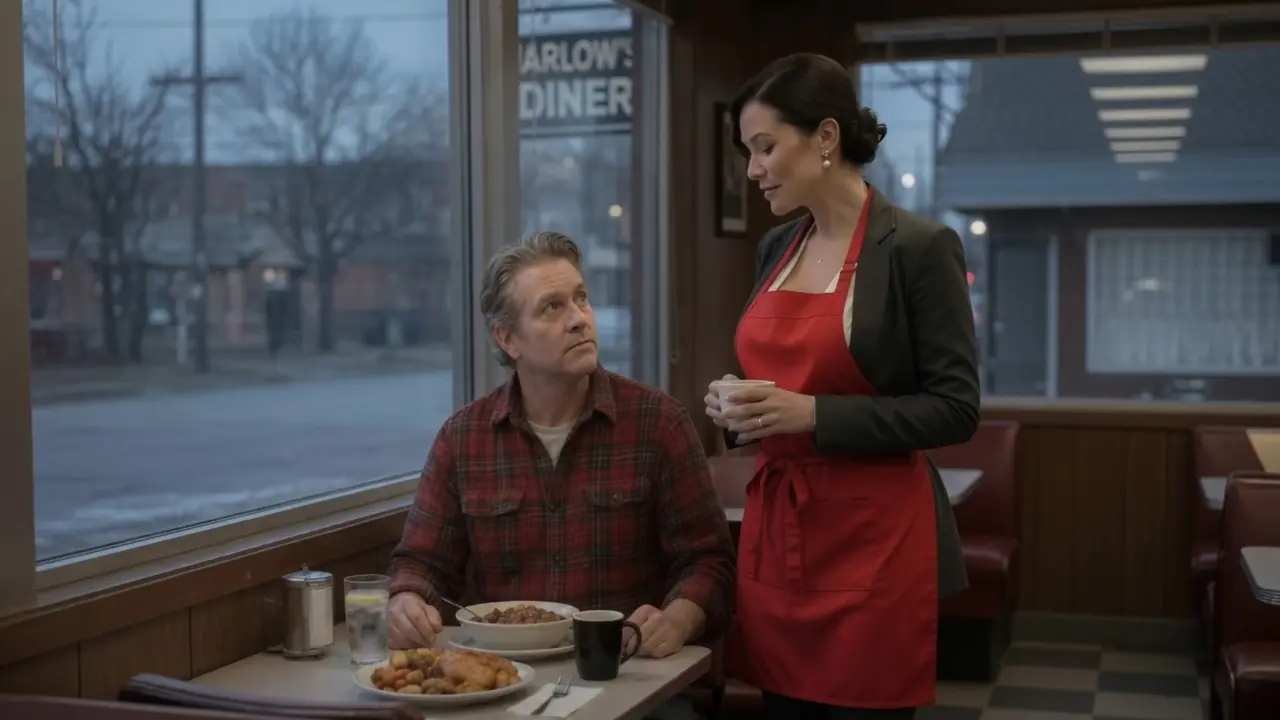
The first was meatloaf with mashed potatoes, green beans, and black coffee. The second was grilled chicken, macaroni and cheese, apple slices, and chocolate milk. Daniel ate the first meal slowly while the second remained untouched beneath the yellow light above the table. At seven fifteen, he asked for the untouched food to be packed and carried it to the homeless shelter two streets away.
He had repeated the ritual for twelve years.
Most customers assumed the empty chair belonged to a dead wife or child. Others believed Daniel had been abandoned by a woman he could not forget. The older waitresses knew part of the truth, but none asked questions anymore. Grief had rules, and Daniel’s first rule was that the chair remained available.
On the first Friday in December, Evelyn Carter noticed him.
She had entered Harlow’s Diner because a board meeting at Carter Hospitality Group had lasted four hours longer than planned. Her driver was waiting outside, but Evelyn had asked him to leave because she needed twenty quiet minutes without assistants, lawyers, or executives asking for decisions. At forty-two, she controlled one of the largest privately held hospitality companies in the Midwest. Yet that evening, she wanted only coffee and somewhere no one recognized her surname.
She chose a booth three tables from Daniel.
At first, she paid little attention to him. She opened her laptop, reviewed an internal audit, and tried to understand why several archived payments from her family foundation had been hidden beneath outdated program codes. The investigation involved Bright Haven Family Services, a private adoption agency her late mother had operated before merging it into the Carter Foundation. Evelyn had spent the morning reading sealed files that made her increasingly afraid of what her family name had protected.
A waitress brought Daniel’s two meals.
Evelyn watched him adjust the second plate carefully in front of the empty chair. He turned the chocolate milk so the straw faced outward and placed the napkin on the left side. The movement appeared practiced, tender, and unbearably sad.
The second meal remained untouched.
After twenty minutes, Evelyn closed her laptop.
She told herself not to interfere. Powerful people often believed curiosity entitled them to enter other people’s pain, and Evelyn had spent years rejecting that habit in her executives. Still, something about the care Daniel gave the empty place disturbed her. He did not seem confused or performative.
He seemed faithful.
Evelyn carried her coffee toward his table.
“Excuse me,” she said.
Daniel looked up.
He was forty-three, with tired gray-blue eyes, rough hands, and the broad shoulders of someone accustomed to physical labor. His red flannel shirt was clean but worn at the cuffs. A thin white scar crossed his chin.
“Can I help you?” he asked.
“I hope I’m not disturbing you.”
“That depends on what you need.”
Evelyn glanced toward the empty chair. “May I ask who you are waiting for?”
Daniel’s expression closed immediately.
The question had been asked in crueler forms before. Some people wanted a tragic story to discuss later. Others offered advice about acceptance, therapy, and learning to let go.
“No one you know,” he said.
Evelyn nodded. “That was intrusive. I’m sorry.”
She turned to leave.
Daniel looked at the untouched plate and sighed.
“My daughter,” he said.
Evelyn stopped.
He motioned toward the empty chair. “Her name is Sophie.”
“How old is she?”
“She would be eighteen now.”
The choice of words unsettled Evelyn. “Would be?”
“She isn’t dead.”
He said it with quiet certainty.
Evelyn sat only after he gestured toward the end of the booth. She kept her coffee between both hands and waited. Daniel appeared to be deciding whether speaking would betray the private promise he had maintained for so long.
“Sophie was six when her mother took her,” he began.
Daniel had married Laura Bennett at twenty-four. They were young, hopeful, and unprepared for how quickly affection could become resentment when money disappeared. Daniel worked repairing commercial heating systems, while Laura moved between jobs and struggled with addiction after a workplace injury.
When Sophie was born, Daniel believed responsibility might steady their marriage.
For a while, it did.
Laura attended treatment, Daniel took extra shifts, and Sophie grew into a child who loved purple crayons, thunderstorms, and grilled chicken cut into perfectly even pieces. Every Friday, Daniel finished work early and brought her to Harlow’s Diner. They sat at the same window table because Sophie liked counting buses on the street.
Then Laura relapsed.
Their separation became bitter, though Daniel never tried to prevent her from seeing Sophie. A judge granted him primary custody and allowed Laura supervised visits. For the first four months, Laura followed every condition.
Then she asked Daniel for one unsupervised afternoon.
“She said she wanted to take Sophie to a birthday party,” Daniel explained. “She promised they would be back by six fifteen.”
They never returned.
Police treated the case as parental abduction. Laura’s car was found abandoned at a bus terminal in Indianapolis, but security recordings were incomplete. A ticket clerk remembered seeing a woman and child board a bus headed east, though no passenger records confirmed where they left it.
Daniel searched for years.
He distributed photographs, contacted shelters, hired investigators, and traveled whenever someone reported a possible sighting. Most leads were mistakes. Two were deliberate scams created by people who believed a desperate father would pay anyone claiming to know his daughter’s location.
“Did Laura ever contact you?” Evelyn asked.
“Once.”
Daniel opened his wallet.
Behind his driver’s license, he kept a faded photograph inside a transparent sleeve. It showed six-year-old Sophie seated on a wooden bench, holding a stuffed rabbit. Her brown hair fell across one eye, and she was not smiling.
The photograph had arrived eight months after the disappearance.
There was no message, only the picture inside an envelope with no return address. Daniel spent weeks studying every visible detail. A blurred sign behind Sophie contained only part of a name, and a purple ink stamp appeared on the back.
Daniel passed the photograph to Evelyn.
The moment she saw the stamp, the coffee cup nearly slipped from her fingers.
Bright Haven Family Services.
Evelyn looked at Sophie’s face again.
Her heartbeat changed.
That morning, she had reviewed an intake file containing a photograph of a frightened six-year-old girl with the same brown eyes. The child in the file had been renamed Sarah Bennett and placed with a wealthy couple in Cincinnati.
More disturbing was the recent image attached to the file.
It showed an eighteen-year-old apprentice employed at Carter Hospitality’s corporate headquarters.
Her name was Sophie Bennett.
Evelyn looked toward Daniel.
“How did you get this?”
“It arrived in the mail.”
“Did the police contact Bright Haven?”
“The agency denied ever seeing her.”
“Did you show them the stamp?”
“They said anyone could have used it.”
Daniel studied her face. “Why do you recognize it?”
Evelyn placed the photograph carefully on the table.
“My mother owned Bright Haven.”
Daniel became completely still.
The diner sounds seemed to fall away.
“Owned?”
“She founded it thirty-four years ago and later transferred its assets to our family foundation.”
Daniel leaned toward her. “Then you have records.”
“Some.”
“Does Sophie’s name appear in them?”
Evelyn did not answer quickly enough.
Daniel stood.
The table shook, spilling a small amount of coffee. Customers turned toward them, and the waitress behind the counter stopped writing an order.
“You know something,” Daniel said.
“I may.”
“Do not say may.”
Evelyn kept her voice low. “I opened a file this morning with Sophie’s birth date.”
Daniel stared at her.
“There was a photograph,” she continued. “The child had a different first name, but she looked like the girl in this picture.”
“Where is she?”
“I need to confirm everything.”
“You already know.”
“I know that a file exists.”
“Where is my daughter?”
His voice broke on the final word.
Evelyn stood and closed her laptop. “She may work for my company.”
Daniel gripped the table to steady himself.
For twelve years, he had imagined thousands of answers. He imagined Sophie dead, hidden, frightened, grown, forgotten, or waiting for him somewhere without knowing how to return. He had never imagined she might be alive inside an office building owned by the woman standing before him.
“Take me to her.”
“I cannot do that tonight.”
“Why?”
“Because she is eighteen and has spent most of her life under another identity. We do not know what she has been told.”
“I am her father.”
“I believe you.”
“Then take me to her.”
Evelyn looked at the desperation in his face. “If you approach her without warning and she believes you abandoned her, she may run.”
Daniel recoiled.
“What did you say?”
Evelyn wished she could soften the truth.
“The file stated that her biological father surrendered all parental rights.”
“I never signed anything.”
“I know.”
“You cannot know.”
“I reviewed the signature.”
Daniel removed his wallet again and placed his driver’s license beside the photograph. The signature on the license was angular, with a distinctive break between his first and last names.
Evelyn remembered the surrender form.
The signature had been smooth and carefully connected.
“It was forged,” she said.
Daniel sat down slowly.
The waitress approached, but Evelyn asked for privacy. Daniel stared at the empty chair as though Sophie might appear if he remained still enough.
“What else was in the file?” he asked.
Evelyn explained that the records were incomplete. Bright Haven listed Laura as the sole legal guardian and claimed Daniel’s whereabouts were unknown. A physician certified that Laura was mentally competent to surrender the child.
Three days later, Laura died from an overdose in a motel outside Cincinnati.
Daniel covered his face.
He had spent years resenting Laura and imagining what he might say if she returned. Learning that she had died before the photograph reached him removed the possibility of answers and replaced it with a colder grief. Whatever her failures, she had been Sophie’s mother.
“Who mailed the photograph?” he asked.
“The file may tell us.”
“Why did your mother hide it?”
“I don’t know.”
“That is not good enough.”
“No,” Evelyn said. “It isn’t.”
She did not defend Charlotte Carter.
For most of her life, Evelyn had seen her mother as disciplined, charitable, and emotionally distant. Charlotte raised millions for children’s programs and spoke publicly about giving families second chances. After her death, Evelyn inherited corporate control and a collection of sealed archives that no one wanted examined closely.
A whistleblower changed that.
Former Bright Haven nurse Miriam Sloan contacted Evelyn two months earlier and claimed the agency had processed unlawful adoptions for wealthy families. Some involved falsified abandonment records, forged signatures, and payments disguised as donations. Charlotte may not have personally arranged every placement, but her authorization appeared throughout the system.
Evelyn opened Sophie’s file only hours before entering the diner.
“I need one day,” she told Daniel.
“I have given this twelve years.”
“One more day may protect her.”
Daniel’s eyes filled with anger. “People used protection as an excuse to steal her.”
Evelyn accepted the accusation.
“Then come with me tomorrow morning,” she said. “You will sit with my general counsel while we open the complete record.”
Daniel looked toward the photograph.
“If you are lying to me—”
“I’m not.”
“If your company tries to hide this—”
“It won’t.”
“How can you promise that?”
Evelyn looked at him steadily. “Because I am the person who decides whether the Carter name protects the truth or buries it again.”
Daniel did not trust her.
But he arrived at Carter Hospitality headquarters at eight the following morning.
He wore the only dark suit he owned, purchased for his mother’s funeral seven years earlier. Evelyn met him in the private underground entrance to avoid reporters and employees. She introduced him to Margaret Sloan, the company’s general counsel, and Dr. Helen Price, a trauma specialist experienced in family reunification.
Daniel disliked the specialist immediately.
He feared every professional in the room represented another barrier between him and Sophie. Helen did not ask him to trust her. She explained that Sophie was legally an adult and would control whether any meeting occurred.
“I am not asking permission to be her father,” Daniel said.
“No,” Helen replied. “You are asking for the chance to show her that you never stopped.”
The distinction silenced him.
Margaret opened the sealed file.
The first pages confirmed everything Evelyn had described. Laura appeared at Bright Haven with Sophie under the name Sarah, claiming she was fleeing an abusive husband. No police report supported the accusation.
A surrender form carried Daniel’s forged signature.
The witness was an agency employee who had died six years earlier. The notary stamp belonged to a lawyer later convicted of financial fraud.
Then Margaret reached the correspondence section.
A handwritten note from Miriam Sloan stated that Sophie repeatedly asked for her father. She knew Daniel’s full name, home address, and telephone number. She told staff that her father would come if anyone called him.
The agency forbade the call.
Daniel turned away from the table.
For years, he had feared Sophie might have forgotten him. The note proved she had waited. She had been telling adults exactly how to bring her home while those adults prepared papers to make her belong to someone else.
Evelyn read the next document.
An unsigned memorandum stated that the adoptive applicants, Richard and Elaine Bennett, had donated six hundred thousand dollars to the Carter Family Foundation three weeks before the placement. They had previously been denied by two agencies due to Richard’s history of controlling behavior.
Bright Haven approved them in nine days.
Daniel looked toward Evelyn.
“Your family sold my daughter.”
The sentence struck the room with brutal simplicity.
Evelyn did not deny it.
“Yes,” she said quietly.
Margaret looked at her, surprised by the admission.
Evelyn continued. “The documents show money influenced the placement. Whatever legal language they used, that is what happened.”
Daniel pushed away from the table.
He walked toward the window and stared down at the city. Far below, employees entered the building carrying coffee, bags, and ordinary morning concerns. Somewhere among them might be Sophie.
“What happened to the Bennetts?” he asked.
Elaine Bennett died when Sophie was fourteen. Richard remained alive but had moved to Florida two years earlier. After Elaine’s death, Sophie entered a Carter Foundation scholarship program and later joined the company’s paid apprenticeship in guest-experience design.
The file contained her current employee photograph.
Margaret placed it on the table.
Daniel did not approach at first.
He was afraid.
For twelve years, Sophie had remained six years old inside his mind. She wore a purple coat, held a stuffed rabbit, and complained when apple slices touched her macaroni. The young woman in the new photograph had long brown hair, serious eyes, and a careful smile.
She resembled Laura around the mouth.
She resembled Daniel everywhere else.
He touched the edge of the photograph.
“What does she believe?”
Helen answered.
The agency’s summary said Daniel abandoned the family after becoming violent. Richard and Elaine repeated that story during later counseling sessions. Sophie’s employee medical form noted anxiety connected to parental rejection.
Daniel looked ill.
“They made her hate me.”
“Perhaps,” Helen said. “Or they made her afraid to hope.”
Evelyn arranged for an independent advocate to contact Sophie that afternoon. The advocate would disclose that new information had emerged concerning her childhood placement and ask whether she wished to review it. Daniel would not be named until Sophie agreed to hear more.
He objected.
Then he remembered the frightened six-year-old in the photograph and forced himself to wait.
Sophie accepted the meeting.
She arrived at a neutral counseling office the following morning wearing black trousers, a blue sweater, and the Carter Hospitality employee badge clipped to her bag. Evelyn watched through a glass partition only long enough to confirm she was safe, then moved away to protect her privacy.
Daniel waited in another room.
He had brought no gifts except the stuffed rabbit Sophie once carried everywhere. Police found it inside Laura’s abandoned car in 2010. Daniel had washed it carefully and kept it inside a wooden box for twelve years.
Three hours passed.
Helen finally entered.
Daniel stood before she spoke.
“She read the records.”
“Does she want to see me?”
“She needs to ask questions first.”
“She can ask anything.”
Helen sat across from him. “Did you ever strike Laura?”
“No.”
“Did you threaten her?”
“I threatened to seek full custody if she used drugs while caring for Sophie.”
“Did you search after the disappearance?”
Daniel laughed bitterly.
He removed a thick folder from his case. Inside were police reports, investigator invoices, missing-child posters, letters to agencies, and copies of every message he had sent over twelve years. Helen carried the folder to Sophie.
Another hour passed.
When the door finally opened, Daniel could not stand.
Sophie entered alone.
She was eighteen, but fear made her look younger. Her eyes moved across his face, searching for the man from photographs and memories she had spent years being told were false. Daniel’s hands trembled on his knees.
Neither spoke.
Then Sophie saw the stuffed rabbit beside him.
Her breath caught.
“Moonlight,” she whispered.
Daniel’s face broke.
“You named him because you were afraid of the dark,” he said.
Sophie covered her mouth.
Daniel stood slowly but did not move toward her.
“You used to make me check under the bed twice,” he continued. “Then you would ask for water after I turned off the light because you knew I’d come back.”
Tears filled her eyes.
“They said you didn’t want me.”
“I looked for you every day.”
“They said you signed me away.”
“I never did.”
“You stopped writing.”
“I didn’t know where to send letters.”
Sophie’s anger appeared suddenly.
“You should have found me.”
Daniel accepted the words without defending himself.
“I should have,” he said.
She stared at him. “That isn’t an answer.”
“No. It is the truth I have lived with.”
Daniel opened the folder and placed the search records on the table. “I went everywhere the police told me to go. When they stopped, I hired people. When I ran out of money, I searched alone. I never stopped because I wanted you to know one thing if I found you.”
“What?”
“That you were never the person who was left behind.”
Sophie looked at the papers.
There were hundreds.
She read dates, locations, and descriptions of clothing Daniel had believed she might be wearing. She found copies of birthday letters written every year and never mailed because there was no address.
Then she found a photograph of the window table at Harlow’s Diner.
Two meals waited beneath the yellow light.
“What is this?”
Daniel looked toward it. “Friday dinner.”
“You still went?”
“Every week.”
“For twelve years?”
“Yes.”
“Why?”
“Because you were supposed to come back at six fifteen.”
Sophie began crying.
Daniel remained where he was until she crossed the room first.
When she wrapped her arms around him, his knees nearly failed. He held her carefully, afraid she might disappear if he closed his hands too tightly. She smelled like peppermint shampoo and cold air.
For several minutes, neither could speak.
The reunion did not repair twelve years in one embrace.
Sophie carried loyalty toward Elaine Bennett, the woman who raised her, even after learning the adoption had been illegal. She felt anger toward Daniel for failing to find her, shame for believing the lies, and grief for the childhood that could not be returned.
Daniel learned not to demand affection.
He answered questions, attended counseling, and allowed Sophie to leave whenever emotion became unbearable. Some weeks, she called him every day. Other weeks, she sent only one message.
He continued ordering two Friday meals.
The difference was that Sophie began joining him.
Their first dinner at Harlow’s lasted forty minutes. She sat in the empty chair, stared at the grilled chicken and macaroni, and laughed when she noticed the apple slices arranged separately.
“You remembered.”
“I forgot plenty.”
“Not this.”
“No.”
The waitresses cried behind the counter.
Evelyn did not attend that first dinner.
She was dealing with the consequences of the Bright Haven investigation. Outside counsel found twenty-three placements involving forged, altered, or incomplete parental consent. Several children were now adults, and every case required independent legal review.
Carter Hospitality’s board urged Evelyn to limit disclosure.
They warned of lawsuits, criminal investigations, and damage to the family foundation. One director argued that Charlotte Carter was dead and could not defend herself. Evelyn replied that the people harmed by her decisions were alive and had been denied the chance to defend themselves for decades.
She released the records to authorities.
The company created an independent restitution fund financed through the sale of Carter family assets rather than employee pensions or operating budgets. Evelyn removed her mother’s name from the foundation and established a permanent archive available to families affected by Bright Haven.
She expected Daniel to sue.
He did.
But he did not seek a personal fortune.
His legal action demanded compensation for search expenses, counseling, and the years of lost parental access. More importantly, he asked the court to require notification for every family whose records had been falsified.
Evelyn supported the demand.
The board nearly removed her as CEO.
During the emergency vote, Evelyn presented evidence that two directors had received consulting payments from families involved in the illegal placements. Both resigned before the meeting ended.
She kept her position.
Months later, Daniel asked Evelyn to meet at Harlow’s Diner.
She arrived at six fifteen and found Sophie seated in the chair that had remained empty for twelve years. Daniel sat opposite her, and a third place had been prepared at the end of the table.
“For me?” Evelyn asked.
Sophie nodded. “Dad says you asked the first question no one else did.”
Evelyn sat.
“I almost didn’t.”
“Why did you?”
She looked toward the two meals.
“Because the second plate looked like a promise.”
Daniel stirred his coffee. “It became one.”
Sophie studied Evelyn. “Your mother knew what happened to me.”
“Yes.”
“You still loved her?”
Evelyn considered the question.
“I loved the person I believed she was.”
“And now?”
“Now I’m learning that loving someone does not require protecting their lies.”
Sophie nodded slowly.
“That sounds difficult.”
“It is.”
Daniel looked between them.
Three people sat at the table, each connected by a woman who was no longer alive and choices none could undo. Laura’s fear, Charlotte’s corruption, and Elaine’s silence had shaped all their lives.
Yet none of those choices controlled what happened next.
Sophie completed her apprenticeship and later studied social-work policy. She helped design a family-records program ensuring adopted children could access accurate histories once legally permitted. Daniel moved closer to her college but refused to follow her everywhere, a boundary Sophie enforced firmly.
Evelyn transformed the Carter Foundation into the Open Records Trust.
Its first public report listed every known Bright Haven violation without hiding the Carter family’s responsibility. The report cost Evelyn invitations, business relationships, and several board allies.
It also helped reunite eleven families.
On Sophie’s twenty-first birthday, she chose Harlow’s Diner for dinner.
The window table had been refinished, but the yellow light above it remained unchanged. Daniel arrived early and ordered two meals from habit.
Sophie laughed when she saw them.
“Dad, I’m here now. You don’t need to order for the empty chair.”
Daniel looked toward the seat beside her.
“I know.”
“Then who is that meal for?”
He smiled.
A young woman entered the diner with Evelyn. She was twenty-four and had recently discovered that Bright Haven falsified her father’s death during another adoption case. Her surviving relatives had not yet been located.
Daniel stood and pulled out the chair.
“It’s for someone who shouldn’t have to wait alone.”
The young woman sat.
Sophie reached across the table and took her hand.
For twelve years, Daniel ordered a second meal because hope was the only action still available to him. People pitied him, mocked him quietly, or advised him to let go.
Then Evelyn Carter asked who the empty chair was for.
That question opened a file her family had spent years keeping closed. It exposed a crime, reunited a father and daughter, and forced a powerful woman to choose truth over the legacy she inherited.
Daniel never recovered Sophie’s childhood.
Sophie never forgot the years she believed her father abandoned her.
Evelyn never erased what the Carter name had done.
But every Friday, the chair remained at the table.
Not as a monument to someone missing.
As a promise that when the truth finally brought another lost person through the door, there would already be a place waiting for them.