Aaron Brooks pushed a wobbly shopping cart down aisle four with one hand while holding his six-year-old daughter’s mittened hand with the other.
His daughter, Lily, walked close to him, her pink winter hat slipping low over her eyebrows. She was small for her age, with big brown eyes, a missing front tooth, and a stuffed penguin tucked under one arm. Her cough had kept her awake most of the night, which meant Aaron had barely slept either, but she still insisted on coming with him because she said grocery stores were “more fun than staying home with soup.”
Aaron did not have the heart to tell her grocery stores were only fun when money was not a math problem.
At thirty-five, Aaron had learned to calculate life in small numbers. Rent was due in nine days. His paycheck from the warehouse would clear Friday. The winter boots Lily needed were still sitting in an online cart he could not afford to check out. In his wallet were twenty-seven dollars and fourteen cents, and every item he placed in the cart had to justify itself.
Bread.
Eggs.
Store-brand oatmeal.
A small bottle of cough medicine.
A bag of apples because Lily loved them and because apples made him feel like he was still doing something right as a father.
He skipped the coffee he wanted.
He skipped the sandwich meat.
He skipped the frozen pizza Lily pointed at with hopeful eyes.
“Maybe next week, bug,” he said gently.
Lily nodded like she understood, but her hand squeezed his fingers a little tighter.
Aaron hated that she understood so much already.
She was six years old. She should have been worried about stickers, cartoons, lost crayons, and whether her penguin needed a scarf. Instead, she knew what it meant when her father stood in an aisle too long comparing prices.
Aaron worked nights at a distribution warehouse and weekends repairing small engines in a garage behind his apartment building. Before Lily was born, he had wanted to open his own repair shop. He had saved business plans in a folder, watched videos about accounting, and even picked out a name: Brooks Family Auto.
Then Lily’s mother left when Lily was two.
There had not been one big dramatic goodbye. No movie-scene argument, no slammed door in the rain. Just smaller disappearances until one day she was gone completely, leaving Aaron with a toddler, a stack of unpaid bills, and a note that said she was not built for motherhood.
Aaron did not have the luxury of falling apart.
So he worked.
He learned to braid hair from online videos. He learned which cough syrup did not upset Lily’s stomach. He learned how to stretch one roasted chicken into four meals. He learned that a father could cry silently in a bathroom at midnight and still pack a lunchbox before dawn.
That morning, Dawson’s Market was crowded.
A snowstorm was expected by evening, and people were buying bread, milk, soup, batteries, and anything that made them feel prepared. Only two registers were open, and both lines stretched into the aisles. Aaron joined the shorter line behind an elderly woman wearing a faded navy coat and holding a basket with both hands.
The woman was thin and small, with silver hair tucked under a knitted gray hat. Her coat looked old but carefully brushed, and her shoes were the soft kind people wore when their feet hurt too much for style. In her basket were only five things: a can of tomato soup, a small loaf of bread, a carton of milk, two bananas, and a box of tea.
Aaron noticed because he noticed things like that.
People who struggled recognized other people who were counting.
Lily leaned against his leg and looked up at the woman.
“Daddy,” she whispered, “she has the penguin tea.”
Aaron followed her gaze to the box.
Chamomile tea with a little cartoon penguin on the front.
“Looks like it,” he whispered back.
The elderly woman turned at the sound and gave Lily a small smile.
“Do you like penguins?”
Lily lifted her stuffed animal proudly.
“This is Captain Waddles. He’s brave.”
The old woman’s smile grew warmer.
“That is an excellent name for a brave penguin.”
Lily beamed.
Aaron smiled too, but he saw the woman’s hand tremble as she adjusted the basket. Not a little tremor from age or cold. A deep, uncontrollable tremor that made the metal handle rattle faintly against the cans inside.
When it was the woman’s turn, the cashier barely looked up.
“Find everything?” the young man asked, already scanning.
“Yes, thank you,” the woman said.
Her voice was gentle, educated, and tired.
The total appeared on the screen.
“Eight ninety-six.”
The elderly woman opened her purse.
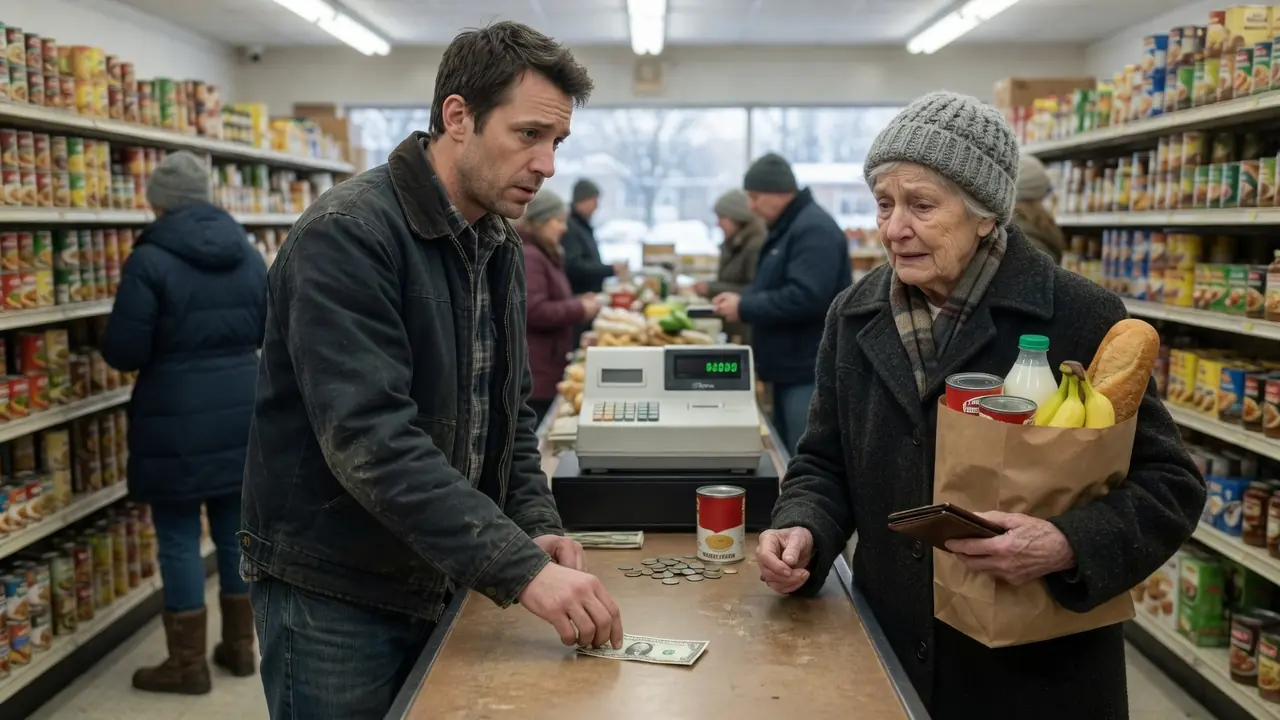
Aaron looked away because dignity mattered, and he knew what it felt like to count money while someone watched. But the line was cramped, and the woman’s hands shook badly enough that coins slipped through her fingers and scattered across the counter. The cashier sighed under his breath.
The woman’s face flushed.
“I’m sorry,” she said quickly. “My hands are not cooperating today.”
The cashier said nothing.
He only watched her sort the coins.
A dime rolled toward the edge of the counter. Lily caught it with both mittened hands and held it up.
“You dropped this.”
The woman looked down at her.
“Oh. Thank you, dear.”
Lily placed the dime on the counter like it was a royal offering.
The woman counted again.
Then again.
Her shoulders slowly sank.
“I’m sorry,” she whispered. “Could you take off the tea?”
The cashier reached for the box without expression.
Aaron looked at the screen.
Short by eighty-five cents.
Not ten dollars.
Not twenty.
Eighty-five cents.
The woman had already lost the tea in her mind. He could see it in the way she lifted her chin, trying to make surrender look like choice. She was preparing herself to leave one small comfort behind because she did not have enough coins to deserve it.
Aaron reached into his coat pocket.
He had three quarters, one dime, and a nickel.
Exactly eighty-five cents.
He set the coins on the counter.
“Leave the tea,” he said.
The woman turned sharply.
“Oh no. Please, no.”
“It’s all right.”
“No, sir, I can’t let you do that.”
Aaron smiled softly.
“You’re not letting me. I already did it.”
The cashier glanced between them, shrugged, and put the tea in the bag.
The woman stared at the coins.
Her eyes filled.
“It is only tea,” she said, though her voice had begun to break.
Aaron shook his head.
“Nothing is only anything when you need it.”
The woman pressed one thin hand against her chest.
Lily stepped closer to her father.
“My daddy says tea helps your heart calm down,” she said seriously.
The old woman looked at her and smiled through tears.
“Your daddy sounds very wise.”
“He burns pancakes,” Lily replied.
Aaron gave his daughter a look.
“Thank you for your honesty.”
The old woman laughed softly, and for a second, the whole line seemed less cold.
The man behind Aaron, wearing a delivery jacket and holding a six-pack of soda, cleared his throat. He had looked annoyed a minute earlier, but now his expression had changed. He pulled a five-dollar bill from his wallet and set it near the register.
“Put that toward whoever’s short next,” he said.
The cashier blinked.
“What?”
“You heard me.”
The woman behind him, a nurse in blue scrubs, smiled faintly.
“I’ll add ten.”
Within minutes, something strange happened in that grocery line.
A small paper cup appeared near the register, then a second one. People began dropping coins and bills inside. Someone said, “For anyone short.” Someone else said, “Call it the eighty-five-cent jar.” A tired-looking mother with two toddlers started crying when the nurse paid for her milk and diapers.
Aaron did not understand how his tiny act had moved through the line so quickly.
He only knew it had.
The elderly woman stood beside the register, holding her grocery bag against her chest with both arms.
“What is your name?” she asked Aaron.
“Aaron Brooks.”
“And your daughter?”
“Lily.”
Lily waved.
The woman bent slightly, though Aaron could see it cost her effort.
“My name is Margaret Whitmore.”
“That is a pretty name,” Lily said.
Margaret smiled.
“So is Lily.”
Aaron picked up his own groceries and paid carefully, watching the total with his stomach tight. The eighty-five cents had been his bus money. Without it, he and Lily would walk home. It was only eight blocks, but the wind had teeth that morning, and Lily’s cough worried him.
He did not regret it.
Not even when Lily looked up at him outside the store and asked, “Are we walking because we helped the tea lady?”
Aaron looked down at her.
“Yes.”
Lily thought about that.
Then she nodded.
“Okay. Captain Waddles likes walking.”
Aaron pulled her hat lower over her ears and took her hand.
“Captain Waddles is a very generous penguin.”
They had walked only half a block when he heard a voice behind them.
“Mr. Brooks.”
Aaron turned.
Margaret Whitmore was standing near the bus stop, her grocery bag at her feet. She looked pale again, and one hand gripped the metal bench for balance. The bus schedule beside her showed the next bus would not come for forty minutes.
Aaron walked back with Lily.
“Are you all right?”
“I am,” Margaret said quickly.
It was a lie.
Aaron had told enough lies like that to recognize them.
Her lips were pale, and she was shivering. Her coat was too thin for the weather, and the tremor in her hands had worsened now that she was outside. The bag of groceries sat on the ground because she no longer had the strength to hold it.
“Where are you headed?” Aaron asked.
Margaret hesitated.
“Riverside House.”
Aaron knew the place.
It was a private senior residence on the edge of town, the kind with a stone sign, trimmed hedges, and a dining room that looked like a hotel. It was nearly three miles away.
“You walked here from Riverside?”
Margaret looked embarrassed.
“I took a shuttle part of the way.”
“Part of the way?”
“It dropped me at the pharmacy. I wanted to go into a real store.” She gave a fragile smile. “It sounds foolish when I say it.”
“It doesn’t.”
“It does. At Riverside, everything is decided for me. Meals. Activities. Medication times. Visitors. Even what they think I should want.” Her eyes drifted toward the grocery bag. “I just wanted to buy my own soup.”
Aaron understood that more than she could know.
Not because he lived in a senior residence, but because poverty had its own way of taking choices away.
“I can walk you home,” he said.
Margaret looked horrified.
“No. You have your daughter.”
“My daughter has strong opinions about helping people.”
Lily nodded.
“And Captain Waddles has a mission.”
Margaret laughed again, but it turned into a cough.
Aaron’s concern deepened.
“You’re freezing. Listen, my apartment is two blocks from here. It isn’t fancy, but it’s warm. You can sit down, drink your tea, and I’ll call Riverside to pick you up.”
Margaret immediately shook her head.
“Oh no, I could not impose.”
“You’re not imposing.”
“I am a stranger.”
“So was everyone before we learned their name.”
Margaret looked at him for a long moment.
Then she looked at Lily, who held up Captain Waddles with solemn approval.
Slowly, Margaret nodded.
“Only for a few minutes.”
Aaron picked up Margaret’s grocery bag with one hand and held Lily’s hand with the other. They walked slowly, adjusting to Margaret’s careful steps. The cold made the short distance feel longer, and by the time they reached Aaron’s apartment building, Margaret’s breathing had turned shallow.
Aaron lived on the second floor of a brick building behind a closed laundromat.
The hallway smelled faintly of old carpet and cooking oil. The stairs creaked beneath their feet. He apologized twice for the climb, but Margaret only smiled and said she had taught teenagers for thirty-eight years and could survive stairs.
Inside, the apartment was small but clean.
A narrow living room, a kitchen barely wide enough for two people, a tiny bedroom for Lily decorated with handmade paper snowflakes, and a pullout couch where Aaron slept. The furniture did not match. A blanket covered the torn arm of the sofa. The heat worked only when the radiator felt like cooperating.
But the apartment was warm.
That was what mattered.
Margaret stepped inside and looked around with quiet attention.
She saw the children’s drawings taped to the wall.
The work boots by the door.
The unpaid utility notice tucked under a magnet on the fridge.
The single bowl in the sink.
The little table set for two.
Aaron noticed her noticing.
His face warmed with embarrassment.
“It’s not much.”
Margaret turned to him.
“It is a home.”
The way she said it made him look away.
He helped her sit on the sofa, then put water on the stove for tea. Lily sat beside Margaret and introduced Captain Waddles properly, explaining that he had once saved an imaginary boat from imaginary sharks. Margaret listened as if this were the most important story in Wisconsin.
Aaron made tea from the box Margaret had almost left behind.
He placed the mug carefully in both her hands, helping her steady it without making a scene.
“There,” he said. “Penguin tea.”
Margaret inhaled the steam.
A tear slipped down her cheek.
Aaron pretended to check the stove so she could wipe it away privately.
“Do you have family nearby?” he asked after a moment.
Margaret’s hands tightened around the mug.
“My son.”
“Can I call him?”
She looked down.
“He is very busy.”
“That doesn’t answer the question.”
Margaret smiled sadly.
“No. It doesn’t.”
She opened her purse and took out a small card. Her fingers trembled so violently that the card slipped onto the floor. Aaron picked it up and glanced at the name.
Nathaniel Whitmore.
Whitmore Development Group.
There was a phone number beneath it.
Aaron recognized the name.
Everyone in Milwaukee recognized the name.
Nathaniel Whitmore owned office towers, apartment complexes, hotels, restaurants, and half the construction cranes downtown. His face appeared in business magazines. His company donated to hospitals and universities. People called him a billionaire without whispering because it was not gossip. It was public fact.
Aaron looked from the card to Margaret.
“You’re Nathaniel Whitmore’s mother?”
Margaret smiled faintly.
“I was his mother long before anyone called him a billionaire.”
Aaron swallowed.
That sentence carried more sadness than pride.
He called the number.
An assistant answered.
Aaron explained carefully that Margaret Whitmore was safe at his apartment, that she had become cold and weak near Dawson’s Market, and that someone from Riverside House should be contacted.
The assistant’s tone changed immediately.
Within thirty seconds, Aaron was on hold.
Within one minute, another voice came on.
Sharp.
Male.
Controlled.
“This is Nathaniel Whitmore. Who is this?”
Aaron straightened without meaning to.
“My name is Aaron Brooks. I’m with your mother. She’s safe.”
There was a silence.
Then Nathaniel’s voice changed.
“My mother is with you?”
“Yes, sir. She got cold near Dawson’s Market. I brought her to my apartment so she could warm up.”
“Put her on the phone.”
Aaron looked at Margaret.
Her face had gone pale.
She shook her head once.
Not fear exactly.
Exhaustion.
Aaron spoke carefully.
“She’s resting right now.”
“I said put her on the phone.”
Lily looked up from the sofa, eyes wide.
Aaron turned slightly away.
“With respect, Mr. Whitmore, your mother is tired, cold, and upset. I’m not going to force a phone into her hand because someone is raising his voice.”
The silence on the other end sharpened.
“Do you know who you’re speaking to?”
“Yes,” Aaron said. “A son whose mother needed help today.”
Margaret closed her eyes.
Nathaniel said nothing for several seconds.
When he spoke again, his voice was quieter.
“What is your address?”
Aaron gave it.
“I’ll be there in twenty minutes.”
The line went dead.
Aaron looked at the phone.
Then at Margaret.
“He’s coming.”
Margaret nodded slowly.
“I’m sorry.”
“For what?”
“For pulling you into my family.”
Aaron glanced around the little apartment.
“My family has had plenty of weather. We can handle a little more.”
Margaret looked at him with sudden tenderness.
“You are a kind man, Aaron Brooks.”
He almost laughed.
“I’m a tired man.”
“Kind people usually are.”
Twenty-two minutes later, a black SUV pulled up outside Aaron’s building.
Aaron saw it from the window.
Then another car behind it.
Not police.
Not an ambulance.
Men in dark coats stepped out, scanning the building like danger might be hiding between the trash bins.
Finally, a tall man in a charcoal overcoat emerged from the back seat.
Nathaniel Whitmore looked exactly like someone who could buy the block, demolish it, and rebuild it before lunch. He was in his late forties, with silver at his temples, a sharp jaw, and the kind of polished shoes that did not belong on Aaron’s cracked sidewalk. His face was composed, but his eyes moved quickly.
Afraid.
Aaron recognized it.
Fear looked the same in rich men and poor men when mothers were involved.
A hard knock came at the door.
Aaron opened it but kept his body angled slightly between the doorway and the room.
“Nathaniel Whitmore?”
“Yes.”
“Come in.”
Nathaniel stepped inside, and the apartment seemed to shrink around him.
His eyes went straight to Margaret on the sofa.
“Mom.”
Margaret looked up.
“Nathaniel.”
He crossed the room and knelt in front of her, his expensive coat brushing the worn rug.
“Why did you leave Riverside? Do you have any idea what happened when they called me? I had people looking everywhere.”
Margaret’s face tightened.
“I left because I wanted soup.”
Nathaniel blinked.
“What?”
“I wanted to buy soup. Myself.”
He stared at her as if she had spoken another language.
“You could have asked them.”
“I am tired of asking them.”
“Mom, that place has staff for a reason.”
“Yes,” Margaret said. “And schedules. And approved outings. And meals chosen by committees. And people who call me Mrs. Whitmore while speaking to me like a child.”
Nathaniel’s jaw worked.
“You’re safe there.”
“I am contained there.”
The words landed hard enough to silence the room.
Lily, sensing adult sadness, slid closer to Aaron and wrapped her arms around his leg.
Nathaniel looked at his mother’s hands around the tea mug. They still trembled. He looked at the grocery bag on the kitchen counter. He looked at the box of chamomile tea. Then he looked at Aaron.
“What happened at the store?”
Aaron answered carefully.
“She was short at the register.”
Margaret closed her eyes.
Nathaniel turned back to her.
“Short?”
“Eighty-five cents,” Aaron said.
Nathaniel went very still.
“Eighty-five cents.”
Nobody spoke.
The apartment radiator hissed.
Somewhere outside, a car horn sounded.
Nathaniel looked at his mother as if seeing her through a different lens, one that hurt him.
“You were short eighty-five cents?”
Margaret’s voice trembled.
“It was just tea.”
Nathaniel stood and turned away, one hand pressed to his mouth.
For the first time, the billionaire looked helpless.
“I pay Riverside eleven thousand dollars a month,” he said, voice low and shaken. “Eleven thousand dollars, and my mother was embarrassed at a grocery register over eighty-five cents.”
Margaret looked down at her tea.
“It was not about the money.”
Nathaniel turned back.
“What was it about?”
She looked up at him, and Aaron saw years of loneliness in her face.
“It was about wanting to still be a person who could choose her own breakfast.”
Nathaniel had no answer.
Margaret continued, her voice soft but steady.
“You gave me comfort, Nathaniel. You gave me safety. You gave me a beautiful room and professional care. But somewhere along the way, you stopped giving me yourself.”
His face changed.
“I visit.”
“You check in.”
“I call.”
“Your assistant schedules calls.”
He flinched.
Aaron looked away.
Some conversations deserved privacy, but the apartment was too small to give them any.
Margaret reached for her son’s hand.
“I know you love me. I have never doubted that. But love that is too busy to listen starts to feel like management.”
Nathaniel sat beside her slowly.
His shoulders lowered.
For a long moment, he said nothing.
Then he whispered, “I thought I was taking care of you.”
“You were,” Margaret said. “But not in the way I needed.”
Nathaniel bowed his head.
“I’m sorry.”
Margaret touched his cheek with one trembling hand.
That gesture broke something in him.
He covered her hand with his own and closed his eyes.
Lily whispered, “Daddy, is he crying?”
Aaron whispered back, “A little.”
“Rich people cry?”
Aaron looked at Nathaniel, kneeling beside his mother with his whole life rearranging in front of him.
“Yes, bug,” he said. “They do.”
Nathaniel looked over and, surprisingly, gave Lily a sad little smile.
“Yes,” he said. “We do.”
Lily nodded thoughtfully.
“Captain Waddles cries when he drops crackers.”
For the first time, Margaret laughed fully.
The sound softened the room.
Nathaniel wiped his eyes and stood.
“Mr. Brooks,” he said, turning to Aaron. “Thank you for helping my mother.”
“You don’t need to thank me.”
“Yes,” Nathaniel said. “I do.”
“It was eighty-five cents.”
“No,” Margaret said. “It was not.”
Aaron looked at her.
She smiled through tears.
“You saw me when I felt invisible.”
That sentence stayed in the air.
Aaron did not know what to do with gratitude that large.
He cleared his throat.
“I just did what I’d hope someone would do for Lily someday.”
Nathaniel’s eyes moved to the child holding the stuffed penguin.
“You’re a single father?”
“Yes.”
“Her mother?”
“Gone,” Aaron said simply.
Nathaniel did not ask for more.
That earned him a little respect.
He looked around the apartment again, but this time not with judgment. With attention. He saw the radiator. The old couch. The small table. The work boots. The unpaid notice on the fridge. The cough medicine still in the grocery bag.
Aaron saw him seeing it and felt his pride rise like a wall.
“We’re okay,” he said quickly.
Nathaniel looked back at him.
“I didn’t say you weren’t.”
“But you were thinking it.”
“I was thinking you helped my mother while clearly carrying plenty yourself.”
Aaron had no easy answer.
Margaret took another sip of tea.
“He gave me his bus money.”
Aaron closed his eyes.
“Margaret.”
Nathaniel’s gaze sharpened.
“Your bus money?”
“It was eighty-five cents,” Aaron muttered.
Lily lifted one hand.
“We walked home. It was okay. Captain Waddles likes missions.”
Nathaniel looked at the little girl, then back at Aaron.
“You paid for my mother’s tea and walked home in the cold with your sick child?”
“She has a cough. She isn’t sick sick.”
Lily coughed at exactly the wrong moment.
Aaron sighed.
Nathaniel’s expression did not become pitying.
It became resolved.
That was almost worse.
“Mr. Brooks,” he said, “I would like to repay you.”
“No.”
“You haven’t heard what I’m offering.”
“No.”
Nathaniel paused.
Margaret smiled faintly into her mug.
“Told you,” she said.
Aaron looked at her.
“Told him what?”
“That you would say no before knowing the question.”
Nathaniel seemed to regain a little of himself.
“Then let me phrase it differently. My mother needs a change. She does not want to return to Riverside House as her permanent home. I need to build a plan that gives her independence without leaving her isolated.”
Aaron listened despite himself.
“I also need someone I can trust,” Nathaniel continued. “Someone who does not see her as an assignment, a schedule, or a luxury service package. Someone who sees her as a person.”
Aaron shifted uncomfortably.
“I don’t have medical training.”
“I’m not asking you to be her nurse.”
“Then what are you asking?”
Margaret answered before Nathaniel could.
“I want a neighbor.”
Aaron looked at her.
“A what?”
She smiled softly.
“A neighbor. Not a servant. Not a caretaker who hovers. Someone nearby. Someone who checks in, shares tea sometimes, lets an old woman feel useful, and reminds her son when he is confusing money with love.”
Nathaniel exhaled.
“That last part may not have been in the job description.”
“It is now,” Margaret said.
Aaron almost smiled.
Nathaniel continued carefully.
“I own a small duplex near Lake Park. One side is empty. My mother could live in the other side. I would hire professional support for the things she actually needs, but she wants ordinary life too. Groceries. Cooking. Porch mornings. Someone she trusts close by.”
Aaron’s heart began to beat faster.
“What does that have to do with me?”
“I want to offer you the empty side of the duplex at no rent for one year, with a salary for part-time property care and companionship. You would help with small repairs, errands if needed, and check-ins. You could continue your job if you want, or I can offer you full-time work in my facilities maintenance division.”
Aaron stared at him.
The apartment seemed to tilt.
No rent.
A real home.
A safer neighborhood.
A job connected to repair work.
A chance to breathe.
It was too much.
“No,” Aaron said automatically.
Margaret looked at him.
“Aaron.”
“No. I paid eighty-five cents. I didn’t buy a new life.”
Nathaniel’s face softened.
“No. You reminded me I had neglected one.”
Aaron looked away.
His pride fought hard.
It had kept him standing when nothing else did.
But then Lily tugged on his hand.
“Daddy,” she whispered, “would the new place have heat all the time?”
That broke him.
Not completely.
But enough.
Aaron crouched in front of his daughter.
“Probably.”
“And maybe no scary hallway?”
He closed his eyes for a second.
Their hallway was not truly scary, but sometimes people argued near the stairs at night. Sometimes bottles broke. Sometimes Lily woke and asked if they were safe.
Aaron had always said yes.
Sometimes he had believed it.
Sometimes he had only needed her to.
He opened his eyes and looked at Nathaniel.
“I won’t take charity.”
“Then don’t,” Nathaniel said. “Take work. Take a lease. Take a salary. Take a chance to give my mother the kind of ordinary kindness I failed to give her.”
Margaret added softly, “And let me make Lily penguin tea.”
Lily gasped.
“With honey?”
“With honey.”
Aaron rubbed a hand over his face.
He was tired.
So tired.
Tired of proving he could survive.
Tired of acting like help was an insult.
Tired of choosing pride over comfort because pride was the only thing poverty had not taken.
“What kind of work?” he asked quietly.
Nathaniel did not smile too quickly.
He was smart enough not to look victorious.
“Maintenance coordinator to start,” he said. “My company owns residential properties across the city. You have repair experience?”
“Small engines. Some plumbing. Basic electrical. Appliance fixes. Whatever landlords won’t do.”
“That sounds like half my maintenance department.”
“I don’t have a degree.”
“I need competence, not framed paper.”
Aaron looked at Margaret.
She was watching him with tears in her eyes.
“You really want this?”
“I want to choose my own soup,” she said. “I want a porch. I want my son to visit without checking his watch. And I want the little girl with the brave penguin to come over for tea.”
Lily whispered, “Say yes, Daddy.”
Aaron’s throat tightened.
He looked at Nathaniel.
“I’ll look at the duplex,” he said. “That’s all I’m promising today.”
Nathaniel nodded.
“That is enough.”
It was not enough for Lily, who immediately asked if Captain Waddles could have his own room.
The answer, apparently, depended on floor plans.
By evening, Nathaniel had arranged for a car to take Margaret home temporarily, though not back to Riverside without changes. He personally called the facility director and informed them, in a voice Aaron was glad was not directed at him, that his mother would be leaving within the week.
Before Margaret left, she hugged Lily.
Then she held Aaron’s hand in both of hers.
Her tremor was still there, but so was strength.
“You paid what I lacked,” she said. “Not just in coins.”
Aaron looked down.
“I didn’t do much.”
“You did the part no one else did.”
The next morning, Nathaniel Whitmore showed up at Aaron’s door again.
This time, he came alone.
No assistants.
No security.
No polished performance.
He wore a dark coat, held two coffees, and carried a folder under one arm.
Aaron opened the door, still half-asleep, Lily peeking from behind him in pajamas with snowflakes on them.
Nathaniel held out one coffee.
“I brought peace offerings.”
Aaron took it suspiciously.
“What’s in the folder?”
“Options.”
“That sounds expensive.”
“It is organized. Not the same thing.”
Lily looked up.
“Did you bring Margaret?”
“She is having breakfast,” Nathaniel said. “By choice.”
Lily nodded solemnly.
“Good.”
They visited the duplex that afternoon.
It sat on a quiet tree-lined street not far from Lake Park, with cream-colored siding, two front doors, a shared porch, and a small fenced backyard. It was not a mansion. It was not flashy. That made Aaron trust it more.
One side had two bedrooms, a sunny kitchen, a living room with built-in shelves, and a small room Lily immediately declared Captain Waddles’s office.
The heat worked.
The windows locked.
The hallway was quiet because there was no hallway.
Lily ran from room to room whispering, “Daddy, look,” as if each ordinary feature were a miracle.
A closet.
A bathtub.
A kitchen window.
A bedroom where the radiator did not bang like a pipe monster.
Aaron stood in the living room, hands in his pockets, trying not to cry.
Nathaniel stood a respectful distance away.
“You would sign a real lease,” he said. “One dollar a month for the first year because my lawyer says zero creates accounting nonsense. After one year, we revisit based on your job status and comfort.”
“One dollar.”
“Yes.”
“That sounds like charity wearing a fake mustache.”
Nathaniel almost smiled.
“It sounds like my mother’s idea.”
Aaron looked toward the porch where Margaret was being helped from a car by a nurse she had apparently hired herself, not one chosen for her.
Margaret stepped onto the porch, looked at the house, and pressed a hand to her heart.
“I know this place,” she whispered.
Nathaniel turned.
“You do?”
She nodded slowly.
“Your father and I walked this street before you were born. We used to dream about houses like this.” She looked at him with wet eyes. “We could never afford one.”
Nathaniel’s face softened.
“Then it’s yours now.”
“No,” Margaret said. “Not mine. Ours.”
She looked at Aaron and Lily.
“Neighbors, remember?”
Lily ran onto the porch and hugged her around the waist.
Margaret laughed, startled and delighted.
Aaron stood in the doorway, watching his daughter wrap herself around a woman who had been a stranger yesterday.
Life could turn so strangely.
One day you were counting coins.
The next day someone was offering you a door.
Two weeks later, Aaron and Lily moved into the duplex.
They did not own much, so the move took only one small truck. Nathaniel sent movers, but Aaron insisted on carrying boxes too. Lily supervised with Captain Waddles from the porch swing, announcing which boxes were “important” based on whether they contained toys.
Margaret moved into the other side the following day.
She brought more books than furniture.
Boxes and boxes of them.
Novels.
Poetry.
History.
Children’s books.
Old cookbooks with notes in the margins.
“I taught literature for thirty-nine years,” she explained when Lily asked if she had read them all.
“All of them?”
“Most twice.”
Lily looked impressed.
“I can read Green Eggs and Ham.”
“A classic,” Margaret said.
Nathaniel began coming for Sunday breakfast.
At first, it was awkward.
He looked uncomfortable in a kitchen that was not staffed by professionals. He kept checking his phone, then catching himself and putting it away. Margaret noticed every time, but said nothing until the third Sunday.
“Nathaniel,” she said, pouring tea, “if you touch that phone again, I will drop it into the pancake batter.”
Aaron nearly choked on his coffee.
Lily looked thrilled.
Nathaniel stared at his mother.
Then he placed the phone face down on the counter.
“Yes, ma’am.”
Margaret smiled.
“Good boy.”
Aaron saw Nathaniel blush like he was twelve again.
Slowly, the strange little arrangement became real life.
Aaron worked full-time in Whitmore Development’s facilities department. He started at the bottom, just like he wanted, learning systems, documenting repairs, driving between properties, fixing what he could and calling specialists when necessary. He was good at it because he had spent years doing repairs under pressure, with no budget and no second chance.
His supervisor, a woman named Denise Alvarez, told him after three months, “You don’t just fix things. You notice why they broke.”
Aaron thought about that for a long time.
Maybe that was what single fatherhood had taught him.
Do not only stop the leak.
Find the weak pipe.
Do not only calm the cough.
Check the air.
Do not only pay the missing eighty-five cents.
Ask why an elderly woman was short, cold, and alone in the first place.
Lily changed too.
Her cough improved in the warmer duplex.
She slept through the night more often.
She walked to school with Aaron in the mornings and spent afternoons next door with Margaret until Aaron came home. They read books, baked banana bread, watered plants, and drank “penguin tea” from matching mugs Margaret had ordered online.
Margaret bloomed.
That was the only word Aaron could think of.
At Riverside, she had been safe but fading.
In the duplex, she became herself again.
She cooked soup in her own kitchen. She planted herbs in window boxes. She sat on the porch swing with Lily and taught her the names of birds. She argued with Nathaniel about everything from his schedule to his shoes and seemed to enjoy every minute of it.
Nathaniel changed more slowly.
But he changed.
He stopped sending assistants to handle personal things.
He came himself.
He learned Lily’s favorite cereal.
He learned Aaron liked black coffee.
He learned his mother hated being called “young lady” by medical professionals trying to sound cheerful.
He hired support around Margaret’s wishes instead of over them.
One evening, months after the grocery store incident, Aaron found Nathaniel sitting alone on the shared porch.
Snow was falling lightly.
The same kind of pale winter morning had become a quiet winter night.
Nathaniel held a mug of tea in both hands.
“You okay?” Aaron asked.
Nathaniel gave a faint smile.
“I’m drinking penguin tea on a porch because a six-year-old told me coffee makes my eyebrows angry.”
Aaron laughed and sat beside him.
“She’s not wrong.”
“No. She rarely is.”
They sat in silence for a moment.
Then Nathaniel said, “I used to think taking care of someone meant making sure they had the best money could buy.”
“That’s not nothing.”
“No,” Nathaniel said. “But it isn’t everything.”
He looked through the window toward Margaret’s living room, where she and Lily were reading under a lamp.
“My mother worked double shifts for years. She gave me everything. Then when I finally had enough money to give something back, I outsourced my love and called it care.”
Aaron said nothing.
Some confessions did not need interruption.
Nathaniel turned the mug in his hands.
“When I saw that video from the grocery store, I hated you for about five seconds.”
Aaron blinked.
“Me?”
“You were standing there beside her. You saw her when I didn’t. I hated that a stranger had done what I should have done.”
Aaron looked out at the street.
“Then what changed?”
Nathaniel’s voice softened.
“I realized hating you was easier than facing myself.”
Aaron nodded slowly.
“I’ve done that.”
“With Lily’s mother?”
Aaron’s chest tightened.
“Sometimes. For a while, I was so angry she left that I didn’t notice how much energy I was still giving her absence. Then Lily asked me once if being mad made me less sad.”
Nathaniel looked at him.
“What did you say?”
“I said no.”
“Was that true?”
“No.”
Nathaniel smiled faintly.
They sat there until the snow began to gather on the porch rail.
That spring, Margaret came to Aaron with an idea.
She had seen the little donation cup at Dawson’s Market during one of their grocery trips. The cashier had written EIGHTY-FIVE-CENT JAR on a piece of tape and stuck it to the front. Customers still used it. Anyone short by a little could take from it, and anyone with extra could add.
“It should be bigger,” Margaret said.
Aaron was fixing Lily’s bike chain in the backyard.
“What should?”
“The jar.”
He looked up.
Margaret sat on the porch steps, cardigan wrapped around her shoulders.
“There are people all over this city who are not in crisis enough for big programs but are still short by a little. Short on groceries. Bus fare. Medicine. School supplies. A small amount can become a wall when you don’t have it.”
Aaron wiped grease from his hands.
“That’s true.”
“I want to start a fund.”
Aaron narrowed his eyes.
“You or Nathaniel?”
“Me,” Margaret said firmly. “Nathaniel may write the check, but I am naming it.”
“And what are you naming it?”
“The Eighty-Five Cent Fund.”
Aaron laughed softly.
“That’s good.”
“I thought so.”
The fund began small.
At least, small by Nathaniel’s standards.
Margaret insisted it operate through local stores, pharmacies, laundromats, schools, and clinics. Not a glossy charity with staged photos and gala speeches, but a practical fund for people who were almost able to make it but needed one small bridge.
A prescription copay.
A winter coat.
A utility reconnect fee.
A week of groceries.
A bus pass.
A car repair that kept someone employed.
Aaron became part of the advisory team because Margaret insisted the fund needed people who knew what being short felt like.
At the first planning meeting, Nathaniel introduced him as “Mr. Brooks, our maintenance coordinator.”
Margaret interrupted.
“Mr. Brooks is the reason we are all here.”
Aaron hated the attention.
Lily clapped anyway.
The Eighty-Five Cent Fund grew faster than anyone expected.
Dawson’s Market hosted the first community day. The cashier who had barely looked up that morning apologized to Margaret in person, awkward and red-faced. The delivery driver who had dropped the first five-dollar bill came too, bringing his mother. The nurse in blue scrubs volunteered to help distribute grocery cards.
Aaron stood near the register where it had all started.
Margaret stood beside him.
Lily held Captain Waddles in the air like a mascot.
Nathaniel gave no long speech.
That was Margaret’s rule.
Instead, she spoke.
“I was eighty-five cents short,” she said to the crowd. “Not because my son did not have money. Not because there was no system around me. I was short because somewhere between comfort and care, I had lost my voice.”
People listened.
“I was ashamed,” she continued. “Then a single father who had every reason to keep his coins for himself paid what I lacked. He did not ask who I was. He did not ask if I deserved it. He simply saw me.”
Aaron looked down, eyes stinging.
Margaret reached for his hand.
“That is what this fund is for. To see people before the shortage becomes a tragedy.”
The applause was gentle at first.
Then strong.
Aaron felt Lily’s small hand slip into his.
“Daddy,” she whispered, “you’re famous.”
“No, bug.”
“Kind of famous.”
“Please don’t tell your teacher that.”
“I already did.”
Of course she had.
A year after the snowy morning at Dawson’s Market, Aaron woke early to the smell of pancakes.
That was suspicious because pancakes usually meant Lily was helping Margaret cook, and Lily’s help often included flour on the ceiling. He got dressed and walked next door through the shared porch entrance. The kitchen was bright with morning light, warm with the smell of butter, tea, and cinnamon.
Margaret stood at the stove.
Lily sat at the table arranging blueberries into smiley faces.
Nathaniel was cracking eggs with deep concentration, as if mergers and acquisitions had not prepared him for breakfast.
“You’re holding it too hard,” Lily advised.
Nathaniel looked wounded.
“I’m being careful.”
“You’re being rich careful. It’s different.”
Margaret burst out laughing.
Aaron leaned against the doorway and watched them.
A year earlier, he had been counting coins in a grocery line, wondering how far he could stretch twenty-seven dollars.
Now his daughter had two safe homes, a porch, a school she loved, and an elderly neighbor who had become family. He had steady work, health insurance, a savings account with more than desperation in it, and a future that no longer looked like a locked door.
The changes still frightened him sometimes.
Good things could feel unstable when you were used to surviving bad ones.
Margaret noticed him in the doorway.
“There you are,” she said. “Breakfast is nearly ready.”
“Do I get a choice?”
“No,” Lily said. “You get pancakes because today is important.”
Aaron looked at Nathaniel.
“What did I miss?”
Nathaniel wiped egg from his fingers.
“The fund approved its thousandth assistance request yesterday.”
Aaron went still.
“A thousand?”
Margaret nodded.
“A mother in Racine needed eighty dollars for medication. Approved within an hour.”
Aaron sat down slowly.
A thousand.
A thousand people helped because one old woman had been short by eighty-five cents and one tired father had decided tea mattered.
Lily climbed into his lap even though she was getting too big for it.
“Daddy?”
“Yeah, bug?”
“Remember when I said Captain Waddles liked walking?”
He smiled.
“I remember.”
“I’m glad we walked that day.”
Aaron kissed the top of her head.
“Me too.”
Margaret set a plate of pancakes in front of him.
Then she placed a mug beside it.
Chamomile tea.
The penguin kind.
Aaron laughed.
“I drink coffee.”
“Not today,” Margaret said. “Today you drink what started all this.”
Nathaniel lifted his own mug.
“To eighty-five cents.”
Lily lifted her orange juice.
“To tea.”
Margaret lifted her cup.
“To being seen.”
Aaron looked around the table.
At his daughter.
At Margaret.
At Nathaniel.
At the strange, beautiful family that had formed from one small decision in a grocery line.
He raised his mug.
“To not walking past.”
For a moment, nobody spoke.
Outside, snow began to fall again, soft against the window, turning the world white and quiet.
Aaron thought about the old life he had been living.
The late shifts.
The unpaid notices.
The fear of not being enough.
He thought about Margaret standing at the register, trembling with shame over eighty-five cents. He thought about Lily catching the dime. He thought about the tea box with the penguin on it, the bus money, the cold walk home, the black SUV outside his apartment, and the first time his daughter asked whether the new place had heat all the time.
He had thought kindness was something he could barely afford.
But kindness, he had learned, did not always leave a person with less.
Sometimes it made a hole in your pocket and opened a door in your life.
Sometimes it cost eighty-five cents and returned as a home.
A job.
A porch.
A grandmother for your child.
A son finding his mother again.
A fund helping strangers he would never meet.
Aaron Brooks was still a single father.
He still worked hard.
He still worried sometimes.
But he no longer felt like he was fighting the entire world alone.
And every time he walked into Dawson’s Market and saw the little jar by the register, he remembered the morning he chose to help an elderly woman buy tea.
It had seemed like almost nothing.
Just eighty-five cents.
Just a few coins.
Just a father showing his daughter that people mattered.
But sometimes the smallest kindness is the one that proves what kind of person you are.
And sometimes, if life is generous, it brings that kindness back wearing a gray hat, holding penguin tea, and asking if your daughter would like honey.