Luke Harper heard the motorcycle before he saw it. The engine coughed twice somewhere beyond the bend, followed by a sharp metallic pop and then silence. He was driving home along a lonely country road outside Columbus with his eight-year-old daughter, Emma, asleep beneath a faded blanket in the passenger seat. The evening sun was dropping behind the fields when he noticed a black motorcycle leaning near the ditch and a woman standing beside it with both hands on her hips.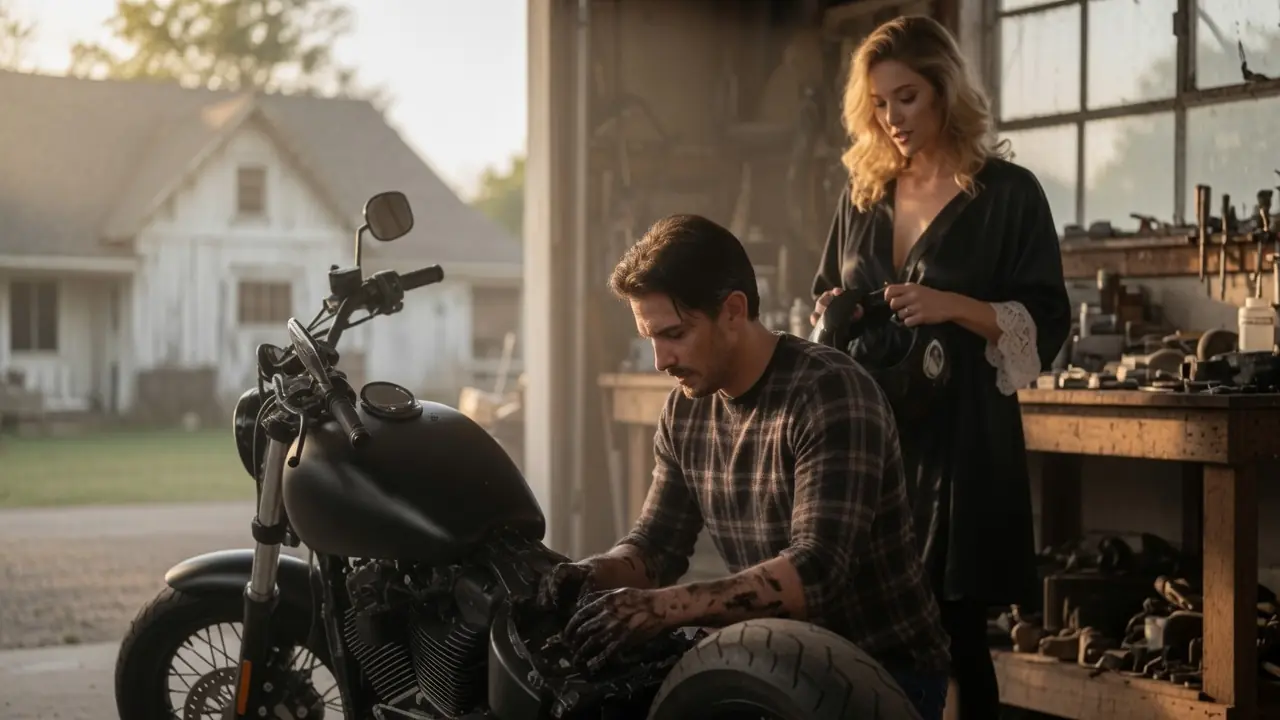
Luke slowed his old pickup.
The woman wore black riding boots, dark jeans, and a fitted leather jacket over a navy shirt. Long blonde hair had escaped from beneath her helmet, and frustration sharpened her otherwise composed face. She looked toward his truck with immediate suspicion, as though she had already learned that help from strangers often came with conditions. Luke stopped several yards ahead and left the engine running.
“Stay in the truck,” he told Emma.
His daughter opened one sleepy eye. “Is somebody hurt?”
“Probably just the bike.”
“Bikes have feelings too.”
“That explains why mine hated me in high school.”
Emma smiled and pulled the blanket closer.
Luke stepped onto the roadside with both hands visible. At thirty-five, he was broad-shouldered from years of lifting engines and raising a child alone, though exhaustion showed beneath his eyes. His plaid work shirt was stained near one sleeve, and an old burn scar crossed his right forearm. He stopped before entering the woman’s personal space.
“Need a mechanic?”
She looked at the faded lettering on his pickup.
HARPER MOBILE REPAIR
“Are you one?” she asked.
“On good days.”
“And today?”
“Depends what your motorcycle did.”
The woman studied him for another moment, then pointed toward the engine. “It lost power, made a snapping sound, and shut down.”
Luke crouched beside the motorcycle without touching it. “May I?”
She nodded.
He removed a flashlight from his pocket and inspected the fuel system, wiring, and battery connections. The motorcycle was expensive, customized, and clearly maintained by someone who understood machines. Yet one section of the fuel line had split near the clamp, leaving a dark stain against the frame.
“The fuel line is split,” Luke said. “I can repair it before dark, but the damaged section should be replaced properly tomorrow.”
The woman’s shoulders relaxed slightly. “How much?”
“Let me fix it first.”
“I prefer knowing the cost.”
“I prefer knowing whether I can actually fix something before charging for it.”
She almost smiled.
Luke returned to the truck for tools. Emma climbed out behind him despite his instruction, carrying a bottle of water and two granola bars. She wore purple sneakers, jeans, and a red jacket inherited from an older cousin.
“Emma.”
“You said she might need help.”
“I said stay in the truck.”
“You also say helping people matters more when it is inconvenient.”
The woman covered a quiet laugh.
Luke sighed. “This is my daughter, Emma. Emma, this is…”
“Raven,” the woman answered.
“Just Raven?” Emma asked.
“For now.”
Emma offered her the water. “You look thirsty.”
Raven accepted it slowly. “Thank you.”
Luke noticed the way she looked at Emma—not merely with kindness, but with recognition. It was the expression of a parent who understood the exhausting vigilance children inspired. When Raven unzipped her jacket to reach for her phone, a small photograph slipped from the inner pocket and landed near Luke’s knee.
He picked it up carefully.
The picture showed Raven beside a little girl of about seven, both sitting on a dock with their shoes removed and their feet above the water. Raven looked entirely different in the photograph. Her hair was tied carelessly, she wore no makeup, and her smile seemed real rather than guarded.
“Your daughter?” Luke asked.
Raven quickly took the picture. “Yes.”
“She has your eyes,” Emma said.
Raven’s expression softened. “Her name is Sophie.”
“Where is she?”
“With someone I trust.”
The answer carried enough tension that Luke did not ask more.
He cut away the damaged section of fuel line and fitted a temporary replacement from his repair kit. Raven watched him work from a few feet away, holding Sophie’s photograph against her palm. After several minutes, Luke secured the final clamp and asked her to try the ignition.
The engine started.
Its deep mechanical rumble rolled across the quiet fields.
Raven looked genuinely relieved. “You fixed it.”
“For tonight.”
She reached into her jacket and removed a black leather wallet. Luke saw the edge of several large bills before she folded them away from Emma’s view.
“What do I owe you?”
“Twenty dollars covers the materials.”
“That is not enough.”
“It took fifteen minutes.”
“You stopped when most people would have kept driving.”
“That part was free.”
Raven held out a hundred-dollar bill. “Take it.”
Luke shook his head. “Twenty.”
“Why?”
“Because that is what the repair costs.”
Her eyes narrowed slightly. “You do not know who I am.”
“You’re a stranded mother with a damaged motorcycle.”
“And if I were somebody important?”
“Then your fuel line would still cost twenty dollars.”
Raven stared at him.
Most men changed when they learned what she owned. Some became excessively helpful, while others immediately tried to prove they could control her. Luke treated the money in her hand as though it had no greater power than any ordinary bill.
She finally gave him twenty dollars.
“Thank you,” she said.
Emma looked toward the sky. “It will be dark soon.”
Raven checked her phone and frowned. “I have no signal.”
“Where are you headed?” Luke asked.
“Columbus.”
“That motorcycle should not take the highway with a temporary line.”
“I cannot leave it here.”
“My garage is eight miles away. I can load it into the pickup, replace the line properly, and you can call someone from there.”
Raven’s guarded expression returned. “You invite strangers to your house often?”
“No.”
“Then why me?”
Luke began putting away his tools. “Because you are another single parent trying to get home.”
The words unsettled her more than flirtation would have.
Luke secured the motorcycle inside the pickup bed using two straps he kept for roadside recoveries. Raven sat beside Emma during the drive, while Luke occupied the front alone. His truck had an extended cab but offered little comfort, and Raven’s boots pressed awkwardly against a toolbox beneath the seat.
Emma filled the silence.
She told Raven about her school, her failed attempt to grow tomatoes, and the neighborhood dog that stole sandwiches from unattended porches. Raven listened with patience, occasionally asking questions that revealed she understood children rather than merely tolerating them. When Emma asked what Sophie liked, Raven’s face brightened.
“She paints,” Raven said. “Mostly horses and houses with enormous windows.”
“Does she ride motorcycles?”
“Not yet.”
“Dad says I have to wait until I am forty.”
“Thirty-five,” Luke corrected.
“Same thing.”
Raven laughed again.
Luke’s home stood behind a small repair garage at the edge of a working-class neighborhood. The house had peeling white siding, a narrow porch, and a wooden swing Emma insisted on decorating with ribbons each summer. The garage door stood open, revealing tools arranged carefully along the walls and an unfinished motorcycle frame beneath a canvas sheet.
Raven examined the place as Luke unloaded her bike.
“You work from home?”
“Mostly.”
“What happened to the shop listed on the truck?”
“It was larger until the rent increased.”
He said it without self-pity, though the truth was heavier. Luke once owned a three-bay repair shop closer to Columbus. After his wife, Sarah, died from complications following surgery, he missed work repeatedly while caring for Emma. Medical bills, funeral costs, and reduced income forced him to close the commercial location and move the business into his garage.
Emma ran inside to start dinner.
Luke pushed Raven’s motorcycle beneath the garage lights and began removing the temporary line. Raven stood behind him, uncertain whether she should wait, leave, or help. She had spent her life entering rooms where people adjusted their behavior around her power.
Luke did not adjust anything.
“You can sit,” he said, pointing toward an old wooden stool.
“I can help.”
“Know motorcycles?”
“A little.”
He handed her a flashlight. “Then hold this.”
Raven stepped closer and directed the beam toward the engine. Her leather jacket became uncomfortable, so she removed it and placed it over the stool. Beneath it, she wore a fitted navy blouse that looked far more expensive than the rest of her disguise.
Luke noticed but said nothing.
“What do you do?” he asked.
“I manage investments.”
“That sounds vague.”
“It keeps conversations short.”
“I repair engines. That keeps conversations long because everyone knows something wrong with their car.”
Raven smiled. “Do you enjoy this?”
“Most days.”
“Even when it does not pay enough?”
Luke tightened a clamp. “Money decides whether work survives. It does not decide whether the work matters.”
She looked toward the small house. “And Emma?”
“She decides everything else.”
Raven’s expression changed.
“Most men change when they learn I have money,” she said quietly. “And disappear when they learn I am a mother.”
Luke stopped working and looked at her.
“Then they never deserved either of you.”
“You say that easily.”
“I lost my wife when Emma was four. I know children do not reduce a person’s life. They become the reason the life matters.”
Raven lowered the flashlight.
“You helped me without asking what I could give you.”
“I’m a single parent too, Raven. Sometimes the best thing we can give each other is a safe place to stop running.”
The final word struck too close.
Raven turned away.
Luke noticed but did not pressure her. He completed the fuel-line replacement, tested the engine, and then inspected the remaining connections. The motorcycle was ready within an hour, but the evening had become fully dark.
Rain began tapping against the garage roof.
Emma appeared in the doorway wearing a flour-stained apron. “Dinner is ready.”
Raven reached for her jacket. “I should leave.”
“You should not ride in this weather,” Luke said.
“I have ridden in worse.”
“That does not make this safe.”
Emma looked toward Raven. “We have enough soup.”
Raven hesitated.
She had spent the previous week sleeping in hotels under a false name. Reporters waited outside her primary residence, investors called constantly, and her former fiancé had released private details about their breakup to business magazines. She had chosen the motorcycle and simple clothes because anonymity felt like oxygen.
A quiet dinner with a mechanic and his daughter should have been dangerous.
Instead, it felt like the safest invitation she had received in years.
“Only dinner,” she said.
The kitchen was small, with mismatched chairs and children’s drawings covering one wall. Emma served vegetable soup, grilled cheese sandwiches, and slices of apple. Raven sat at the side of the table rather than the head, and Luke made no special effort to impress her.
The food was simple.
The conversation was not.
Emma asked whether Sophie had a father. Raven paused before explaining that Sophie’s father had left when their daughter was two. He sent occasional birthday gifts through an assistant but rarely called.
“Does she miss him?” Emma asked.
“Yes.”
“Do you?”
“No.”
Luke gave his daughter a warning look.
Raven shook her head. “It’s all right.”
She explained that Sophie’s father loved comfort, attention, and the idea of being connected to powerful people. Once parenthood required sacrifice, he disappeared. Raven’s later relationships followed a different pattern but ended for the same reason.
The men did not leave because she was poor.
They stayed because she was rich.
That had become worse.
After dinner, Raven called the woman caring for Sophie. The conversation was brief but tender. Sophie asked when her mother would return, whether the motorcycle had been repaired, and whether reporters still waited outside the apartment.
Luke heard only fragments, yet enough to understand that Raven’s life was far from ordinary.
When the call ended, he asked no questions.
“You are not curious?” she said.
“About what?”
“The reporters.”
“They bother many people?”
“Not usually mechanics.”
Luke leaned against the counter. “I assumed you would explain when you were ready.”
Raven looked at him for a long time.
“My full name is Raven Steele.”
Luke remained still.
Emma’s spoon dropped against her bowl. “Steele like Steele Global?”
Raven looked surprised. “You know the company?”
“My school got computers from your foundation.”
Luke slowly folded his arms. “Steele Global owns energy, technology, and half the buildings downtown.”
“Not half.”
“That is the part you correct?”
Raven’s voice softened. “I am the chief executive and majority owner.”
Silence filled the kitchen.
Luke looked toward her motorcycle, the expensive blouse, and the guarded way she had answered every personal question. The pieces now fit, but the revelation did not inspire admiration.
It inspired caution.
“You lied to us,” he said.
“I withheld my surname.”
“You allowed us to believe you were an ordinary traveler.”
“I was an ordinary stranded mother.”
“You know that is not what I mean.”
Emma looked between them. “Dad.”
Luke lowered his voice. “Go finish your homework.”
“I already did.”
“Check it again.”
Emma reluctantly left.
Raven stood. “I should go.”
“Probably.”
Pain crossed her face before she concealed it.
“I did not plan to deceive you.”
“You traveled under another name.”
“My former fiancé has been leaking my locations. Reporters follow Sophie to school. Men I date eventually ask for contracts, investments, introductions, or access.”
“And you thought testing a mechanic would prove something?”
“I was not testing you.”
“Then what were you doing?”
“Trying to breathe.”
Luke looked away.
His anger weakened because the exhaustion in her voice was real. Yet he had spent too many years rebuilding stability for Emma to invite a billionaire’s public chaos into their home without thought.
Raven put on her jacket.
“I am sorry,” she said. “For not telling you sooner.”
Luke nodded but did not stop her.
She rode away after the rain softened.
For the next week, Luke heard nothing from Raven.
Emma asked about her twice but stopped after noticing his expression. Luke returned to repairing trucks, lawn equipment, motorcycles, and anything else customers could afford to save rather than replace. He told himself the encounter had been a strange evening and nothing more.
Then Sophie Steele appeared at the garage.
A black SUV stopped outside on Saturday morning, followed by another vehicle carrying security staff. A seven-year-old girl climbed from the rear seat wearing jeans, red boots, and a yellow jacket.
Raven followed.
She wore no disguise this time. Her cream coat, dark trousers, and tailored blouse reflected the world she usually inhabited. Yet her face remained the same tired face Luke had seen beside the road.
Emma rushed from the house.
“You’re Sophie?”
The girls stared at each other for several seconds.
Then Sophie held up a drawing of a black motorcycle.
“My mom said your dad fixed this.”
Emma examined it. “The back wheel should be bigger.”
Within minutes, they were sitting on the garage floor drawing motorcycles, horses, and impossible houses with ramps reaching the roof. Luke watched them before turning toward Raven.
“You brought your daughter.”
“She wanted to thank you.”
“She has security.”
“She needs it.”
“What happened?”
Raven’s former fiancé, Preston Vale, had accessed internal company travel files and leaked her private schedule to reporters. He wanted public pressure to force her back into the relationship before a major shareholder vote. Preston had also begun challenging Raven’s leadership by claiming personal instability made her unfit to run Steele Global.
“He says a single mother cannot handle the company,” Raven said.
Luke’s expression hardened. “And investors believe him?”
“Some believe anything that protects profit.”
“Why are you here?”
Raven looked toward the girls.
“Because Sophie has stopped trusting every new person I meet,” she said. “Yesterday, she asked whether you were another man waiting for money.”
Luke’s face softened.
“I told her you charged me twenty dollars.”
“That does sound trustworthy.”
“She asked to meet Emma.”
The girls laughed over a badly drawn horse.
Raven stepped closer. “I also came because I thought about what you said. A safe place to stop running.”
“And?”
“I do not know how to stop.”
Luke remained silent.
“I know how to negotiate acquisitions, fight lawsuits, and move billions across markets,” Raven continued. “I do not know how to believe someone can care without wanting ownership.”
“You do not learn that in one afternoon.”
“I know.”
“Or with one apology.”
“I know that too.”
Luke looked into her eyes. “Then start with honesty.”
Raven nodded.
Their relationship began slowly after that.
Raven visited without the motorcycle disguise, though she often dismissed all but one security driver several blocks away. Luke refused expensive restaurants and preferred diners where Emma could color on paper menus. Raven resisted at first, then discovered she enjoyed places where no one expected a speech.
Sophie and Emma formed their own friendship.
Emma taught Sophie how to repair a bicycle chain. Sophie taught Emma how to paint without outlining every shape first. They argued, forgave quickly, and began referring to each other as sisters long before either adult knew what to call the relationship growing between them.
Luke saw parts of Raven hidden from shareholders.
She checked Sophie’s breathing twice each night because the child once had pneumonia. She saved every drawing, even those made on restaurant napkins. She feared silence after phone calls because silence usually meant another crisis waiting behind a closed door.
Raven saw Luke differently too.
He was not simply kind. He was proud, sometimes stubborn, and deeply protective of the small life he had rebuilt. He refused her offer to pay for new garage equipment but accepted a fair corporate contract after Steele Global’s vehicle division independently selected Harper Mobile Repair through competitive bids.
Luke insisted Raven remove herself from the decision.
She did.
Preston Vale noticed their relationship before either admitted it publicly.
Photographs appeared online showing Raven leaving Luke’s neighborhood. Reporters called him a “mystery mechanic” and speculated that he was seeking access to her fortune. Customers stopped visiting because cameras blocked the street, and Emma was followed outside school.
Luke confronted Raven in her office.
“This is not safe for my daughter.”
“I increased security.”
“That is not the point.”
“Then tell me the point.”
“My child cannot become evidence in your fight with Preston.”
Raven’s face tightened. “You think I am using you?”
“I think your world consumes people who did not choose it.”
“And you believe leaving protects us?”
“It protects Emma.”
“What about Sophie?”
Luke had no answer.
Raven turned toward the windows overlooking Columbus. “Every man who left told me he was protecting himself from my life.”
“I am not them.”
“Then do not use their words.”
The argument ended without resolution.
Luke returned home, but Emma had already seen the photographs online. She asked whether Raven had done something wrong.
“No,” Luke said.
“Did you?”
“I don’t know.”
Emma sat beside him on the porch swing. “Mom died, and then you stopped inviting people inside because losing them hurts.”
Luke looked at her.
“That does not mean everyone leaves,” she continued.
“You are eight years old.”
“I’m almost nine.”
“That changes everything.”
“It changes one year.”
Luke laughed despite himself.
The shareholder vote occurred three days later.
Preston presented documents suggesting Raven had misused company assets to benefit Luke’s business. The accusation depended on the repair contract, travel records, and security expenses connected to the visits. Raven’s attorneys proved that she had removed herself from the contract selection and paid all personal security costs privately.
Then Luke entered the boardroom.
He carried every invoice, competing bid, and inspection report connected to the contract. He explained how Steele Global’s older vehicle maintenance system overcharged regional branches and replaced repairable parts unnecessarily. His proposal had saved the company fourteen percent in three months.
Preston smiled coldly. “You expect us to believe your relationship with Ms. Steele had no influence?”
Luke looked toward Raven, then back at the board.
“I expect you to read the bids.”
Several directors lowered their eyes to the documents.
“The numbers do not care who I love,” Luke continued. “They show who did the work.”
Raven stared at him.
It was the first time he had used the word love.
The independent directors confirmed Luke’s account. Preston’s challenge collapsed further when investigators revealed that he had leaked private information and manipulated internal travel files. The board removed him from every company position and referred the evidence to legal authorities.
After the meeting, Raven found Luke standing alone near the elevators.
“You said you love me.”
“I noticed.”
“Was that accidental?”
“No.”
She stepped closer. “And the reporters?”
“Still terrible.”
“My money?”
“Complicated.”
“Security?”
“Annoying.”
Raven’s eyes filled. “Then why are you here?”
Luke touched her cheek.
“Because I taught Emma not to leave good people alone when life becomes inconvenient.”
Raven closed her eyes beneath his hand. “I do not want to be rescued.”
“I know.”
“I want someone who stays beside me while I rescue myself.”
Luke smiled. “That sounds expensive.”
She laughed through her tears.
Their first kiss happened inside the quiet hallway, without cameras, contracts, or children watching. It was gentle and careful, but neither mistook caution for uncertainty. They had both spent years protecting their families from people who confused love with access.
This felt different.
One year later, Luke’s garage remained open behind the same modest house. Raven offered to build him a larger facility, but he accepted only after creating a business plan, purchasing a share with his own savings, and insisting the new shop remain independent from Steele Global.
The building included a training room for single parents entering mechanical trades.
Raven funded scholarships through her foundation, but Luke selected applicants with an outside committee. Their lives joined without one disappearing inside the other.
Sophie and Emma painted the waiting room wall.
Their mural showed two motorcycles riding toward a large house with enormous windows. Four figures stood on the porch, joined by a crooked dog neither family actually owned.
“Why is there a dog?” Luke asked.
“Future planning,” Emma replied.
On the anniversary of the roadside repair, Raven rode the same black motorcycle back to the country road. Luke followed in his pickup with both girls arguing over music in the back seat.
They stopped near the place where the fuel line had split.
Raven removed her helmet and looked across the fields.
“I thought I was hiding from people who wanted my money,” she said.
“You were.”
“I was also hiding from anyone who might love me enough to see how frightened I was.”
Luke leaned against the motorcycle. “I saw the fuel line first.”
“That is very romantic.”
“It was visibly damaged.”
She stepped closer. “And me?”
“You were harder to diagnose.”
Raven touched his chest. “What did you find?”
“A stubborn single mother who believed running alone was safer than stopping with someone honest.”
“And were you right?”
“Usually.”
She kissed him beside the repaired motorcycle.
Emma opened the truck window. “Are we getting dinner or watching this all night?”
Sophie leaned across her. “Give them five more seconds.”
Raven laughed and rested her forehead against Luke’s.
She was still a billionaire.
He was still a mechanic.
Their lives remained unequal in money, visibility, and power, but never in dignity. Luke had not fallen in love with the woman behind the fortune because she had hidden it well.
He loved the woman who finally trusted him enough to stop hiding.
And Raven had not found a man willing to rescue her from wealth, motherhood, heartbreak, or responsibility.
She found a man who repaired what was broken, charged exactly what the work was worth, and stayed long enough to prove that real love never asked her to become smaller before entering his life.