“Can I sit here? Are you okay?”
Daniel Reed asked the question softly because the woman looked like someone who might break if the whole world spoke too loudly at once. He stood beside the corner booth of Miller’s Lunch Diner, holding a cheap plastic tray with a grilled cheese sandwich, fries, and a bottle of water. His dark work jacket was stained with oil near the sleeves, and there was a smear of grease under one fingernail he had missed during his rushed hand wash. Every other seat in the diner was full.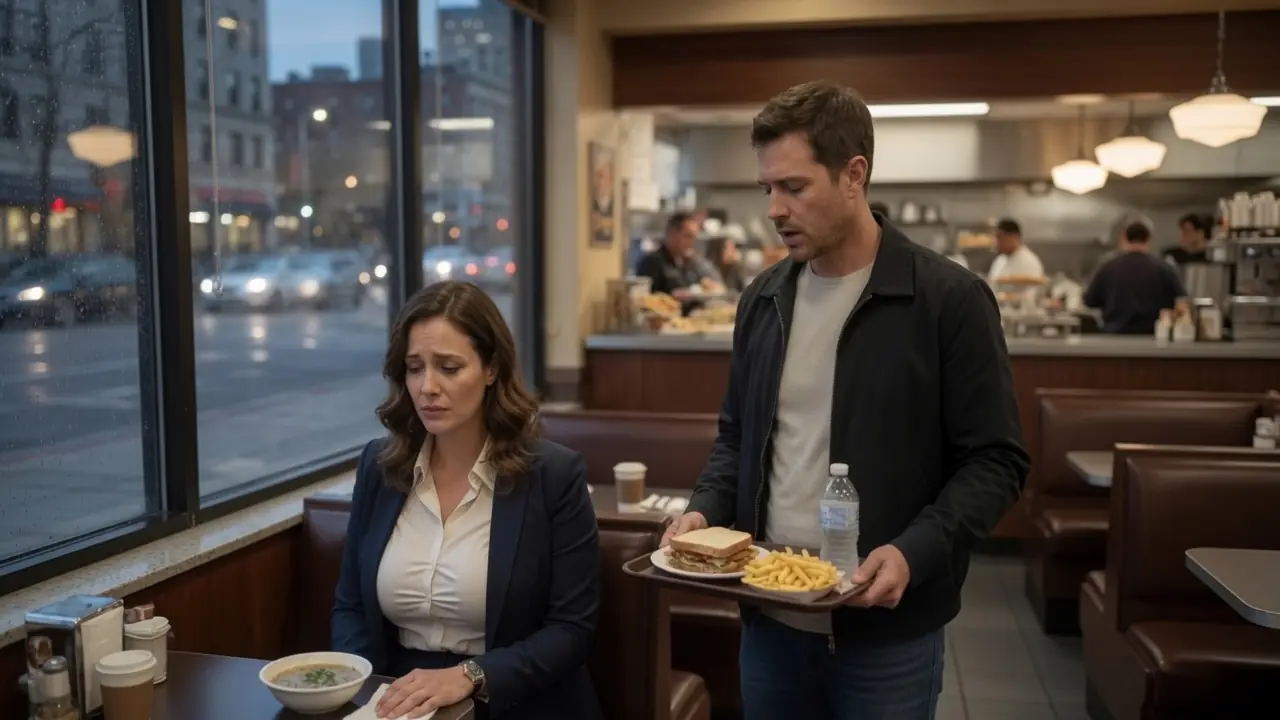
The woman looked up quickly, as if she had been caught doing something shameful. She wore a navy business suit, a white blouse, and a silver watch that looked more expensive than Daniel’s truck. Her soup sat untouched in front of her, and a folded napkin was pressed beneath one trembling hand. Her eyes were red, but she had the posture of someone trained to hide pain until it had nowhere left to go.
“I’m fine,” she said, though her voice proved the opposite.
Daniel glanced around the packed diner. Lunch hour had turned the little place into a noisy shelter from the cold rain outside. Workers from nearby shops filled the booths, office employees stood near the counter waiting for takeout, and the smell of hot noodles, coffee, and fried onions hung thick in the air. Daniel shifted his tray awkwardly, embarrassed to be intruding.
“I can stand,” he said. “I just didn’t want to sit down if you were waiting for someone.”
The woman looked toward the empty seat across from her. For one second, her face tightened with something like grief. Then she shook her head.
“No,” she whispered. “I’m not waiting for anyone.”
Daniel nodded and slid into the booth carefully, keeping his tray close so he would not crowd her. “Thank you.”
She gave a small nod, then looked down at her soup again. Daniel unwrapped his sandwich and tried not to stare. He had not meant to ask if she was okay, but the words had come out before he could stop them. Maybe it was because he knew what it looked like when a person was trying to fall apart quietly.
His son Noah did that sometimes.
Noah was nine, and whenever he felt scared, he tried to act older than he was. He would fold his little hands, keep his voice calm, and tell Daniel he was fine. That word had become a warning in their apartment. Fine usually meant the math homework was too hard, the field trip money was due, or he missed his mother but did not want to hurt his father by saying so.
The woman wiped one corner of her eye quickly and looked toward the rain-streaked window. “I’m sorry. I don’t usually cry in diners.”
Daniel took a bite of his sandwich and spoke after swallowing. “I don’t think diners have rules against it.”
That surprised a tiny laugh out of her.
It was a broken little sound, but it made her look human in a way her expensive suit had hidden. Daniel smiled gently, then pushed his fries a little toward the center of the table.
“Fries help sometimes,” he said.
She looked at them, then at him. “Do you always offer fries to strangers?”
“Only when they look like the soup lost the fight.”
This time, her laugh lasted half a second longer. She picked up one fry, stared at it like she had forgotten how normal people ate lunch, and took a small bite.
“I’m Victoria,” she said.
“Daniel.”
She glanced at his jacket. “You work nearby?”
“Northbridge Systems. Maintenance department.” He wiped his fingers on a napkin. “Well, technically the old Columbus assembly plant. Northbridge just owns us now.”
Her hand paused over the soup spoon.
Daniel did not notice. He was looking down at his tray, counting whether he had enough time to finish eating before getting back to the floor. He had only thirty minutes, and twelve had already disappeared while he waited in line.
Victoria lowered her eyes. “Do you like working there?”
Daniel thought about lying politely. Most people did. But something about the woman’s tired face made politeness feel useless.
“I like fixing things,” he said. “Machines make sense most of the time. People are harder.”
“That’s true.”
“The plant used to feel like a place that fed families,” Daniel continued. “Now it feels like a place waiting for someone far away to decide whether we still matter.”
Victoria’s face went still.
Outside, a bus hissed at the curb, and headlights blurred through the wet glass. Daniel picked up another fry, unaware that every word he spoke was landing inside the woman across from him like stones dropped into deep water.
“Have there been layoffs?” she asked quietly.
“Rumors.” Daniel gave a short laugh. “There are always rumors. But this time the supervisors stopped denying them, and that’s usually how you know the rumors got close to the truth.”
Victoria looked at the soup. “I’m sorry.”
“You don’t have to be. You didn’t do it.”
She did not answer.
Daniel studied her for a moment. “Did someone do something to you today?”
Victoria’s mouth trembled. She looked away quickly, but not before he saw fresh tears gather.
“I had to make a decision,” she said. “Or I thought I did.”
“That sounds heavy.”
“It is.”
“What kind of decision?”
She drew a slow breath. “The kind where every option hurts someone.”
Daniel sat back slightly. He knew that kind of decision too, though on a smaller scale. Rent or truck repair. Groceries or school shoes. Pay the gas bill or hope the weather warmed up before the shutoff notice became real. People with money called those choices budgeting. People without it called them survival.
“My dad used to say if every option hurts someone, start by asking who has already been hurt the most,” Daniel said.
Victoria looked at him.
“He was a mechanic,” Daniel added. “Not a philosopher. But sometimes he sounded like one after two beers.”
Victoria’s eyes softened. “Was he a good father?”
“The best.” Daniel looked down at his wedding ring, which he still wore though his wife had left three years earlier. “He taught me how to fix engines, how to show up, and how not to make a kid feel like a burden.”
“You have a child?”
“A son. Noah. Nine years old.” Daniel’s smile appeared before he could stop it. “He thinks I can fix anything.”
“Can you?”
“No.” Daniel picked up his water bottle. “But I let him believe it on bad days.”
Victoria looked toward the window. “That must be a lot to carry alone.”
“It is.” He shrugged. “But he’s worth carrying.”
The sentence pierced her more than he could have known. Victoria Hale had built her life around never appearing weak. She was forty-one, CEO of Northbridge Systems, daughter of a founder, widow of a man the public still praised but the private world barely knew. She had one daughter at boarding school who spoke to her like a polite client and a board full of men who called her decisive when she cut costs but emotional when she hesitated.
That morning, her board had pushed again to approve the closure of the Columbus assembly division. Four hundred and eighty jobs. Maintenance, line workers, packers, quality control, drivers, cafeteria staff, janitorial crews. The numbers said the closure would satisfy investors and stabilize the company’s balance sheet before the next quarter. The people behind the numbers had not been invited into the room.
Victoria had left the meeting before signing.
She told her driver she needed fifteen minutes, stepped out near the diner, and walked inside because it looked ordinary. She wanted to sit somewhere no one called her ma’am, no one handed her a report, and no one asked whether she was strong enough to make a brutal decision. Then Daniel Reed, oil-stained and tired, asked if he could sit with her.
Now the brutal decision had a face.
A single father eating cheap grilled cheese because he had probably skipped something else to afford it.
Daniel checked the clock on the wall. “I’ve got eight minutes before I’m late.”
Victoria’s voice came out low. “What would happen if the plant closed?”
He looked at her, surprised by the seriousness of the question.
“To me?” he asked.
“To you. To everyone.”
Daniel leaned back and thought for a moment. “Some people would find other jobs. Worse jobs, mostly. Some would leave town. Some would stay and drown slow. You’d see trucks get repossessed first, then houses for sale, then kids changing schools. The diner would lose lunch customers. The hardware store would cut hours. The church food pantry would get busier.”
Victoria’s eyes glistened.
Daniel continued, “People talk about job cuts like they cut a line on paper. But it spreads. A plant closes, and suddenly a whole town starts holding its breath.”
She swallowed. “And you?”
He looked down at his hands. “I’d do whatever I had to do.”
“That is not an answer.”
“It’s the only one parents get sometimes.”
Victoria pressed the napkin beneath her hand. “Does Noah know?”
“He knows I’m worried. Kids always know more than we want them to.”
Daniel gathered his tray, then paused. “Whatever decision you’re making, Victoria, I hope someone in the room remembers people have children waiting at home.”
She looked at him, unable to speak.
He stood. “Thank you for letting me sit.”
“Daniel.”
He stopped.
Her voice trembled. “What if the person in the room forgot?”
Daniel looked at her for a long moment. He did not know who she was. He did not know what room she meant. He only saw a woman who looked ashamed of something she had not yet done.
“Then maybe it’s not too late to remember,” he said.
He carried his tray to the trash and left the diner with his hood pulled up against the rain.
Victoria sat alone after he was gone. His fries remained partly on the plate, untouched now. Her soup had gone cold. She watched through the window as he crossed the street, shoulders hunched against the weather, moving like a man already used to carrying too much.
Her phone buzzed.
Board Chair: We need your signature by 3.
Victoria stared at the message.
Then she picked up her spoon, took one bite of cold soup, and finally began to cry without trying to hide it.
The next morning, Daniel arrived at Northbridge Systems at 6:15. The plant looked the same from outside, a long gray building with loading docks, chain-link fencing, and steam rising from roof vents. But something felt different. Clusters of workers stood near the time clock, whispering. Supervisors moved quickly without meeting anyone’s eyes.
At 8:00, an announcement came over the intercom.
All employees report to the main assembly floor at 9:00 a.m.
The rumors became fear in an instant.
Daniel called Mrs. Alvarez, who watched Noah after school, just to make sure she could take him if he was late. Then he stood beside the machine press with the rest of maintenance, waiting for the hour to arrive. Nobody joked. Nobody complained. The usual noise of the plant seemed thinner, as if the building itself was listening.
At 9:00, nearly five hundred people gathered on the assembly floor. Men and women in work jackets, uniforms, safety glasses, and steel-toed boots stood shoulder to shoulder. Some crossed their arms. Some held coffee cups they had forgotten to drink. Daniel stood near the back, hands in his pockets, trying to prepare himself for words like restructuring and difficult decision.
Then Victoria Hale walked onto the platform.
Daniel stopped breathing.
She wore a dark suit, the same kind of suit as the woman from the diner. Her hair was pinned back neatly now, her face composed, her eyes clear but tired. Behind her stood board members, executives, and plant managers. A large Northbridge Systems logo hung on the wall behind them.
Someone whispered, “That’s the CEO.”
Daniel felt the floor shift beneath him.
Victoria looked over the crowd. For one brief second, her eyes found Daniel’s.
She knew.
He looked down, heat rising to his face. He had told the CEO her company felt like a faraway room deciding whether workers mattered. He had told her plant closures spread like grief. He had told her someone needed to remember the children waiting at home.
Victoria stepped to the microphone.
“I came here today to say something my board did not expect me to say,” she began.
The assembly floor went silent.
“For months, Northbridge Systems has studied whether to close the Columbus assembly division. The numbers supported closure. The reports supported closure. Several people in leadership recommended closure.”
A wave of fear moved through the crowd.
Victoria paused.
“Yesterday, I realized those reports were incomplete.”
The board chair shifted visibly behind her.
Victoria continued, “They counted operating costs, but not the cost of breaking families. They counted facility savings, but not the businesses that depend on this plant. They counted positions, but not people.”
Daniel’s throat tightened.
“So I am not closing this plant.”
For a second, no one reacted. The words seemed too large to understand.
Then the room erupted.
Some people shouted. Some cried. A woman near the front covered her face with both hands. Two men hugged awkwardly and slapped each other’s backs. Daniel stood frozen, his eyes fixed on Victoria as relief moved through the crowd like electricity.
Victoria lifted one hand, and slowly the room quieted.
“This does not mean nothing will change,” she said. “The plant has problems. The company has problems. But closing this division would have been leadership choosing the easiest pain because other people would carry it.”
The sentence landed hard.
“We are launching a ninety-day rebuild plan,” she continued. “New contracts, updated equipment, voluntary retraining, and a worker advisory council that will sit directly with leadership. We will begin with maintenance, line safety, scheduling, and local supplier partnerships.”
The plant manager looked stunned. Several executives looked uncomfortable. Victoria did not seem to care.
Then she said, “Daniel Reed, if you are willing, I would like you on that council.”
Every head turned.
Daniel’s stomach dropped. He heard a coworker whisper, “Reed?” Someone nudged his shoulder. He wanted to disappear behind the machine press, but Victoria was looking directly at him now, not as a CEO catching a worker off guard, but as the woman from the diner who had asked what happened when someone forgot.
Daniel cleared his throat. “Ma’am, I’m just maintenance.”
Victoria’s voice softened. “Yesterday, you were the only person who explained this company clearly.”
The room went quiet again.
Daniel did not know what to do with all those eyes on him. He thought of Noah, of rent, of his father, of every worker standing around him holding a life that could have been wrecked by one signature.
He nodded once. “Then yes.”
The applause started near the maintenance crew and spread across the floor.
After the meeting, Daniel tried to return to work, but a supervisor told him Ms. Hale wanted to speak with him. He followed a hallway to a small conference room, feeling every oil stain on his jacket as though it had become brighter. Victoria stood by the window, looking out over the parking lot where workers were calling spouses, parents, and friends with the news.
When Daniel entered, she turned. “I owe you an apology.”
He laughed nervously. “I don’t think you do.”
“I sat across from you yesterday and let you speak about your life without telling you I had power over it.”
Daniel looked down. “That’s a strange lunch.”
“Yes,” she said. “It was.”
He shifted. “Did you really change your mind because of me?”
Victoria took a breath. “You reminded me that I had been asking the wrong question.”
“What was the question?”
“How do we reduce loss?” she said. “You made me ask who we were asking to carry it.”
Daniel nodded slowly.
“I can’t promise this will be easy,” Victoria continued. “There will be hard changes. But they will not be made by people who never step inside this building.”
“That matters.”
“I want the council to be honest. Not polite. Honest.”
Daniel smiled faintly. “You might regret asking maintenance for honesty.”
“I hope not.”
He looked toward the floor. “Can I ask you something?”
“Yes.”
“Why were you crying?”
Victoria’s composure flickered.
Daniel immediately regretted it. “Sorry. That’s not my business.”
“No,” she said quietly. “It’s all right.” She looked out the window again. “My daughter told me last week that she didn’t know who I was when I wasn’t working. I told myself she was being dramatic. Yesterday morning, I realized she was right.”
Daniel said nothing.
“My husband died six years ago,” Victoria continued. “I buried myself in the company because it was easier than feeling helpless at home. Somewhere along the way, I became very good at decisions and very bad at being human.”
Daniel thought of Noah waiting at home with drawings and math homework. He thought of the way children measure love not by money, but by whether someone looks up when they speak.
“It’s not too late,” he said.
Victoria looked at him. “You said that yesterday.”
“Still true today.”
Her eyes softened. “Thank you.”
The rebuild plan began the following week. At first, many workers distrusted it. They had seen corporate promises before. Daniel did too, which was why he took the council seriously. He brought notes from coworkers, complaints about unsafe scheduling, equipment delays, broken tools, and managers who ignored problems until they became expensive.
Victoria attended every meeting in person.
Not by video. Not through assistants. In person.
She listened more than she spoke, which made people nervous at first. Then they realized she was writing things down. Within a month, two failing machines were replaced, overtime rules were revised, and local vendors were invited to bid on maintenance supply contracts. The plant did not become perfect, but it stopped feeling like a place waiting to be abandoned.
Daniel’s life changed too, though not in a sudden fairy-tale way. He still worked long shifts. He still packed Noah’s lunches and worried about bills. But the fear that the ground would vanish beneath him began to loosen. The council paid a small stipend, enough to cover Noah’s field trip and the window repair in his bedroom.
One Friday evening, Daniel brought Noah to the plant family day Victoria created as part of the rebuild effort. Noah walked between machines with wide eyes, wearing safety glasses too big for his face. When Victoria met him, she crouched slightly and shook his hand like he was an executive.
“You must be Noah.”
Noah nodded. “Are you the lady from the diner?”
Daniel closed his eyes. “Buddy.”
Victoria laughed, a real laugh this time. “Yes. I am.”
“Dad said you were sad.”
Daniel wanted the floor to open.
Victoria smiled gently. “I was. Your dad was kind to me.”
Noah looked proud. “He does that.”
Victoria looked at Daniel. “I know.”
Over the next months, Victoria changed in ways that were quieter than company announcements. She began leaving the office earlier twice a week to have dinner with her daughter, Lily. The first dinners were awkward, then less so. Lily visited the Columbus plant once and stood beside Noah during a safety demonstration, both children wearing oversized glasses and pretending not to be interested in each other.
The board did not love Victoria’s new approach. Some investors complained that she had become sentimental. She answered them with numbers when numbers mattered and with steel when they mistook compassion for weakness. The Columbus division began meeting targets again by the second quarter, partly because workers who no longer felt disposable worked like the place had a future.
One afternoon, Victoria returned to Miller’s Lunch Diner.
Daniel was already there, sitting in the same corner booth with the same cheap tray, though this time he had ordered soup too. The diner was crowded again, but the seat across from him was empty. Victoria stood beside the booth.
“Can I sit here?” she asked.
Daniel looked up and smiled. “Are you okay?”
She laughed softly. “Better than last time.”
“Then sit.”
She slid into the booth, and for a moment neither of them spoke. Outside, rain streaked the window just as it had that first day. Inside, the diner smelled of coffee and hot noodles, ordinary and comforting.
Victoria looked at his tray. “Still grilled cheese?”
“Still affordable.”
She picked up a menu. “What do you recommend?”
“Depends. Are you crying today?”
“No.”
“Then the noodles.”
She smiled and ordered them.
As they ate, they spoke not as CEO and worker, not as rich woman and single father, but as two tired people who had once met at the exact moment one of them needed to remember something important. Daniel told her Noah had passed his math test. Victoria told him Lily had agreed to come home for spring break. Neither story sounded grand to anyone else, but to them, both felt like repair.
At the end of lunch, Victoria looked at Daniel carefully. “You know, I almost signed the closure order before I came here that day.”
Daniel nodded. “I figured.”
“I think about that a lot.”
“So do I.”
“I also think about what you said. That parents only get one answer. Do whatever they have to do.”
Daniel looked out the window. “That’s how it feels.”
Victoria’s voice softened. “Maybe the better answer is making sure fewer parents are forced into impossible choices.”
He looked back at her.
“That’s the kind of company I want to run,” she said.
Daniel smiled faintly. “Then don’t forget again.”
“I won’t.”
A year after the diner meeting, Northbridge Systems held a community event inside the Columbus plant. The company announced new apprenticeship programs, local supplier contracts, and a childcare assistance fund for shift workers. Daniel had helped push for that last one because he knew how many good employees were one babysitting emergency away from losing everything.
Victoria asked him to speak.
He refused three times.
She asked a fourth time, and Noah told him he was being dramatic, so Daniel agreed.
Standing in front of workers, families, executives, and local reporters, Daniel held a microphone like it might bite him. He looked at Noah in the front row, then at Victoria standing to the side.
“I’m not good at speeches,” he began.
Someone from maintenance shouted, “Yes, you are!”
The room laughed.
Daniel smiled, then continued. “A year ago, most of us thought this plant was done. We thought decisions had already been made by people who didn’t know our names. Maybe some decisions almost were.”
Victoria lowered her eyes, accepting it.
“Then something changed,” Daniel said. “Not because everything got easy. It didn’t. But because someone with power finally listened before signing away people’s lives.”
The room went quiet.
“I learned something too. Sometimes you don’t know who you’re sitting with. Could be a CEO. Could be a single dad. Could be someone having the worst day of her life. So maybe the best thing we can do is treat people like they matter before we find out whether they can help us.”
Victoria’s eyes filled.
Noah clapped first. Then the room followed.
After the event, Victoria found Daniel near the side door where he was trying to escape attention. “That was a good speech.”
“No, it wasn’t.”
“It was.”
“I forgot half of it.”
“Then the half you remembered was enough.”
Daniel laughed.
Victoria looked toward the plant floor, now full of families and noise. “I used to think leadership meant carrying the hardest decisions alone.”
“What do you think now?”
She looked at him. “I think it means not hiding from the people who carry the consequences.”
Daniel nodded. “That sounds better.”
Outside, evening settled over Columbus. The plant lights glowed against the darkening sky, and cars filled the parking lot where workers lingered with their families instead of rushing home in fear. Noah ran past with Lily and two other children, laughing so hard Daniel had to call for him to slow down.
Victoria watched them. “He looks happy.”
“So does she.”
For a moment, they stood side by side in comfortable silence.
Neither of them spoke of romance, though something gentle had begun growing between them, something neither wanted to rush or name too quickly. Their lives were complicated. Their worlds were different. But both knew that one lunch had tied their stories together in a way neither could dismiss.
Months later, when people asked Victoria why she saved the Columbus plant, she gave business reasons first. Local expertise. Repairable inefficiencies. Long-term value. All of that was true.
But privately, she kept a napkin from Miller’s Lunch Diner folded inside her desk drawer. On it, written in her own hand after Daniel left that first day, were seven words.
Remember the children waiting at home.
Whenever a report turned people into columns, she opened the drawer and read the sentence again.
And Daniel, on hard days, still took lunch at Miller’s when he could. Sometimes alone. Sometimes with Noah. Sometimes, when her schedule allowed, with Victoria sitting across from him, no longer pretending to be fine when she wasn’t.
The corner booth became ordinary again, which was exactly what made it sacred.
A place where a single father once held a cheap tray and asked a broken woman if she was okay.
A place where a CEO remembered the human cost of her signature.
A place where one small act of kindness saved hundreds of families before anyone even knew what had happened.
And every time Daniel passed that booth, he smiled a little.
Because sometimes changing a life does not begin with power.
Sometimes it begins with a crowded diner, a trembling stranger, and one gentle question.
“Can I sit here? Are you okay?”