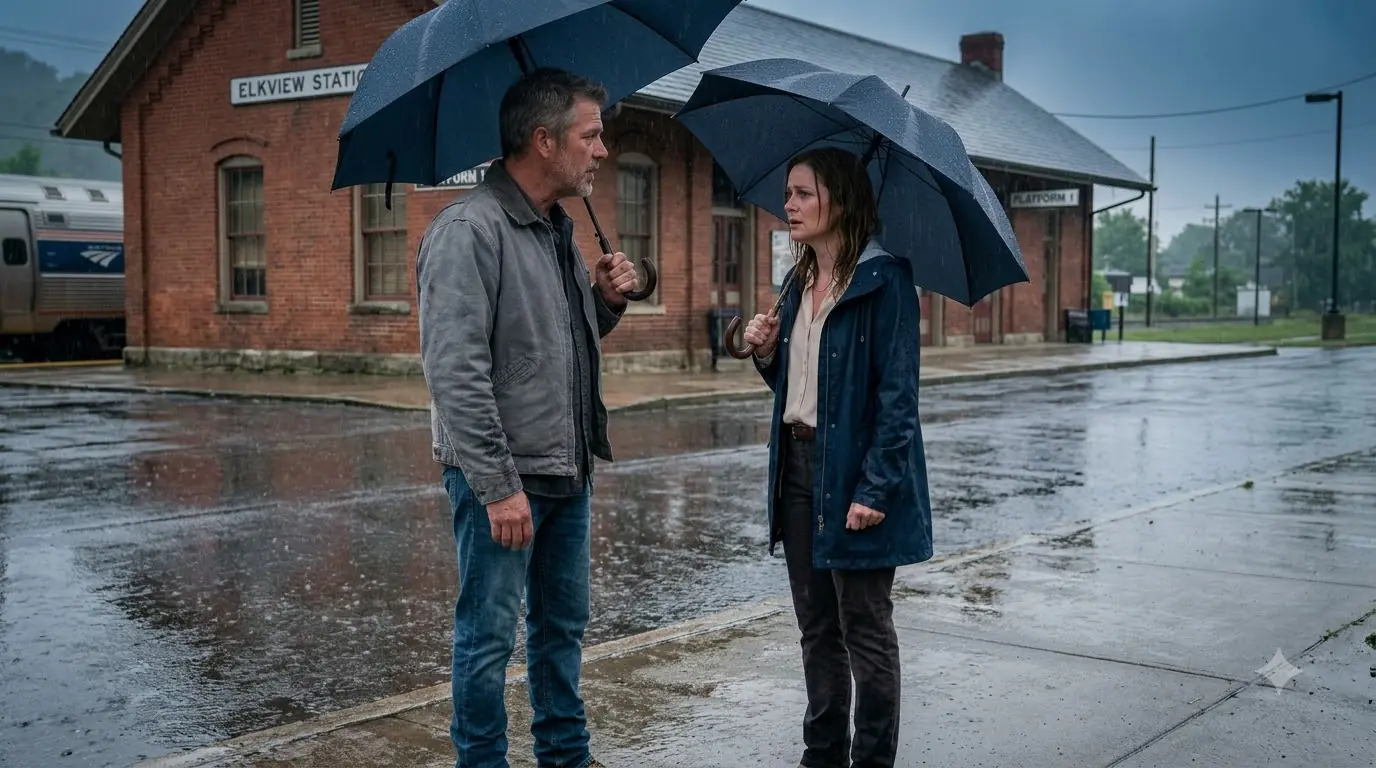
 Then, on a rain-soaked afternoon at the train station, Nolan saw a face he had buried two decades earlier. Beside her stood a young woman with gray eyes that matched his own, eyes he had only ever seen in a mirror and in his son's face.
The woman he had mourned looked at him, trembling, and told him not to say her name because someone was still watching them.
Nolan Reed had come to the Blackwater train station for nothing more complicated than a crate of parts for the 1967 Mustang sitting half-finished in his shop. He expected the afternoon to end the way most of his afternoons ended, with grease beneath his fingernails and the radio playing low while he worked in peace.
His life had settled into something manageable over the years: a small restoration garage on the edge of town, a house that still smelled faintly of sawdust, and a son named Elliott who called less often now that he had built a career of his own two states away.
Nolan had made peace, or something close to it, with the shape his life had taken after the accident that stole his wife from him when Elliott was barely three years old.
He did not expect the crowd at the station to part the way it did, or for his eyes to land on a woman standing near the ticket counter whose face stopped his breath in his chest.
She was older and thinner, and her eyes kept sliding toward the exits the way a person's eyes move when they have spent years learning not to be found.
The station smelled of wet concrete and diesel, and somewhere behind him a departure board clattered through its rotations. Nolan barely registered any of it because his whole body had narrowed down to the single fact of her face.
He told himself it was impossible, that grief could conjure familiar faces out of strangers if a man stared long enough. But the longer he looked, the more certain he became that this was not a trick of memory.
It was Merryn.
His wife, the woman he had married in a church with peeling paint and mourned after a coroner swore the recovered remains were hers, was standing thirty feet away in a station full of people who had no idea the ground beneath Nolan had just shifted.
Beside her stood a young woman no older than twenty, with dark hair, a familiar set to her jaw, and eyes the exact shade of gray Nolan saw every morning in the mirror and had seen in Elliott's face since the day the boy was born.
Nolan said Merryn's name before he could stop himself. The sound of it seemed to strike her physically because she flinched, grabbed the younger woman's arm, and began pulling her toward the far doors before he had even taken a full step forward.
He caught up to them on the sidewalk outside as rain began to needle down around them. He demanded to know how a dead woman was standing in front of him breathing.
Merryn would not look at him directly. Her attention stayed fixed on a black SUV idling across the street, its windows tinted dark enough that Nolan could not tell whether anyone sat inside.
She told him they could not be seen standing together in a place with cameras, and that every second they lingered increased a danger he did not yet understand.
When he pressed her for an explanation, she asked only one thing: that he take them somewhere no one would think to look.
Before Nolan could answer, the young woman turned to Merryn with a question that landed harder than anything else that afternoon.
"Is he really my father?"
Nolan drove them to the old storage building behind his garage, a place he used for parts he no longer needed but could not bring himself to throw away.
For a long moment none of them spoke while rain drummed against the metal roof. A single bulb buzzed overhead and swayed whenever wind pushed through a gap in the siding, throwing long shadows across shelves crowded with carburetors and coiled hose.
The smell of old motor oil settled over the three of them like something almost comforting in its ordinariness.
Nolan sat on an overturned crate because his legs did not entirely trust him to stand. He studied the two women across from him the way he might study an engine that refused to start, searching for the one detail that would explain everything.
He could not stop looking at the younger woman. He could not reconcile the shape of her face with anything he understood about his own history, yet some old instinct in him refused to dismiss what his eyes kept insisting was true.
Merryn finally broke the silence. Her hands wrapped tightly around a paper cup of coffee she had not touched as she told him that when she vanished twenty years earlier, she had been carrying a child neither of them yet knew existed.
Something cold moved through Nolan's chest because even in the deepest years of grief, he had never imagined a version of the truth that included a daughter he had never been told about.
The young woman introduced herself as Sloane Hart, though she said the surname carefully, as if it belonged to a costume rather than to her.
She explained that she had grown up believing her father died before she was born, a story repeated so many times that it had calcified into something she never thought to question.
Only two weeks earlier, her mother had finally told her that her father was not dead at all. He was alive and living less than a day's drive from where they had been hiding.
Sloane did not call Nolan anything resembling a father in that first conversation. She studied him the way a person studies a stranger who happens to share their face, cataloging the similarities without trusting what they might mean.
Nolan noticed that she pressed her fingers against the edge of the table when she grew tense. It was an unconscious habit identical to one he shared with Elliott, and the resemblance rattled him more than any words could have.
He told them plainly that two decades of lies could not be undone by a resemblance, however striking. He needed proof before he let himself believe any of it.
Merryn agreed without hesitation, but warned him they could not send a sample to any ordinary laboratory because Gideon Wickliffe had people embedded in hospitals, courts, and private data firms across the region.
The name hit Nolan like a stone dropped into still water. He remembered it from the earliest days of their marriage, when Merryn's family had made their disapproval of a small-town mechanic marrying into their world unmistakably clear.
He understood then that whatever had pulled his wife back from the dead was not a simple story of a woman running from grief. It was something larger and more dangerous than he had allowed himself to imagine.
Before he could ask another question, Merryn reached into her bag and set a photograph on the table between them. Its edges had been worn soft from handling.
It showed Nolan walking three-year-old Elliott into his first day of preschool, an ordinary morning frozen in time. The photograph had clearly been taken twelve years after the date on Merryn's death certificate.
The story that unfolded that evening carried Nolan back twenty years to a version of his life he had only ever understood in fragments.
Merryn had been born into the Wickliffe family, daughter of the late Augustus Wickliffe, founder of Wickliffe Crown Holdings, an empire built across decades of shrewd investment and careful public image.
She had never wanted the crown that came with the name. She chose instead to marry a mechanic from a town most of her relatives could not locate on a map, enduring their cold disapproval because Nolan had never once made her feel like a consolation prize.
In the early years of their marriage, Merryn used to joke that the Wickliffe name was a coat she had finally learned to take off. She could hang it beside the door of their small house and step into a life measured in oil changes and grocery lists instead of boardrooms.
She believed distance alone would be enough to keep the family's ambitions from touching the life she had built for herself.
After Augustus died, his younger brother Gideon assumed control of the company, and with it, control over nearly everything the Wickliffe name still touched.
Merryn watched her uncle tighten his grip on the family's fortune with a patience that unsettled her long before she understood exactly why.
Three days before she disappeared, Merryn discovered that Gideon had been siphoning hundreds of millions of dollars from the company's employee pension fund through a web of shell corporations designed to obscure the trail.
Digging further, sleepless and increasingly afraid, she found documents suggesting her own father's signature had been forged across dozens of financial filings in the years before his death. The records pointed toward fraud stretching back further than she dared imagine.
She decided to gather every piece of evidence she could find and deliver it to federal investigators, believing naively that the truth alone would be enough to protect her family from her uncle's ambition.
Gideon learned of her plan before she could act. His response was not a threat spoken aloud, but a manila envelope left on her doorstep containing photographs of Nolan and Elliott taken without their knowledge.
The pictures proved that her family knew exactly where to find the people she loved most.
Silas Crow, the family's longtime director of security, came to her that same week with an offer that felt less like rescue and more like surrender.
He told her that if she wanted her husband and son to remain safe, her death would have to be believable in every detail. Gideon would not be fooled by a staged disappearance if Nolan's mourning ever wavered into something less than genuine.
A car resembling Merryn's was pushed into Blackwater Lake and set ablaze before sinking. Dental records used to identify the recovered body were quietly substituted by someone loyal to the family.
Merryn told herself in the earliest days of exile that she would disappear only for a few months, just long enough for Silas to build a case strong enough to protect her when she returned.
Those months stretched into years, and the years became two decades.
Nolan asked her, his voice low and controlled in a way that frightened him more than shouting would have, why she never came back once she believed herself safe.
Merryn's answer came slowly, each word costing her something. Silas had once tried to bring her home, arranging the earliest stages of a return that would have reunited her with Nolan and introduced him to the daughter he never knew he had.
Before that plan could move forward, Silas vanished without explanation. Every channel Merryn had used to communicate with the outside world went silent within days of his disappearance.
For twenty years, Merryn moved through a patchwork of borrowed names and rented rooms, first through Oregon, then farther north into Montana, eventually living near the Canadian border before putting down something resembling roots in a small coastal town in Maine.
She learned to live light, keeping a single suitcase packed beneath whatever bed she slept in. She learned the particular loneliness of watching other families gather at diner tables on ordinary Sunday mornings while she sat alone with a newspaper she used more as a shield than a source of news.
There were towns where she stayed only weeks and towns where she stayed years. In every one of them she kept a small photograph of Nolan folded inside a coat pocket, worn soft at the creases from being unfolded too many times in the dark.
In the earliest years, Silas had still been able to send her photographs of Nolan and Elliott, proof that they remained safe. Each image was a small mercy that allowed her to sleep through another night of exile.
He warned her repeatedly that Gideon's people had never stopped watching Blackwater, waiting patiently for the moment she made a mistake that would confirm what he already suspected.
Merryn wrote letters during those years, dozens of them addressed to a husband who would never receive a single one. She trusted no method of delivery except passing them through Silas, and Silas alone controlled whether they ever left his hands.
When Silas disappeared, Merryn was left with no way to know whether he had betrayed her, been discovered by Gideon, or simply been erased the way inconvenient people in her family's orbit seemed to disappear.
Without a trusted intermediary, she convinced herself that any attempt to reach out would place Nolan and Elliott directly in danger.
So she let the silence continue long after the fear that justified it had curdled into something closer to habit.
Nolan listened without softening. He was unwilling to accept an explanation that reduced his son's entire childhood to a decision made unilaterally on his behalf.
He told her plainly that grief he could forgive, but the theft of his right to know the truth about his own life was a different wound entirely.
Sloane, who had said little through most of the conversation, finally spoke up with a question of her own. She asked her mother whether the same lie had been used to protect both sides of the family from each other.
Merryn did not flinch from the accusation. She admitted that fear alone no longer explained everything.
Somewhere in the passing years, she had simply lost the ability to imagine what a return might look like, or how she would begin explaining twenty years of absence to a husband and son who had already learned to live without her.
Nolan asked more sharply why she had chosen this particular moment to resurface after so long spent hiding.
In answer, Merryn slid a thick folder across the table. Its cover was embossed with the small silver crown that marked every official document belonging to Wickliffe Crown Holdings.
Sloane would turn twenty-one years old in exactly three days, and that single fact carried the power to unravel everything Gideon Wickliffe had spent two decades building.
Before his death, Augustus Wickliffe had structured a trust that held fifty-one percent of the voting shares in Wickliffe Crown Holdings, a controlling stake designed to protect the company from exactly the kind of consolidation Gideon had since achieved.
Gideon had only ever been granted temporary stewardship of those shares under the condition that Merryn had died without leaving behind a legitimate heir of her own.
A hidden clause within the trust, one Gideon believed had died with Augustus, specified that control would automatically revert to Merryn or to her biological child the moment that child turned twenty-one. The transfer would also trigger a mandatory audit of every pension fund and corporate account the company controlled.
For twenty years, Gideon had built his empire on the confident assumption that Merryn was dead and that no heir existed to threaten his position.
At that very moment, he was finalizing the sale of a substantial portion of the company to a foreign investment fund, a deal structured to close before Sloane's birthday made her legal claim impossible to ignore.
Once the sale closed, Merryn explained, the financial evidence of Gideon's fraud would be scattered across so many shell companies that even a federal investigation might never fully reconstruct it.
She possessed only a copy of the trust's hidden clause because the sole original document had been hidden by Silas Crow somewhere in Blackwater before his disappearance two decades earlier.
Days before appearing at the train station, Merryn had received a recording from a lawyer representing Silas's estate, a message set to release automatically after his death.
In it, Silas revealed that the original document had been concealed inside something belonging to Nolan.
The memory surfaced before Nolan consciously reached for it: a wooden toolbox Merryn had given him the day he opened his garage, a gift he had treasured enough to keep for twenty years without ever suspecting it held anything but wrenches and sockets.
The three of them drove back to the shop through streets slick with rain, headlights smearing gold across the wet asphalt. None of them spoke because there seemed to be nothing left that words could accomplish.
When they arrived, Nolan found the toolbox exactly where it had always sat, undisturbed in the corner of the storage room for two full decades. Its brass latches were dulled with age but intact beneath a thin film of dust.
Yet the room itself had clearly been searched before their arrival. Drawers had been overturned, and the lock on the storage door had been forced.
Scrawled across the wall behind the toolbox, in handwriting none of them recognized, was a single sentence meant to be read as both a warning and a threat.
THE DEAD OUGHT TO KNOW BETTER THAN TO STOP STAYING BURIED.
Shaken but unwilling to retreat, Nolan reached out that same night to Delaney Price, a lawyer he had trusted since their school years together and the only person he could think of with the expertise to make sense of a trust this complicated.
She arrived at the garage still dressed from a late night at her own office, reading glasses pushed into her hair. She listened to the entire story without interrupting as her expression shifted from polite skepticism to alarm.
Delaney confirmed that the clause Merryn described could well be legally binding. She cautioned, however, that a photocopy alone would never withstand the scrutiny of a company as well resourced and well lawyered as Wickliffe Crown Holdings.
She suggested bringing in Elliott, whose career as a forensic data auditor made him uniquely suited to trace the layers of shell companies Gideon had used to hide his fraud.
The suggestion meant reopening a wound Nolan had spent years trying to protect his son from.
Elliott arrived in Blackwater the following morning fully convinced that his father had fallen victim to a pair of elaborate con artists preying on an old man's unresolved grief.
He had rehearsed the entire drive down a version of the conversation in which he gently but firmly talked his father back to reason.
That certainty collapsed the moment he saw Merryn's face in person. He recognized in an instant the same features he had only ever known from a handful of surviving photographs kept in a drawer his father rarely opened.
As a boy, Elliott had studied those photographs and tried to imagine a voice to match the smile.
Something in his chest went hollow and cold, and the careful speech he had prepared dissolved into nothing.
There was no tearful reunion, no embrace between mother and son separated by twenty years of silence.
Instead, Elliott asked her with controlled fury where she had been during every birthday, every graduation, and every night his father worked a second job just to keep a roof over their heads.
Merryn did not attempt to defend herself. She told him simply that she was sorry and that she understood if forgiveness was something he could never offer her.
Sloane watched in silence, absorbing for the first time the full weight of what her own survival had cost someone else. She had a half brother whose childhood had been shaped entirely by an absence she had never endured herself.
Before Elliott could walk away, something about the proportions of the toolbox caught his attention. Its base sat noticeably thicker than it should have given its dimensions.
Beneath a false panel at the bottom, he found a hidden compartment holding a single object: the antique pocket watch that had once belonged to Augustus Wickliffe himself.
There was no document folded inside and no legal paper to prove anything in court. Instead, the watch's case concealed a small brass key and a handwritten string of numbers that Elliott immediately recognized as belonging to a bank account.
He traced the numbers far enough to discover that they corresponded to a safety deposit box frozen on the exact date, twenty years earlier, that Merryn was legally declared dead.
Delaney filed an emergency motion the following morning to force the bank to open the frozen deposit box. Word of the filing reached Gideon Wickliffe faster than any of them anticipated.
Within hours, Wickliffe Crown Holdings launched a coordinated media campaign painting Nolan as a man being manipulated by an impostor attempting to extort the family for money.
Grainy photographs of Nolan and Merryn standing together at the train station were splashed across local news broadcasts.
Longtime customers began canceling contracts with Nolan's garage overnight. His bank accounts came under sudden and unexplained scrutiny, and police arrived within the week to search his property based on an anonymous tip claiming he possessed documents stolen from the Wickliffe family.
Nolan endured it all with grim, practiced patience. By then he understood that Gideon's reach extended into places he had never imagined a single family could touch.
Gideon himself appeared at the garage not long after the police left. He arrived without warning and without the security detail Nolan expected a man of his stature to require.
He wore a coat too fine for a town like Blackwater, and his shoes clicked against the concrete floor with an unhurried confidence that made Nolan's jaw tighten.
Gideon walked slowly among the half-finished cars, running one gloved finger along a fender as though inspecting merchandise rather than standing inside another man's livelihood.
He made no direct threats. Instead, he offered Nolan twenty million dollars in exchange for a signed statement declaring that the woman traveling with him was not, in fact, Merryn Wickliffe Reed.
Gideon reasoned aloud that Nolan owed nothing to a wife who had allowed him to believe her dead for two decades. He framed the offer as mercy rather than bribery.
For one unsettling moment, standing in his own garage surrounded by the wreckage of his reputation, Nolan felt something close to temptation. It had far less to do with the money than with the rage toward Merryn he had not yet allowed himself to fully feel.
Then Gideon made his first true mistake.
He referred to Sloane by her full legal name, a name known only to Merryn, Nolan, and Delaney. It should have been impossible for him to know unless he had been tracking the girl for years.
The slip told Nolan everything he needed to understand about how long Gideon had actually known of his niece's existence. It hardened whatever resolve had briefly wavered inside him.
He refused the offer outright.
Within days, a discreet paternity test conducted under Delaney's supervision confirmed what Nolan had already begun to accept in his heart: Sloane was his daughter with a probability that left no reasonable room for doubt.
Delaney warned them that private test results, however conclusive, would never be enough on their own to sway a corporate board loyal to Gideon's version of events.
That same evening, Gideon sent Sloane a private message crafted with the precision of a man who understood exactly which doubts would cut deepest. It suggested, without offering specifics, that her mother had never told her the full truth about the night the car went into the lake.
Rattled by the message, Sloane arranged a secret meeting with Gideon at the Wickliffe family's downtown hotel, desperate to understand what part of the story her mother had left incomplete.
She sat across from him in a lounge decorated in muted gold and marble, acutely aware that everyone around her seemed to know exactly who he was while no one had any idea who she was.
It was a strange kind of invisibility for a woman who had just learned she stood to inherit control of half of everything around her.
Gideon presented her with documents showing that Merryn had, at one point, been offered a place in a formal witness protection program, a legitimate path to safety that she had ultimately declined.
He used the revelation carefully, planting the idea that her mother had never been purely a victim of circumstance, but a woman who had, at least in part, chosen the life of hiding that followed.
When Sloane confronted her later, Merryn did not deny it.
She admitted that fear alone had not been the whole reason for her refusal. The program would have required surrendering every piece of evidence she had gathered and permanently severing her ability to shape the future of the child she was carrying.
Merryn had also never been entirely certain whether the official handling her case had already been compromised by Gideon's influence. That suspicion made the offered protection feel less like safety and more like another kind of trap.
Nolan remained disappointed by the choice, but he began to understand, however reluctantly, that nearly every decision Merryn had made over twenty years had been shaped by a system Gideon had already learned to bend to his will.
Elliott, meanwhile, spent his nights combing through Silas Crow's old digital records. He uncovered dozens of letters Merryn had written and mailed to Blackwater over the years.
Every one of them had been rerouted to a storage facility owned by a security company under Wickliffe control.
Gideon had been intercepting his niece's correspondence for the better part of two decades, ensuring that not a single word of her attempted contact ever reached the family she had left behind.
In the final letter Elliott recovered, dated only a week before Silas vanished, Merryn had written that she intended to come home no matter what danger it might bring.
The discovery gave Elliott a version of his mother he had not expected: a woman who had genuinely tried to return long before he was ready to forgive her for the years she had not.
Delaney, working a separate angle, tracked down the forensic pathologist who had originally signed off on the identification of the body recovered from Blackwater Lake.
Her name was Lydia Voss, and she had long since left the county coroner's office.
Under careful questioning in a small kitchen that still smelled of coffee brewed out of nervous habit, Lydia admitted that the dental records used in the identification had been quietly swapped by a superior before she ever saw the original file.
It was a confession she had carried in silence for twenty years out of fear for her own career and safety.
Her hands shook as she spoke. She had thought about that file more nights than she could count, wondering whether the woman she had unknowingly helped erase was still alive somewhere, waiting for someone to tell the truth.
Lydia agreed to testify, but only if Delaney could guarantee legal protection from whatever retaliation Gideon might attempt once her statement became public.
With Lydia's cooperation secured, Delaney finally succeeded in forcing open the long-frozen safety deposit box tied to the numbers hidden inside Augustus Wickliffe's pocket watch.
Instead of the original trust document they had all hoped to find, the box contained an empty envelope and a single photograph.
The image showed Miles Harrow, the company's longtime chief financial officer, removing something from the very same box a full decade earlier.
With Sloane's birthday now less than a day away, Gideon convened an emergency meeting of the company's board of directors. He was determined to push the foreign investment sale through before midnight stripped him of the authority to approve it alone.
Nolan, Merryn, Sloane, Elliott, and Delaney arrived together at the towering Wickliffe Crown headquarters as the glass facade caught the last orange light of evening.
They were stopped at the lobby entrance because Merryn remained on every official record a woman who had been legally dead for twenty years.
Security guards in dark suits formed a quiet wall in front of the elevators, polite but immovable. For several tense minutes, it seemed the entire confrontation might end there in a marble lobby before it had even properly begun.
Delaney fought to secure entry using Lydia Voss's sworn statement as leverage. She demanded the board delay any vote until Merryn's identity could be formally addressed.
Gideon met them in the lobby himself, visibly amused. In front of several arriving board members, he mocked Nolan as nothing more than a small-town mechanic whose greed had finally gotten the better of him.
It was Miles Harrow, arriving unannounced and clearly agitated, who changed the direction of the entire confrontation.
He confirmed, without being asked, that he had indeed removed documents from the safety deposit box exactly ten years earlier. Everyone in the room initially assumed the admission would strengthen Gideon's position.
Instead, Miles revealed that Silas Crow himself had asked him to safeguard the original trust document years before his disappearance, fearing correctly that even a bank vault would not remain safe from Gideon's reach forever.
Miles admitted he had stayed silent for a decade because Gideon threatened to pin the company's entire pattern of financial fraud on him if he ever spoke a word of what he knew.
What finally broke his silence was the realization that Gideon intended to liquidate the very pension fund that thousands of ordinary employees depended on, a betrayal Miles could no longer carry alone.
He had spent thirty years climbing the company's ranks and trained himself to look away from smaller compromises by telling himself they did not matter.
But he could not stand in a room and watch factory workers and receptionists lose their retirements to fund a stranger's yacht and a private island somewhere off the coast of a country he could not even pronounce correctly.
Miles produced the original trust document on the spot, along with independently verified copies of the paternity results, Lydia Voss's signed statement, and the intercepted letters Elliott had painstakingly traced back to Wickliffe-owned storage facilities.
The papers were spread across the long mahogany table one by one. Each document landed with a quiet finality that hushed the room, and several board members who had spent years nodding along to Gideon's decisions now sat in visible discomfort.
Laid together before the board, the evidence left little room for doubt. It confirmed both that Merryn Wickliffe Reed was alive and that Sloane stood as the legitimate heir to the controlling interest in the company her grandfather had built.
Gideon made one final desperate attempt to force the foreign sale through before the clock struck midnight.
But the moment Sloane's twenty-first birthday arrived, his temporary authority over the disputed shares was automatically suspended by the very clause he had spent twenty years believing no longer existed.
Sloane now held the deciding voice over fifty-one percent of Wickliffe Crown Holdings.
The fact visibly unsettled Gideon more than any accusation leveled against him that night because he clearly expected retribution equal to everything he had taken from her family.
Standing before the seat that had once belonged to her grandfather, Sloane made her first decision as the company's newly recognized controlling shareholder.
She did not remove Gideon from the board out of vengeance. Instead, she ordered the company's entire financial history opened without restriction to federal investigators.
Gideon Wickliffe was suspended from his position within days, facing formal charges of fraud, document forgery, and obstruction of a federal investigation.
His empire was dismantled not through a dramatic act of revenge, but through the quiet weight of paperwork he had spent two decades believing was permanently under his control.
Merryn refused every suggestion that she step into the role of chief executive herself. She chose instead to hand day-to-day authority to an independent oversight board.
Her first and only non-negotiable condition was that the depleted pension fund be restored to every employee it had once belonged to.
Sloane wanted no part of a life defined entirely by inherited wealth and corporate obligation. She agreed to retain her voting authority but remained focused on finishing her education, involving herself only in the company's most significant ethical decisions rather than its daily operations.
Elliott was not ready to call Merryn his mother, and he made no pretense otherwise. But he agreed to let her write to him again, this time using a real address and no intermediary standing between them.
Against his own expectations, he found himself checking the mailbox a little more eagerly than he would ever admit.
Sloane asked Nolan quietly whether he wanted to run the paternity test a second time now that the truth carried no legal urgency behind it.
Nolan told her he did not need another piece of paper to confirm what he had already understood the moment he first saw her eyes at the train station.
Merryn asked him for a chance to begin again, carefully and without assuming the years lost between them could simply be waved away by good intentions.
Nolan did not slide his wedding ring back onto his finger that night. He did not pretend twenty years of grief and silence could be forgiven in a single conversation.
He told her plainly that the marriage they once shared had ended the day the world declared her dead. Whatever came next between them would have to be something new, built honestly from the ground up rather than salvaged from what had been lost.
Merryn accepted that condition without argument. For a moment, something in her posture eased as though she had been braced for a harsher answer.
She asked, almost tentatively, whether she might come back to the garage the following morning.
Nolan considered the question for a long moment before answering.
"Tomorrow sounds like a reasonable place to start."
A year passed before Blackwater truly settled back into something resembling ordinary life, though nothing about it felt quite the same as before.
Reed Restoration reopened under a freshly painted sign, but Nolan kept the old wooden toolbox exactly where it had always sat in the corner of his office, a reminder he had no interest in packing away.
Wickliffe Crown Holdings entered a long and painful restructuring under independent oversight. Its pension fund was gradually restored to the employees who had been quietly robbed of it.
Gideon awaited trial as former allies within his own network chose cooperation with investigators over continued loyalty to a man whose empire had already collapsed.
Elliott began having dinner with Merryn every few weeks. Their relationship remained cautious and imperfect, the two of them relearning each other slowly rather than pretending twenty years apart could be erased through effort alone.
Sloane spent school breaks working part-time at the garage, freely admitting she had little natural talent for engine repair. She often went home with smudges of grease on her jeans that never quite washed out.
She discovered, almost by accident, that she could recognize the sound of a faulty engine with the same instinctive ear her father had always possessed.
Merryn and Nolan had not remarried. They chose instead to date cautiously, sometimes arguing over small things and relearning each other's habits without flinching away from the parts of the past that still ached.
On a quiet afternoon many months later, autumn light slanted low through the open bay doors while the radio hummed an old song neither of them bothered to name.
Nolan stood beside Sloane in front of the fully restored 1967 Mustang, its work finally complete after months of careful attention.
The car's paint caught the light the way it had the day Merryn first gave him the toolbox. It was a coincidence Nolan chose to notice rather than dismiss.
Sloane caught his reflection in the rearview mirror. For the first time since the day they met at that rain-soaked train station, she called him something other than a stranger who happened to share her face.
"Dad."
Nolan did not answer immediately. He set down the wrench in his hand, wiped his palms slowly against an old shop rag, and let the moment settle over him the way sunlight settles over a room after a long storm finally passes.
Then he smiled at the gray eyes that had once dragged his entire past back into the present, eyes that were no longer a reminder of everything he had lost, but a quiet promise of everything still ahead.For twenty years, Nolan Reed believed his wife had drowned in the black water beneath Blackwater Lake, where a burned-out car had been pulled from the depths and a body had been identified as hers.
He built a quiet life out of the wreckage, raising their son alone and filling his evenings with engine grease and silence instead of grief he refused to name.
Then, on a rain-soaked afternoon at the train station, Nolan saw a face he had buried two decades earlier. Beside her stood a young woman with gray eyes that matched his own, eyes he had only ever seen in a mirror and in his son's face.
The woman he had mourned looked at him, trembling, and told him not to say her name because someone was still watching them.
Nolan Reed had come to the Blackwater train station for nothing more complicated than a crate of parts for the 1967 Mustang sitting half-finished in his shop. He expected the afternoon to end the way most of his afternoons ended, with grease beneath his fingernails and the radio playing low while he worked in peace.
His life had settled into something manageable over the years: a small restoration garage on the edge of town, a house that still smelled faintly of sawdust, and a son named Elliott who called less often now that he had built a career of his own two states away.
Nolan had made peace, or something close to it, with the shape his life had taken after the accident that stole his wife from him when Elliott was barely three years old.
He did not expect the crowd at the station to part the way it did, or for his eyes to land on a woman standing near the ticket counter whose face stopped his breath in his chest.
She was older and thinner, and her eyes kept sliding toward the exits the way a person's eyes move when they have spent years learning not to be found.
The station smelled of wet concrete and diesel, and somewhere behind him a departure board clattered through its rotations. Nolan barely registered any of it because his whole body had narrowed down to the single fact of her face.
He told himself it was impossible, that grief could conjure familiar faces out of strangers if a man stared long enough. But the longer he looked, the more certain he became that this was not a trick of memory.
It was Merryn.
His wife, the woman he had married in a church with peeling paint and mourned after a coroner swore the recovered remains were hers, was standing thirty feet away in a station full of people who had no idea the ground beneath Nolan had just shifted.
Beside her stood a young woman no older than twenty, with dark hair, a familiar set to her jaw, and eyes the exact shade of gray Nolan saw every morning in the mirror and had seen in Elliott's face since the day the boy was born.
Nolan said Merryn's name before he could stop himself. The sound of it seemed to strike her physically because she flinched, grabbed the younger woman's arm, and began pulling her toward the far doors before he had even taken a full step forward.
He caught up to them on the sidewalk outside as rain began to needle down around them. He demanded to know how a dead woman was standing in front of him breathing.
Merryn would not look at him directly. Her attention stayed fixed on a black SUV idling across the street, its windows tinted dark enough that Nolan could not tell whether anyone sat inside.
She told him they could not be seen standing together in a place with cameras, and that every second they lingered increased a danger he did not yet understand.
When he pressed her for an explanation, she asked only one thing: that he take them somewhere no one would think to look.
Before Nolan could answer, the young woman turned to Merryn with a question that landed harder than anything else that afternoon.
"Is he really my father?"
Nolan drove them to the old storage building behind his garage, a place he used for parts he no longer needed but could not bring himself to throw away.
For a long moment none of them spoke while rain drummed against the metal roof. A single bulb buzzed overhead and swayed whenever wind pushed through a gap in the siding, throwing long shadows across shelves crowded with carburetors and coiled hose.
The smell of old motor oil settled over the three of them like something almost comforting in its ordinariness.
Nolan sat on an overturned crate because his legs did not entirely trust him to stand. He studied the two women across from him the way he might study an engine that refused to start, searching for the one detail that would explain everything.
He could not stop looking at the younger woman. He could not reconcile the shape of her face with anything he understood about his own history, yet some old instinct in him refused to dismiss what his eyes kept insisting was true.
Merryn finally broke the silence. Her hands wrapped tightly around a paper cup of coffee she had not touched as she told him that when she vanished twenty years earlier, she had been carrying a child neither of them yet knew existed.
Something cold moved through Nolan's chest because even in the deepest years of grief, he had never imagined a version of the truth that included a daughter he had never been told about.
The young woman introduced herself as Sloane Hart, though she said the surname carefully, as if it belonged to a costume rather than to her.
She explained that she had grown up believing her father died before she was born, a story repeated so many times that it had calcified into something she never thought to question.
Only two weeks earlier, her mother had finally told her that her father was not dead at all. He was alive and living less than a day's drive from where they had been hiding.
Sloane did not call Nolan anything resembling a father in that first conversation. She studied him the way a person studies a stranger who happens to share their face, cataloging the similarities without trusting what they might mean.
Nolan noticed that she pressed her fingers against the edge of the table when she grew tense. It was an unconscious habit identical to one he shared with Elliott, and the resemblance rattled him more than any words could have.
He told them plainly that two decades of lies could not be undone by a resemblance, however striking. He needed proof before he let himself believe any of it.
Merryn agreed without hesitation, but warned him they could not send a sample to any ordinary laboratory because Gideon Wickliffe had people embedded in hospitals, courts, and private data firms across the region.
The name hit Nolan like a stone dropped into still water. He remembered it from the earliest days of their marriage, when Merryn's family had made their disapproval of a small-town mechanic marrying into their world unmistakably clear.
He understood then that whatever had pulled his wife back from the dead was not a simple story of a woman running from grief. It was something larger and more dangerous than he had allowed himself to imagine.
Before he could ask another question, Merryn reached into her bag and set a photograph on the table between them. Its edges had been worn soft from handling.
It showed Nolan walking three-year-old Elliott into his first day of preschool, an ordinary morning frozen in time. The photograph had clearly been taken twelve years after the date on Merryn's death certificate.
The story that unfolded that evening carried Nolan back twenty years to a version of his life he had only ever understood in fragments.
Merryn had been born into the Wickliffe family, daughter of the late Augustus Wickliffe, founder of Wickliffe Crown Holdings, an empire built across decades of shrewd investment and careful public image.
She had never wanted the crown that came with the name. She chose instead to marry a mechanic from a town most of her relatives could not locate on a map, enduring their cold disapproval because Nolan had never once made her feel like a consolation prize.
In the early years of their marriage, Merryn used to joke that the Wickliffe name was a coat she had finally learned to take off. She could hang it beside the door of their small house and step into a life measured in oil changes and grocery lists instead of boardrooms.
She believed distance alone would be enough to keep the family's ambitions from touching the life she had built for herself.
After Augustus died, his younger brother Gideon assumed control of the company, and with it, control over nearly everything the Wickliffe name still touched.
Merryn watched her uncle tighten his grip on the family's fortune with a patience that unsettled her long before she understood exactly why.
Three days before she disappeared, Merryn discovered that Gideon had been siphoning hundreds of millions of dollars from the company's employee pension fund through a web of shell corporations designed to obscure the trail.
Digging further, sleepless and increasingly afraid, she found documents suggesting her own father's signature had been forged across dozens of financial filings in the years before his death. The records pointed toward fraud stretching back further than she dared imagine.
She decided to gather every piece of evidence she could find and deliver it to federal investigators, believing naively that the truth alone would be enough to protect her family from her uncle's ambition.
Gideon learned of her plan before she could act. His response was not a threat spoken aloud, but a manila envelope left on her doorstep containing photographs of Nolan and Elliott taken without their knowledge.
The pictures proved that her family knew exactly where to find the people she loved most.
Silas Crow, the family's longtime director of security, came to her that same week with an offer that felt less like rescue and more like surrender.
He told her that if she wanted her husband and son to remain safe, her death would have to be believable in every detail. Gideon would not be fooled by a staged disappearance if Nolan's mourning ever wavered into something less than genuine.
A car resembling Merryn's was pushed into Blackwater Lake and set ablaze before sinking. Dental records used to identify the recovered body were quietly substituted by someone loyal to the family.
Merryn told herself in the earliest days of exile that she would disappear only for a few months, just long enough for Silas to build a case strong enough to protect her when she returned.
Those months stretched into years, and the years became two decades.
Nolan asked her, his voice low and controlled in a way that frightened him more than shouting would have, why she never came back once she believed herself safe.
Merryn's answer came slowly, each word costing her something. Silas had once tried to bring her home, arranging the earliest stages of a return that would have reunited her with Nolan and introduced him to the daughter he never knew he had.
Before that plan could move forward, Silas vanished without explanation. Every channel Merryn had used to communicate with the outside world went silent within days of his disappearance.
For twenty years, Merryn moved through a patchwork of borrowed names and rented rooms, first through Oregon, then farther north into Montana, eventually living near the Canadian border before putting down something resembling roots in a small coastal town in Maine.
She learned to live light, keeping a single suitcase packed beneath whatever bed she slept in. She learned the particular loneliness of watching other families gather at diner tables on ordinary Sunday mornings while she sat alone with a newspaper she used more as a shield than a source of news.
There were towns where she stayed only weeks and towns where she stayed years. In every one of them she kept a small photograph of Nolan folded inside a coat pocket, worn soft at the creases from being unfolded too many times in the dark.
In the earliest years, Silas had still been able to send her photographs of Nolan and Elliott, proof that they remained safe. Each image was a small mercy that allowed her to sleep through another night of exile.
He warned her repeatedly that Gideon's people had never stopped watching Blackwater, waiting patiently for the moment she made a mistake that would confirm what he already suspected.
Merryn wrote letters during those years, dozens of them addressed to a husband who would never receive a single one. She trusted no method of delivery except passing them through Silas, and Silas alone controlled whether they ever left his hands.
When Silas disappeared, Merryn was left with no way to know whether he had betrayed her, been discovered by Gideon, or simply been erased the way inconvenient people in her family's orbit seemed to disappear.
Without a trusted intermediary, she convinced herself that any attempt to reach out would place Nolan and Elliott directly in danger.
So she let the silence continue long after the fear that justified it had curdled into something closer to habit.
Nolan listened without softening. He was unwilling to accept an explanation that reduced his son's entire childhood to a decision made unilaterally on his behalf.
He told her plainly that grief he could forgive, but the theft of his right to know the truth about his own life was a different wound entirely.
Sloane, who had said little through most of the conversation, finally spoke up with a question of her own. She asked her mother whether the same lie had been used to protect both sides of the family from each other.
Merryn did not flinch from the accusation. She admitted that fear alone no longer explained everything.
Somewhere in the passing years, she had simply lost the ability to imagine what a return might look like, or how she would begin explaining twenty years of absence to a husband and son who had already learned to live without her.
Nolan asked more sharply why she had chosen this particular moment to resurface after so long spent hiding.
In answer, Merryn slid a thick folder across the table. Its cover was embossed with the small silver crown that marked every official document belonging to Wickliffe Crown Holdings.
Sloane would turn twenty-one years old in exactly three days, and that single fact carried the power to unravel everything Gideon Wickliffe had spent two decades building.
Before his death, Augustus Wickliffe had structured a trust that held fifty-one percent of the voting shares in Wickliffe Crown Holdings, a controlling stake designed to protect the company from exactly the kind of consolidation Gideon had since achieved.
Gideon had only ever been granted temporary stewardship of those shares under the condition that Merryn had died without leaving behind a legitimate heir of her own.
A hidden clause within the trust, one Gideon believed had died with Augustus, specified that control would automatically revert to Merryn or to her biological child the moment that child turned twenty-one. The transfer would also trigger a mandatory audit of every pension fund and corporate account the company controlled.
For twenty years, Gideon had built his empire on the confident assumption that Merryn was dead and that no heir existed to threaten his position.
At that very moment, he was finalizing the sale of a substantial portion of the company to a foreign investment fund, a deal structured to close before Sloane's birthday made her legal claim impossible to ignore.
Once the sale closed, Merryn explained, the financial evidence of Gideon's fraud would be scattered across so many shell companies that even a federal investigation might never fully reconstruct it.
She possessed only a copy of the trust's hidden clause because the sole original document had been hidden by Silas Crow somewhere in Blackwater before his disappearance two decades earlier.
Days before appearing at the train station, Merryn had received a recording from a lawyer representing Silas's estate, a message set to release automatically after his death.
In it, Silas revealed that the original document had been concealed inside something belonging to Nolan.
The memory surfaced before Nolan consciously reached for it: a wooden toolbox Merryn had given him the day he opened his garage, a gift he had treasured enough to keep for twenty years without ever suspecting it held anything but wrenches and sockets.
The three of them drove back to the shop through streets slick with rain, headlights smearing gold across the wet asphalt. None of them spoke because there seemed to be nothing left that words could accomplish.
When they arrived, Nolan found the toolbox exactly where it had always sat, undisturbed in the corner of the storage room for two full decades. Its brass latches were dulled with age but intact beneath a thin film of dust.
Yet the room itself had clearly been searched before their arrival. Drawers had been overturned, and the lock on the storage door had been forced.
Scrawled across the wall behind the toolbox, in handwriting none of them recognized, was a single sentence meant to be read as both a warning and a threat.
THE DEAD OUGHT TO KNOW BETTER THAN TO STOP STAYING BURIED.
Shaken but unwilling to retreat, Nolan reached out that same night to Delaney Price, a lawyer he had trusted since their school years together and the only person he could think of with the expertise to make sense of a trust this complicated.
She arrived at the garage still dressed from a late night at her own office, reading glasses pushed into her hair. She listened to the entire story without interrupting as her expression shifted from polite skepticism to alarm.
Delaney confirmed that the clause Merryn described could well be legally binding. She cautioned, however, that a photocopy alone would never withstand the scrutiny of a company as well resourced and well lawyered as Wickliffe Crown Holdings.
She suggested bringing in Elliott, whose career as a forensic data auditor made him uniquely suited to trace the layers of shell companies Gideon had used to hide his fraud.
The suggestion meant reopening a wound Nolan had spent years trying to protect his son from.
Elliott arrived in Blackwater the following morning fully convinced that his father had fallen victim to a pair of elaborate con artists preying on an old man's unresolved grief.
He had rehearsed the entire drive down a version of the conversation in which he gently but firmly talked his father back to reason.
That certainty collapsed the moment he saw Merryn's face in person. He recognized in an instant the same features he had only ever known from a handful of surviving photographs kept in a drawer his father rarely opened.
As a boy, Elliott had studied those photographs and tried to imagine a voice to match the smile.
Something in his chest went hollow and cold, and the careful speech he had prepared dissolved into nothing.
There was no tearful reunion, no embrace between mother and son separated by twenty years of silence.
Instead, Elliott asked her with controlled fury where she had been during every birthday, every graduation, and every night his father worked a second job just to keep a roof over their heads.
Merryn did not attempt to defend herself. She told him simply that she was sorry and that she understood if forgiveness was something he could never offer her.
Sloane watched in silence, absorbing for the first time the full weight of what her own survival had cost someone else. She had a half brother whose childhood had been shaped entirely by an absence she had never endured herself.
Before Elliott could walk away, something about the proportions of the toolbox caught his attention. Its base sat noticeably thicker than it should have given its dimensions.
Beneath a false panel at the bottom, he found a hidden compartment holding a single object: the antique pocket watch that had once belonged to Augustus Wickliffe himself.
There was no document folded inside and no legal paper to prove anything in court. Instead, the watch's case concealed a small brass key and a handwritten string of numbers that Elliott immediately recognized as belonging to a bank account.
He traced the numbers far enough to discover that they corresponded to a safety deposit box frozen on the exact date, twenty years earlier, that Merryn was legally declared dead.
Delaney filed an emergency motion the following morning to force the bank to open the frozen deposit box. Word of the filing reached Gideon Wickliffe faster than any of them anticipated.
Within hours, Wickliffe Crown Holdings launched a coordinated media campaign painting Nolan as a man being manipulated by an impostor attempting to extort the family for money.
Grainy photographs of Nolan and Merryn standing together at the train station were splashed across local news broadcasts.
Longtime customers began canceling contracts with Nolan's garage overnight. His bank accounts came under sudden and unexplained scrutiny, and police arrived within the week to search his property based on an anonymous tip claiming he possessed documents stolen from the Wickliffe family.
Nolan endured it all with grim, practiced patience. By then he understood that Gideon's reach extended into places he had never imagined a single family could touch.
Gideon himself appeared at the garage not long after the police left. He arrived without warning and without the security detail Nolan expected a man of his stature to require.
He wore a coat too fine for a town like Blackwater, and his shoes clicked against the concrete floor with an unhurried confidence that made Nolan's jaw tighten.
Gideon walked slowly among the half-finished cars, running one gloved finger along a fender as though inspecting merchandise rather than standing inside another man's livelihood.
He made no direct threats. Instead, he offered Nolan twenty million dollars in exchange for a signed statement declaring that the woman traveling with him was not, in fact, Merryn Wickliffe Reed.
Gideon reasoned aloud that Nolan owed nothing to a wife who had allowed him to believe her dead for two decades. He framed the offer as mercy rather than bribery.
For one unsettling moment, standing in his own garage surrounded by the wreckage of his reputation, Nolan felt something close to temptation. It had far less to do with the money than with the rage toward Merryn he had not yet allowed himself to fully feel.
Then Gideon made his first true mistake.
He referred to Sloane by her full legal name, a name known only to Merryn, Nolan, and Delaney. It should have been impossible for him to know unless he had been tracking the girl for years.
The slip told Nolan everything he needed to understand about how long Gideon had actually known of his niece's existence. It hardened whatever resolve had briefly wavered inside him.
He refused the offer outright.
Within days, a discreet paternity test conducted under Delaney's supervision confirmed what Nolan had already begun to accept in his heart: Sloane was his daughter with a probability that left no reasonable room for doubt.
Delaney warned them that private test results, however conclusive, would never be enough on their own to sway a corporate board loyal to Gideon's version of events.
That same evening, Gideon sent Sloane a private message crafted with the precision of a man who understood exactly which doubts would cut deepest. It suggested, without offering specifics, that her mother had never told her the full truth about the night the car went into the lake.
Rattled by the message, Sloane arranged a secret meeting with Gideon at the Wickliffe family's downtown hotel, desperate to understand what part of the story her mother had left incomplete.
She sat across from him in a lounge decorated in muted gold and marble, acutely aware that everyone around her seemed to know exactly who he was while no one had any idea who she was.
It was a strange kind of invisibility for a woman who had just learned she stood to inherit control of half of everything around her.
Gideon presented her with documents showing that Merryn had, at one point, been offered a place in a formal witness protection program, a legitimate path to safety that she had ultimately declined.
He used the revelation carefully, planting the idea that her mother had never been purely a victim of circumstance, but a woman who had, at least in part, chosen the life of hiding that followed.
When Sloane confronted her later, Merryn did not deny it.
She admitted that fear alone had not been the whole reason for her refusal. The program would have required surrendering every piece of evidence she had gathered and permanently severing her ability to shape the future of the child she was carrying.
Merryn had also never been entirely certain whether the official handling her case had already been compromised by Gideon's influence. That suspicion made the offered protection feel less like safety and more like another kind of trap.
Nolan remained disappointed by the choice, but he began to understand, however reluctantly, that nearly every decision Merryn had made over twenty years had been shaped by a system Gideon had already learned to bend to his will.
Elliott, meanwhile, spent his nights combing through Silas Crow's old digital records. He uncovered dozens of letters Merryn had written and mailed to Blackwater over the years.
Every one of them had been rerouted to a storage facility owned by a security company under Wickliffe control.
Gideon had been intercepting his niece's correspondence for the better part of two decades, ensuring that not a single word of her attempted contact ever reached the family she had left behind.
In the final letter Elliott recovered, dated only a week before Silas vanished, Merryn had written that she intended to come home no matter what danger it might bring.
The discovery gave Elliott a version of his mother he had not expected: a woman who had genuinely tried to return long before he was ready to forgive her for the years she had not.
Delaney, working a separate angle, tracked down the forensic pathologist who had originally signed off on the identification of the body recovered from Blackwater Lake.
Her name was Lydia Voss, and she had long since left the county coroner's office.
Under careful questioning in a small kitchen that still smelled of coffee brewed out of nervous habit, Lydia admitted that the dental records used in the identification had been quietly swapped by a superior before she ever saw the original file.
It was a confession she had carried in silence for twenty years out of fear for her own career and safety.
Her hands shook as she spoke. She had thought about that file more nights than she could count, wondering whether the woman she had unknowingly helped erase was still alive somewhere, waiting for someone to tell the truth.
Lydia agreed to testify, but only if Delaney could guarantee legal protection from whatever retaliation Gideon might attempt once her statement became public.
With Lydia's cooperation secured, Delaney finally succeeded in forcing open the long-frozen safety deposit box tied to the numbers hidden inside Augustus Wickliffe's pocket watch.
Instead of the original trust document they had all hoped to find, the box contained an empty envelope and a single photograph.
The image showed Miles Harrow, the company's longtime chief financial officer, removing something from the very same box a full decade earlier.
With Sloane's birthday now less than a day away, Gideon convened an emergency meeting of the company's board of directors. He was determined to push the foreign investment sale through before midnight stripped him of the authority to approve it alone.
Nolan, Merryn, Sloane, Elliott, and Delaney arrived together at the towering Wickliffe Crown headquarters as the glass facade caught the last orange light of evening.
They were stopped at the lobby entrance because Merryn remained on every official record a woman who had been legally dead for twenty years.
Security guards in dark suits formed a quiet wall in front of the elevators, polite but immovable. For several tense minutes, it seemed the entire confrontation might end there in a marble lobby before it had even properly begun.
Delaney fought to secure entry using Lydia Voss's sworn statement as leverage. She demanded the board delay any vote until Merryn's identity could be formally addressed.
Gideon met them in the lobby himself, visibly amused. In front of several arriving board members, he mocked Nolan as nothing more than a small-town mechanic whose greed had finally gotten the better of him.
It was Miles Harrow, arriving unannounced and clearly agitated, who changed the direction of the entire confrontation.
He confirmed, without being asked, that he had indeed removed documents from the safety deposit box exactly ten years earlier. Everyone in the room initially assumed the admission would strengthen Gideon's position.
Instead, Miles revealed that Silas Crow himself had asked him to safeguard the original trust document years before his disappearance, fearing correctly that even a bank vault would not remain safe from Gideon's reach forever.
Miles admitted he had stayed silent for a decade because Gideon threatened to pin the company's entire pattern of financial fraud on him if he ever spoke a word of what he knew.
What finally broke his silence was the realization that Gideon intended to liquidate the very pension fund that thousands of ordinary employees depended on, a betrayal Miles could no longer carry alone.
He had spent thirty years climbing the company's ranks and trained himself to look away from smaller compromises by telling himself they did not matter.
But he could not stand in a room and watch factory workers and receptionists lose their retirements to fund a stranger's yacht and a private island somewhere off the coast of a country he could not even pronounce correctly.
Miles produced the original trust document on the spot, along with independently verified copies of the paternity results, Lydia Voss's signed statement, and the intercepted letters Elliott had painstakingly traced back to Wickliffe-owned storage facilities.
The papers were spread across the long mahogany table one by one. Each document landed with a quiet finality that hushed the room, and several board members who had spent years nodding along to Gideon's decisions now sat in visible discomfort.
Laid together before the board, the evidence left little room for doubt. It confirmed both that Merryn Wickliffe Reed was alive and that Sloane stood as the legitimate heir to the controlling interest in the company her grandfather had built.
Gideon made one final desperate attempt to force the foreign sale through before the clock struck midnight.
But the moment Sloane's twenty-first birthday arrived, his temporary authority over the disputed shares was automatically suspended by the very clause he had spent twenty years believing no longer existed.
Sloane now held the deciding voice over fifty-one percent of Wickliffe Crown Holdings.
The fact visibly unsettled Gideon more than any accusation leveled against him that night because he clearly expected retribution equal to everything he had taken from her family.
Standing before the seat that had once belonged to her grandfather, Sloane made her first decision as the company's newly recognized controlling shareholder.
She did not remove Gideon from the board out of vengeance. Instead, she ordered the company's entire financial history opened without restriction to federal investigators.
Gideon Wickliffe was suspended from his position within days, facing formal charges of fraud, document forgery, and obstruction of a federal investigation.
His empire was dismantled not through a dramatic act of revenge, but through the quiet weight of paperwork he had spent two decades believing was permanently under his control.
Merryn refused every suggestion that she step into the role of chief executive herself. She chose instead to hand day-to-day authority to an independent oversight board.
Her first and only non-negotiable condition was that the depleted pension fund be restored to every employee it had once belonged to.
Sloane wanted no part of a life defined entirely by inherited wealth and corporate obligation. She agreed to retain her voting authority but remained focused on finishing her education, involving herself only in the company's most significant ethical decisions rather than its daily operations.
Elliott was not ready to call Merryn his mother, and he made no pretense otherwise. But he agreed to let her write to him again, this time using a real address and no intermediary standing between them.
Against his own expectations, he found himself checking the mailbox a little more eagerly than he would ever admit.
Sloane asked Nolan quietly whether he wanted to run the paternity test a second time now that the truth carried no legal urgency behind it.
Nolan told her he did not need another piece of paper to confirm what he had already understood the moment he first saw her eyes at the train station.
Merryn asked him for a chance to begin again, carefully and without assuming the years lost between them could simply be waved away by good intentions.
Nolan did not slide his wedding ring back onto his finger that night. He did not pretend twenty years of grief and silence could be forgiven in a single conversation.
He told her plainly that the marriage they once shared had ended the day the world declared her dead. Whatever came next between them would have to be something new, built honestly from the ground up rather than salvaged from what had been lost.
Merryn accepted that condition without argument. For a moment, something in her posture eased as though she had been braced for a harsher answer.
She asked, almost tentatively, whether she might come back to the garage the following morning.
Nolan considered the question for a long moment before answering.
"Tomorrow sounds like a reasonable place to start."
A year passed before Blackwater truly settled back into something resembling ordinary life, though nothing about it felt quite the same as before.
Reed Restoration reopened under a freshly painted sign, but Nolan kept the old wooden toolbox exactly where it had always sat in the corner of his office, a reminder he had no interest in packing away.
Wickliffe Crown Holdings entered a long and painful restructuring under independent oversight. Its pension fund was gradually restored to the employees who had been quietly robbed of it.
Gideon awaited trial as former allies within his own network chose cooperation with investigators over continued loyalty to a man whose empire had already collapsed.
Elliott began having dinner with Merryn every few weeks. Their relationship remained cautious and imperfect, the two of them relearning each other slowly rather than pretending twenty years apart could be erased through effort alone.
Sloane spent school breaks working part-time at the garage, freely admitting she had little natural talent for engine repair. She often went home with smudges of grease on her jeans that never quite washed out.
She discovered, almost by accident, that she could recognize the sound of a faulty engine with the same instinctive ear her father had always possessed.
Merryn and Nolan had not remarried. They chose instead to date cautiously, sometimes arguing over small things and relearning each other's habits without flinching away from the parts of the past that still ached.
On a quiet afternoon many months later, autumn light slanted low through the open bay doors while the radio hummed an old song neither of them bothered to name.
Nolan stood beside Sloane in front of the fully restored 1967 Mustang, its work finally complete after months of careful attention.
The car's paint caught the light the way it had the day Merryn first gave him the toolbox. It was a coincidence Nolan chose to notice rather than dismiss.
Sloane caught his reflection in the rearview mirror. For the first time since the day they met at that rain-soaked train station, she called him something other than a stranger who happened to share her face.
"Dad."
Nolan did not answer immediately. He set down the wrench in his hand, wiped his palms slowly against an old shop rag, and let the moment settle over him the way sunlight settles over a room after a long storm finally passes.
Then he smiled at the gray eyes that had once dragged his entire past back into the present, eyes that were no longer a reminder of everything he had lost, but a quiet promise of everything still ahead.