Marcus Hale rounded the corner onto Fifth Avenue with his eight-year-old daughter’s hand tucked inside his own. The morning air carried the damp chill of late November, and overnight rain still shone across the sidewalk beneath the gray New York sky. In his other hand, Marcus carried a metal thermos and a brown paper bag containing two egg sandwiches he had made before sunrise. One was meant for him, while the other waited for Sophie to eat after he walked her to school.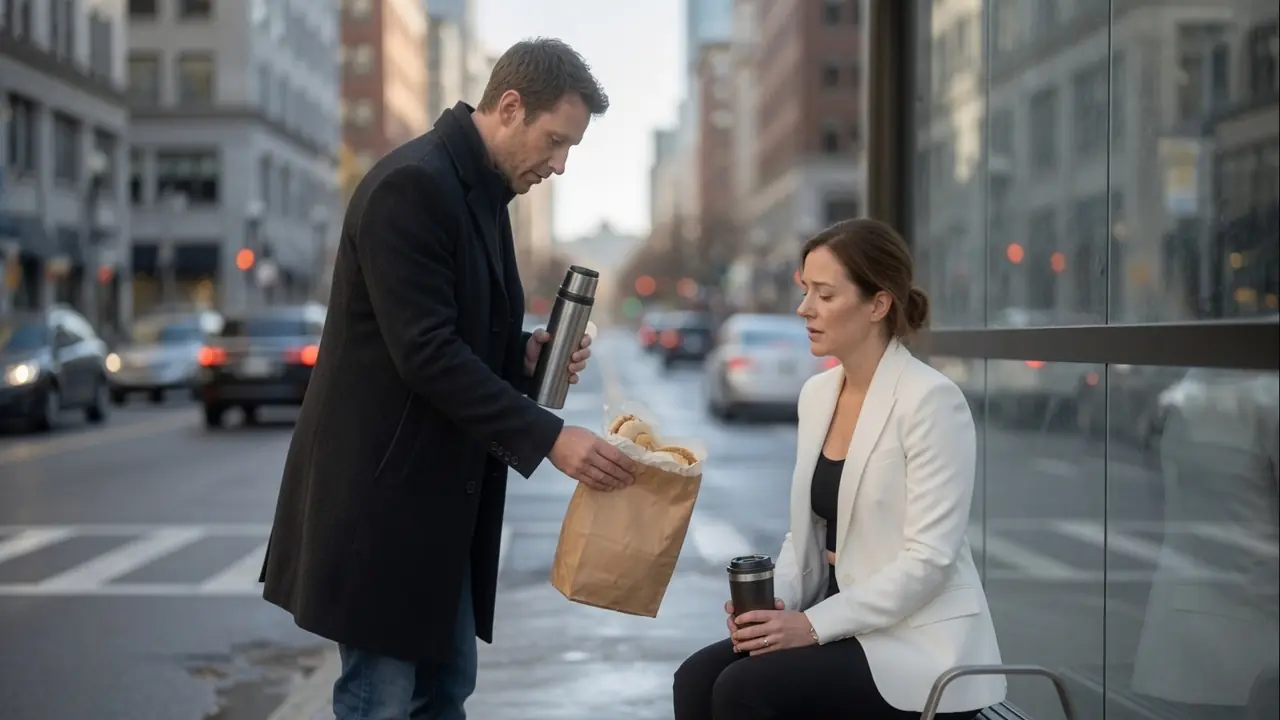
Marcus had twenty-three dollars in his wallet and less than four hundred remaining in his bank account. His rent was already late, his electricity bill carried a red warning, and the temporary repair work he depended on had disappeared after the neighborhood garage changed ownership. That morning, he planned to deliver another application to Weston Transit Systems, even though the company had already rejected him through its online system. He hoped that placing his résumé into a real person’s hands might accomplish what fifteen years of experience had failed to prove on a screen.
“You’re walking too fast,” Sophie complained.
Marcus slowed immediately.
“Sorry.”
“You always walk fast when you’re nervous.”
“I am not nervous.”
Sophie looked up at him with the patient disbelief only children could express without saying anything. She wore a purple coat inherited from her cousin, and her dark curls escaped from beneath a knitted hat Marcus had repaired twice. After her mother died four years earlier, Sophie had become skilled at reading the emotions her father tried to hide.
“You checked your folder three times,” she said.
“That is called being prepared.”
“You also checked your hair in the toaster.”
“The bathroom mirror was fogged.”
“You weren’t making anything hot.”
Marcus looked down at her.
“Whose side are you on?”
“Yours.”
Her answer came immediately, and it struck him with more force than she understood. Marcus squeezed her hand and continued toward the bus stop ahead. The shelter stood between a pharmacy and a bank, its narrow metal roof protecting three benches from the remaining drizzle.
Only one person sat beneath it.
The woman wore a dark wool coat over a black business suit, but the polished clothing could not hide how exhausted she looked. Her chestnut-colored hair had been tied loosely behind her head, with damp strands clinging to her pale face. Both hands were wrapped around a travel mug that appeared empty, and her eyes remained fixed on the pavement. A small leather handbag rested beside her, untouched.
Marcus might have walked past if Sophie had not slowed.
“Dad,” she whispered.
“I see her.”
“She’s crying.”
The woman quickly wiped one cheek when she noticed them. She straightened her shoulders and turned toward the street, pretending to study approaching traffic. Marcus recognized the movement because he had performed it many times when grief caught him in public.
He checked the time.
It was 7:42. Sophie’s school began at eight fifteen, and the Weston Transit offices opened at nine. Marcus had enough time to stop, but stopping was different from knowing what to say.
“Come on,” he murmured.
They moved several steps beyond the shelter.
Then Sophie pulled his hand.
“Mom used to say people shouldn’t cry alone.”
Marcus closed his eyes briefly.
Laura had said that. She had said it after finding an elderly neighbor weeping outside their apartment building and bringing her inside for tea. Sophie had been only four at the time, yet somehow she remembered.
Marcus turned back.
The woman heard them approach and straightened again. Up close, Marcus could see that the travel mug was shaking between her fingers. She looked as though she had not slept, and the skin beneath her eyes was dark with exhaustion.
“Are you all right?” Marcus asked.
“Yes.”
The answer arrived too quickly.
Sophie stepped closer to her father.
“You don’t look all right.”
“Sophie,” Marcus said softly.
“It’s okay,” the woman replied.
She tried to smile at the child, but the expression collapsed almost immediately. Her eyes filled again, and she lowered her face. Marcus looked at the unopened paper bag in his hand.
“Why are you sitting here cold and hungry when you look like you haven’t eaten all night?”
The woman stared at him.
“How do you know I’m hungry?”
Marcus nodded toward the empty travel mug.
“You keep trying to drink from that cup.”
She looked down as though noticing it for the first time.
“I suppose I do.”
Marcus opened the paper bag and removed one sandwich wrapped in foil. He held it toward her. She looked at the food, then at Sophie.
“No, thank you.”
“Take it.”
“That belongs to your daughter.”
“We have two,” Marcus said.
Sophie nodded.
“And I had cereal.”
Marcus glanced at her because the cereal had consisted mostly of the final crumbs at the bottom of the box. Sophie met his eyes without embarrassment. The woman noticed the silent exchange.
“You need it more than I do,” she said.
Marcus placed the sandwich beside her handbag.
“Then eat first and argue afterward.”
A faint smile touched her face.
“You give orders to strangers often?”
“Only the stubborn ones.”
The woman unwrapped the sandwich slowly. Her fingers trembled as she lifted it, and after the first bite, she stopped trying to appear unaffected. She ate as someone who had ignored hunger until her body could no longer cooperate with pride.
Marcus poured coffee from the thermos into its metal lid.
“It has too much sugar,” he warned.
“How much?”
“Sophie made it.”
“Four spoons,” the child said proudly.
The woman accepted the cup.
“Then it sounds perfect.”
They stood together beneath the shelter while buses passed through the wet avenue. Marcus gave Sophie the second sandwich and claimed he had already eaten at home. Sophie knew he was lying, but she broke her sandwich in half and handed one piece back to him without comment.
The woman watched them.
“My name is Claire,” she said.
“Marcus Hale.”
“Sophie Hale.”
Claire looked at Sophie.
“It’s nice to meet you.”
“Why were you crying?”
Marcus gently touched his daughter’s shoulder.
“You don’t have to answer that.”
Claire stared into the sweet coffee.
“My father died last night.”
The sounds of traffic seemed to move farther away. Sophie’s expression softened, and Marcus felt the familiar ache of helplessness that came whenever death entered a conversation. There was no useful repair for it, no sequence of tools that could restore what had been lost.
“I’m sorry,” Marcus said.
Claire nodded.
“He had been ill for months, so everyone keeps telling me it was expected.”
“Expected does not mean easy.”
“No.”
She took another drink.
“I spent the night at the hospital. My driver came for me this morning, but I asked him to leave.”
“You preferred the bus?”
“I preferred not being taken anywhere.”
Marcus understood that too. After Laura died, he had once ridden the subway to its final stop and remained seated until an employee asked him to leave. Moving without choosing a destination had felt easier than returning to an apartment where every object carried her absence.
Claire looked toward his worn folder.
“Are you going to an interview?”
“Not exactly.”
He explained that he had applied for an electrical systems technician position at Weston Transit Systems. The job involved maintaining charging equipment for the company’s growing fleet of electric buses. Marcus had worked on municipal buses, diesel-electric hybrids, and commercial charging systems, but the application required a bachelor’s degree.
“They rejected me automatically,” he said.
“Then why are you going there?”
“Because machines don’t care where you studied.”
Claire’s eyes moved toward him.
“That does not answer the question.”
“I’m hoping a person might agree with the machines.”
Marcus opened his folder and showed her the résumé. Behind it were hand-drawn diagrams of a charging circuit he had designed while working for a private bus operator. The system had reduced repeated connector failures caused by heat buildup during short turnaround periods.
Claire studied the pages carefully.
“You drew these?”
“Yes.”
“This switching sequence is unusual.”
Marcus looked surprised.
“You understand it?”
“A little.”
He sat on the edge of the opposite bench and pointed toward the diagram.
“Most systems balance load by assigning equal charging windows. That works on paper, but buses arrive late, batteries age differently, and weather changes demand. This version adjusts based on connector temperature and route priority.”
Claire traced one line without touching the paper.
“Why isn’t this installed anywhere?”
“The company I worked for closed before we finished testing.”
“Did you patent it?”
Marcus almost laughed.
“I was trying to pay for Sophie’s dental work.”
Claire’s expression changed.
Before she could answer, Sophie’s school bus appeared at the intersection. Marcus quickly gathered the folder and stood.
“That’s ours.”
Claire handed back the coffee lid.
“Thank you.”
“For breakfast?”
“For treating me like a person before asking who I was.”
Marcus frowned slightly.
“I didn’t ask who you were.”
“Exactly.”
Sophie hugged her father before boarding the school bus. Then she turned and waved to Claire through the window. Claire raised one hand in return.
Marcus watched until the bus disappeared.
When he turned back, Claire was standing.
“I should go.”
“So should I.”
She glanced toward the Weston Transit application folder.
“Ask for Elena Morris when you arrive.”
“Who is she?”
“Director of fleet engineering.”
“Do you know her?”
Claire looked toward the avenue.
“Yes.”
Marcus waited for more, but she picked up her handbag.
“Tell her Claire sent you.”
He hesitated.
“I don’t want anyone thinking I used a personal connection.”
“You gave breakfast to a stranger. That is not networking.”
“I still want a fair chance.”
“That is all I’m suggesting.”
Claire walked away before Marcus could ask another question. She moved slowly at first, then entered a black sedan that had stopped near the curb. The driver stepped out and opened the rear door for her.
Marcus stared after the vehicle.
He looked down at the empty thermos lid.
“Interesting bus,” he murmured.
Weston Transit Systems occupied twelve floors of a glass building near Bryant Park. Marcus arrived shortly after nine, his stomach empty and his confidence weakening with every step through the polished lobby. Employees crossed the marble floor wearing identification badges, while a digital wall displayed photographs of electric buses moving through cities across the country. Marcus’s repaired boots squeaked faintly against the floor.
At reception, he asked for Elena Morris.
“Do you have an appointment?” the receptionist asked.
“No.”
“Then you may submit your application online.”
“I already did.”
She gave him a polite expression that meant the conversation had ended.
Marcus placed the folder on the counter.
“A woman named Claire suggested I speak with Ms. Morris.”
The receptionist looked up.
“Claire who?”
“I didn’t get her last name.”
The woman’s expression became less patient.
“Ms. Morris does not accept unscheduled visitors based on first-name referrals.”
Marcus felt foolish. He imagined Claire as a consultant, former employee, or simply someone familiar with the company directory. Her suggestion had sounded meaningful at a bus stop, but inside the corporate lobby, it became nothing more than a stranger’s encouragement.
He picked up the folder.
“Thank you for your time.”
As he turned, the elevator doors opened.
A woman in her fifties stepped out carrying a tablet. She wore safety glasses on top of her head and moved with the speed of someone already late for several things. The receptionist stood immediately.
“Ms. Morris.”
Elena Morris barely slowed.
“Is the Route Seven failure report ready?”
“Engineering sent it ten minutes ago.”
Elena’s gaze landed on Marcus’s folder.
“Are you here for maintenance?”
“No, ma’am.”
The receptionist answered for him.
“He is delivering an application.”
Marcus handed Elena his résumé.
“I applied for the electrical systems technician position, but I was rejected because I don’t have a degree.”
Elena glanced at the first page.
“Human resources controls initial screening.”
“I understand.”
“Then what do you want me to do?”
“Look at the work before deciding whether the education requirement matters.”
Elena’s eyes narrowed, not with contempt but evaluation.
“Who told you to ask for me?”
“Claire.”
She became completely still.
“Where did you meet Claire?”
“At a bus stop.”
The receptionist looked confused.
Elena looked toward the elevators.
“Come with me.”
Marcus followed her through security and into a conference room on the sixth floor. She closed the door and placed his diagrams beneath a bright desk lamp. For fifteen minutes, she asked questions about load balancing, thermal protection, connector degradation, and emergency shutdown sequences.
Marcus answered directly.
When he did not know something, he admitted it.
When Elena challenged one of his assumptions, he redrew the circuit and showed why he had chosen it. Her initial impatience slowly became concentration.
“This would require custom firmware,” she said.
“Yes.”
“We use a third-party controller.”
“Then your system is probably reacting too slowly to heat changes.”
Elena looked at him.
“How would you know that?”
“The Route Seven failure you mentioned in the lobby.”
Marcus pointed toward a charging station photograph displayed on her tablet.
“The burn mark is above the connector, not inside the socket. That suggests the controller did not reduce power after cable resistance increased.”
Elena enlarged the image.
Her expression tightened.
Three Weston buses had experienced charging faults during the previous month. No one had been injured, but one connector melted, and the company was preparing to replace equipment across twenty depots at enormous cost. The supplier blamed improper maintenance, while Weston’s technicians suspected defective cables.
Elena made a phone call.
“Prepare a visitor pass and bring him to the Brooklyn test depot.”
Marcus raised one hand.
“I have not been hired.”
“No.”
“Is this an interview?”
“It is a paid technical assessment.”
“How much?”
Elena almost smiled.
“Claire said you would ask that.”
Marcus looked at her.
“Who is Claire?”
Elena turned the tablet around.
A news article showed Claire Weston standing beside a new electric bus, her name printed beneath the photograph.
FOUNDER AND CEO CLAIRE WESTON ANNOUNCES NATIONAL EXPANSION.
Marcus stared at the image.
“The woman at the bus stop owns the company?”
“She founded it with her father.”
He looked toward the closed conference-room door.
“Why didn’t she tell me?”
Elena gathered the diagrams.
“Perhaps she wanted you to speak honestly.”
Marcus thought about the breakfast, Claire’s grief, and the way she had listened to his technical explanation. He felt no excitement about having helped someone powerful. Instead, he worried that Elena’s sudden interest came from obligation.
“I don’t want a charity interview.”
Elena met his eyes.
“Claire did not ask me to hire you.”
“What did she ask?”
“To look at your work before allowing a software filter to decide your value.”
That answer was enough.
The Brooklyn depot smelled of wet concrete, rubber, and electrical insulation. Rows of blue-and-white buses stood beneath a high metal roof, while charging cabinets hummed along the rear wall. Marcus changed into borrowed safety gear and met the technicians responsible for diagnosing the failed connectors.
One of them, senior engineer Blake Turner, was visibly displeased.
“We already completed the analysis,” Blake said.
Elena handed him Marcus’s diagrams.
“Then another opinion cannot hurt.”
“It can waste time.”
Marcus ignored the remark and examined the damaged connector. The outer casing had warped from heat, but the contact surfaces showed less damage than expected. He asked for charging logs from the forty-eight hours before the failure.
Blake folded his arms.
“You think you’ll find something we missed?”
“I hope you found everything.”
“That is not an answer.”
“It is the only honest one.”
Marcus compared cable temperature, battery demand, ambient weather, and arrival times. The failure appeared during a morning when three buses returned late and connected within minutes of each other. The load controller had reduced total power correctly, yet one cable continued heating after current dropped.
“The problem isn’t only electrical,” Marcus said.
Blake sighed.
“Of course.”
Marcus asked a technician to bring one of the cable support arms. He moved it through its full range and felt a slight resistance near the upper hinge. When buses parked at an angle, the support arm pulled the charging cable tightly against its internal sensor wire.
“The temperature sensor is being stretched,” Marcus explained.
Elena stepped closer.
“It still reports data.”
“Incorrect data.”
He opened the protective sleeve and revealed a partially separated wire. The signal remained within an acceptable range, but it understated the actual temperature by nearly twenty degrees.
Blake examined it.
“That damage should trigger a sensor fault.”
“Only if the circuit opens completely.”
Marcus pointed toward the charging cabinet.
“Your controller trusts a believable lie.”
The sentence silenced everyone.
They tested five additional support arms. Three contained similar damage. The cables were not defective, and the maintenance crews had not caused the failures.
A small routing bracket installed during a recent equipment upgrade had created tension on the sensor wires. Replacing every charging unit would have cost the company millions without correcting the underlying issue. Marcus designed a temporary guide that removed the pressure and proposed a software update comparing temperature rise against resistance changes.
Elena called Claire.
Marcus could hear only one side of the conversation.
“He was right,” Elena said. “Not about the exact cause, but about the controller responding too slowly to hidden heat. The bracket damaged the sensor wire.”
She listened.
“Yes, we can repair it without replacing the stations.”
Another pause followed.
“I agree.”
Elena ended the call.
“Claire wants to meet you tomorrow.”
Marcus removed his safety gloves.
“For a job?”
“For a conversation.”
“That sounds less promising.”
Elena smiled.
“You will learn that Claire enjoys making people nervous.”
The following morning, Marcus returned wearing his cleanest shirt. Claire sat behind a long conference table, no longer the exhausted stranger beneath the bus shelter. Her hair was neatly arranged, and the dark suit she wore made her look every bit like the person whose photograph filled the company website.
Marcus remained standing.
“You could have told me.”
Claire gestured toward the chair.
“Would you have shown me your diagrams?”
“Probably not.”
“Would you have accepted the breakfast conversation?”
“That depends.”
“On what?”
“Whether I thought you might give me something because I helped you.”
Claire looked down briefly.
“That is why I stayed Claire.”
Marcus sat.
“I’m sorry about your father.”
“Thank you.”
A framed photograph stood on a cabinet behind her. It showed a younger Claire beside an elderly man in front of the company’s first bus. Marcus realized her father had not merely been family; he had built the business beside her.
Claire folded her hands.
“Elena says your diagnosis may save us more than four million dollars.”
“Her technicians helped confirm it.”
“She also says you challenged three of her assumptions.”
“She challenged five of mine.”
“That sounds like Elena.”
Claire slid a document across the table.
It was not an employment contract.
It offered Marcus a twelve-week paid engineering trial focused on charging reliability. The salary was fair, the hours allowed him to collect Sophie from school, and successful completion would qualify him for a permanent senior technician position. The company would evaluate his work through practical tests rather than academic credentials.
Marcus read every page.
“You are not offering this because of breakfast?”
“No.”
“Or because I spoke to you after your father died?”
“No.”
“Then why?”
“Because you identified a failure our engineers missed.”
Marcus glanced toward her.
“And if I fail the trial?”
“You receive every dollar promised and an honest assessment of your work.”
He picked up the pen.
“That is a chance.”
“That is what I offered.”
Marcus signed.
The first weeks were difficult.
Blake resented reporting to someone without a degree and repeatedly referred to Marcus as “the bus-stop consultant.” Several younger engineers dismissed his hand-drawn diagrams as outdated. Marcus responded by arriving early, documenting every test, and asking for evidence whenever someone challenged him.
He did not win arguments by speaking louder.
He built working solutions.
The modified cable guides reduced sensor damage across the test depot. Marcus’s software comparison detected false temperature readings before they became dangerous. Within two months, the company installed the system at six additional locations.
Claire observed from a distance.
She did not protect Marcus from criticism or approve every request. When his first budget proposal exceeded the trial limit, she returned it with questions covering three pages. Marcus revised it, removed unnecessary equipment, and proved the remaining expense through failure data.
Their conversations remained professional.
Still, Claire sometimes visited the test depot carrying two breakfasts. She claimed the café had prepared an extra order. Marcus never believed her, but he accepted the food because refusing every kindness could become another form of pride.
Sophie met Claire during a family tour of the depot.
“You look better,” Sophie told her.
Claire laughed.
“Better than what?”
“The bus stop.”
Marcus closed his eyes.
“Sophie.”
“What? She does.”
Claire crouched beside her.
“I feel better too.”
“Did the sandwich help?”
“It helped more than you know.”
Sophie considered this.
“My dad makes good sandwiches.”
“He does.”
At the end of twelve weeks, Marcus presented his final reliability report to the executive board. It recommended changing the supplier bracket, updating sensor verification software, and creating a technician feedback system so maintenance warnings could bypass management delays.
One executive objected to the final recommendation.
“Technicians are not trained to evaluate engineering policy,” he said.
Marcus looked toward the maintenance employees seated at the back of the room.
“They are trained to recognize when equipment behaves differently from a report.”
“That does not mean they understand the system.”
“It means they are standing beside the system while we are reading about it.”
Claire did not rescue him.
She asked the executive to challenge the data rather than Marcus’s credentials. He could not.
The board approved the plan.
Marcus received a permanent position as field systems supervisor, with responsibility for translating depot-level problems into engineering changes. His salary allowed him to catch up on rent, replace the empty refrigerator, and buy Sophie a winter coat that had never belonged to anyone else.
He did not move them into an expensive apartment.
Instead, he built savings and enrolled in evening engineering courses offered through the company. Claire told him the degree was not necessary for his role. Marcus replied that he wanted the knowledge even if he had already earned the opportunity.
Weston Transit also changed its hiring process.
Technical applicants without college degrees could complete a paid skills assessment. Experienced mechanics, electricians, and military technicians were evaluated through practical work instead of being rejected automatically.
Within a year, the company hired thirty-one people through the new program.
Claire named it the Open Route Initiative.
Marcus objected when reporters described the program as inspired by a charitable breakfast encounter. He insisted that Claire had not hired him because he fed her. She had simply looked beyond a filter long enough to discover what he could do.
One cold morning, almost a year after they first met, Marcus and Sophie walked along Fifth Avenue again. Snow rested in thin patches near the curb, and the metal bus shelter looked almost exactly as it had that November morning.
Claire waited beneath it.
She held three travel mugs and a large paper bag.
Marcus stopped.
“Are you stranded?”
“No.”
“Hungry?”
“Not this time.”
Sophie opened the bag.
“There are three sandwiches.”
Claire handed Marcus a mug.
“Only two spoons of sugar.”
“You’re learning.”
They sat together while buses moved through the avenue. Claire spoke about her father without breaking, though sadness remained beneath every memory. Marcus understood that healing did not erase grief; it only created room around it.
Claire looked at Sophie.
“Your father changed my company.”
Sophie shook her head.
“You gave him the job.”
“I gave him a trial.”
“He did the rest,” Marcus said.
Claire smiled.
“That is exactly right.”
The first breakfast had cost Marcus more than he could comfortably give. Yet he had not offered it because he expected a reward, and Claire had not returned with charity disguised as gratitude.
She offered him work.
He brought the ability.
Together, they created a door for people who had spent years being told that experience did not matter unless a degree confirmed it.
Marcus eventually framed the original charging diagram and hung it above his desk. Beside it, Sophie placed the empty paper bag from their anniversary breakfast and wrote one sentence across the bottom.
A chance is better than a handout.
Marcus kept it there because it explained the entire story more clearly than any company announcement could. He had given away half of a simple breakfast at a bus stop and expected nothing beyond helping a grieving stranger survive the next few minutes.
He did not know she was a CEO.
Claire did not know he could save her company millions.
For a brief morning beneath a metal shelter, neither identity mattered. There was only a tired single father, a grieving woman, one paper bag, and the decision to treat another person’s pain as worthy of attention.
Everything that followed began with that.