Every morning at 7:15, Ethan Walker parked his old blue pickup outside Main Street Pharmacy in Millbrook, Ohio. The truck coughed twice before the engine settled, and the passenger door always rattled a little when his eight-year-old daughter, Lily, shifted in her seat with her backpack on her lap. Ethan would check the dashboard clock, glance at the pharmacy door, and then look over at Lily with the same tired smile. Life had become a schedule held together by minutes, and one missed minute could knock the whole day sideways.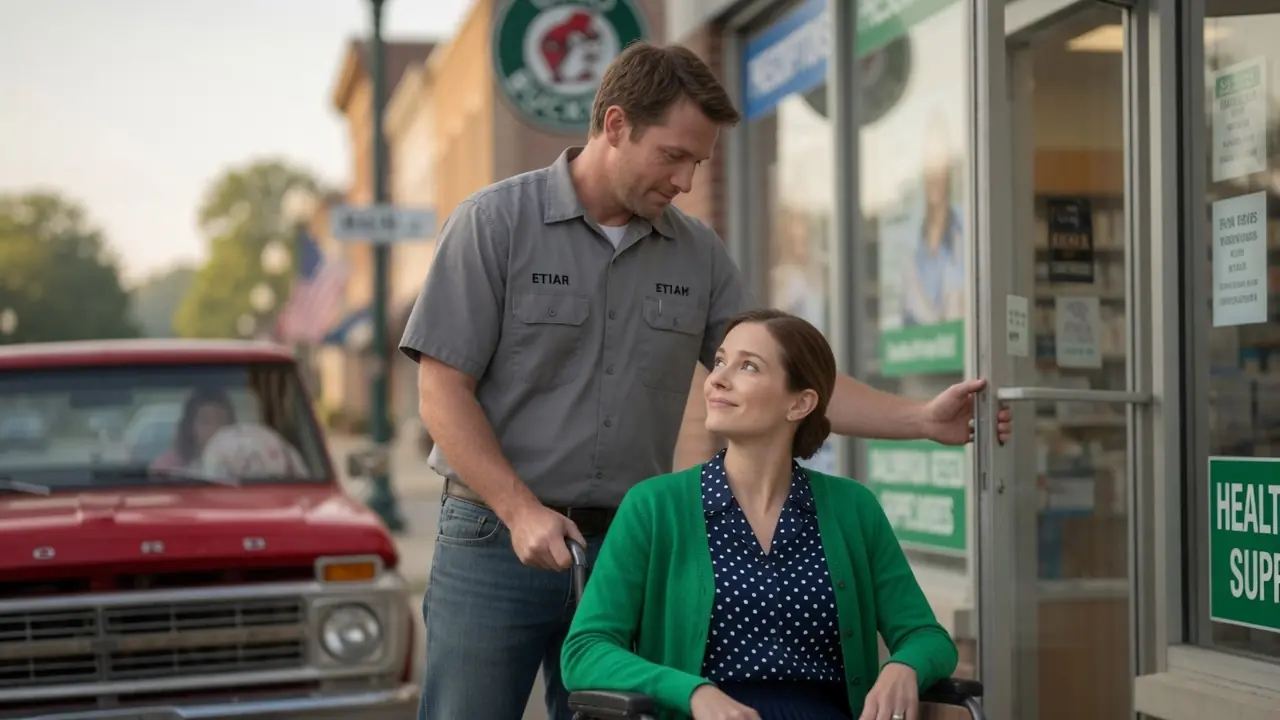
He worked maintenance at a small factory twenty minutes away, and his shift began at eight. Before that, he had to drop Lily at school, stop for her allergy prescription when needed, and sometimes pick up the cheapest breakfast sandwich he could afford if they had run out of eggs at home. There was no wife waiting in the kitchen anymore, no second adult to remember permission slips or missing socks. Since Rachel had passed away three years earlier, Ethan had learned to be father, mother, driver, cook, comforter, and the person who smiled even when bills were stacked on the counter.
Main Street Pharmacy sat in an old brick building with a white sign, green window decals, and a heavy glass door that seemed to fight anyone who tried to open it. Ethan noticed the woman in the wheelchair on a cold Monday morning in March. She was waiting outside near the entrance, wrapped in a cream cardigan with a small brown purse in her lap, one hand on the wheel and the other gripping a paper prescription bag. The door was too heavy for her to pull while holding the chair steady.
Ethan was already late that morning, but he stopped anyway. He told Lily to stay buckled, jogged to the pharmacy entrance, and opened the door wide. The woman looked up at him with surprise, then gratitude, as if she had expected the whole town to hurry past her. “Thank you,” she said softly.
“No trouble,” Ethan replied, holding the door until she was safely inside.
The next morning, she was there again.
By the end of the week, it had become a routine neither of them had planned. Ethan would arrive at 7:15, help the woman through the pharmacy door, and hurry back to the truck while Lily waved from the passenger seat. The woman’s name was Clara Bennett, and she always thanked him as though he had done something larger than open a door. Ethan never understood that, but he did not question it.
Some mornings Clara had a prescription to pick up. Other mornings she bought tea, greeting cards, or nothing at all. Ethan began to suspect she came at that hour simply because she knew he would be there. He did not mind. The world had taken enough from people; holding a door felt like one small place where he could still give something back.
Lily noticed first.
“Dad,” she said one morning, pressing her face toward the truck window, “Miss Clara is already waiting.”
Ethan followed her gaze. Clara sat near the flower planters beside the pharmacy entrance, watching the street as if she had been waiting for a train instead of a man in a work shirt. Her silver hair was tucked neatly under a blue scarf, and a sealed manila envelope rested across her lap. She touched it once, then looked away quickly when Ethan pulled into the parking space.
“She likes seeing us,” Ethan said.
“Maybe she’s lonely.”
“Maybe.”
Lily looked at him seriously. “Can lonely people have friends if they’re old?”
Ethan smiled, though the question hurt in a gentle way. “Anybody can have friends, sweetheart.”
“Then we’re her friends.”
Ethan looked through the windshield at Clara waiting beside the glass door. “I guess we are.”
Spring turned into early summer, and the routine continued. Ethan helped Clara through rain, wind, and bright mornings when the town still smelled of fresh bread from the bakery down the street. Clara always asked about Lily, and Lily always waved. Sometimes Clara brought a peppermint from the pharmacy counter and asked Ethan to give it to her, though she always checked first that Lily was allowed to have one.
Ethan tried not to accept too much. Pride was a stubborn thing when a man had little else to protect. But Clara had a way of offering kindness that did not feel like pity. She never asked why his truck was old, why his boots were cracked, or why the sleeves of his work shirt had been mended twice.
One Friday morning, Ethan arrived with dark circles under his eyes. Lily had been up late crying over a school event called “Mother’s Morning,” where students were supposed to invite their moms for breakfast in the cafeteria. Ethan had promised to come instead, but Lily had whispered that it was not the same. He had held her until she fell asleep and then sat alone at the kitchen table, staring at Rachel’s photograph.
Clara noticed immediately.
“Hard morning?” she asked as Ethan pulled the door open.
“Nothing we can’t handle,” he said.
Clara looked toward the truck, where Lily sat quiet and small behind the windshield. “Children sometimes carry questions too heavy for their hands.”
Ethan looked at her.
For a moment, Clara’s expression seemed filled with something deeper than sympathy. It looked almost like recognition. Then she smiled sadly and rolled herself inside.
That night, Ethan found Lily sitting on the bedroom floor with a shoebox of old photographs. Rachel’s face smiled up from picture after picture, young, bright, and full of the kind of hope that made grief feel cruel. Lily held one photo in both hands. It showed Rachel standing outside Main Street Pharmacy years earlier, laughing with one hand on the same heavy glass door.
“Dad,” Lily asked, “did Mom know Miss Clara?”
Ethan looked closer.
The photo was old, maybe from before Lily was born. Rachel wore a green dress, and beside her, half cut off by the edge of the picture, was a woman in a wheelchair. Ethan’s breath caught.
“Where did you find that?”
“In Mom’s box.”
Ethan sat on the bed and took the photo carefully. He had never noticed Clara in it before. Maybe he had looked at Rachel too much and everything else too little. The woman in the picture was younger, but the eyes were unmistakable.
“I think she did,” Ethan said.
“Why didn’t Miss Clara tell us?”
Ethan had no answer.
On Monday morning, Clara was not outside the pharmacy.
Ethan slowed the truck, then parked anyway. The absence felt strange, like a missing note in a song. Lily looked around from the passenger seat. “Maybe she’s sick.”
“Maybe she had an appointment later,” Ethan said, but worry tightened in his chest.
He walked to the pharmacy door and asked the clerk if Clara had been in. The clerk shook her head and said Clara usually came early, same as always. Ethan left for work with a heaviness he could not explain. All day, while fixing a conveyor belt and checking boiler gauges, he kept seeing the empty space by the pharmacy entrance.
Clara returned the next morning.
She looked paler than usual, but she was waiting beside the door with the manila envelope on her lap. Ethan got out quickly and came around the truck. “Miss Clara, are you all right?”
She smiled. “I’m old, Ethan. Some days that is answer enough.”
He did not laugh.
“I worried yesterday,” he said.
Her eyes softened. “I know.”
The words landed oddly. Not “thank you,” not “I’m sorry.” I know. As if his worry had been part of something she had been measuring for a long time.
He opened the door, but Clara did not roll forward.
Instead, she reached out and gently caught his wrist.
“Ethan,” she said, “don’t leave yet.”
He glanced at the clock. 7:18. “Clara, I’m already late for work.”
“I know,” she said again. Her hand trembled against his sleeve. “But I didn’t wait here every morning just because I needed help with a door.”
Ethan looked toward the truck. Lily was watching them with wide eyes, her backpack hugged to her chest.
“What do you mean?” he asked.
Clara lifted the manila envelope from her lap. On the front, written in careful blue ink, were three words that made Ethan’s body go still.
For Lily Walker.
Ethan stared at it. “Why is my daughter’s name on that?”
Clara’s eyes filled with tears. “Because before Rachel died, she trusted me with something meant for both of you. And today, I finally know you deserve to hear the truth.”
The street seemed to quiet around them. Cars passed behind Ethan, but he barely heard them. The pharmacy door remained half-open against his shoulder, and inside, the clerk stood frozen behind the counter. Ethan looked from the envelope to Clara’s face, trying to understand why a woman he had helped for months was suddenly holding something from his dead wife.
“You knew Rachel,” he said.
Clara nodded.
“How?”
“She worked here part-time in college,” Clara said. “Before she became a nurse. Before she married you. Before life became so hard.”
Ethan’s throat tightened. “Why didn’t you tell me?”
“Because Rachel asked me not to rush.” Clara’s voice shook. “She said if anything ever happened to her, I should watch carefully before giving this away. Not because she doubted your love. Because she knew grief can change people, and she wanted to be sure Lily was being raised by someone who still chose kindness even when life gave him every excuse not to.”
Ethan stepped back slightly, wounded despite himself. “So you were testing me?”
Clara flinched. “At first, yes.”
His face hardened.
Clara lowered her eyes. “I’m sorry.”
Ethan looked toward the truck again. Lily’s little face was pressed near the glass. He thought of every morning he had stopped, every late clock-in, every warning from his supervisor, every time he had swallowed frustration because Clara needed help. He had never imagined those moments were being weighed.
“I didn’t help you for a reward,” he said quietly.
“I know,” Clara whispered. “That is why I’m giving it to you.”
The anger in Ethan’s chest faltered, but did not disappear. “What is in it?”
“Rachel’s letter,” Clara said. “A legal document. And the key to something she hoped Lily would have when the time was right.”
Ethan looked down at the envelope again. It was sealed with old tape, but the paper had been handled carefully. Rachel’s presence seemed to rise from it, impossible and painful. He wanted to tear it open. He wanted to run from it.
“Not here,” he said finally.
Clara nodded. “The pharmacy has a consultation room. It’s private.”
Ethan opened the passenger door of the truck and unbuckled Lily. “Come on, sweetheart.”
Lily climbed out slowly, looking from her father to Clara. “Is that from Mom?”
Ethan knelt in front of her. “I think so.”
Her eyes filled instantly. “Did Mom write to me?”
“I don’t know yet.”
Clara pressed a hand to her mouth.
Inside the pharmacy, the consultation room was small, with a round table, three chairs, and a cabinet of medical pamphlets. Clara rolled in first, then Ethan and Lily sat together on one side of the table. The envelope lay in front of them like a door to a room they had been locked out of for three years.
Ethan opened it carefully.
The first thing inside was a letter folded into three parts. Rachel’s handwriting crossed the front: Ethan first. Then Lily when you’re ready.
Ethan’s hand shook so hard that Clara gently placed her palm on the table, not touching him, only offering steadiness nearby. He unfolded the letter and began reading silently. After two lines, he stopped.
“Can you read it out loud?” Lily asked.
Ethan closed his eyes. “I’ll try.”
He began.
My dear Ethan, if Clara is giving you this, then I am gone, and I am sorry for every morning you have had to wake up without me. I know you will blame yourself for things you could not control, because that is the kind of man you are. Please do not teach Lily that love means carrying guilt forever.
Ethan’s voice broke. Lily reached for his hand.
He kept reading.
I asked Clara to wait because I know people will offer help for the wrong reasons. I needed her to see you as I saw you, not as a file, not as a widow’s husband, not as a struggling father, but as the man who stops when someone needs him. If you are angry, you have the right to be. But if you are reading this, it means you remained who I believed you were.
A tear fell onto the paper.
Ethan wiped it quickly, afraid of ruining the ink.
The letter continued with memories Rachel had saved for him: the night they bought the old blue pickup, the first time he held Lily, the way he sang badly while fixing the kitchen sink, the promise he made that their daughter would always know she was loved. Then Rachel wrote about Clara.
Clara was my first friend in Millbrook. She saw me when I was young and afraid, and she helped me become brave. Years ago, she lost her own son and never had grandchildren. I asked her to watch over Lily from a distance if I could not. Not to replace me. Not to judge you. Only to make sure the last gift I arranged would not fall into the hands of people who might use it poorly.
Ethan looked up. “What gift?”
Clara reached into the envelope and withdrew a second packet, thicker than the letter. It contained legal papers, a bank statement, and a small brass key taped to a card.
“Rachel’s grandmother left her a house,” Clara said softly. “A small one outside town, near the old orchard. Rachel never sold it. She wanted to fix it up for Lily someday, but then she got sick.”
Ethan stared at her. “Rachel had a house?”
“She found out about the inheritance late,” Clara explained. “By then, medical bills were already circling, and some relatives were pressuring her to sign things over. She placed the property in a protected trust for Lily, with me as temporary trustee.”
Ethan shook his head slowly. “Why didn’t she tell me?”
“She was going to. Then her health declined faster than anyone expected.” Clara’s eyes glistened. “And after she passed, I was afraid. Rachel’s cousin came asking questions. Then another relative called about the property. I had to make sure the trust stayed safe.”
Ethan’s expression tightened. “So Lily owns a house?”
“When she turns eighteen,” Clara said. “Until then, you can live in it with her if you choose. The trust covers taxes, repairs, and a modest education account. It is not a fortune, Ethan. But it is shelter. Stability. A place Rachel wanted Lily to call home.”
Lily touched the brass key with one finger. “Mom gave me a house?”
Ethan pulled her close. “She gave you a future.”
Lily began to cry then, not loudly, but with the stunned grief of a child realizing her mother had been loving her from beyond absence. Ethan held her and looked at the papers through blurred eyes. For three years he had fought rent increases, repair bills, late fees, and the fear that one missed paycheck could push them out of their apartment. All that time, Rachel had left something behind, waiting behind Clara’s patience and a sealed envelope.
Ethan turned to Clara. “You watched us for months.”
“Yes.”
“You saw me struggle.”
“Yes.”
“And you still waited.”
Clara’s face crumpled. “I wanted to give it to you the first week. I wanted to tell you when Lily waved at me from the truck and reminded me of Rachel. But Rachel’s instructions were clear. She said kindness under pressure was the proof. Not a good mood. Not one generous day. A pattern.”
Ethan looked down.
Clara continued, “The morning you came late with a flat tire and still helped me. The morning your supervisor called and shouted through the phone, and you still held the door. The morning Lily was crying, and you stopped to ask whether I needed anything before taking care of your own pain. That was when I knew. But I needed the lawyer to finalize the transfer.”
Ethan’s anger loosened into something more complicated. He still wished he had known sooner. He still hated that Rachel’s gift had sat in an envelope while he lay awake wondering whether he could keep their apartment. But Clara’s tears were not manipulative. They were the tears of a woman who had carried a promise that had become heavier every morning.
“I should have trusted you sooner,” Clara said.
Ethan nodded slowly. “Maybe.”
She accepted that without defending herself.
Lily wiped her face and looked at Clara. “Did my mom like you?”
Clara laughed through tears. “She bossed me around like a daughter. So yes, I think she did.”
That made Lily smile.
Ethan called work from the pharmacy parking lot and told his supervisor he had a family emergency. The supervisor complained, then stopped when Ethan said he would use unpaid time if necessary. For once, Ethan did not apologize until his voice disappeared. Some mornings rearrange a life, and a conveyor belt could wait.
Clara insisted on going with them to the house.
It sat two miles outside Millbrook, down a quiet road lined with maple trees and split-rail fences. The house was small, white, and tired, with blue shutters, a sagging porch step, and a wild patch of daisies growing near the mailbox. Behind it stood an old apple orchard, not large enough for profit, but beautiful enough to make Lily gasp.
Ethan parked the blue pickup in the gravel drive.
Nobody moved for a moment.
Clara sat in the passenger seat now, Lily in the middle, and Ethan behind the wheel with the brass key in his hand. The house looked like a memory he had never been given. Rachel had known this place. Rachel had walked here, maybe dreamed here, maybe imagined Lily running through the orchard with sticky fingers and grass-stained knees.
“Go on,” Clara whispered.
Ethan helped her from the truck into her wheelchair, then took Lily’s hand. Together, they climbed the porch. The key resisted at first, then turned with a soft click. The door opened into a room filled with dust, sunlight, and covered furniture.
Lily stepped inside first.
“It smells old,” she whispered.
Ethan laughed despite the tears. “It is old.”
In the living room, there was a fireplace, built-in shelves, and a faded rug rolled near the wall. On the mantel sat a framed photograph Ethan had never seen. Rachel was standing in the orchard, younger than he had known her, holding a basket of apples and smiling toward whoever had taken the picture. Clara rolled in behind them and stopped at the threshold, crying quietly.
“She wanted to bring you here,” Clara said. “She said you would fix the porch badly first, then properly after watching a video.”
Ethan let out a broken laugh. “That sounds like me.”
They found more letters in the kitchen drawer, exactly where Clara said Rachel had left them. One for Lily’s tenth birthday. One for her sixteenth. One for graduation. One for the day she felt angry that her mother was not there. Ethan read only the labels and placed them back carefully. Some gifts needed time.
In the smallest bedroom upstairs, Lily found pale yellow walls and a window facing the orchard. Dust floated in the air, glowing in the afternoon light. She stood in the doorway with both hands at her sides.
“Can this be my room?” she asked.
Ethan looked at the cracked paint, the old floorboards, and the window that opened to apple trees. “If you want it.”
Lily nodded. “I want it.”
That night, they did not move in. The house needed cleaning, repairs, and inspection. Ethan was practical enough to know miracles still required paperwork. But when they returned to the apartment, the walls no longer felt like a trap. For the first time in years, Ethan slept more than four hours.
Over the next few weeks, Clara became part of their lives in a way that no longer needed secrecy. Ethan picked her up on Saturday mornings, and the three of them worked at the house. Lily dusted shelves, labeled boxes, and made plans for curtains. Ethan repaired the porch step, badly at first, then properly after watching a video, just as Rachel had predicted.
Clara sat in the shade and sorted old papers. Sometimes she told stories about Rachel at twenty, Rachel at twenty-four, Rachel laughing behind the pharmacy counter, Rachel bringing soup to Clara after a hospital stay, Rachel afraid of motherhood and then transformed by it. Lily listened to every word like she was gathering pieces of a broken mirror.
By August, the house was livable.
On the first night they slept there, Ethan stood in the doorway of Lily’s yellow room and watched her arrange Rachel’s photo on the windowsill. She climbed into bed, hugged her stuffed rabbit, and looked around with wonder.
“Dad,” she said, “do you think Mom knew we’d come here?”
Ethan leaned against the doorframe. “I think she hoped.”
“Did Miss Clara know too?”
“Miss Clara kept the hope safe.”
Lily thought about that. “Then we should keep her too.”
Ethan smiled. “I think we already have.”
The next morning, at 7:15, Ethan parked outside Main Street Pharmacy out of habit. He did not need to stop. Clara was not waiting there for a test anymore. The heavy glass door was closed, and the sidewalk was empty except for a planter of pink flowers.
Then Lily pointed. “There she is.”
Clara was inside, near the window, buying tea. Ethan got out, crossed the sidewalk, and opened the door before she reached it. Clara looked up, surprised.
“You don’t have to do that anymore,” she said.
Ethan smiled. “I know.”
Lily ran in behind him and wrapped her arms around Clara’s shoulders.
Clara closed her eyes and held the child’s hands.
From that day on, Ethan still helped her through the pharmacy door whenever he could. Not because he was being watched. Not because an envelope waited. Not because kindness had earned a house, a trust, or a future.
He did it because some doors are heavy.
And some people are worth stopping for.