Maya Carter noticed the elderly man because no one else wanted to.
He sat alone in the last booth at Carter’s Roadside Diner, though the restaurant had no connection to Maya beyond the name stitched above the door. His gray hair was tangled, his coat was torn at both elbows, and dried mud covered the lower half of his trousers. One hand rested beneath the table while the other, wrapped in a dirty bandage, trembled beside an untouched glass of water.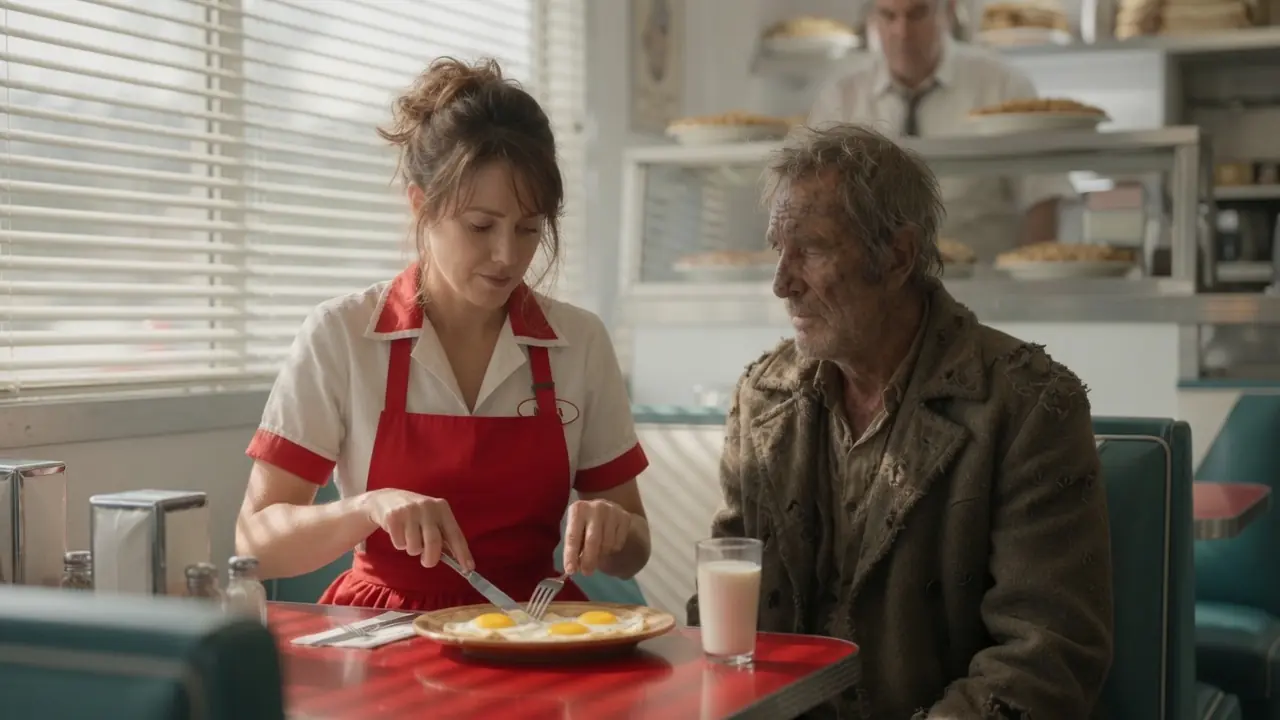
Customers looked at him briefly and then looked away.
Maya had learned that people often treated suffering as though attention might make it contagious. A truck driver requested a different table. A mother pulled her young son closer when they passed the booth. Two construction workers whispered that the man probably came inside only to escape the January cold.
Maya saw something else.
She saw how his eyes followed every plate leaving the kitchen.
At thirty-one, Maya understood hunger too well to mistake it. She had skipped enough dinners to know the difference between appetite and desperation. Hunger made people study food without appearing to look at it. It made them swallow when someone nearby cut into toast.
Maya carried a menu to his table.
“Good morning,” she said. “My name is Maya.”
The man looked up slowly. His face was deeply lined, and a purple bruise marked one cheek. Despite his condition, his eyes remained sharp.
“I know your name,” he said, glancing at her uniform tag.
“That saves us time.”
His mouth moved slightly, almost forming a smile.
Maya placed the menu before him. “Would you like coffee?”
“Water is enough.”
“You’ve been holding the same glass for ten minutes.”
“I’m a slow drinker.”
She crouched slightly so they could speak without attracting more attention. “When did you last eat?”
His gaze dropped.
“Yesterday?” she asked.
He did not answer.
“The day before?”
Still nothing.
Maya straightened. “I’ll bring breakfast.”
The man’s uninjured hand tightened around the edge of the table. “I cannot pay.”
“I didn’t ask yet.”
“You would eventually.”
“Most restaurants do.”
He looked toward the counter, where owner Frank Dalton stood watching them. Frank was sixty, heavyset, and permanently dissatisfied. He had purchased the diner eight years earlier but never changed the original sign because repainting it cost money.
He cared about three things: tables turning quickly, customers paying fully, and employees remembering that compassion never appeared on a balance sheet.
Frank motioned for Maya to come over.
She joined him beside the pie display.
“That man ordered anything?” he asked.
“Not yet.”
“Then get him out.”
“He is hungry.”
“He is homeless.”
“Those can both be true.”
Frank’s face hardened. “Customers are complaining.”
“One customer asked to move.”
“That is a complaint.”
Maya glanced toward the booth. The elderly man sat with his shoulders bent, pretending not to hear.
“He has an injured hand,” she said.
“Then send him to a hospital.”
“He may not have insurance.”
Frank leaned closer. “This is not a shelter, clinic, or charity kitchen. It is a business.”
Maya knew the speech.
She had heard it whenever someone entered without enough money, when a tired mother asked for hot water to warm a baby bottle, or when an elderly customer counted coins twice before paying. Frank spoke about business as though basic decency were an expensive luxury.
Maya needed the job.
Her six-year-old son, Noah, needed asthma medication before the end of the week. Their landlord had given her until Friday to pay the remaining rent. The diner shifts barely covered groceries, electricity, and the small apartment where they slept beneath a ceiling stained by an old leak.
Losing the job would be disastrous.
Maya looked at Frank. “Take the meal from my pay.”
“You cannot afford your own lunch.”
“That’s my problem.”
“No, your problem becomes my problem when you start crying for an advance.”
“I’ve never asked you for one.”
“Not yet.”
Frank pointed toward the entrance. “Tell him to leave.”
Maya returned to the booth.
The elderly man had heard everything.
“You should do what he says,” he murmured.
“You’re not my boss.”
“He is.”
“That’s unfortunate, but temporary.”
The man looked toward her. “You have a child.”
Maya paused.
“How did you know?”
“You keep checking the time near three o’clock, and there is a dinosaur sticker on your order book.”
“Noah says dinosaurs improve paperwork.”
“He may be right.”
Maya smiled despite herself. “He’s six.”
“Then you need this job.”
“I also need to be able to look at him tonight and not feel ashamed.”
She turned toward the kitchen window.
“Two eggs, toast, potatoes, and milk,” she called.
Frank stepped out from behind the counter. “Maya.”
She ignored him.
Cook Luis Mendoza looked between them. “Should I make it?”
“I’ll pay.”
Luis lowered his voice. “I’ve got it.”
Frank struck the counter with his palm. “Nobody has anything. That table is not being served.”
The room went quiet.
Maya felt every customer watching.
The elderly man stood slowly, using the table for support. His damaged hand remained pressed against his chest.
“I am leaving,” he said.
Maya blocked the aisle gently. “Sit down.”
“Your employer has made himself clear.”
“So have I.”
Frank walked toward them. “Move, Maya.”
She reached into her apron and removed eighteen dollars, nearly everything she possessed until payday. She placed the bills on the counter.
“That covers breakfast.”
Frank looked at the money and then at her.
“You’re paying for a man whose name you don’t know?”
Maya turned toward the elderly stranger.
“What is your name?”
He hesitated.
“Arthur.”
She looked back at Frank. “Now I know.”
Several customers smiled quietly.
Frank did not.
“Serve him,” he said. “Then clock out.”
Maya stared at him. “For how long?”
“Until I decide whether you still work here.”
Her stomach tightened.
The rent, Noah’s medication, and the empty refrigerator at home flashed through her mind. She could apologize. Frank wanted obedience more than he wanted to fire her, and one submissive sentence might repair everything.
Then Arthur swayed.
Maya caught his shoulder before he fell.
“Luis,” she called. “Bring the food now.”
Arthur lowered himself into the booth again.
His face had become pale, and sweat formed along his forehead despite the cold room. Maya brought him milk first, then the eggs, toast, and potatoes. When she placed the fork beside his plate, he tried to pick it up with his injured hand.
Pain crossed his face.
Maya sat beside him.
“Let me see.”
“It’s nothing.”
“Nothing usually doesn’t turn purple.”
She carefully loosened the bandage. His wrist and fingers were badly swollen, and two knuckles had split open. The injury appeared several days old.
“You need a doctor.”
Arthur pulled away. “After I eat.”
Maya cut the eggs into small pieces.
He watched her.
“You don’t have to do that.”
“I know.”
She lifted the first bite toward him.
Shame filled his expression. “I never thought I would become a man who needed a stranger to feed him.”
Maya kept her hand steady.
“There’s no shame in needing help. The shame belongs to people who watch someone starve and decide it isn’t their concern.”
Arthur slowly accepted the bite.
For several minutes, Maya fed him in silence.
She cut the toast, softened pieces in the egg, and raised the fork each time he was ready. Arthur ate carefully at first, but hunger soon overcame embarrassment. Maya pretended not to notice how quickly he swallowed.
She held the glass of milk for him.
Tears gathered in his eyes.
“You’ve given me more dignity in five minutes,” he whispered, “than my own family gave me in years.”
Maya lowered the glass.
“What happened to you?”
Arthur stared toward the window. “I made the mistake of becoming old while owning something other people wanted.”
“That sounds dangerous.”
“It was.”
Frank appeared beside the table carrying Maya’s coat.
“Your shift is over.”
Maya looked at Arthur’s unfinished plate.
“I’m still helping him.”
“You’ve already cost me customers.”
“No one left.”
“They will.”
Maya stood. “Then perhaps the problem isn’t Arthur.”
Frank’s eyes narrowed.
“You’re fired.”
The words struck harder than Maya expected.
She had imagined the threat many times but always assumed she would feel anger first. Instead, fear arrived so quickly that she struggled to breathe. She saw Noah sleeping under two blankets because the apartment heater barely worked.
Arthur looked up sharply. “Because she fed me?”
“Because she disobeyed me.”
Maya removed her name tag.
Frank extended his hand for it.
She placed it on the table instead.
“Let him finish,” she said.
“You no longer give orders here.”
“No. I’m asking you as a human being.”
Frank pointed toward the door. “Leave before I call the police.”
Maya picked up her coat.
Arthur attempted to stand.
She touched his shoulder. “Stay and eat.”
“I will not remain where they treat you this way.”
“You need food more than I need company.”
“I may disagree.”
Maya helped him into his coat, then asked Luis for a paper bag. Luis packed the toast, potatoes, two pieces of pie, and a carton of milk while Frank watched furiously.
“You’ll pay for those too,” Frank said.
Luis removed money from his pocket. “Then I pay.”
Frank looked around the diner.
The truck driver who had requested another table placed five dollars on the counter.
“For the old man,” he said.
One of the construction workers added ten.
Within a minute, customers had contributed enough to cover several meals. Frank’s face darkened because the public humiliation had turned against him.
Maya guided Arthur outside.
Cold air struck them immediately. Snow had begun falling across the highway, and Arthur’s body shook beneath his thin coat. Maya had no car, but Luis’s wife operated a small urgent-care clinic ten minutes away.
Maya called her.
When the car arrived, Arthur resisted.
“I cannot pay for treatment.”
“Neither can I,” Maya said. “We’ll solve that after they look at your hand.”
“You have already lost your job because of me.”
“I lost it because Frank wanted someone smaller than himself to control.”
Arthur studied her face. “Why are you doing this?”
Maya thought about Noah.
Three years earlier, after her husband abandoned them, Maya sat inside a grocery store parking lot with twelve dollars and a crying toddler. A stranger bought Noah’s medicine without asking why Maya had no money.
She never learned the woman’s name.
“Someone once helped me,” Maya said. “I’m passing it forward.”
Arthur entered the car.
Before the door closed, he reached into his coat and handed Maya a small silver card.
It carried no address, only a name and telephone number.
Arthur James Whitmore
“Call that number tomorrow morning,” he said.
“What is it?”
“The only person I still trust.”
The car drove away.
Maya remained beside the snowy road holding the card.
At home that afternoon, she told Noah she no longer worked at the diner.
He sat at their small kitchen table coloring a dragon green. “Did you do something bad?”
“I helped someone your old boss didn’t like.”
“Was the person bad?”
“No.”
“Then why are you fired?”
“Because adults sometimes confuse rules with doing what’s right.”
Noah considered this seriously. “Can we still buy my medicine?”
Maya smiled before he could see her fear. “I’ll find a way.”
The next morning, she called the number on Arthur’s card.
A woman answered immediately.
“Whitmore Legal Group.”
Maya almost ended the call.
She gave Arthur’s name.
The woman became silent.
“Where did you meet him?”
“At Carter’s Diner.”
“Is he safe?”
“He went to a clinic.”
“Which clinic?”
Maya provided the details.
“Please remain available,” the woman said. “Someone will contact you.”
“No one did.
Maya spent the day applying for jobs at two restaurants, a grocery store, and a motel. The grocery manager promised to call. The motel said they might need a cleaner after February.
That evening, the clinic contacted her.
Arthur had a fractured wrist, two cracked ribs, dehydration, and severe exhaustion. A social worker had arranged temporary shelter, but Arthur refused to speak about his family or money.
Maya asked whether she could visit.
The social worker said Arthur had already left with representatives from a legal firm.
Three days passed.
On Monday morning, Maya returned to Carter’s Diner to collect her final paycheck. Frank had reduced it for the food, claiming she owed additional money for inventory losses. The check barely covered Noah’s medicine.
“You stole food after being dismissed,” he said.
“Luis paid for it.”
“I decide what counts as payment.”
Maya placed the check inside her handbag. “One day, Frank, you will discover that being able to hurt people is not the same as being important.”
“Save your speeches. You need a reference.”
“I’d rather explain the truth.”
The entrance bell rang.
Two people stepped inside.
The first was a silver-haired woman in a tailored navy suit carrying a leather case. Beside her walked a younger man holding several thick folders and a sealed document envelope.
The room became quiet.
The woman looked directly at Maya.
“Ms. Carter?”
“Yes.”
“My name is Evelyn Grant. I represent Arthur Whitmore.”
Frank straightened behind the counter.
Evelyn examined the diner, the booth where Arthur had eaten, and the manager watching her.
“Is there somewhere private we can speak?”
Frank stepped forward. “My office.”
“This conversation does not concern you.”
“It happened in my establishment.”
Evelyn’s expression cooled. “Then perhaps you should listen.”
She sat across from Maya at Arthur’s booth.
The younger attorney placed a recorder and several documents on the table. Maya noticed Frank moving closer, pretending to clean the counter.
“Is Arthur all right?” she asked.
“He is receiving medical care in a protected location.”
“Protected from whom?”
“His family.”
Maya remembered Arthur’s words.
He had made the mistake of growing old while owning something others wanted.
Evelyn opened the first folder.
Arthur Whitmore was not homeless in the ordinary sense.
He was the founder and majority owner of Whitmore Food and Hospitality Group, a privately held corporation controlling diners, hotels, distribution centers, and agricultural suppliers across fourteen states. His personal holdings were valued at more than one billion dollars.
Maya stared at Evelyn.
“The man I fed?”
“Yes.”
“Why was he dressed like that?”
“Because three weeks ago, his son and daughter attempted to have him declared mentally incompetent.”
Arthur had refused to transfer controlling shares of the company. His children claimed age had impaired his judgment and petitioned for guardianship. Before a court hearing, Arthur discovered several employees monitoring his calls, controlling his transportation, and restricting access to longtime advisers.
He escaped.
During the following days, he traveled without identification to determine how quickly his children could find him. Two private security contractors located him near a bus station and attempted to force him into a vehicle. Arthur resisted, injuring his hand and ribs before escaping.
“That is why he looked homeless,” Maya whispered.
“He had no wallet, phone, or safe place to go.”
Frank moved closer.
“So he is really rich?”
Evelyn turned toward him. “That appears to be the detail you find most relevant.”
Frank’s face reddened.
The younger attorney opened a second folder.
Arthur had undergone independent medical evaluation after leaving the clinic. He was mentally competent and had already filed legal action against his children, the security company, and several corporate officers.
Maya listened without understanding why the lawyers needed her.
Then Evelyn placed a sealed document on the table.
“Mr. Whitmore amended his will two days ago.”
Maya’s stomach tightened.
“Why are you telling me?”
“Because your name appears in it.”
Frank stopped breathing loudly behind the counter.
Maya stared at the envelope. “Arthur barely knows me.”
“He believes he knows what mattered.”
“What did he leave me?”
Evelyn did not answer immediately.
Arthur had not simply included Maya as a beneficiary. He had named her in a conditional trust connected to Whitmore Food and Hospitality Group.
Under the new plan, a substantial portion of Arthur’s voting shares would transfer to an independent charitable foundation after his death. Maya had been nominated as one of five trustees responsible for directing food-access programs, employee emergency funds, and community diners.
The position carried a salary, legal protection, and significant influence.
Maya shook her head. “I’m a waitress.”
“You are currently unemployed.”
“That does not qualify me to control anything.”
“Mr. Whitmore disagrees.”
Frank laughed nervously. “This is absurd. She fed him eggs.”
Evelyn faced him. “She protected his dignity when doing so cost her employment. Your records suggest you fired her for refusing to expel an injured elderly man.”
Frank crossed his arms. “She violated policy.”
“Mr. Whitmore owns the property beneath this diner.”
Silence filled the room.
Frank’s mouth opened.
Evelyn continued. Carter’s Diner operated under a long-term lease held by a Whitmore real-estate subsidiary. Arthur had personally approved renewal terms several years earlier because he valued independent roadside restaurants.
He now planned to terminate the lease for documented violations involving employee wages, food-safety practices, and discriminatory treatment of customers.
“You can’t do that,” Frank said.
“We can.”
“This diner is my business.”
“The fixtures may be yours. The building and land are not.”
Frank looked toward Maya.
“You brought them here.”
Maya stood. “I didn’t even know who Arthur was.”
Evelyn placed another document before her.
It was an employment offer.
Arthur wanted Maya to become director of a pilot program called Open Table, designed to create low-cost meals, emergency food access, and dignified service inside selected Whitmore restaurants. Maya would begin with training in finance, operations, and nonprofit management.
The salary was more than four times what she had earned at the diner.
Health insurance included Noah.
Maya’s eyes filled with tears.
“This is too much.”
“It is an opportunity,” Evelyn said. “Not a reward for one breakfast.”
“It feels like repayment.”
“Arthur anticipated that concern.”
She handed Maya a handwritten letter.
Maya,
You did not help me because I was Arthur Whitmore. You helped me because you believed a hungry man deserved food even when he had nothing to offer. That is exactly why I trust you with something larger than money.
My children learned to measure people by usefulness. I spent too many years teaching them that power mattered more than character. I cannot correct every mistake, but I can place responsibility in the hands of someone who understands what food is supposed to provide beyond survival.
You may refuse. No debt will remain between us. But if you accept, build tables where no one must prove wealth before receiving dignity.
Maya read the letter twice.
Frank watched from behind the counter, his anger replaced by fear.
“What happens to the diner?” she asked.
Evelyn glanced toward him. “That may depend on what Mr. Whitmore and the foundation decide.”
Frank stepped closer. “Maya, you know this place. You could tell them I made one mistake.”
She looked at him.
“One?”
He lowered his voice. “We can work something out.”
“You fired me for feeding an injured man.”
“I was under pressure.”
“You charged employees for broken dishes, reduced hours when they complained, and made Luis work while sick because you refused to close the kitchen.”
Frank’s face hardened again. “You were happy to take the paycheck.”
“No. I was desperate enough to endure it.”
Several customers listened openly.
Luis stood in the kitchen window.
Maya looked toward Evelyn. “I’ll consider the position, but I want one condition.”
“What condition?”
“If Arthur takes control of this diner, the employees keep their jobs. Frank does not.”
Frank slammed his hand onto the counter.
“You cannot do this!”
Maya faced him calmly.
Three days earlier, his anger would have frightened her.
Now she understood that men like Frank depended on other people believing they had no choices.
“I’m not doing it,” she said. “I’m making a recommendation.”
Evelyn smiled slightly. “A strong first act from a future trustee.”
Maya accepted the training offer one week later.
Arthur insisted she meet him before finalizing anything.
He received her in a private hospital suite without luxury beyond excellent medical care. His hair had been washed and combed, his beard trimmed, and his clothing replaced with a simple gray sweater. Yet the man beneath the clean appearance remained the same.
His injured hand rested inside a proper cast.
Noah stood beside Maya holding a drawing.
Arthur smiled. “You must be the dinosaur expert.”
Noah’s eyes widened. “My mom told you?”
“She spoke highly of your paperwork improvements.”
Noah handed him the picture.
It showed Arthur seated at a table while Maya held an enormous fork. Above them, Noah had drawn the words NOBODY EATS ALONE.
Arthur studied it for a long time.
“This may be better than anything my company’s marketing department has created.”
Maya sat beside the bed.
“Why me?”
“Because when you believed I had nothing, you gave me something costly.”
“Eighteen dollars.”
“Your job.”
She looked down.
Arthur continued. “My children have degrees, advisers, and access to every room money can open. Yet neither understood what you understood without being taught.”
“What was that?”
“That food offered without respect can still be a form of humiliation.”
Maya remembered cutting his eggs while customers watched.
“You were ashamed.”
“Yes.”
“I didn’t want you to be.”
“That is why I chose you.”
Maya accepted the role.
She spent six months training before making major decisions. She learned budgeting, employment law, food distribution, governance, and the complicated difference between helping people and creating systems that forced them to perform suffering for assistance.
Open Table launched inside twelve restaurants.
Customers could request a community meal without proving hardship publicly. Meals appeared on ordinary plates, served by the same staff, with no separate menu marking someone as poor. Other customers could contribute anonymously, while the Whitmore Foundation covered remaining costs.
Employees received emergency support too.
A waitress facing eviction could apply privately for short-term assistance. A cook needing medical care no longer had to choose between missing work and feeding a family. Managers were evaluated partly on staff retention and customer dignity, not only revenue.
Carter’s Diner reopened under new management.
Luis became kitchen manager.
Maya refused ownership because she wanted the diner governed by the foundation, not by her personal gratitude toward Arthur. Frank’s lease was terminated after wage records confirmed years of improper deductions.
He sued.
The case failed.
Arthur’s family battle lasted longer.
His son, Charles, and daughter, Vivian, challenged the revised will and accused Maya of manipulating a vulnerable elderly man. Newspapers described her as a waitress who fed a billionaire and received a fortune.
The description was deliberately misleading.
Maya received no immediate inheritance and did not control Arthur’s personal wealth. She held a paid professional role within a trust governed by five trustees, independent audits, and court supervision.
Still, strangers called her a thief.
Reporters waited outside Noah’s school.
Maya nearly resigned.
Arthur asked her to visit.
“You warned me this could become dangerous,” she said.
“I did.”
“I didn’t understand what you meant.”
“My children believe money is proof of love. Your presence threatens the story they tell themselves.”
“I don’t want your fortune.”
“That is precisely what makes you dangerous to them.”
Arthur offered to remove her from the will while keeping her employment.
Maya thought about every insult, headline, and frightened night.
Then she thought about Noah’s drawing.
Nobody eats alone.
“No,” she said. “They don’t get to frighten me away from work that matters.”
The court upheld Arthur’s competency and estate plan.
Evidence revealed Charles and Vivian had authorized surveillance, intercepted legal communications, and attempted to force their father into guardianship so they could sell major company assets. Both were removed from executive positions.
Arthur did not disinherit them completely.
He left each a limited trust sufficient for security but without corporate control. He said wealth should prevent desperation, not reward cruelty.
Two years later, Arthur died peacefully at eighty-two.
Maya sat beside him during his final evening.
His cast was long gone, but she still remembered the fragile hand wrapped in a dirty bandage. He asked whether Carter’s Diner continued serving eggs.
“Every morning.”
“Are they still overcooked?”
“Luis says you lack appreciation.”
“He always was defensive.”
Maya smiled through tears.
Arthur looked toward the window.
“Do you regret feeding me?”
“No.”
“Even knowing what followed?”
“Some days.”
He laughed softly.
Then his voice weakened.
“You made my final years useful again.”
“You made mine possible.”
“No,” Arthur said. “I opened a door. You did the walking.”
He died before sunrise.
The revised will took effect without further legal challenge.
The foundation received Arthur’s voting shares and enough capital to operate permanently. Maya became chair five years later, elected unanimously by the trustees after proving herself through work rather than sentiment.
She did not become a billionaire.
She earned a strong salary, purchased a modest home, paid for Noah’s medical care, and built savings without fearing each unexpected bill. More importantly, she helped expand Open Table to hundreds of locations.
Noah grew up inside the program.
At sixteen, he volunteered in the diner where his mother once worked. He washed dishes, stocked shelves, and learned that kindness without structure could exhaust good people, while structure without kindness could become another machine that humiliated them.
A framed photograph of Arthur hung near the last booth.
Not the wealthy founder in a suit.
The photograph showed him after recovery, seated beside Maya and Noah, laughing over a plate of eggs. Beneath it were the words from Noah’s childhood drawing.
Nobody Eats Alone.
Years after that winter morning, a young waitress began her shift at Carter’s Diner and noticed an elderly woman counting coins near the counter. The woman looked embarrassed and attempted to leave after seeing the menu prices.
The waitress stopped her.
“You can sit anywhere,” she said.
“I don’t think I have enough.”
“That’s all right.”
The woman’s eyes filled. “I don’t want charity.”
The waitress smiled.
“Then we won’t call it that. We’ll call it breakfast.”
Across the room, Maya heard the words.
She turned toward the window so no one would see her tears.
Arthur had entered the diner with a broken hand, an empty stomach, and a fortune no one could see. Frank treated him according to what he appeared unable to give.
Maya treated him according to what no person should ever lose.
Dignity.
The lawyers later arrived carrying wealth, power, and a will bearing her name. But the most important inheritance was never the money, the shares, or the title.
It was the responsibility Arthur placed in her hands.
To build rooms where hunger did not become humiliation.
To protect workers whose desperation made them easy to control.
And to remember that a person should never need to reveal a fortune before the world decides they are worth feeding.