Susan Miller had learned to count everything before she spent it. She counted the dollars in her purse before entering the grocery store, counted the slices of bread left in the bag, counted the bus stops between the diner and her apartment, and counted the hours of sleep she could survive on before her body started shaking. At twenty-eight, she had the tired eyes of a woman twice her age and the stubborn heart of someone who refused to let her daughter see how close the ground was beneath them. Zuri was six, bright-eyed and trusting, and Susan had promised herself that no matter how small their apartment became under the weight of bills, it would never feel loveless.
Their town sat outside Cleveland, just far enough from the city for people to call it quiet, though Susan knew quiet did not mean easy. She worked breakfast and lunch shifts at Marlene’s Diner, then cleaned offices three evenings a week after Zuri fell asleep at a neighbor’s apartment. Her hands were always cracked from soap, bleach, and cold weather. Still, every morning, she braided Zuri’s hair, kissed her forehead, and said, “Today will be better,” even when she did not believe it.
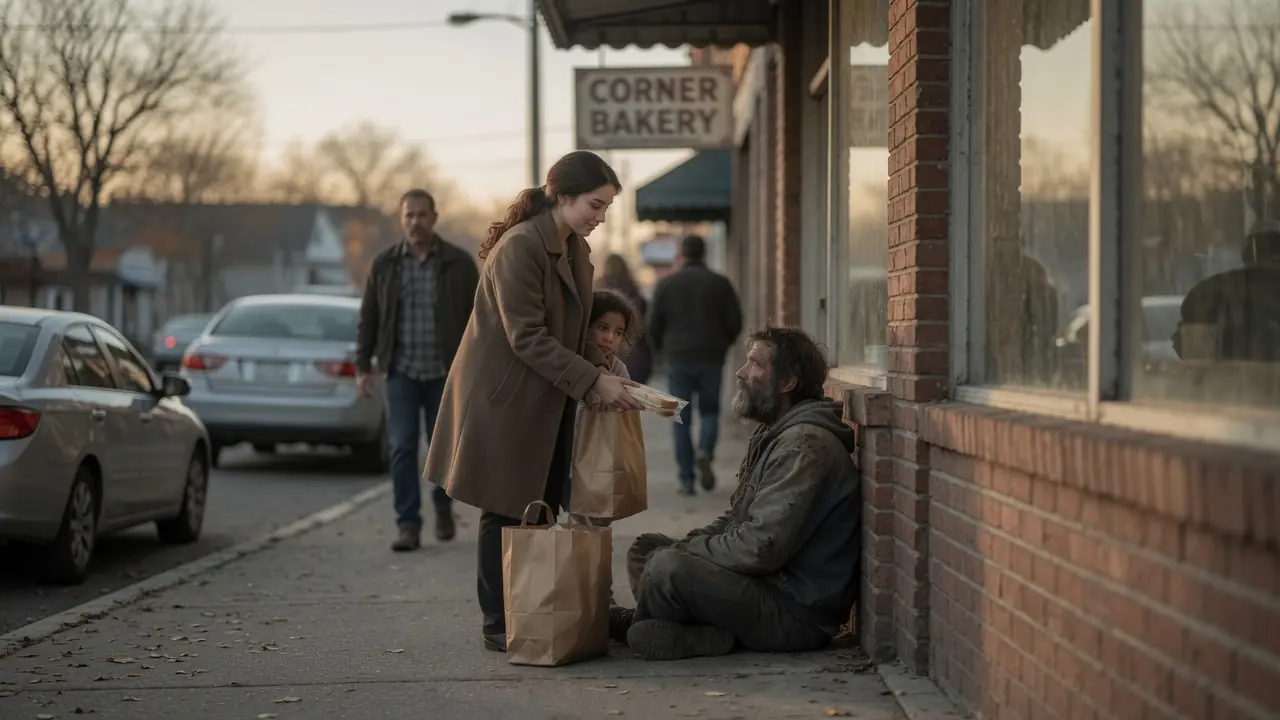
That Thursday evening, the sky had turned gray with rain by the time Susan left the corner market. She carried two grocery bags, one half-full because half-full was all she could afford. There was a small loaf of bread, a carton of eggs, discount apples, one box of pasta, and a wrapped turkey sandwich she had bought for Zuri’s snack the next day. She was already thinking about stretching dinner when she saw the man sitting outside the bakery.
He sat on the curb beneath the striped awning, his hood pulled low, his clothes worn and rumpled. People stepped around him with practiced avoidance, looking through him like he was part of the sidewalk. His beard was rough, his shoes scuffed, and his hands were tucked deep into his pockets as if he were trying to hold himself together. Susan would have walked past if he had not looked up.
His eyes stopped her. They were blue-gray, sharp and awake, not dull with drink or cruelty. They carried loneliness, but not surrender. Susan had seen men pretending to be helpless before, and she had learned to be careful because a single mother’s kindness could become danger if given to the wrong person. But something in this man’s face did not ask to be rescued; it only seemed surprised that anyone had noticed him.
Susan slowed, annoyed with herself before she even spoke. “Are you hungry?”
The man blinked as if the question had reached him from another world. “I could be,” he said quietly.
She set one grocery bag down and pulled out the wrapped sandwich. For one second, she thought of Zuri’s lunchbox, of the way her daughter’s face would light up at a store-bought sandwich instead of leftovers. Then Susan held it out anyway. “It’s not much.”
The man accepted it with both hands, careful, almost reverent. “Thank you.”
Before Susan could answer, Zuri tugged at her coat sleeve. The little girl had been walking beside her quietly, one mitten missing and her pigtails damp from the misting rain. She looked at the man with open curiosity. “Mommy, why is he sitting outside?”
Susan crouched beside her. “Maybe he doesn’t have anywhere warm to go right now.”
Zuri looked at him again, serious in the way children become when they are trying to understand unfairness. Then she smiled. “Hi. I’m Zuri. You don’t look scary. You just look sad.”
The man’s face changed. Not much, but enough for Susan to notice. His mouth softened, and his eyes lowered for a moment like he needed time to survive the kindness of a child. “Hello, Zuri,” he said. “I’m Eli.”
It was not his real name.
Susan would learn that later.
For now, he was only Eli, a quiet man outside a bakery with rain collecting on his hood. Susan looked toward the darkening street, then back at the apartment building two blocks away. Her common sense told her to leave. Her daughter’s hand was in hers, and she had no room in her life for strangers, secrets, or men who carried trouble in their pockets.
But Zuri was still looking at him.
Susan sighed and lifted one grocery bag toward him. “If you want to repay the sandwich, you can carry this to our building. Only to the steps.”
Eli stood slowly, as if sudden movement might frighten her. “Only to the steps,” he said.
They walked together through the light rain. Zuri slipped her small hand into his without asking, and Eli froze so completely that Susan almost pulled her daughter away. But he did not grip her, did not pull, did not take advantage of the trust. He simply looked down at Zuri’s hand in his like it was something precious he did not deserve to hold.
At the apartment steps, Susan took back the grocery bag. “You can sit here while I make dinner,” she said. “But the door stays locked.”
Eli nodded. “Fair.”
Susan turned off the stove and stood still for a moment. Through the glass, Eli sat on the steps with the sandwich wrapper folded neatly beside him, looking at the rain like it had finally become bearable. She found an old blanket in the closet, one with a tear near the corner, and brought it outside.
“Here,” she said, holding it out.
Eli took the blanket slowly. “You don’t know what this means.”
Susan crossed her arms against the cold. “Don’t make it bigger than it is. I’m doing what I’d hope someone would do for me.”
His eyes lifted to hers. “That’s exactly what makes it big.”
Susan did not know what to do with that, so she went back inside.
The next morning, he was still there.
Susan opened the door before dawn in her diner uniform and nearly dropped her keys. Eli sat on the steps, wrapped in the blanket, his head bowed in sleep. The sight should have made her angry or afraid, but instead it made her chest ache. He looked peaceful, as if a cracked concrete step outside her apartment had given him more rest than wherever he had been before.
“You’re still here,” she said.
He woke quickly, eyes alert. “You said I could wait.”
“I didn’t mean forever.”
“I’ll earn my keep,” he said. “If you let me.”
That was how Eli became part of their days. At first, Susan allowed only small things. He carried groceries upstairs, tightened the loose kitchen cabinet, fixed the squeaking hinge on Zuri’s bedroom door, and swept the front steps before the landlord could complain. He never asked for money, never pushed inside when Susan seemed unsure, and never acted offended by her caution.
Zuri adored him almost immediately. She called him Uncle Eli by the third day, and Susan scolded her gently, but Eli looked so startled and moved that she did not have the heart to correct it twice. He helped Zuri with math homework at the tiny kitchen table, drawing apples and stars in the margins to explain subtraction. He read bedtime stories in a low, steady voice that made Zuri fall asleep faster than Susan ever could.
The apartment changed with him in it. Not because it became richer or larger, but because the weight inside it shifted. Susan still came home exhausted, still counted money, still worried about rent, but now someone had already washed the dishes, folded Zuri’s blanket, or repaired the wobbly chair. Eli never made a speech about helping. He simply saw what needed doing and did it.
That frightened Susan more than if he had been useless.
Men who helped could become men you missed. Men who made your child laugh could become empty chairs at dinner. Susan knew abandonment too well to welcome comfort without fear. Zuri’s father had promised forever until forever became inconvenient, then disappeared with a suitcase and no forwarding address.
One night, Susan came home from cleaning offices and found Eli sitting with Zuri at the table, both of them bent over a worksheet. Zuri had fallen asleep with a pencil in her hand, cheek pressed against the paper. Eli was carefully sliding the pencil away so she would not poke herself.
Susan stood in the doorway. “You’re good with her.”
He looked up. “She makes it easy.”
“Children are never easy.”
“No,” he said softly. “But she is honest.”
Susan leaned against the doorframe, studying him. His clothes were rough, but his posture did not belong to a man beaten down by life. Sometimes his words sounded too polished. Sometimes his eyes moved around a room like he was used to measuring exits, people, and consequences. And sometimes, late at night, Susan heard him outside taking phone calls in a voice that did not sound homeless at all.
“Where are you really from, Eli?” she asked.
He smiled faintly, but sadness pulled at it. “Nowhere I miss.”
“That is not an answer.”
“No,” he admitted. “It isn’t.”
She should have pushed harder. Instead, she looked at Zuri sleeping at the table and let the question rest. She told herself everyone had pasts. She told herself secrets were not always danger. But deep down, she knew she was making a choice to trust him before she had proof.
The breaking point came on a rainy Tuesday evening.
Susan sat at the kitchen table with bills spread out before her. Rent. Electricity. School lunch balance. A notice from the landlord folded in half because looking at it open made her feel sick. She pressed her fingers against her eyes, refusing to cry, but the tears came anyway.
Eli stepped in quietly. He did not speak at first. He sat across from her and waited until she lowered her hands.
“I can’t keep doing this,” she whispered. “No matter how hard I work, it’s never enough.”
His hand moved across the table and covered hers. Warm. Steady. Too steady.
“You’re not alone,” he said.
The words nearly undid her. Susan wanted to pull away, but for one fragile second, she let herself stay. Eli looked at her like she mattered beyond what she could carry, beyond what she could survive, beyond being someone’s mother, waitress, cleaner, debtor, or responsibility.
He leaned closer.
Susan’s breath caught.
Then fear rose like a wall. She stood so fast her chair scraped the floor. “I can’t.”
Eli’s face tightened, but he nodded. “I understand.”
“No, you don’t,” she said, voice shaking. “You don’t know what it costs me to trust someone.”
He lowered his eyes. “I know more than you think.”
The next day, Susan’s boss at the diner found the magazine.
Marlene was flipping through old celebrity and business magazines someone had left in a booth. She stopped suddenly, frowned, and turned the page toward Susan. “Isn’t this that man who’s been helping you? The one your girl calls Eli?”
Susan wiped her hands on her apron and looked.
Her whole body went cold.
On the glossy page stood Eli, but not Eli. Clean-shaven. Expensive suit. Confident posture. Standing beside men in tuxedos at a tech gala. The caption beneath the photo read: Joel Tally, billionaire founder of TallyTech, remains missing from public view amid questions about his sudden retreat from the company.
Susan stared until the words blurred.
Billionaire.
Founder.
Joel Tally.
Not Eli.
The sandwich. The blanket. The nights on her steps. The groceries he carried while pretending to have nothing. The way he had watched her count coins, cry over bills, and stretch meals thin enough to shame her. Her kindness, the most expensive thing she owned, had been given to a man who could have bought the whole street.
She folded the magazine page with shaking hands and carried it home like a weapon.
Joel was waiting near the door when she arrived. He smiled when he saw her, then stopped when he saw her face. Zuri was in her room coloring, humming softly. Susan was grateful for that. She did not want her daughter to see what betrayal looked like when it entered a kitchen.
She held up the magazine.
“Then explain this, Joel,” she said, voice shaking. “Why is a billionaire’s face on a magazine cover while he sat outside begging for food?”
Joel went still.
The name hung between them like a shattered plate.
“Susan,” he said.
“No.” Her hands trembled harder. “No more Eli. No more quiet little answers. Who are you?”
He looked at the floor. “My name is Joel Tally.”
The truth was simple. That made it worse.
Susan laughed once, broken and bitter. “You let my daughter call you Uncle Eli.”
His face flinched. “I didn’t mean for that to happen.”
“You slept on my steps.”
“I know.”
“I gave you food I could barely afford.”
“I know.”
Her anger sharpened because his guilt was not enough. “You watched me struggle while pretending my kindness saved you.”
Joel stepped closer, then stopped when she moved back. “Because I was tired of being loved for money I hated.”
Susan stared at him. “That is not an excuse.”
“No,” he said. “It isn’t.”
“You made my life into some experiment.”
His voice broke. “No, Susan… your kindness didn’t save a poor man. It exposed a lonely billionaire.”
The words might have moved her on another night. Not that night. That night, every gentle memory turned cruel in her mind. She saw him fixing the cabinet while knowing he could replace the building. She saw him helping Zuri with homework while hiding a company empire behind a fake name. She saw herself offering a blanket and felt humiliated by her own compassion.
“You need to leave,” she whispered.
Joel’s eyes filled with panic. “Please.”
“Leave.”
Zuri appeared in the bedroom doorway, clutching a crayon. “Mommy?”
Susan wiped her face quickly. “Go back inside, baby.”
Joel looked at Zuri as if the sight of her hurt him physically. “Zuri, I’m sorry.”
The little girl frowned. “Are you leaving?”
Susan closed her eyes.
Joel swallowed. “Yes.”
Zuri began to cry.
That sound broke something in all three of them, but Susan held the door open anyway. Joel walked out without taking the blanket. Without taking anything. The hallway swallowed him, and Susan shut the door before her courage failed.
The days after felt colder.
Zuri asked about him every morning. Susan answered gently at first, then shorter when the questions became too painful. She said Eli had lied. She said sometimes adults made mistakes that hurt people. She said missing someone did not mean letting them back in before trust was repaired.
At night, Susan lay awake and hated him. Then she missed him. Then she hated herself for missing him. It would have been easier if everything had been fake, but memory refused to obey anger. Joel had never mocked her apartment, never touched her without permission, never treated Zuri like a burden. His lie was real, but so had been his tenderness.
Meanwhile, Joel returned to the world that had been waiting for him. TallyTech’s glass tower rose over downtown Cleveland like a monument to everything he had tried to escape. Lawyers, board members, assistants, and investors rushed around him with relief and irritation. They spoke of market confidence, leadership optics, acquisition pressure, and shareholder anxiety.
Joel heard almost none of it.
He sat in his top-floor office and stared at the city, thinking of Susan’s kitchen table. He thought of Zuri’s small hand in his, of Susan’s cracked fingers around a coffee mug, of the blanket left on the steps. He had built a company worth billions, but he had never built anything as honest as the life he had entered under a lie.
His assistant found him one evening still sitting in the dark.
“Mr. Tally,” she said carefully, “the board needs your answer.”
Joel turned from the window. “Tell them I’ll answer tomorrow.”
“You’ve said that three times.”
“Then tell them I’m consistent.”
When she left, Joel opened a folder on his desk. It contained Susan’s rent record, utility balances, and the overdue notices he had obtained through legal channels after asking his private office to help “a family in need.” He wanted to clear every debt. He wanted to buy the building, repair it, secure Zuri’s future, and remove every burden from Susan’s shoulders.
But he heard her voice again.
You watched me struggle while pretending my kindness saved you.
So he did nothing at first.
Not because he did not care, but because he finally understood that money could become another form of control if offered without trust. He had spent his life surrounded by people who used wealth as a lever. He refused to become one more man pushing Susan’s life into shape because he had the power.
Instead, he wrote a letter.
Susan did not read it for two days.
It arrived in a plain envelope, no company name, no expensive paper scent, no grand gesture. She recognized his handwriting from notes he had left on Zuri’s homework. She placed it on the counter, made dinner, bathed Zuri, folded laundry, and stared at it until nearly midnight.
Finally, she opened it.
Susan,
I lied about my name, and I understand why you may never forgive that.
I told myself I was hiding from people who only wanted my money, but I never had the right to test your kindness without your consent. You gave from your lack. I received from my abundance. That imbalance is the wound I caused, and I am sorry.
I will not send money unless you ask. I will not come to your door unless you invite me. I will not use power to force forgiveness.
But I need you to know one truth: nothing I felt in your kitchen was false. Nothing I felt when Zuri took my hand was false. The lie was mine. The love was not.
Joel.
Susan cried after reading it, and that made her angry all over again.
A week passed.
Then Zuri got sick.
It began with a fever after school, then a cough that deepened too quickly. Susan took her to urgent care, where the nurse frowned and sent them to the hospital for observation. Hours blurred under fluorescent lights. Susan sat beside Zuri’s bed, holding her daughter’s hot little hand and trying not to fall apart.
At two in the morning, Susan realized she had typed Joel’s number before deciding to do it.
He answered on the first ring.
“Susan?”
She closed her eyes at the sound of his voice. “Zuri’s in the hospital.”
He arrived twenty minutes later.
Not with cameras, not with assistants, not with a show of wealth. He came in jeans, an old coat, and panic he could not hide. He stopped outside the room, waiting for Susan to decide whether to let him in.
That waiting mattered.
Susan looked at him through the glass. “No lies,” she said.
“No lies,” he answered.
She opened the door.
Zuri woke enough to see him and whispered, “Uncle Eli.”
Joel’s face crumpled. He sat carefully beside the bed, taking her small hand only after Susan nodded. “Hi, starshine.”
“You left.”
“I know,” he whispered. “I’m sorry.”
“You were bad?”
Joel glanced at Susan, then back at Zuri. “I lied. That was bad.”
Zuri thought about that with fever-heavy seriousness. “Don’t do it again.”
“I won’t.”
By morning, Zuri’s fever broke. The doctor said she would recover fully with rest and medicine. Susan stood in the hospital hallway beside Joel, exhausted beyond anger. For several long seconds, neither spoke.
“You came,” she said.
“You called.”
“I didn’t know who else to call.”
Joel nodded. “I’m glad it was me.”
She looked at him, really looked at him, and saw the difference between the man outside the bakery and the man standing there now. Before, he had hidden behind poverty. Now, he stood exposed in his wealth, his guilt, and his fear of losing them. The second version was harder to forgive, but more honest.
“I don’t want your money,” Susan said.
“I know.”
“I don’t want to be rescued.”
“I know.”
“I don’t know if I can trust you.”
Joel swallowed. “Then don’t rush. Let me earn what I broke.”
That was the first right thing he said.
Weeks followed slowly. Joel did not move back into their lives as if an apology erased the wound. He showed up when invited, left when asked, and answered every question Susan gave him. He told her about TallyTech, about the fortune that had made him powerful and lonely, about the people who laughed at jokes before he finished them because money trained them to.
Susan told him about Zuri’s father, about debt, about fear, about how hard it was to accept help when help had always come with strings. They talked in parks, hospital follow-up rooms, diners after closing, and once on the same apartment steps where the lie began. The blanket was still there, washed and folded.
One evening, Zuri asked if Joel was rich enough to buy a zoo.
Joel smiled. “Probably not a good one.”
Susan gave him a look.
He corrected himself. “Maybe a small zoo.”
Zuri gasped, delighted. Susan tried not to laugh and failed.
Healing entered that way, not through grand declarations, but through ordinary moments that survived honesty. Joel helped Zuri with math again, this time at Susan’s invitation. He carried groceries, but now he paid for his own coffee first and never pretended he could not afford dinner. He offered help carefully, and Susan learned to say yes only when yes did not feel like surrender.
Months later, Susan visited Joel’s office for the first time. The glass tower intimidated her, but she walked in with her head high. Joel met her in the lobby instead of making her ride alone to the top floor. He introduced her to people as Susan Miller, not as a charity story, not as proof of his humility, not as the woman who loved him when he was pretending to be poor.
When they reached his office, Susan stood by the window overlooking the city. “This is the world you ran from.”
Joel stood beside her. “Yes.”
“And my apartment was where you hid.”
“At first,” he said. “Then it became where I wanted to be seen.”
She turned toward him. “You understand why that still hurts?”
“Yes.”
“Good.” Her voice softened. “Because I don’t want a perfect man. I want one who tells the truth before I have to find it in a magazine.”
Joel took her hand carefully. “Then that is the man I’ll spend my life becoming.”
A year after the day outside the bakery, Susan stood again under the striped awning. The bakery owner had donated leftover bread to a new community kitchen funded by Joel but run by Susan, with one strict rule: no one had to prove they were poor enough to deserve kindness. Zuri helped pass out wrapped sandwiches, taking her job very seriously.
Joel stood beside Susan, not disguised, not hiding, not pretending to be less than he was or more than he had become. A reporter asked him why he started the project. Joel looked at Susan.
“Because once, someone gave me food when she thought I had nothing,” he said. “And she taught me that kindness should never be a test.”
Susan’s eyes warmed, though she rolled them slightly so he would not get too proud.
That evening, after everyone left, Zuri ran ahead toward the apartment, singing nonsense into the cool night air. Susan and Joel walked behind her, hand in hand. They passed the curb where he had once sat alone in the rain.
Susan stopped there.
Joel stopped too.
“This place changed everything,” she said.
He nodded. “It changed me.”
Susan looked at him for a long moment. “No more fake names.”
“No more fake names.”
“No more tests.”
“No more tests.”
“No pretending you need saving just to see who will stop.”
Joel’s voice grew quiet. “No. From now on, I ask for love as myself.”
Susan squeezed his hand. “Good. Because that’s the only version I’m willing to love.”
Under the bakery awning, with the streetlights flickering on and Zuri calling for them from the corner, Joel bent and kissed Susan gently. There were no cameras, no board members, no glossy magazine covers, no lies dressed as humility. Just a single mother who had learned that kindness needed boundaries, and a billionaire who had learned that being seen was worthless if he hid the truth.
And for the first time, Joel Tally did not feel loved for his money or forgiven because of it.
He felt loved because he had finally stopped pretending.
Susan, who had once given a sandwich to a stranger in the rain, understood the lesson too. Love was not proven by poverty, wealth, rescue, or sacrifice performed in secret. Love was proven when two people stood in the truth, wounded but willing, and chose not to hide from each other again.