Rain had been falling over Columbus since four in the afternoon, turning the restaurant windows into gray, trembling mirrors. Hannah Cole wiped down the same corner table for the third time, not because it was dirty, but because staying busy kept her from thinking about the electric bill waiting on her kitchen counter. She was thirty years old, a single mother, and every shift at Miller’s Table felt like another small fight to keep the roof over her little boy’s head. Her blue restaurant polo was still damp at the sleeves from carrying trash outside earlier, and her white apron smelled faintly of coffee and lemon cleaner.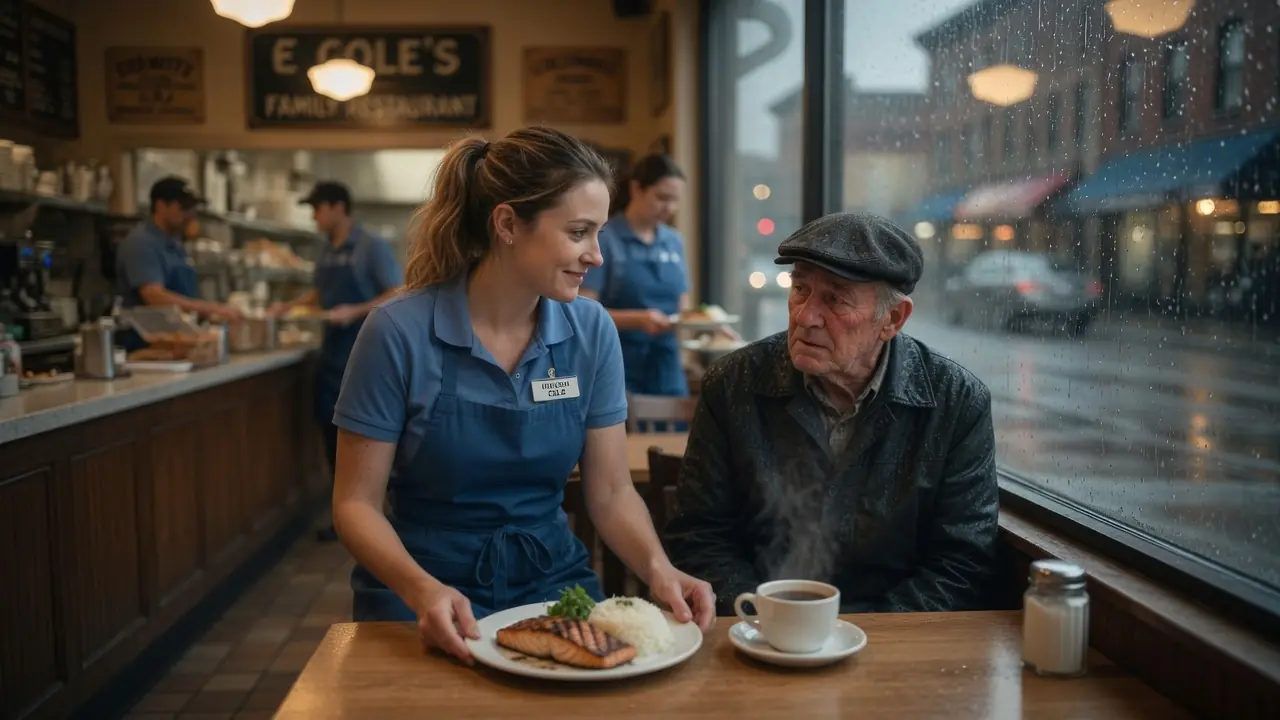
Her son, Noah, was seven and staying with Mrs. Alvarez from upstairs until Hannah could finish closing. He had drawn her a picture that morning of the two of them standing in front of a yellow house with a red door, even though their real apartment had peeling paint and a door that stuck whenever it rained. Hannah had folded the drawing carefully and tucked it inside her locker beside her tips. Some nights, when her feet hurt so badly she wanted to cry, she opened the locker and looked at that drawing like it was a map to a future she had not reached yet.
Miller’s Table sat on a busy street near downtown Columbus, the kind of family restaurant where office workers came for lunch, older couples came after church, and tired people came when they needed something warm without pretending life was fine. By six-thirty, the dinner rush had thinned. Two servers leaned near the coffee machine, checking their phones between tables. Hannah kept moving because Tom Reed, the manager, always noticed when she stopped.
Tom was not the owner, but he wore authority like he had invented it. He cared about receipts, portion sizes, complaints, and whether customers looked profitable before they sat down. He had reminded Hannah more than once that kindness did not count as a business strategy. She usually lowered her eyes and said yes, because arguing with a man who controlled the schedule was a luxury she could not afford.
At seven-fifteen, the front door opened with a small bell and a gust of cold rain. An elderly man stepped inside, his dark jacket soaked through, an old cap pulled low over wet gray hair. He stood near the entrance for a moment, blinking at the lights as if he had walked into the wrong place. Water dripped from the hem of his coat onto the floor, and his hands trembled at his sides.
The two servers near the coffee station glanced at him, then looked away. One whispered something Hannah could not hear, and the other gave a small shrug. The man did not look homeless, exactly, but he looked lost in a way that made people uncomfortable. His shoes were muddy, his face pale, and his eyes moved around the restaurant with quiet fear.
Hannah watched him from the corner table. Something in his expression reminded her of Noah when he woke from a bad dream and could not remember where he was. She set down the rag and walked toward him before anyone could stop her. “Good evening, sir,” she said gently. “You can come in out of the rain.”
The man looked at her name tag. “Hannah,” he read slowly.
“Yes, sir.” She smiled. “Would you like a table by the window or somewhere warmer?”
He swallowed. “I was looking for the bus stop.”
“There’s one across the street, but you’re soaked.” She glanced outside, where headlights smeared across the wet glass. “Why don’t you sit for a minute and warm up?”
He hesitated like sitting down might cost more than he had. Hannah understood that look. She had worn it in grocery stores, pharmacies, and at the mechanic’s counter when someone said the total out loud. Without making him answer, she led him to a booth near the window but away from the draft.
“What’s your name?” she asked.
“Walter,” he said after a pause. “Walter Hayes.”
“Well, Mr. Hayes, I’m going to bring you some coffee.”
He looked alarmed. “I don’t know if I ordered coffee.”
“You didn’t,” Hannah said softly. “But I’m offering.”
His eyes shifted toward the kitchen, then toward the door. “I should not be trouble.”
“You’re not trouble.”
She returned with a cup of hot coffee, cream, and sugar packets. His hands closed around the mug, and Hannah saw how cold his fingers were. The skin around his knuckles looked almost blue. She fought the urge to ask a dozen questions at once, because frightened people sometimes ran when kindness came too quickly.
From behind the counter, Tom watched her with narrowed eyes. Hannah felt his stare between her shoulder blades. She pretended not to notice and brought Walter a glass of water too. When she passed the kitchen window, the cook asked, “That old guy ordering?”
“He will.”
Tom stepped closer. “Make sure he can pay.”
Hannah kept her voice low. “He’s cold, Tom.”
“So is half the city in February.” Tom looked toward Walter’s booth. “We are not a shelter.”
Hannah bit back the answer on her tongue. She thought of Noah eating cereal for dinner last week because she had miscalculated groceries, and she knew exactly how thin the line was between a customer and a person needing mercy. She also knew Tom could cut her hours with one sentence. So she nodded, then walked back to Walter with a menu.
Walter stared at the page, but his eyes did not seem to follow the words. “My son likes salmon,” he said.
Hannah sat across from him for just a second. “Do you know your son’s phone number?”
Walter frowned. “Ethan knows numbers.”
“Is Ethan your son?”
He nodded slowly. “He worries too much.”
Hannah’s heart tightened. “Do you want me to call him?”
Walter looked out at the rain. “I was going to meet him. Or he was coming to me. I had it written down.”
He patted his pockets with growing panic. Hannah leaned forward. “It’s okay. Take your time.”
“My wallet,” Walter whispered. “I had my wallet.”
Hannah glanced beneath the table, then beside him, but there was nothing. She did not know whether he had lost it before entering or forgotten it at home. What she did know was that he was soaked, confused, and trying very hard not to look afraid.
“Mr. Hayes,” she said gently, “how about some warm food first?”
He blinked. “I didn’t order this much.”
“You haven’t ordered yet.” Hannah smiled. “But I think you should eat something.”
He looked ashamed. “I may not have money.”
The words were barely audible, but they pierced her. Hannah thought of the coins in her apron pocket, the small bills folded inside her shoe because she had learned not to leave cash in her locker. She thought of Tom, of the schedule, of Noah’s drawing. Then she thought of this old man walking back into the rain hungry because everyone had decided he was not worth the trouble.
She stood. “You let me worry about that.”
Hannah ordered grilled salmon with rice and vegetables because it was soft enough, warm enough, and better than soup for a man who had been wandering in the rain. She paid for it herself by writing her employee meal code on the slip, even though she knew Tom might question it later. The cook raised an eyebrow but said nothing. When the plate was ready, Hannah carried it to Walter with another coffee.
Walter stared at the food. “I didn’t order this much,” he said again, his voice small.
“I know, sir.” Hannah placed the plate in front of him. “You looked cold, and I couldn’t let you sit here hungry.”
His eyes filled with something like gratitude and embarrassment mixed together. “Most people stop seeing you when you get old enough to look lost.”
Hannah swallowed hard. “Then tonight, Mr. Hayes, you don’t have to be invisible.”
He ate slowly at first, then with more hunger than he seemed willing to admit. Hannah checked on her other tables, refilled waters, cleared plates, and kept looking toward him. Once, he held the fork still and stared out the window for nearly a minute, as if listening to a memory. She returned quietly and asked if he was all right.
“My wife used to make salmon,” Walter said.
“What was her name?”
“Margaret.” His mouth trembled around the name. “She died in the spring. Or maybe it was last spring. Ethan says I mix days.”
Hannah sat down again because no one else needed her at that moment, and because Walter’s loneliness had become too large to leave untouched. “I’m sorry.”
“She liked lemon.” He looked at the plate and gave a tiny smile. “You put lemon.”
“I did.”
He touched the lemon wedge like it was a piece of the past. “She would have liked you.”
Hannah looked down quickly before her eyes could fill. It had been a long time since anyone had said something kind to her without needing anything. She rose when Tom appeared near the hallway, his expression hard. Walter finished half the plate, drank the coffee, and seemed steadier after a while.
Hannah found an old church bulletin in his coat pocket when he asked her to help look again for his wallet. Inside was a folded paper with the name Ethan Hayes and a phone number. She called it from the restaurant phone near the servers’ station. No one answered the first time. On the second try, a man picked up with panic in his voice.
“Dad?”
Hannah exhaled. “Is this Ethan Hayes?”
“Yes. Who is this?”
“My name is Hannah Cole. I work at Miller’s Table in Columbus. Your father is here. He’s safe.”
The silence on the line was so heavy that she thought the call had dropped. Then Ethan’s voice came back rough and shaken. “Where exactly are you?”
She gave the address. “He’s had food and coffee. He’s wet, but he seems better now.”
“I’ve been looking for him for four hours,” Ethan said. “He has early dementia. He walked out while my sister was upstairs, and we couldn’t find him.”
Hannah closed her eyes. “I’m so sorry.”
“No,” Ethan said, voice breaking. “You found him.”
Twenty minutes later, Ethan Hayes rushed into the restaurant in a dark coat, rain on his shoulders and terror still in his face. He was in his early forties, well-dressed but disheveled, like money had not protected him from fear. When Walter saw him, confusion crossed his face first, then relief. Ethan went to him and dropped to one knee beside the booth.
“Dad,” he whispered.
Walter patted his son’s shoulder. “I had salmon.”
Ethan laughed and cried at the same time. “I see that.”
Hannah stood back, suddenly feeling like she had intruded on something private. Ethan looked at her over his father’s shoulder. His eyes were wet, and his face held gratitude so intense it made her uncomfortable. “You’re Hannah?”
“Yes.”
“You stayed with him?”
“I just brought him food.”
“You called me.” He glanced at the rain outside. “You kept him from going back out.”
Hannah folded her hands in front of her apron. “Anyone would have.”
Ethan’s expression changed. “No. They wouldn’t.”
Before leaving, Ethan tried to pay for the meal, but Hannah told him it was handled. He insisted, pressing cash toward her, but she stepped back. “Please, sir. Just get him home safe.”
Ethan looked like he wanted to argue, then nodded. “I’ll come back tomorrow.”
Hannah thought he meant for the restaurant. She did not understand the weight of that promise yet.
After they left, Tom called her into the back office. The room smelled of paper, old coffee, and bleach. Receipts were stacked beside the computer, and the clock above the door ticked too loudly. Tom held the meal slip between two fingers as if it were evidence.
“You used your employee meal for that man?”
Hannah stood straight. “Yes.”
“Employee meals are for employees.”
“I know.”
“And then you sat with him during shift time?”
“He was confused.”
Tom leaned back against the desk. “You are paid to serve customers, not rescue strangers.”
Hannah’s hands tightened around her apron. “He was a customer.”
“He had no wallet.”
“He had a son looking for him.”
Tom’s face hardened. “Do you know what happens when staff starts giving away food? People take advantage. We become known as a place where anyone can walk in soaked and sad and get salmon on our dime.”
“It was on my meal.”
“Do not get clever with me.” He tossed the receipt onto the desk. “We’ll talk tomorrow. For now, finish closing.”
Hannah left the office with her throat burning. She worked the rest of the shift in silence, mopping floors, restocking napkins, and cleaning the coffee station while the rain kept tapping at the windows. When she finally got home after ten, Noah was asleep on Mrs. Alvarez’s couch with one sock missing. Hannah carried him upstairs, tucked him into bed, and sat beside him until her fear settled into exhaustion.
The next morning, her phone buzzed before she had finished packing Noah’s lunch. It was a message from Tom. Come in early. Need to discuss last night.
Hannah stared at the screen. Her stomach sank. Noah looked up from the table, where he was drawing another house, this one with a porch. “Mommy?”
She forced a smile. “It’s okay, baby.”
But it was not okay. Missing even one week of shifts could mean choosing between rent and groceries. Losing the job entirely would mean applying everywhere again, answering questions about availability, pretending she had childcare solved when she did not. She kissed Noah’s forehead, dropped him at school, and walked into Miller’s Table with dread heavy in her chest.
The restaurant was not open yet, and the morning staff moved quietly through prep. Hannah noticed two coworkers watching from the back hallway. Tom was waiting in the office, wearing a pale blue shirt and black tie, his name tag straight and his expression already decided. On the desk lay the receipt from Walter’s meal, circled in red pen.
“Close the door,” Tom said.
Hannah did.
He pointed to the paper. “This is why we have policies.”
Hannah looked at the receipt. Grilled salmon, rice, coffee. One plate of food that had kept an elderly man safe and warm. It looked so small beneath Tom’s finger.
“You gave salmon and coffee to a confused old man who couldn’t pay, Hannah,” Tom said coldly. “This restaurant is not your charity.”
Her voice trembled despite her effort. “He was soaked, hungry, and lost. I couldn’t look at him and do nothing.”
Tom folded his arms. “Then pack your apron, because kindness doesn’t pay my bills.”
For a second, Hannah could not breathe. The room tilted slightly, or maybe it was only fear rising too fast. She thought of Noah’s lunchbox, the rent notice, the yellow house with the red door. She thought of Walter saying most people stopped seeing you when you looked lost.
The office door opened before she could answer.
A well-dressed man stepped inside, rainwater still on the shoulders of his coat. Ethan Hayes looked from Hannah to Tom, then to the receipt on the desk. Behind him, two staff members leaned into the hallway, suddenly alert.
“No,” Ethan said, his voice sharp with fury. “But my father’s life does. And she’s the only reason he made it home alive.”
Tom blinked. “Excuse me?”
Ethan stepped farther into the office. “I’m Ethan Hayes. Walter Hayes is my father.”
Tom’s expression shifted into the polite confusion of a man trying to calculate whether someone mattered. “I’m glad your father is all right, but this is an internal staff matter.”
“It became my matter when you decided to punish the woman who helped him.”
Hannah whispered, “Mr. Hayes, you don’t have to-”
“Yes,” Ethan said, looking at her. “I do.”
Tom straightened. “Sir, we have rules. She violated meal policy.”
Ethan stared at him. “Your policy would have sent my confused seventy-eight-year-old father back into the rain.”
“That is not what happened.”
“Because she stopped it from happening.”
The hallway was silent now. The two coworkers who had watched Walter the night before stood near the door, their faces pale. Ethan reached into his coat and took out a folded paper. “My father was reported missing yesterday evening. Police were searching nearby blocks. If Hannah had ignored him like everyone else did, he could have wandered into traffic, collapsed in the cold, or disappeared before we found him.”
Tom’s mouth opened, then closed.
Ethan placed the paper on the desk. “That meal you circled in red is the only reason he stayed long enough for me to get here.”
Hannah pressed her lips together, trying not to cry. She had spent years learning how to be small in rooms where men held power. Ethan’s anger on her behalf felt unfamiliar and almost frightening. It was one thing to know she had done right. It was another thing to hear someone say it out loud.
Tom recovered enough to force a tight smile. “Of course, we are happy your father is safe. But from a business perspective-”
Ethan cut him off. “From a business perspective, I own Hayes Commercial Properties.”
Tom went still.
Ethan continued, “This building is under a Hayes lease portfolio. My office handles several restaurant properties in this district, including the renewal review your owner has been requesting for next spring.”
The color drained from Tom’s face.
“I am not here to threaten your lease,” Ethan said. “I am here because my father asked me if the woman who gave him salmon would be in trouble. He worried about her all night. Imagine that, Mr. Reed. A man fighting confusion still had more concern for her job than you did for his life.”
One of the coworkers in the hallway lowered her eyes.
Tom’s voice came out weaker. “I was not aware of all the details.”
Hannah finally spoke. “You knew he was lost. I told you.”
The words surprised her. They were not loud, but they were clear. Tom looked at her as if he had not expected her to find her voice.
Ethan turned to Hannah. “Did anyone else help him?”
She hesitated. The room waited. She could have protected her coworkers, protected Tom, made the truth softer so everyone could pretend. But she thought of Walter’s trembling hands around the coffee cup.
“No,” she said. “They looked away.”
Ethan nodded once, slowly. “Then the problem in this restaurant is not a salmon dinner.”
Tom looked toward the doorway. “Everyone back to work.”
No one moved at first. Then Ethan said, “Actually, I would like them to hear this.”
Tom’s jaw tightened, but he said nothing.
Ethan faced Hannah again. “My father lost his wife last year. Since then, he has had moments where time slips on him. He left home yesterday thinking he was meeting her for dinner, because they used to come to this neighborhood years ago.” His voice broke slightly. “He remembered salmon because my mother loved it.”
Hannah’s eyes filled. “He told me.”
“He told me you put lemon on the plate.” Ethan smiled sadly. “He said Margaret would have liked you.”
That broke her. Hannah turned her face away, but tears slipped down anyway. She had not helped Walter for praise. She had helped him because she knew what it meant to feel unseen. But hearing that small detail returned to her made the whole night feel holy in a way she had not expected.
Tom cleared his throat. “Hannah, perhaps termination is not necessary.”
Ethan looked at him coldly. “How generous.”
Tom stiffened. “A written warning, then.”
“No,” Hannah said.
Everyone looked at her.
Her heart pounded so hard she could feel it in her hands. She thought of Noah, and fear tried to pull her back into obedience. But another thought rose beside it. If she accepted a warning for kindness, she would be teaching her son that mercy was something to apologize for.
“No,” she said again, stronger this time. “I will not sign a warning for helping a lost old man stay safe.”
Tom’s eyes narrowed. “Be careful.”
“I have been careful for years,” Hannah said. “Careful with my words, careful with my hours, careful with every dollar. Last night, I was careful with someone’s father. If that is wrong here, then maybe I don’t belong here.”
The room went silent.
Ethan’s expression softened with respect. “Hannah, my father also asked me to bring you something.”
He reached into his coat pocket and handed her a small envelope. Hannah did not open it. “I can’t take money.”
“It’s not payment for food.”
“Then what is it?”
“A note.”
She opened the envelope with trembling fingers. Inside was a piece of stationery with shaky handwriting.
Dear Hannah,
Thank you for seeing me when I did not know where I was.
The coffee was warm.
So were you.
Walter Hayes.
Hannah covered her mouth.
Ethan said quietly, “There is something else. My family funds a small care program for seniors with memory loss. We have been planning a community cafe partnership, a place where older adults and caregivers can eat safely and be treated with dignity. After last night, I know exactly who should help run it.”
Hannah stared at him. “Me?”
“Yes. A management position. Better pay, stable hours, and childcare support through the foundation if you need it.”
Tom made a small sound of disbelief. “She is a server.”
Ethan looked at him. “She is the only person in this building who understood hospitality.”
Hannah could not speak. The words settled over her slowly, too large to trust all at once. Better pay. Stable hours. Childcare support. A job where kindness was not a violation.
“I don’t have a degree,” she whispered.
“I did not ask if you had a degree,” Ethan said. “I asked if you knew how to see people.”
Tears ran down her face freely now. For years, Hannah had believed survival meant accepting whatever was handed to her, even disrespect, even exhaustion, even fear. But standing in that office, holding Walter’s note, she felt something inside her lift. Not pride exactly. Dignity.
Tom looked desperate now. “Hannah, let’s not make a rushed decision.”
She untied her apron slowly.
The white fabric had coffee stains near the pocket and a small tear at the strap. She thought of every double shift, every missed bedtime, every forced smile when customers snapped their fingers. She thought of the night before, when Tom had cared more about a receipt than a lost man. Then she folded the apron carefully and placed it on the desk.
“I’m not rushing,” she said. “I’m finally leaving the place that thought kindness was a problem.”
She walked out of the office with Ethan beside her. The coworkers in the hallway stepped back, ashamed. One of them whispered, “Hannah, I’m sorry.” Hannah nodded, but she did not stop. Some apologies needed time before they deserved an answer.
Outside, the rain had softened to a mist. Ethan held the door for her, and across the street, traffic moved through shining puddles. Hannah looked back once at Miller’s Table, at the windows where Walter had sat with his coffee and salmon. She did not feel triumphant. She felt shaken, grateful, and terrified of the new life opening in front of her.
That afternoon, she picked Noah up from school earlier than usual. He ran into her arms, surprised and delighted. “Mommy, you’re not at work?”
She hugged him tightly. “Not that work anymore.”
His smile faded. “Are we in trouble?”
Hannah knelt in front of him. “No, baby. I think we might be okay.”
A week later, Hannah visited Walter at Ethan’s home. He was sitting in a sunroom with a blanket over his knees, looking clearer than he had in the restaurant. When he saw her, his face brightened slowly. “Hannah.”
She smiled. “Hi, Mr. Hayes.”
He looked at Ethan. “That’s the coffee lady.”
Ethan laughed softly. “Yes, Dad.”
Walter reached for her hand. “I didn’t order that much.”
Hannah laughed through sudden tears. “I know.”
Walter squeezed her fingers. “But I needed it.”
She sat beside him, and for a while they talked about salmon, Margaret, Noah, and the rain. Walter drifted in and out of memory, but each time he returned, he looked at Hannah with warmth. Ethan watched from the doorway, his expression full of quiet gratitude.
The community cafe opened three months later in a bright corner space two blocks from the restaurant. It served simple meals, strong coffee, and had staff trained to recognize confusion, fear, and wandering. Seniors came with caregivers, widowers came alone, and tired people came because the place felt gentle. Hannah wore a blue manager’s blouse with her name stitched neatly above her heart.
On opening day, Walter sat at the first table by the window. Ethan stood beside him, and Noah handed out menus with serious importance. When Hannah brought Walter a small plate of salmon with lemon, he looked up at her and smiled.
“I didn’t order this much,” he said.
Hannah set the coffee beside him. “I know, Mr. Hayes.”
This time, the words did not come from confusion alone. They came from a memory that had found a safe place to land. Ethan looked away, blinking hard, and Noah slipped his hand into his mother’s.
That evening, after the last customer left, Hannah stood by the window and watched rain begin to fall over Columbus again. The streetlights glowed in the wet pavement, and the city looked softer than it had on the night Walter wandered in. Noah leaned against her side, tired and proud. Behind them, the cafe smelled of coffee, clean tables, and something warm from the kitchen.
“Mommy,” Noah asked, “is this our yellow house?”
Hannah looked down at him.
It was not a house. It had no red door, no yard, and no little porch like the one in his drawing. But it was the first place in years where Hannah did not feel invisible, the first place where her kindness could help pay the bills instead of risking them. It was a beginning.
She kissed the top of his head. “Not yet,” she said softly. “But I think this is the road to it.”
And across the room, on the wall near the entrance, Ethan had framed Walter’s note in simple wood.
Thank you for seeing me when I did not know where I was.
The coffee was warm.
So were you.
People stopped to read it every day. Some smiled. Some cried quietly. And whenever a tired stranger came in from the rain, Hannah Cole remembered the night one lost old man sat by a window, looked at a plate of salmon, and whispered that he had not ordered that much.
She remembered how close the world had come to looking away.
Then she pulled out a chair, poured the coffee, and made sure it never did.