“Ma’am, could I have a piece of cake? I haven’t eaten all day.”
Emily Carter looked up from wiping the glass display case and saw an elderly man standing just inside the bakery door, clutching a worn brown cap in both hands. His jacket was faded, his beard was untrimmed, and his shoulders bent slightly as if the weight of the whole day had settled there. Behind him, cold wind slipped through the open door before he gently pushed it shut. He did not step closer at first, as though even asking for food made him feel like he had crossed a line.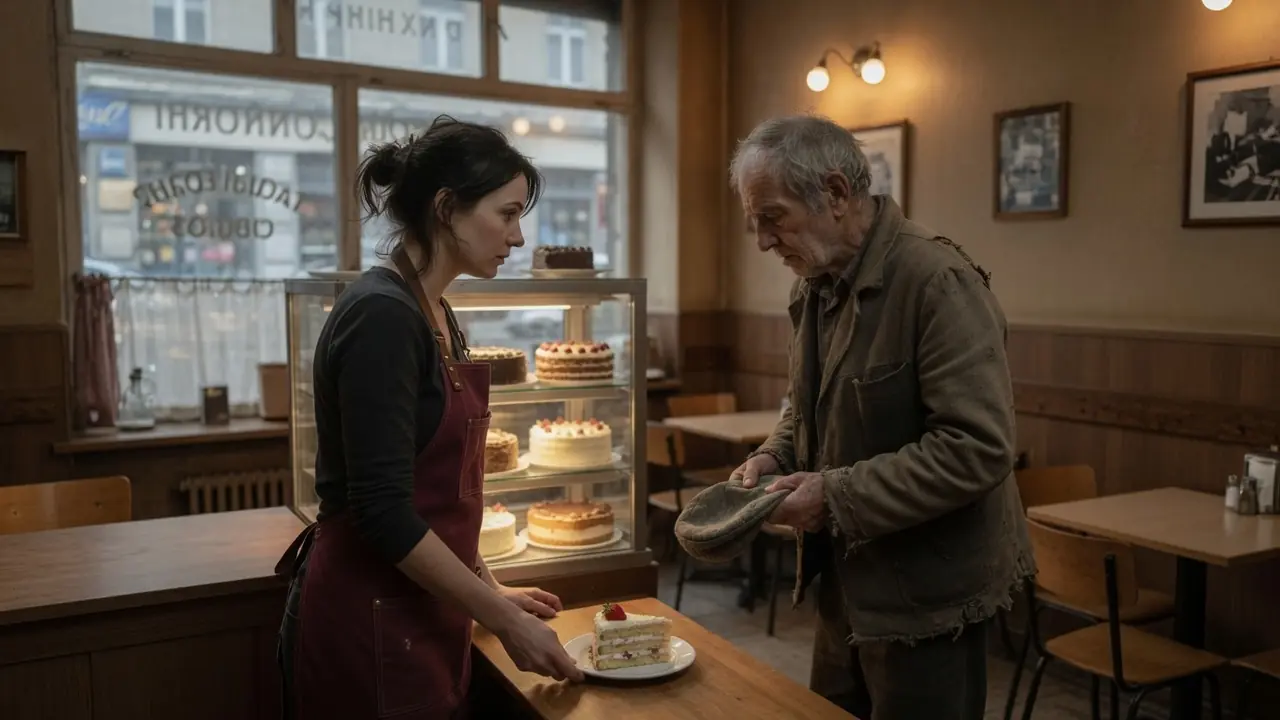
The bakery smelled of sugar, butter, coffee, and fresh bread, the kind of smell that made hungry people hurt worse. Inside the display case sat lemon cake, chocolate layers, strawberry cream slices, and one tall vanilla cake with thick frosting swirled like clouds. Emily had been on her feet since six that morning, running the counter, cleaning tables, boxing orders, and smiling at customers who barely looked at her face. Her back ached, her fingers were sticky with frosting, and her mind kept counting how much she had left until payday.
She was thirty-one years old, a single mother to a seven-year-old boy named Noah, and every dollar mattered. Rent was due in six days. Noah needed new school shoes because his toes were pressing against the front of the old ones. Her car had made a grinding sound that morning, and Emily had pretended not to hear it because pretending was sometimes the only repair she could afford.
The old man lowered his eyes toward the floor. “I’m sorry to ask. I know this is a business. I just smelled the cake from outside.”
Emily’s hand tightened around the cleaning cloth. She had seen hunger before, real hunger, not the kind people joked about between lunch and dinner. This man’s voice carried the quiet shame of someone who had already been turned away that day. He did not ask for a meal, a drink, or money. He asked for one piece of cake, as if even kindness had to be kept small.
Before Emily could answer, a sharp voice came from the register behind her. “We don’t give out free food.”
Victor Lane stepped out from the office doorway, wearing his stiff white shirt and narrow black tie like a uniform of control. He was the bakery manager, though he acted as if he owned every crumb in the building. His eyes moved over the old man with open disgust, then shifted to Emily with warning. “If he wants cake, he pays like everyone else.”
The old man flinched. “It’s all right,” he whispered. “I shouldn’t have come in.”
Emily watched him turn toward the door, and something inside her refused to let him leave that way. Maybe it was because her father had once stood in a pharmacy counting coins for medicine. Maybe it was because Noah sometimes asked for extra toast at night and pretended it was because he liked toast, not because dinner had been too small. Or maybe it was because cruelty felt louder when it happened beside cake.
“Wait,” Emily said softly.
Victor’s eyes narrowed. “Emily.”
She ignored him and opened the display case. She did not reach for the broken corner piece in the back or the slice with frosting smeared against the paper. She chose the best slice of vanilla cake, the tall one with thick white frosting and a ribbon of strawberry filling in the middle. She placed it on a small plate, added a fork, and carried it to the table near the window.
The old man stared at her as if he did not understand. “Ma’am, I can’t pay.”
Emily set the plate down gently. “Sir, please eat. I’ll pay for it.”
His hands shook around the cap. “I can’t let you do that. I have nothing to give back.”
“You don’t have to give anything back,” Emily said. “Just sit down and eat before the hunger hurts you more.”
Victor came closer, his shoes clicking hard against the tile floor. “That cake is coming out of your paycheck.”
Emily looked at him, fear pressing tight in her chest. She needed that money. Even one slice mattered when her life had become a line of small shortages connected together. But the old man was watching her now, and if she stepped back, he would remember this place not by the smell of cake, but by the taste of humiliation.
“Then take it,” she said. “I’d rather lose a few dollars than watch an old man starve in front of me.”
The bakery went quiet. Two customers near the coffee station stopped stirring their drinks. A woman picking up a birthday cake lowered her phone and stared. Victor’s face reddened, but he did not shout because there were witnesses, and Victor preferred his cruelty behind office doors.
The old man slowly sat at the small table near the window. Emily brought him a glass of water and a napkin, then stood beside him for a moment as he picked up the fork. The first bite made his eyes close. He chewed slowly, carefully, like the sweetness was something fragile that might disappear if he hurried.
“Thank you,” he whispered.
Emily smiled, though her throat felt tight. “You’re welcome.”
“What’s your name?”
“Emily Carter.”
The old man nodded. “Emily Carter,” he repeated, almost to himself. “A good name.”
Victor stepped behind the counter again, but his glare stayed on her for the rest of the afternoon. Emily finished her shift with a knot in her stomach, waiting for him to call her into the office. Every time the bell above the door rang, she looked up too fast. Every time the register opened, she thought of the cake slice being deducted from her pay.
The old man finished every bite. Before leaving, he walked to the counter and placed the napkin neatly beside his empty plate. Then he turned to Emily and gave a small bow of his head. He looked different after eating, not richer, not cleaner, but steadier. “You fed more than my hunger today,” he said.
Emily did not know what to say to that. “Take care of yourself, sir.”
He put his cap back on and left through the front door, stepping into the gray afternoon. Emily watched until he disappeared past the window. Something about his final look stayed with her, but she pushed it away because she had tables to wipe and bills to survive.
At 5:12, Victor called her into the office.
The office was small, windowless, and smelled of paper dust and stale coffee. A calendar from last year still hung beside the file cabinet because Victor never noticed anything that did not involve money. Emily stood in front of the desk with her apron still tied around her waist. Victor sat down slowly, enjoying the silence before he spoke.
“You embarrassed me today,” he said.
Emily folded her hands. “I helped a hungry man.”
“You gave away product without permission.”
“I said I would pay for it.”
“You said that in front of customers,” Victor snapped. “You made me look cruel.”
Emily almost laughed, but she knew better. “I didn’t make you look anything.”
Victor leaned back. “That slice was $6.75 with tax. I’m deducting it from your wages, and I’m writing you up for insubordination.”
Her stomach dropped. “Victor, please. I need every hour this week.”
“Then maybe you should stop pretending you’re a saint.” His mouth twisted into a smile. “You’re a single mother working a bakery counter, Emily. You can’t afford to be generous.”
The words hit exactly where he meant them to. Emily thought of Noah’s shoes again, the rent, the car, the half-empty refrigerator at home. She hated that he knew enough about her life to weaponize it. She hated more that her eyes burned, and she had to look away to keep him from seeing.
Victor slid a write-up form across the desk. “Sign it.”
Emily stared at the paper. “For giving food to someone who hadn’t eaten all day?”
“For breaking policy.”
She picked up the pen, then stopped. Her hand trembled, but she set the pen back down. “No.”
Victor’s smile vanished. “Excuse me?”
“I’ll pay for the cake,” she said. “But I won’t sign a paper saying kindness is misconduct.”
For a second, the room was silent.
Then Victor stood. “You think you can challenge me?”
“No,” Emily said. “I think I can tell the truth.”
Victor grabbed the paper and shoved it into a folder. “Fine. I’ll mark that you refused to sign. And if you do anything like that again, you’re done. Do you understand?”
Emily nodded once. She did understand. She understood that Victor could make her life harder. She understood that kindness had a cost. And she understood, with a strange calm that surprised her, that she would still give the old man the cake again.
That night, she picked Noah up from Mrs. Alvarez’s apartment and drove home in the dark. Noah climbed into the back seat, swinging his backpack onto the floor. “Did you bring any cake today?” he asked hopefully.
Emily smiled at him in the rearview mirror. “Not today, baby.”
“That’s okay,” he said quickly, as if he did not want her to feel bad. “Maybe tomorrow.”
At home, she made macaroni and canned peas. Noah ate happily, then did his homework at the kitchen table while Emily calculated bills in a notebook. She subtracted rent, gas, school lunch money, and the $6.75 Victor would take from her check. The number left at the bottom was so small she closed the notebook before fear could swallow her.
“Mom,” Noah said, “why do grown-ups sigh when they look at paper?”
Emily looked up. “Because paper is rude.”
He giggled, and the sound repaired something in her chest.
Two days passed. Victor barely spoke to her except to correct small things. He told her the napkins were crooked, the coffee lids were low, and her smile looked “tired” in front of customers. Emily worked quietly and kept her head down. She had learned that surviving sometimes meant saving your strength for the moment that mattered.
On the third morning, the bakery was unusually busy. A corporate order had come in for six dozen cupcakes, the espresso machine was leaking, and a customer was complaining that her cake inscription looked “too cheerful” for her mother-in-law. Emily moved quickly, tying boxes, refilling display trays, and calming people with the kind of patience no one paid her enough to have.
At 10:43, the front door opened.
The old man returned.
Only this time, he was not hunched in the same way. He still wore the brown jacket and carried the old cap, but his eyes were sharper. He walked slowly to the counter, and Emily’s face softened with recognition.
“Good morning,” she said. “Are you hungry again?”
Victor looked up from the register, his expression darkening immediately. “Absolutely not.”
The old man looked at Emily. “I was hoping for another slice of the same cake.”
Emily reached for her apron pocket, where she kept a few dollars folded for emergencies. Victor slapped his hand down on the counter. “Don’t even think about it.”
Customers turned.
Emily froze.
Victor stepped around the counter, angry enough now that he forgot to hide it. “You come in here again begging, and she pays again? Is that the plan? Find the softest fool in the room and bleed her dry?”
The old man lowered his cap slightly. “Sir, I only asked.”
“And I’m telling you to leave.”
Emily stepped forward. “Victor, stop.”
He turned on her. “No, you stop. I warned you. If you give him one more crumb, you can clean out your locker.”
Emily’s heart pounded. She thought of rent. She thought of Noah. She thought of the old man’s eyes when he took that first bite of cake. Then she walked to the display case and opened it.
Victor’s face twisted. “Emily.”
She lifted a slice of vanilla cake and placed it on a plate.
“Put it back,” he said.
She set the plate on the counter in front of the old man. “Sir, please eat. I’ll pay for it.”
Victor laughed in disbelief. “That’s it. You’re finished.”
The old man did not touch the cake. He looked at Emily for a long moment, and there was something in his expression now that made her uneasy. Not hunger. Not shame. Sorrow, maybe. Or disappointment.
Victor pointed toward the office. “Get your things.”
Emily untied her apron slowly. The bakery felt far away now, as if she were standing underwater. A woman near the door whispered, “That’s cruel,” but no one stepped forward. People often recognized cruelty more easily than they interrupted it.
Then the old man spoke.
“No, Victor. She will not be getting her things.”
Victor turned. “What did you say?”
The old man straightened.
It was a small movement, but it changed the room. The trembling seemed to leave his hands. His shoulders lifted. His voice, when he spoke again, was no longer small or begging. It was calm, controlled, and powerful enough to silence every person in the bakery.
“I said she will not be getting her things.”
Victor’s face hardened. “Who do you think you are?”
The old man removed his cap. “Thomas Whitaker.”
Victor blinked.
The woman near the door gasped softly. Another customer whispered, “Whitaker?”
Emily stared at him, confused. The name meant something, but her shock was moving too slowly to catch up.
Thomas reached into the inside pocket of his worn jacket and removed a folded document. “Owner of this bakery, the building, the recipes, the lease, and the Whitaker name printed on the sign outside.”
Victor went pale.
Emily looked from Thomas to the front window, where gold lettering read Whitaker’s Bakery & Café. She had never met the owner. None of the employees had. They were told he was old, private, and lived out of state. Victor always spoke as though he answered to no one.
Thomas placed the document on the counter. “I came in three days ago to test my own store.”
Victor’s mouth opened, but nothing came out.
Thomas looked around the bakery. “My wife started this bakery with one rule: no hungry person leaves unseen. After she died, I stepped away. I trusted managers, reports, and numbers.” His eyes settled on Victor. “That was my mistake.”
Victor swallowed. “Mr. Whitaker, I didn’t recognize you. If I had known—”
“That is exactly why I came dressed like this,” Thomas said. “To see who you were when recognition could not profit you.”
The words struck harder than shouting.
Emily stood behind the counter with her apron in her hands, unable to move. Thomas turned to her, and his expression softened.
“Emily Carter gave me cake when she thought I had nothing,” he said. “She gave me the best slice, not the leftover one. She offered to pay for it from wages she could not afford to lose. And you punished her for it.”
Victor tried to recover. “Sir, with respect, there are policies.”
Thomas looked at him coldly. “Do not hide behind policy when you mean greed.”
A few customers murmured approval. Victor’s face reddened, then paled again when Thomas lifted another paper.
“You deducted $6.75 from her wages.”
Victor stiffened. “It was a product loss.”
“It was wage theft.”
The room went silent.
Thomas continued, “I had the books reviewed last night. Emily is not the first employee you punished this way. Small deductions. Missing tips. Unpaid minutes before and after shifts. You stole in amounts small enough that desperate workers would be afraid to fight you.”
Emily looked at Victor, stunned. She thought of paychecks that always seemed slightly short, of hours rounded down, of tips disappearing into “shared fees” no one understood. She had blamed herself for not calculating better. Now her stomach turned with anger.
Victor pointed at Thomas. “You can’t prove intent.”
Thomas smiled sadly. “Victor, I own the cameras too.”
Victor’s mouth shut.
Thomas turned to the customers. “I apologize to everyone who witnessed what this bakery became under my neglect.” Then he looked at Emily. “And I apologize to you most of all.”
Emily shook her head. “You don’t have to apologize to me.”
“Yes,” he said. “I do. A good owner is responsible for what happens under his roof, especially when he is not standing in the room.”
He reached into another pocket and pulled out an envelope. “Your deducted wages are inside. So are the missing tips and unpaid time my accountant could confirm. The rest will be reviewed.”
Emily took the envelope with numb fingers. It was thick. Too thick.
Victor stepped forward. “Mr. Whitaker, please. We can discuss this privately.”
“We will not.” Thomas looked at him with finality. “You are terminated, effective immediately.”
The bakery erupted in whispers.
Victor’s face twisted with humiliation. “You’re firing me over a slice of cake?”
Thomas glanced at the untouched plate on the counter. “No. I am firing you because a single mother making hourly wages understood my wife’s mission better than the manager I trusted with her bakery.”
Victor looked at Emily with hatred. “You think you won?”
Emily’s hands shook, but she lifted her chin. “No. I think you finally got seen.”
Security arrived ten minutes later, though no one knew who had called them. Maybe Thomas had planned everything. Maybe he knew Victor would not leave quietly. Victor gathered his keys, argued twice, threatened lawsuits, and finally walked out with everyone watching him go.
When the door closed behind him, the bakery felt different. Not peaceful exactly, but released, like a room after a storm breaks. Emily set the apron down on the counter and looked at Thomas. “What happens now?”
Thomas picked up the slice of cake she had given him and gently pushed it toward her. “First, we eat.”
Emily let out a shocked laugh. “I’m working.”
“No,” Thomas said. “Today you are sitting down.”
He led her to the table by the window, the same table where he had first eaten. Customers watched, but this time the watching felt kind. Thomas cut the cake in half and gave her one side.
Emily took a bite, mostly because she did not know what else to do. The cake tasted like vanilla, sugar, and the first breath after holding fear too long.
Thomas leaned back. “I have an offer.”
Emily nearly choked. “An offer?”
“This bakery needs a manager.”
She stared at him. “Me?”
“You know the customers. The staff trusts you. You understand kindness without needing a policy manual.” He paused. “And I suspect you know what hunger looks like from both sides of the counter.”
Emily looked down at the plate. “I’m just a waitress.”
“My wife was just a waitress when she started this place.”
The sentence landed softly, but deep.
Emily’s eyes filled. “I don’t know how to manage a bakery.”
“Then I will teach you. And I will hire someone honest to handle the accounting until you learn that too.” Thomas smiled faintly. “You will be paid properly. With benefits. With a schedule that lets you see your son.”
At the mention of Noah, Emily covered her mouth. She had fought so hard not to cry in front of Victor. Now she could not stop tears from coming in front of a man who had first entered her life asking for cake.
“I don’t know what to say.”
“Say yes if you want the work,” Thomas said. “Say no if you do not. But do not say no because someone like Victor taught you to think small.”
Emily looked around the bakery: the display case, the tables, the employees watching with hope, the sign outside bearing Thomas’s family name. She thought of Noah asking if she brought cake home, of bills that might finally stop stalking her, of hungry people outside windows who were told they did not belong.
“Yes,” she whispered.
Thomas smiled. “Good.”
That evening, Emily brought Noah to the bakery after school. He ran in wearing his too-small sneakers and stopped when he saw the cake display. Thomas was waiting with a small box tied in blue ribbon.
“You must be Noah,” he said.
Noah looked at his mother, then at Thomas. “Are you the man my mom gave cake to?”
“I am.”
“Were you really hungry?”
Thomas’s expression softened. “Not as hungry as I pretended to be. But hungry enough to know your mother has a rare heart.”
Noah considered this seriously. “Does she still have to pay for the cake?”
Emily laughed through tears.
Thomas handed Noah the box. “No. From now on, your mother decides who gets cake.”
Months later, the bakery changed in ways people could see and ways they could not. Victor’s office became a staff break room with a real table and comfortable chairs. The schedule became fair. Paychecks became accurate. A small sign appeared near the counter: If you are hungry and short on money, ask quietly. We will help.
Emily became the manager slowly, imperfectly, with Thomas teaching her every Monday morning. She made mistakes, asked questions, learned ordering, payroll, customer service, and how to lead without fear. The employees worked harder for her than they ever had for Victor because respect made people stand taller.
One rainy afternoon, an elderly woman came in with two coins and asked if yesterday’s bread was cheaper. Emily packed fresh bread, a cup of soup, and a slice of cake into a bag. When the woman began apologizing, Emily gently shook her head.
“At this bakery,” she said, “people eat first.”
Thomas watched from the back table, older now, quieter, but smiling.
Years later, people in town still told the story of the single mom who gave free cake to a stranger and became the manager of Whitaker’s Bakery. Some told it like a miracle. Some told it like luck. But Emily knew the truth was both simpler and harder.
It was not the cake that changed her life.
It was the choice to give it when losing a few dollars could hurt, when fear had every reason to win, when no reward was visible, and when the person in front of her looked like he had nothing to offer.
One evening, after closing, Noah sat at the counter doing homework while Emily wiped the display case. Thomas’s old cap now hung on the wall near the register, framed beneath a small brass plaque.
The plaque read: Kindness is only real when you do not know who you are serving.
Noah looked up at it. “Mom, do you think Mr. Whitaker knew you’d help him?”
Emily smiled softly. “No.”
“Then why did he come here?”
She looked at the cake case, at her son, and at the door where the old man had once stood with hunger in his voice. “Because sometimes people test a place to see if it still has a heart.”
Noah nodded, then returned to his homework.
Emily switched off the front lights, leaving only the soft glow over the display case. Inside sat one perfect slice of vanilla cake, saved for whoever might need it tomorrow.