On a snowy night in Oakridge, Illinois, a single mother heard frantic knocking at her door.
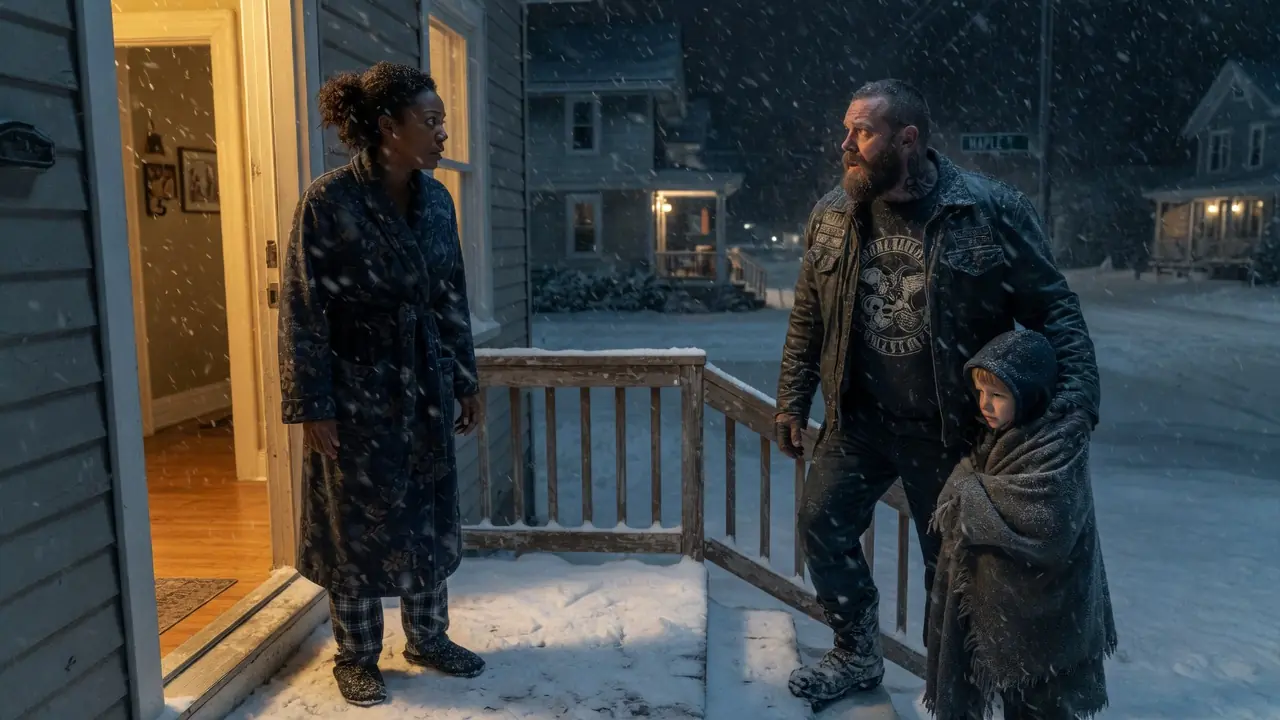
Outside stood a huge man in a Hell’s Angels jacket, holding a four-year-old boy whose lips had turned faintly blue from the cold.
Every fearful instinct in Diane Washington told her not to open the door.
But her kindness would not let her leave a child outside in the storm.
A few days later, hundreds of bikers showed up on Maple Street, and Diane finally understood that one frightened act of compassion had not only saved a little boy.
It had changed her own life too.
The blizzard hit Oakridge like a freight train.
By sunset, the wind was screaming through the streets at nearly sixty miles per hour, driving snow sideways and turning everything beyond the windows into a white blur. Power lines snapped under the weight of ice. One by one, the lights across town went dark.
Inside her small rental house at the end of Maple Street, Diane Washington sat on the edge of the couch with a flashlight in one hand and a blanket wrapped around her shoulders.
The house was cold.
Getting colder.
The furnace had stopped three hours earlier when the power went out, and the old windows did nothing to keep the wind from slipping in around the frames. The kitchen clock had frozen at 10:17 when the electricity died. The only light came from a camping lantern on the coffee table and the faint glow of the emergency candles Diane had placed safely inside glass jars.
At thirty-six, Diane knew how to pretend she was not scared.
Single mothers learned that skill early.
Her eight-year-old daughter, Amara, was asleep in the back bedroom under two quilts and a winter coat, her favorite stuffed rabbit tucked beneath one arm. Diane had checked on her six times since the power went out, each time touching her forehead, adjusting the blankets, and whispering, “You’re okay, baby. Mama’s here.”
Amara had asthma, and the cold always made Diane nervous.
The rescue inhaler was on the nightstand.
The backup inhaler was in Diane’s purse.
The nebulizer was useless without power, but Diane had already told herself not to think too long about that because panic never made a plan better.
She had lived in that house for seven years.
It was not beautiful, but it was theirs.
The porch sagged on one side, the kitchen cabinets stuck in damp weather, and the hallway floor creaked loudly enough to betray anyone walking to the bathroom at night. But it was the first home Diane had managed to keep after Amara’s father left.
He had disappeared when Amara was three.
At first, he still called.
Then the calls became late.
Then rare.
Then only birthdays.
Then not even that.
Diane stopped explaining his absence when Amara stopped asking.
She worked mornings at a laundromat, evenings three nights a week at a grocery store, and cleaned a dental office on Saturdays. Her hands were always dry from soap and bleach, her feet always sore, and her bank account always too close to empty.
But Amara had a bed, warm meals, school supplies, and a mother who showed up.
That counted.
Diane pulled the blanket tighter and looked toward the front window, where snow had piled halfway up the glass.
She should have taken Amara to her sister’s apartment before the storm got bad. But Tanya lived across town, and by the time the mayor declared emergency conditions, roads had already become dangerous.
So Diane stayed.
She had canned soup, crackers, bottled water, batteries, candles, and enough stubbornness to outlast one bad night.
At least, that was what she told herself.
The storm rattled the house.
Something metal banged outside, probably Mrs. Patterson’s loose garbage cans from next door.
Diane flinched anyway.
Three months earlier, someone had broken into the house while she and Amara were at church.
The back window had been shattered.
Muddy boot prints had crossed the kitchen floor.
The old television was gone, along with Diane’s small emergency cash jar and the gold necklace her mother had left her.
The police officer had stood in her kitchen and said, “You’re lucky you weren’t home, ma’am. People get hurt in break-ins like this.”
After that, Diane installed five locks on the front door.
A deadbolt.
A chain.
A sliding bolt.
A reinforced latch.
A cheap portable door brace she bought online after reading reviews until two in the morning.
Every night, she checked them twice.
Some nights, three times.
Safety was expensive when you were poor.
Fear was free.
Diane had just reached for the flashlight to check on Amara again when the pounding started.
Bang.
Bang.
Bang.
Her whole body froze.
The sound came from the front door.
Not the wind.
Not a branch.
Not a loose shutter.
A fist.
Someone was knocking at 2:03 in the morning in the middle of the worst blizzard Oakridge had seen in twenty years.
Bang.
Bang.
Bang.
Harder now.
More desperate.
Diane’s hand flew to her chest.
Her heartbeat slammed so fast it hurt.
She did not move at first.
She could not.
Every terrible possibility raced through her mind.
The break-in.
The muddy prints.
The officer’s warning.
The fact that the phone lines were down.
The fact that her cell phone had only nineteen percent battery left.
The fact that her daughter was sleeping in the back room.
“Go away,” Diane whispered into the dark.
For one second, she thought whoever it was had heard her and left.
Then a man’s voice came through the door, muffled by wind and wood.
“I know someone’s in there. Please. I need help.”
Diane’s stomach tightened.
No.
No, no, no.
Criminals could fake desperation.
People said anything to get inside.
She had seen enough local news, enough warnings, enough stories told in church parking lots by women who survived only because they listened to their fear.
She reached for her phone, but it was not beside her.
Charging in the bedroom.
Except the power was out now.
She remembered placing it on the dresser beside Amara’s inhaler after calling Tanya.
The man pounded again.
Bang.
Bang.
Bang.
“Please,” he shouted. “I’ll leave if you want. I swear I will. But please, can you just take him?”
Diane’s breath caught.
Take him?
She pushed herself up from the couch slowly, gripping the flashlight like a weapon.
Her knees felt weak, but she forced herself toward the hallway. Every board creaked beneath her feet. The house seemed darker than it had a minute before.
“Who are you?” she called, trying to make her voice stronger than she felt.
A gust of wind swallowed part of his answer.
“Name’s Marcus Boone,” he shouted. “My truck slid off the road. My phone’s dead. My boy’s freezing.”
Diane stopped halfway down the hall.
Boy.
“My son,” the man shouted. His voice cracked so sharply it cut through the storm. “He’s four. Please. He’s not breathing right. You don’t have to let me in. Just take my son.”
Diane closed her eyes.
For one second, she saw Amara at four years old, sitting on the edge of an emergency room bed, struggling through an asthma flare while Diane stood beside her trying not to cry.
She knew the sound of a child fighting for air.
She knew how fear rearranged a parent’s voice.
That voice outside did not sound fake.
It sounded broken.
Still, Diane moved carefully.
She reached the door and leaned toward the peephole.
What she saw made her blood turn cold.
A man stood on her porch, huge and broad-shouldered, snow whipping around him like the storm had followed him there personally.
He wore a black leather jacket beneath a frozen layer of snow.
Even through the tiny peephole, Diane could see patches on the back and shoulders.
A skull.
Wings.
Bold letters.
Hell’s Angels.
Her fingers tightened around the flashlight.
The man’s face was rough and unshaven, his dark hair wet from melted snow, his neck marked with tattoos that disappeared beneath his collar.
Every survival instinct Diane possessed screamed at her to back away.
Then he shifted.
And she saw the child in his arms.
A small boy wrapped in blankets, pressed against the man’s chest. Only part of his face was visible, but it was enough.
His eyes were closed.
His skin looked too pale beneath the porch light.
His lips had a bluish tint that made Diane’s heart lurch.
The boy moved faintly.
A weak, thin sound escaped him.
Diane’s fear shattered.
Not disappeared.
Shattered.
Because fear could protect a locked door, but it could not let a child freeze on the other side of it.
Her hands moved to the locks before she fully decided.
The first deadbolt slid open.
Then the chain.
Then the second latch.
Her fingers stumbled on the third lock because the cold had stiffened them. She muttered, “Come on, come on,” under her breath, fighting the metal until it gave.
Outside, the man’s voice broke.
“Thank you. Oh God. Thank you.”
Diane opened the door.
The wind hit her like a fist, stealing her breath and throwing snow into the hallway. Cold burned across her face. The man on the porch looked even larger up close, his body blocking half the doorway, but his eyes were not threatening.
They were terrified.
“My son,” he said. “His name is Caleb.”
Diane stepped aside.
“Get him in.”
The man hesitated.
“You sure?”
“Now.”
He entered carefully, turning his body so the child did not hit the doorframe. Snow fell from his boots and jacket, melting instantly on the old hallway floor.
Diane slammed the door against the wind and locked only the main deadbolt with shaking hands.
“Bring him to the couch,” she said.
The man obeyed.
That surprised her.
Men that big rarely looked like they were used to obeying anyone.
But Marcus Boone moved exactly where she told him, his arms curved protectively around the child.
The camping lantern threw gold light across the little boy’s face.
Diane’s stomach dropped.
Caleb was four, maybe small for his age, with dark curls damp against his forehead and lashes stuck together from melted snow. His breathing was shallow and uneven.
Not gone.
But wrong.
Diane forced herself not to panic.
Panic wastes time.
“Is he wet?” she asked.
Marcus nodded, voice hoarse.
“Truck heater died after we slid. I wrapped him in everything I had, but we walked. I couldn’t keep the wind off him.”
“How long?”
“I don’t know. Maybe twenty minutes. Maybe more.”
Diane pulled the coffee table aside.
“Lay him here. Gentle.”
Marcus knelt beside the couch and lowered Caleb as if placing down something made of glass.
Diane ran to the hallway closet and grabbed towels. Then she hurried to the bedroom for her phone and Amara’s extra blankets.
Amara stirred when Diane entered.
“Mama?”
Diane kept her voice soft.
“Stay in bed, baby. Someone needs help.”
“Are we okay?”
“Yes. Stay warm.”
When Diane returned, Marcus had removed his jacket and was rubbing Caleb’s hands between his own.
His arms were covered in tattoos.
His T-shirt was soaked.
His face was tight with fear.
Diane dialed 911.
The call took two tries before it connected.
“This is 911. What is your emergency?”
“I have a four-year-old child, very cold, weak breathing, exposed to blizzard conditions,” Diane said quickly. “Power is out. We need help.”
The dispatcher asked for the address.
Diane gave it.
“Roads are blocked in your area,” the dispatcher said. “We have emergency crews delayed, but I’m sending the call through. I need you to keep him warm, but do not use hot water or direct heat. Remove wet clothing if possible, wrap him in dry blankets, warm the room as safely as you can.”
Diane repeated the instructions.
Her voice shook, but her mind stayed focused.
She had cared for Amara through enough breathing scares to know that fear could sit beside action as long as it did not take the wheel.
She turned to Marcus.
“We need to get the wet layers off.”
His eyes widened.
“I don’t know—”
“I do,” Diane said firmly. “Help me.”
Together, they removed the damp outer blankets and Caleb’s wet little coat. Diane wrapped him in dry towels first, then blankets, then tucked a warmed towel from near the kitchen stove around his feet.
She had an old gas stove with a manual lighter. She had used it earlier to warm soup, leaving one pot of water near it in case she needed heat.
Now she filled a mug with warm, not hot, water and set it nearby.
“Don’t make him drink unless he’s alert,” the dispatcher said through the phone.
“I understand.”
Marcus hovered, huge and helpless.
Diane looked at him.
“Take off that wet shirt.”
He blinked.
“What?”
“You’re soaked too. You pass out on my floor, and I’ve got two emergencies. There are towels in the bathroom. Go.”
“I’m not leaving him.”
“You can see him from the hallway. Go.”
For a second, he looked like he might argue.
Then Caleb made another weak sound.
Marcus’s face crumpled.
“I’m right here, buddy,” he whispered. “Daddy’s right here.”
Diane’s hands stilled for half a second.
Daddy.
Not biker.
Not stranger.
Not danger.
Daddy.
She looked at Marcus again and saw past the leather, the tattoos, the size, the reputation stitched on his back.
She saw a father terrified of losing his child.
“Bathroom,” she said more gently. “Dry towel. Now.”
Marcus obeyed.
Diane stayed with Caleb, rubbing his arms through the blanket, speaking softly.
“Come on, sweetheart. You’re safe now. You’re in a warm house. Your daddy got you here.”
Caleb’s eyelids fluttered.
Diane leaned closer.
“That’s it. Stay with us.”
From the bedroom hallway, Amara appeared wrapped in two blankets, her eyes wide.
Diane turned sharply.
“Amara, I told you to stay in bed.”
“I heard a kid.”
Diane softened despite the urgency.
“He’s very cold.”
Amara looked at Caleb, then disappeared into her room.
“Amara!”
She came back carrying her stuffed rabbit, the one she slept with every night.
She walked to the edge of the couch and placed it beside Caleb’s hand.
“For him,” she whispered. “If he wakes up scared.”
Marcus reappeared in a dry towel over his shoulders, his wet T-shirt gone, wearing only a thermal undershirt beneath. He saw the rabbit, then looked at Amara.
His eyes filled.
“Thank you,” he said, voice rough.
Amara hid slightly behind Diane.
“You’re big.”
Marcus let out a broken laugh that sounded almost like a sob.
“I know.”
Diane guided Amara back toward the bedroom.
“Baby, stay where it’s warm. I mean it this time.”
Amara nodded and whispered, “Don’t let him die, Mama.”
Diane’s throat tightened.
“I won’t.”
But she knew promises like that were dangerous.
No mother controlled the world.
Still, she went back to the couch and fought as if she did.
Minutes stretched.
The dispatcher stayed on the line as long as the signal allowed, then the call dropped.
Diane tried calling again but could not reconnect.
Outside, the storm continued to batter the house.
Inside, the little circle of lantern light held.
Marcus knelt beside the couch, one hand hovering over Caleb as though he was afraid to touch too much and afraid not to.
Diane kept checking Caleb’s breathing, his skin, his response to her voice.
After what felt like forever, the boy stirred.
His lips parted.
“Daddy?”
Marcus bent over him instantly.
“I’m here. I’m here, little man.”
Caleb’s eyes opened halfway.
He looked confused.
Then he saw Diane.
His small brow furrowed.
“Where?”
Diane smiled through sudden tears.
“My house. You’re safe.”
Caleb’s gaze shifted toward the stuffed rabbit.
“Bunny.”
Amara’s voice called softly from the hallway, “You can hold him.”
Diane turned.
Her daughter had ignored instructions again and was peeking from the bedroom door.
Caleb’s fingers moved weakly toward the rabbit.
Diane placed it into his hand.
Marcus covered his mouth.
His shoulders began to shake.
This enormous man, covered in tattoos, wearing a Hell’s Angels jacket, kneeling in Diane’s freezing living room, started crying silently beside his son.
Diane looked away to give him dignity.
She knew what it was to break quietly because a child was breathing again.
The emergency crew arrived nearly forty minutes later, led by a snowplow and two paramedics bundled in heavy gear.
By then, Caleb was more responsive, still weak but awake enough to ask for his father and clutch Amara’s stuffed rabbit to his chest.
The paramedics checked him, wrapped him in thermal blankets, and praised Diane for warming him carefully.
Marcus kept saying, “She saved him.”
Diane kept saying, “I did what anyone should have done.”
One paramedic looked at the five locks on the door, then at the huge biker standing in the hallway, then at the single mother in worn pajamas and a robe, and seemed to understand more than she said.
“Not everyone would have opened,” she told Diane quietly.
Diane did not answer.
Marcus carried Caleb to the ambulance because Caleb began crying when the paramedics tried to lift him without his father.
Before stepping outside, Marcus turned back.
Snow swirled behind him.
His Hell’s Angels jacket hung heavy and wet over one arm.
“What’s your name?” he asked.
“Diane Washington.”
He repeated it like he was memorizing more than a name.
“Diane Washington.”
Then he looked toward Amara, who stood behind her mother.
“And yours?”
Amara whispered, “Amara.”
Marcus nodded.
“My boy’s going to want to return the rabbit.”
Amara lifted her chin.
“He can keep it until he’s not scared.”
Marcus’s face changed.
“Thank you.”
Then he was gone into the storm.
The ambulance lights disappeared behind the snow.
Diane locked the door again with shaking hands.
All five locks.
Then she turned and found Amara staring at her.
“Mama?”
“Yes, baby?”
“You opened the door even though you were scared.”
Diane sat heavily on the couch.
Her knees were shaking now that the emergency had passed.
“Yes.”
“Was that brave?”
Diane pulled Amara into her arms.
“I don’t know,” she whispered. “It was necessary.”
Amara leaned against her.
“I think necessary can be brave.”
Diane closed her eyes.
Maybe it could.
The next two days passed strangely.
The power returned the following afternoon, though the furnace still struggled.
Diane called the hospital twice, but without Caleb’s last name, she could not get information.
She did not even know Marcus’s full name.
Only Marcus Boone.
Only that he had a son with dark curls.
Only that he rode with a club people feared.
Only that his fear had sounded just like hers.
By the third day, Oakridge had begun digging itself out.
Snowbanks lined the streets higher than car hoods. Neighbors shoveled driveways. Kids climbed piles of snow at the ends of sidewalks. Plows carved gray paths through the white.
Diane was in the kitchen trying to stretch a pot of beans into two dinners when the rumble began.
At first, she thought it was a snowplow.
Then the sound grew.
Deeper.
Wider.
Rolling through the street like thunder trapped under pavement.
Amara ran to the front window.
“Mama.”
Diane wiped her hands and joined her.
Her heart nearly stopped.
Motorcycles.
Dozens of them.
Then more.
They rolled slowly down Maple Street in a long, disciplined line, engines low, headlights glowing in the pale winter afternoon.
Behind them came pickup trucks.
Vans.
SUVs.
Men and women in leather jackets and heavy boots.
Some neighbors came out onto porches.
Mrs. Patterson next door crossed herself.
Diane’s first instinct was fear.
Then the line stopped in front of her house.
One motorcycle rolled forward.
Marcus Boone got off.
He was dressed in the same black leather jacket, now clean and dry, the Hell’s Angels patch visible across his back.
But in his arms was Caleb, bundled in a red coat, wearing a knit hat too big for his head.
The boy was awake.
Pink-cheeked.
Alive.
And in one hand, he held Amara’s stuffed rabbit.
Diane opened the door before Marcus knocked.
Cold air rushed in, but this time it did not bring fear with it.
Marcus stood at the bottom of the porch steps, looking up at her.
Behind him, more bikers continued arriving until the whole block seemed filled with chrome, leather, and watchful silence.
Diane looked around, overwhelmed.
“What is this?”
Marcus climbed the steps slowly.
Caleb leaned against his shoulder.
“Say it, buddy,” Marcus whispered.
Caleb looked at Diane, then at Amara peeking from behind her mother.
“Thank you,” he said softly.
Amara smiled.
“You can keep Bunny longer.”
Caleb clutched the rabbit.
Marcus’s eyes shone.
“He wouldn’t let it go at the hospital.”
Diane pressed one hand to her chest.
“He’s okay?”
“Because of you.”
“The paramedics—”
“Because of you,” Marcus repeated.
He looked back toward the street.
Every biker there seemed to stand a little straighter.
“My brothers heard what happened,” he said. “They heard a woman with a child of her own opened her door in a storm to a man she had every reason to fear.”
Diane swallowed.
Marcus continued.
“They heard you took my son in, warmed him, calmed him, and treated him like he mattered before you knew my name.”
Diane’s throat tightened.
“He’s a child.”
“Yes,” Marcus said. “And you remembered that before you remembered the jacket.”
The words landed deeply.
Because he was right.
For one terrible minute, she had seen the jacket first.
Then she had seen the boy.
Marcus stepped back and gestured toward the trucks.
“We came to return kindness.”
Diane looked past him.
The pickup beds were full.
Boxes of groceries.
Bottled water.
Firewood.
Blankets.
Space heaters.
A generator.
Toolboxes.
A new storm door.
Bundles of insulation.
A furnace repair van pulled in behind the motorcycles, followed by two men wearing work jackets with a heating company logo.
Diane shook her head.
“No. No, I can’t—”
Marcus looked at her gently.
“You can.”
“I didn’t help you for this.”
“I know.”
“I don’t need—”
He tilted his head toward her front window, where plastic sheeting fluttered under tape.
Then toward the porch step that sagged dangerously.
Then toward the chimney where smoke had not risen because she had no working backup heat.
Diane felt shame flare hot in her face.
Marcus saw it and immediately softened his voice.
“This is not charity,” he said. “This is debt.”
“I don’t want you owing me.”
“Too bad.”
Amara whispered, “Mama, his kid almost died.”
“Amara.”
“I’m just saying,” Amara whispered back. “If someone saved me, you’d bring them everything too.”
Diane closed her eyes.
Her daughter had a gift for cutting straight through pride.
Marcus knelt carefully so Caleb could stand on the porch.
The little boy held the rabbit in one arm and took something from his coat pocket with the other.
A small drawing.
He handed it to Diane.
It showed a house in a snowstorm.
A big man.
A small boy.
A woman opening a door.
And a little girl holding a rabbit.
At the top, in uneven letters, someone had helped him write:
THANK YOU FOR LETTING US IN.
Diane covered her mouth.
Tears rose before she could stop them.
Marcus stood.
“My wife died two years ago,” he said quietly. “Caleb’s all I have.”
Diane lowered her hand.
“I’m sorry.”
“He had a fever that night. Roads were already bad, but I thought I could get him to urgent care before the storm closed everything. Truck slid into a ditch. Phone died. I saw your porch light.”
His voice roughened.
“I knocked on three doors before yours.”
Diane went still.
“Three?”
He nodded.
“One light turned off while I was standing there.”
The cold that moved through Diane then had nothing to do with weather.
She looked down at Caleb, alive and holding Amara’s rabbit.
Three doors.
Three chances.
Three noes.
Then hers.
“I almost didn’t open,” she whispered.
Marcus’s eyes held hers.
“But you did.”
Behind him, the bikers began unloading without fanfare.
They did not rush the house.
They did not crowd her porch.
They moved with surprising care, waiting for Marcus’s nod, placing boxes neatly near the steps, carrying tools to the side yard, speaking quietly to one another.
A woman with gray braids and a leather vest approached with a clipboard.
“My name’s Red,” she said. “I coordinate when these fools decide to be useful. May I come in and check where the generator can safely connect?”
Diane blinked.
“You have a clipboard.”
Red smiled.
“Without me, they’d fix the roof before asking if you wanted the roof touched.”
From the street, one biker shouted, “We heard that.”
“You were meant to,” Red called back.
Amara giggled.
The sound eased something in Diane’s chest.
By evening, Maple Street looked like a work site.
The furnace repair crew had the heat running properly for the first time in years.
Two bikers repaired the sagging porch step.
Another sealed the drafty front window.
Someone replaced the broken back window latch left over from the break-in.
A retired electrician checked the fuse box.
Red organized donated groceries into Diane’s pantry with military precision and made a list of what Amara liked to eat.
Diane tried to help and was repeatedly told to sit down.
She ignored them and carried small things anyway.
Pride still needed something to do.
Neighbors watched from porches at first.
Then, slowly, they came closer.
Mrs. Patterson brought coffee.
Mr. Lewis from across the street offered a snow shovel.
By sunset, half the block was helping clear the sidewalk while bikers worked on Diane’s house under the fading winter light.
No one said much about fear.
No one needed to.
Everyone understood that something had shifted.
The people they would have crossed the street to avoid were fixing a single mother’s furnace because she had opened a door no one else would.
That night, Diane cooked the largest pot of chili she had ever made.
It was not enough for everyone, so Red ordered pizzas.
Marcus tried to pay.
Red swatted his hand away.
“The club fund covers food,” she said.
“We have a club fund for pizza?” Diane asked.
Red looked at her seriously.
“We have a club fund for emergencies.”
“Pizza is an emergency?”
“With this many men standing around hungry? Absolutely.”
For the first time in three days, Diane laughed hard enough to feel warm without a blanket.
Caleb and Amara sat at the kitchen table coloring together.
The stuffed rabbit sat between them like a peace treaty.
Marcus stood in the doorway watching them, his expression softer than Diane would have expected from a man who looked like him.
“She’s a good kid,” he said.
“Amara?”
He nodded.
“She gets it from you.”
Diane looked down.
“I’m still figuring it out.”
“Parenting?”
“Everything.”
Marcus leaned against the doorframe.
“Yeah. Me too.”
For a moment, they were not a Hell’s Angels biker and a single mother from Maple Street.
They were just two parents watching their children breathe safely in a warm kitchen.
That was enough.
Later, after most of the bikers had gone and only a few remained outside to finish securing the generator, Marcus stood on the porch with Diane.
The storm had passed fully now.
The sky was black and clear, stars sharp above the snow-covered street.
Diane wrapped her sweater around herself and looked at the repaired step beneath their feet.
“You didn’t have to do all this.”
Marcus looked out at the street.
“Yes, I did.”
“Why?”
He was quiet for a moment.
“Because the world teaches people to look away from men like me,” he said. “And maybe sometimes they’re right to be careful.”
Diane did not interrupt.
“But you looked twice,” he continued. “You saw my jacket. Then you saw my son.”
His voice lowered.
“Most people stop at the first thing.”
Diane thought about the doors that had stayed shut before hers.
“I almost did.”
“But you didn’t.”
She looked at him.
“I was scared.”
“I know.”
“I have a daughter. I had to think about her.”
“You should have.”
“I still opened.”
Marcus turned toward her.
“That’s why we came.”
Diane did not answer.
A person could go years believing their small choices did not matter.
Then one night proved otherwise.
Marcus reached into his jacket and pulled out an envelope.
Diane immediately shook her head.
“No.”
“You don’t know what it is.”
“It’s money.”
“Yes.”
“No.”
“Diane—”
“No.”
Her voice was firm enough that he stopped.
“I’m grateful for the repairs,” she said. “I don’t know how to accept all of that yet, but I’m trying. But I won’t take cash from you like I sold kindness.”
Marcus studied her.
Then nodded slowly.
“All right.”
That surprised her.
“No argument?”
“I’ve met Red. I know when arguing is pointless.”
Diane smiled despite herself.
Marcus tucked the envelope away.
“Then I’ll put it toward something else.”
“What?”
He looked through the window at Amara and Caleb coloring.
“A college fund.”
Diane turned sharply.
“No.”
“Not just for Amara. For both of them. In Caleb’s name and hers. Equal deposits. Legal paperwork. You control her side.”
Diane stared.
“That is still too much.”
“My son is alive.”
Her protest died.
Marcus’s voice broke slightly.
“I watched his lips turn blue in my arms, Diane. I knocked on doors and heard locks stay locked. Then yours opened.”
Diane’s eyes filled.
He continued.
“You gave me more years with my boy. I can’t repay that. But I can make sure your girl has more doors open for her than you did.”
Diane looked away before tears fell.
No one had ever said something like that about Amara.
Not Amara’s father.
Not Diane’s family.
Not anyone.
“She wants to be a veterinarian this week,” Diane whispered.
Marcus smiled faintly.
“Caleb wants to be a dinosaur.”
“That may require a different fund.”
“Red can research it.”
Diane laughed through tears.
For the first time in a long time, the future felt like something other than a bill coming due.
The story spread through Oakridge by morning.
Not accurately, of course.
Stories rarely travel unchanged.
Some said Diane fought through a gang to save a child.
She had not.
Some said the bikers bought her a new house.
They had not.
Some said Marcus Boone was dangerous and Diane should be careful.
That one, Diane thought, might still be true in some ways.
But she had learned something the night of the storm.
Danger and tenderness could exist in the same person.
So could fear and courage.
So could poverty and generosity.
The repairs changed Diane’s life in practical ways first.
The house stayed warm.
Amara’s asthma improved through the rest of the winter.
The new lock on the back window helped Diane sleep.
The groceries carried them through three weeks without Diane needing to skip meals and call it “not hungry.”
The generator meant the next power outage would not turn the house into an icebox.
But the deeper change came quietly.
Marcus checked in every few days.
At first, Diane resisted.
Then she accepted.
Sometimes he texted: Caleb says Bunny likes oatmeal.
Sometimes she replied: Bunny has strange taste.
Red began stopping by with paperwork Diane did not want to understand but appreciated anyway.
College fund forms.
Home repair warranties.
A list of winter assistance programs Diane had never known existed.
A name of a legal clinic that helped single parents with custody and child support issues.
“Why are you doing all this?” Diane asked her once.
Red looked offended.
“Because you opened the door.”
“That can’t be the answer to everything.”
“It can if we decide it is.”
Diane had no argument for that.
Spring came slowly.
Snow melted into dirty piles along the curbs.
The repaired porch dried in the sun.
Amara and Caleb became friends in the uncomplicated way children sometimes manage faster than adults.
Caleb was shy at first, staying close to Marcus’s leg whenever they visited. But Amara showed him how to draw rabbits with superhero capes, and soon he was laughing at her kitchen table like he had always belonged there.
Marcus never entered Diane’s house without knocking.
Even after months.
Even when invited.
That mattered to her more than she knew how to explain.
One Saturday in April, Diane found him fixing the loose railing beside the porch steps while Caleb and Amara drew chalk pictures on the sidewalk.
“You know that was already fixed,” she said from the doorway.
Marcus looked up.
“It was improved. Not fixed.”
“You just like having tools in your hands.”
“That too.”
She leaned against the doorframe.
“You don’t have to keep proving you’re safe.”
His expression changed.
Slowly.
Carefully.
“I’m not proving it to you.”
“No?”
He tightened a screw, then said, “I’m reminding myself.”
Diane did not know what to say.
Marcus sat back on his heels.
“I spent a lot of years being the man people crossed the street to avoid. Some of it earned. Some of it not. But when Caleb’s mother died, I realized my son was going to learn what kind of man I was by watching who I became after losing her.”
Diane looked at Caleb, who was coloring a blue dinosaur beside Amara’s purple rabbit.
“His mother died?”
“Three years ago.”
“I’m sorry.”
“Me too.”
“Is that why it’s just you two?”
Marcus nodded.
“Her family doesn’t like my world. My world doesn’t know what to do with grief unless it can ride away from it.”
Diane understood that too well.
“My world doesn’t know what to do with single mothers except tell us to be strong and then act surprised when we’re tired.”
Marcus smiled sadly.
“That sounds about right.”
They sat in the quiet for a while, watching the children turn the sidewalk into a rainbow of chalk creatures.
Then Diane said, “Amara’s father left when she was little.”
Marcus looked at her.
“He ever come back?”
“No.”
“His loss.”
Diane gave a small laugh.
“People say that like it fixes anything.”
“It doesn’t.”
“No.”
“But it’s still true.”
That sentence stayed with her.
By summer, Diane no longer felt startled when motorcycles turned onto Maple Street.
The neighbors no longer hid behind curtains either.
Mrs. Patterson brought lemonade.
Mr. Lewis asked Marcus about fixing his lawn mower.
Red organized a neighborhood safety day that somehow involved both fire extinguishers and barbecue.
The five locks remained on Diane’s door.
But she no longer checked them three times every night.
Sometimes only once.
Healing did not always look like forgetting fear.
Sometimes it looked like needing less of it.
On the one-year anniversary of the blizzard, Marcus and the club returned to Maple Street again.
This time, Diane knew they were coming.
So did the whole neighborhood.
The street was blocked off with city permission.
A long row of motorcycles gleamed beneath a pale winter sun.
There were food tables, heaters, blankets, donation boxes, and a banner stretched across Diane’s porch that read:
THE OPEN DOOR WINTER DRIVE
Diane had argued about the name.
She had lost.
The drive collected coats, blankets, batteries, portable chargers, children’s winter boots, and emergency supplies for families across Oakridge.
Red ran the sign-in table.
Marcus carried boxes.
Caleb and Amara handed out hot chocolate with great seriousness.
Diane stood near the porch watching strangers come for help without shame.
Mothers.
Grandparents.
Single fathers.
Elderly neighbors.
People who worked hard and still got cold.
People who had been one storm away from disaster, the way Diane had been.
At noon, Marcus climbed the porch steps and quieted the crowd.
Diane immediately felt nervous.
She hated public attention.
Marcus knew that.
Which meant he only did this because he thought it mattered.
“A year ago,” he said, his voice carrying over the street, “my truck went off the road in a storm. My son was freezing in my arms. Three doors stayed shut.”
The crowd went silent.
Diane looked down.
Marcus turned slightly toward her.
“Then this door opened.”
Every eye moved to Diane.
She wanted to disappear, but Amara slipped her hand into hers.
Marcus continued.
“Diane Washington did not know me. She had every reason to fear me. She had her own child to protect. But she saw my boy and chose compassion.”
His voice grew rough.
“My son is alive because she opened the door.”
Caleb, standing beside Red, lifted one hand shyly.
The crowd softened.
Marcus looked back at everyone.
“So today, we open more doors. We keep more houses warm. We make sure no parent has to stand in a storm begging strangers to care.”
Applause rose.
Not loud at first.
Then stronger.
Diane cried despite herself.
Amara squeezed her hand.
“You’re brave, Mama,” she whispered.
Diane looked down at her daughter.
“No,” she said softly. “I was scared.”
Amara smiled.
“I know. That’s why it counts.”
That evening, after the drive ended and the last boxes had been loaded for delivery, Diane stood on the porch with Marcus.
Snow began to fall lightly.
Not a blizzard.
Just soft flakes drifting through the streetlight.
Inside, Amara and Caleb were arguing over whether rabbits or dinosaurs made better superheroes.
Red was in the kitchen pretending not to listen while absolutely listening.
The house was warm.
The porch was steady.
The door was repaired, sealed, and strong.
Diane looked at Marcus.
“Do you ever think about that night?”
“Every day.”
“Me too.”
“I still hear the first door closing,” he said.
Diane’s chest tightened.
“I still hear your knock.”
Marcus looked at her.
“I’m sorry I scared you.”
“I’m not.”
He frowned.
She smiled faintly.
“I needed to know I could be scared and still do the right thing.”
Marcus turned toward the street.
“That night changed me.”
“It changed me too.”
“How?”
Diane thought about it.
About all the years she had lived believing help was something she gave but could not accept.
About being a single mother who measured safety in locks, money in coins, and love in sacrifices no one saw.
About opening the door to a man the world had taught her to fear and finding a father desperate to save his son.
“It made the world bigger,” she said.
Marcus looked back at her.
“Bigger?”
“I thought it was just me and Amara against everything. Then one night, I opened the door, and somehow the whole world came back through it.”
Marcus’s expression softened.
“You opened it first.”
Diane looked through the window at the children laughing.
“Yes,” she said. “I did.”
And for once, that truth did not make her feel burdened.
It made her feel strong.
Not the lonely kind of strong people praised when they wanted to avoid helping.
A different kind.
The kind built from community, repaired steps, shared blankets, warm houses, and children who survived storms because someone answered when the world knocked.
Diane Washington had opened her door during a blizzard.
She thought she was saving a little boy.
But in the months that followed, she realized the storm had carried more than danger to her porch.
It had carried friendship.
Protection.
Purpose.
A second family made of unlikely people with leather jackets, loud engines, soft hearts, and debts they repaid with hammers, groceries, college funds, and loyalty.
Most of all, it had carried back warmth.
The kind her house had been missing.
The kind her heart had forgotten it needed.
And every winter after that, when snow began falling over Oakridge, Diane checked her locks only once.
Then she turned on the porch light.
Just in case someone out there needed to find an open door.