Grace Holloway had been awake since five-thirty that morning, long before the first customer pushed through the door of Miller’s Diner. She had packed her son’s lunch, searched under the couch for his missing math worksheet, and counted the cash in her wallet twice before deciding she could afford gas only if she skipped breakfast. At forty-two, she no longer believed life became easier if a person worked hard enough, but she still believed work was the only rope she had left to hold. So she tied her faded blue apron around her waist, lifted the coffee pot, and smiled like her feet did not already ache.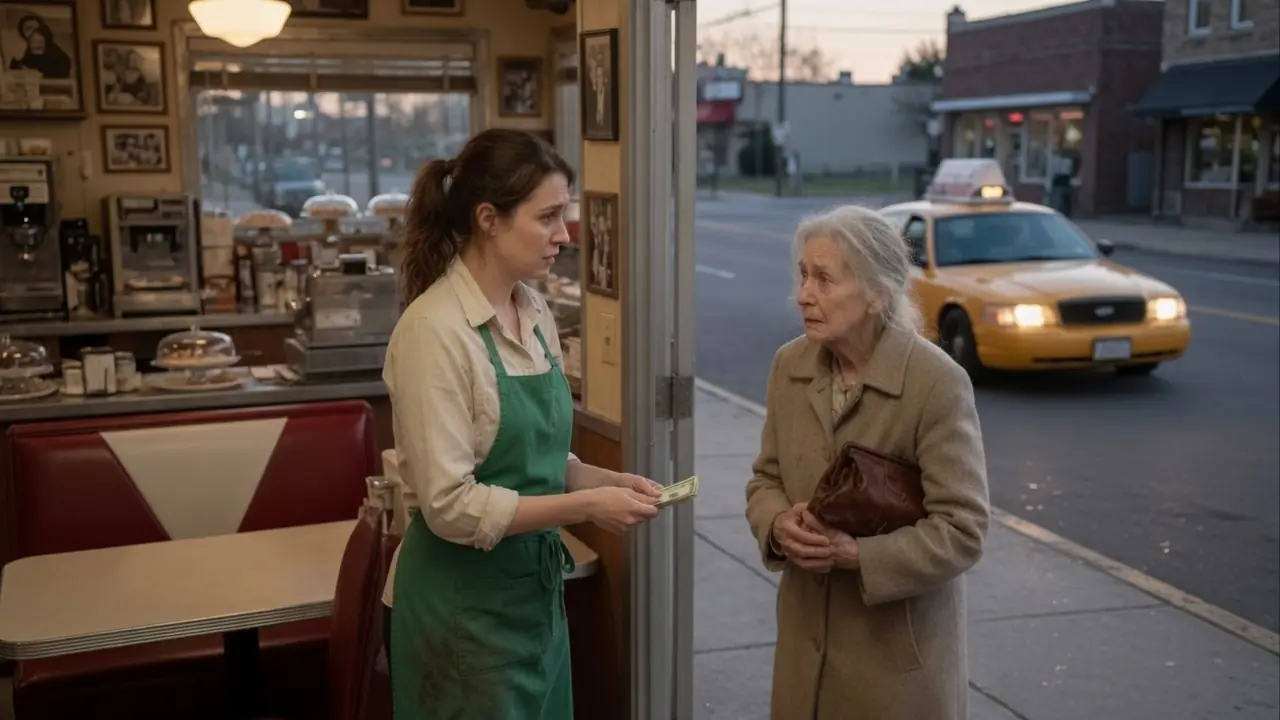
Miller’s Diner sat on the edge of a tired Columbus neighborhood, where the roads were patched, the streetlights flickered, and the same customers came every morning because habit was cheaper than hope. The inside smelled of coffee, toast, bacon grease, and lemon cleaner. Red vinyl booths lined the windows, and framed black-and-white photos of the old city hung crookedly on the walls. Grace knew which booth stuck in winter, which table needed sugar packets first, and which customers would complain even when their eggs were perfect.
She moved quickly between tables with an order pad tucked inside her apron pocket. Her hair was tied back, her sleeves rolled, and her smile ready before anyone earned it. A truck driver wanted black coffee and two eggs over easy. A retired couple split pancakes and argued gently over the crossword. A young mother bounced a baby on her knee while trying to drink coffee before it went cold.
Grace treated them all kindly because kindness was the only thing she could give without checking her bank account first. Her son, Noah, was nine and still sleeping in a bedroom with a cracked window Grace had patched with tape until she could afford a real repair. He needed new shoes, a winter coat, and money for a school field trip he had not asked about twice because he had already learned too much from her tired face. Grace hated that most of all.
By midmorning, the rush had thinned. Rain from the night before still clung to the sidewalk outside, and the morning sun came through dusty windows in pale strips across the floor. Grace refilled ketchup bottles, wiped down the counter, and slipped two dollar bills from her tip pocket into a separate envelope marked rent. It was not enough, but it was something.
Her manager, Carl Benson, watched from behind the register. He was not cruel in a dramatic way. He was the kind of man who thought every problem could be solved by telling someone to be realistic. He often reminded Grace that single mothers needed steady choices, not soft hearts. Grace usually nodded, because she needed the schedule and did not have the strength to argue every time he mistook exhaustion for weakness.
The bell above the door rang, but no one stepped fully inside. Grace turned and saw an elderly woman standing just outside the open doorway, clutching a brown purse against her chest. A yellow taxi idled at the curb behind her with its meter still running. The woman’s gray coat looked too thin for the damp morning, and loose strands of white hair framed a face full of panic.
Grace set down the rag and walked toward her. “Ma’am, are you all right?”
The woman looked at the taxi, then at Grace, then down at her open purse. Her hands trembled so badly the clasp clicked against the leather. “I had my wallet when I left home,” she whispered. “Now I can’t pay the taxi cash.”
The taxi driver leaned from the window, impatient but not unkind. “Lady, I can’t sit here all morning. Meter’s running.”
The old woman flinched as if the words had struck her. Grace felt something tighten in her chest. She knew that look. It was the look of someone realizing the world had decided her problem was an inconvenience.
Grace stepped out onto the threshold. “How much is it?”
The driver glanced at the meter. “Eighteen seventy-five.”
Grace had twenty-three dollars in her apron pocket, plus the rent envelope she had not yet hidden in her locker. Eighteen seventy-five meant groceries would be thinner. It meant she would have to tell Noah they were making “breakfast dinner” again, which was her way of making eggs sound exciting. It meant one more tiny sacrifice stacked on top of too many others.
Still, she reached into her apron.
“It’s okay, ma’am,” Grace said softly, holding out the cash. “I’ll pay it before the driver leaves you stranded.”
The elderly woman’s eyes filled immediately. “Dear, you don’t even know me.”
Grace gave the driver the money, then looked back at her. “I know you’re scared, and today that’s enough reason for me to help.”
The driver counted the bills, nodded, and pulled away from the curb. The yellow taxi disappeared down the street, leaving the elderly woman standing there as though she still expected punishment. Grace gently guided her inside and led her to the booth nearest the counter.
“What’s your name?” Grace asked.
“Ruth,” the woman said after a pause. “Ruth Mallory.”
“Well, Mrs. Mallory, let’s get you warm.”
“I’m not hungry.”
“I didn’t ask if you were hungry.” Grace smiled. “I said let’s get you warm.”
She brought coffee, toast, and a small bowl of oatmeal. Ruth tried to refuse all three, but Grace placed them on the table anyway. Ruth wrapped both hands around the mug and stared into it like it contained an answer she had misplaced. Her breathing slowly steadied.
Carl appeared near the end of the counter, arms folded. “Grace.”
She knew that tone. “Just a minute.”
He lowered his voice. “Did you pay that cab?”
“Yes.”
“With your own tips?”
“Yes.”
Carl looked toward Ruth, then back at Grace. “You can’t keep doing things like that.”
“I don’t keep doing things like that.”
“You do whenever someone looks sad enough.” He sighed. “Kindness is nice, Grace, but kindness won’t pay your rent.”
Grace glanced at Ruth, who was breaking her toast into tiny pieces with trembling fingers. “Maybe not. But it got her out of the rain.”
Carl shook his head and walked away, muttering about soft hearts and unpaid bills. Grace returned to Ruth’s booth and pretended she had not heard. But Ruth had heard enough. Her eyes lifted with shame.
“I caused trouble.”
“No, ma’am.”
“I didn’t mean to lose it.” Ruth touched her purse again. “My son tells me to keep my wallet zipped. He worries.”
“What’s your son’s name?”
Ruth hesitated. “Frankie. No, Francis. But nobody calls him that.” A faint smile touched her mouth. “They call him Bear.”
Grace blinked. “Bear?”
“He’s a good boy.” Ruth looked down at her coffee. “Big, though. Scares people before he opens his mouth.”
Grace smiled gently. “Sounds like he loves you.”
Ruth’s expression softened. “He does. Too much sometimes.”
Grace asked if Ruth knew his phone number, but Ruth became flustered searching through her purse. There was no wallet, no phone, only tissues, a folded church bulletin, and a small packet of peppermints. Grace found a card tucked in the side pocket with the name Frank Mallory and a number written on the back in thick black ink.
“May I call him?”
Ruth nodded, then grabbed Grace’s wrist. “Don’t make him angry.”
Grace squeezed her hand. “I’ll just tell him you’re safe.”
The first call went to voicemail. The second rang without answer. Grace left a message with the diner number, explaining that Ruth Mallory was safe at Miller’s Diner and had misplaced her wallet. She kept her voice calm because she did not want to frighten a stranger more than necessary.
Ruth stayed for twenty more minutes. She drank half the coffee and ate three bites of oatmeal. Then she looked out the window and suddenly seemed to recognize the block. “My church is two streets over,” she said. “My neighbor volunteers there on Tuesdays.”
Grace did not like the idea of Ruth walking alone, so she called the church. A woman named Linda answered, gasped when she heard Ruth’s name, and said she would come immediately. When Linda arrived, she hugged Ruth hard enough to make the old woman laugh weakly.
Before leaving, Ruth reached for Grace’s hand. “I’ll pay you back.”
Grace shook her head. “You don’t need to.”
“I will.” Ruth’s eyes sharpened for one clear second. “My boy will make sure.”
Grace smiled, thinking it was only the pride of a mother who hated owing anyone. “You just get home safe.”
Ruth left with Linda, and Grace went back to work. She cleared plates, poured coffee, and smiled at customers who had no idea she had just spent almost her entire tip pocket. Her stomach was empty, but she ignored it. Some days, doing the right thing still hurt afterward.
An hour later, the phone rang behind the counter.
Carl picked it up first. “Miller’s Diner.”
His expression changed almost immediately. “Hold on.”
He covered the receiver and looked toward Grace. “Someone named Bear wants the waitress who helped his mother.”
The diner seemed to quiet around her. Grace wiped her hands on her apron and took the phone. “This is Grace.”
The voice on the other end was deep, rough, and tight with emotion. “You paid my mother’s taxi?”
Grace swallowed. “I did.”
“Ruth Mallory?”
“Yes, sir. She was safe when she left. A woman from her church picked her up.”
“I know.” The man exhaled hard. “She’s home now.”
Grace closed her eyes in relief. “I’m glad.”
There was a pause. “She keeps saying a waitress paid cash because she looked scared.”
Grace looked down at the counter. “She was scared.”
“She said you didn’t ask questions.”
“I asked a few.”
“She said you didn’t make her feel small.”
Grace’s throat tightened. “Nobody should.”
Another silence followed. Then the man said, “My name is Frank Mallory. People call me Bear. I ride with the Hell’s Angels.”
Grace’s hand tightened around the receiver.
He seemed to hear the shift in her breathing. “Don’t worry. I’m not calling to scare you.”
“I didn’t think you were,” Grace lied.
A low, sad laugh came through the line. “Yes, you did. Most people do.”
Grace said nothing.
“My mother’s wallet fell between the taxi seats. Driver found it and called me after you paid him. She has early memory trouble, and when she panics, she loses track of everything.” His voice roughened. “She could’ve wandered off. She could’ve been embarrassed and refused help. Instead, she sat in your diner with coffee.”
Grace looked toward Ruth’s empty booth. “I’m just glad she was safe.”
“I’m coming by.”
Her heart jumped. “You don’t have to.”
“Yes,” Bear said. “I do.”
He hung up before she could answer.
Carl stared at her. “What did he want?”
Grace slowly replaced the receiver. “To come by.”
Carl’s face went pale. “Here?”
“Yes.”
“Grace, what exactly did you get us into?”
She looked at him, suddenly tired of being treated like kindness was a form of danger. “I helped an old woman pay for a taxi.”
Carl rubbed his forehead. “And now a Hell’s Angel is coming to my diner.”
Grace returned to the counter. “Maybe you should make fresh coffee.”
Forty-five minutes later, the sound of motorcycles rolled down the street like distant thunder. Every head in the diner turned toward the windows. Three bikes pulled up outside, followed by a black pickup. The men who climbed off them wore leather vests, denim, boots, and the heavy presence of people used to being judged before they spoke.
The largest man removed his helmet first. He was in his late fifties, broad-shouldered, gray-bearded, with tattooed hands and eyes that looked red from worry rather than anger. Grace knew immediately he was Bear. He stood outside for a moment, looking through the window until he found her.
Carl whispered, “Oh, Lord.”
Bear stepped inside. The bell above the door sounded too cheerful for the silence that followed. The two men behind him stayed near the entrance, respectful but watchful. Bear walked straight to the counter and stopped in front of Grace.
“You’re Grace Holloway?”
“Yes.”
He reached into his vest.
Carl made a small choking sound.
Bear pulled out a worn leather wallet, opened it, and placed a twenty on the counter. Then another. Then a fifty. “Taxi fare. Food. Trouble.”
Grace shook her head. “I can’t take all that.”
“You can.”
“I paid eighteen seventy-five.”
“And gave my mother dignity.” His voice broke on the last word. “I don’t know the going rate for that, but it’s more than eighteen dollars.”
Grace’s eyes filled. “Mr. Mallory—”
“Bear,” he said. “Please.”
She nodded. “Bear, I didn’t help her for repayment.”
“I know.” He looked around the diner, and several customers quickly dropped their eyes. “That’s why I’m repaying you.”
Carl stepped forward with an anxious smile. “Mr. Mallory, we’re very glad your mother is safe. Grace is one of our best waitresses.”
Grace almost laughed at the sudden praise.
Bear looked at Carl. “Funny. She said her manager told her kindness won’t pay rent.”
Carl’s smile froze.
Grace closed her eyes briefly. Ruth had told him. Of course Ruth had told him.
Bear turned back to Grace. “Is that true?”
Grace did not want trouble. She did not want a scene in the diner. But she also did not want to lie for a man who had made her feel foolish for helping someone.
“He said something like that.”
Bear nodded slowly, then looked at Carl again. “Then maybe he ought to learn kindness pays in customers.”
He turned toward the bikers at the door. One of them stepped outside and waved. More people entered from the pickup, not rough and threatening like Carl clearly feared, but ordinary in their own way. A woman with silver hair. A younger man carrying takeout menus. Two older riders with gentle eyes. They filled three booths and the counter stools.
Bear looked at Grace. “We’re all eating here today. And every Tuesday after my mother’s church group, if you’re working.”
Grace stared at him. “You don’t have to do that.”
“My mother says this place has someone who sees old people.” He glanced at Carl. “I’d hate for management not to understand the value of that.”
Carl straightened immediately. “Of course we understand.”
Bear sat at the counter. “Good. Then I’ll have coffee. Black. And whatever Grace recommends.”
For the next hour, Miller’s Diner was busier than it had been in months. The riders ordered pancakes, omelets, burgers, pie, coffee, and more coffee. They were polite, tipped heavily, and called Grace “ma’am” in a way that made two regular customers sit up straighter. The woman with silver hair asked if Grace’s son liked baseball, then told her to bring him to the charity game the club sponsored every summer.
Bear ate meatloaf, though it was barely noon, and asked quietly about Grace’s boy. She told him Noah was nine and loved drawing houses. Bear listened with the serious attention of a man who knew family was not something to treat lightly.
When the meal ended, Bear left the repayment money under his cup, plus a tip that made Grace’s hands shake. She tried to return most of it. He refused.
“My mother told me you looked tired,” he said.
Grace gave a watery laugh. “Your mother notices a lot.”
“She raised me. She had to.”
Bear stood, then hesitated. “She wants to see you again. Not today. She’s resting. But soon.”
“I’d like that.”
“She also wants you to know she found her wallet.”
Grace smiled. “Good.”
“And she said to tell you she still thinks you have kind eyes.”
That was what finally made Grace cry. Not the money, not the motorcycles, not Carl’s embarrassed silence. It was the image of Ruth at home, safe, remembering kindness clearly enough to send it back.
Bear looked away politely while she wiped her face.
After the riders left, the diner felt different. Customers spoke more softly. Carl disappeared into the office and did not come out for twenty minutes. When he finally returned, he told Grace she could take the rest of the afternoon off if she needed it, with pay.
Grace stared at him. “With pay?”
He cleared his throat. “You handled a difficult situation well.”
She looked toward the window where the motorcycles had been. “It wasn’t difficult until people made it that way.”
Carl had no answer.
Grace took the paid afternoon because pride did not pay rent either. She picked Noah up early from school, and he ran to her with surprise in his eyes. They stopped at the grocery store, where she bought chicken, apples, milk, and the cereal he loved but rarely asked for anymore. When he saw it in the cart, his mouth fell open.
“Did we win something?”
Grace smiled. “Something like that.”
At home, she told him a careful version of the story. An elderly woman lost her wallet, Grace helped, and the woman’s son came to thank her. Noah listened seriously while eating cereal from a bowl too large for him. When she finished, he asked, “Was he scary?”
Grace thought of Bear’s red eyes when he spoke of his mother. “At first glance, maybe.”
“But not really?”
“No,” she said. “Not really.”
Noah nodded. “People probably think you’re just a waitress.”
Grace blinked. “Do they?”
“But you’re not just a waitress.” He spooned cereal into his mouth. “You’re the person who notices.”
She looked down quickly, because children sometimes told the truth so cleanly it hurt.
The next Tuesday, Ruth Mallory came to the diner with Bear. She wore a clean blue coat, her white hair brushed neatly, and her brown purse zipped tight beneath one arm. When she saw Grace, her face brightened.
“There she is,” Ruth said. “The woman who rescued me from that terrible taxi meter.”
Grace laughed and hugged her gently. “I only paid it.”
“No.” Ruth patted her cheek. “You saved me from feeling foolish.”
Bear stood behind her, quieter than before. “She’s been talking about you all week.”
Ruth slid into the booth by the window. “Coffee, please. And toast. I’m paying today.”
Grace smiled. “Yes, ma’am.”
Every Tuesday after that, Ruth came after church, usually with Bear, sometimes with two or three riders who treated her like royalty. The diner gained new regulars. Carl became noticeably careful about how he spoke to Grace. Customers who had once snapped their fingers learned to say please when Bear’s friends were nearby, though Grace wished they had learned it for better reasons.
Still, life changed in small but real ways. Her tips improved. Her hours became steadier. Carl gave her a small raise after Bear mentioned how many customers now came because of “the waitress with the heart.” Grace accepted the raise without thanking Carl too much. Some things were owed.
One afternoon, Bear asked if he could speak with her after her shift. Grace met him outside near his motorcycle, where the late sun turned the diner windows orange. He held a folded flyer in one hand.
“Our club runs a ride every December,” he said. “Toys, coats, grocery cards for families. My mother wants your boy on the list.”
Grace stiffened. “Bear, I appreciate it, but we’re managing.”
He nodded. “I figured you’d say that.”
“I don’t want charity.”
“Neither did my mother at your door.”
The words stopped her.
Bear softened his voice. “Sometimes help is just help, Grace. You taught her that. Let someone teach you too.”
Grace looked away toward the street. Pride rose in her like a shield, but so did the memory of Ruth trembling with her empty purse. Had Grace thought less of her? No. She had only wanted her safe.
“What kind of grocery card?” Grace asked quietly.
Bear smiled. “A useful one.”
In December, Noah received a winter coat that fit, art supplies, and a grocery card tucked inside a holiday envelope. Grace cried in the bathroom before letting him open the rest because she did not want him to think gifts always came with sadness. Bear pretended not to notice her red eyes when she came back out.
Ruth became part of their lives in a way Grace had not expected. She remembered Noah’s name most days, though sometimes she called him “the drawing boy.” Noah did not mind. He drew her pictures of houses, motorcycles, diners, and once a taxi with wings because, he said, “It should have taken you straight home.”
Ruth laughed at that for nearly a minute.
One spring morning, almost a year after the taxi incident, Grace arrived at Miller’s Diner to find Carl standing outside with a paper taped to the door. CLOSED FOR RENOVATIONS. Her heart dropped. Renovations usually meant lost wages for people like her. She pushed inside and found Bear, Ruth, Carl, and a woman she did not recognize standing near the counter.
“What’s going on?”
Carl looked nervous, but Bear smiled. “Good morning, Grace.”
She frowned. “Why do I feel like everyone knows something I don’t?”
Ruth clapped her hands softly. “Because we do.”
Bear introduced the woman as a local small-business advisor. Then he explained that Carl had decided to sell the diner after years of struggling. Grace’s first thought was panic. Her second was Noah’s rent, Noah’s food, Noah’s shoes. But Bear kept talking before fear could swallow her.
“My mother and I bought it,” he said.
Grace stared at him.
Ruth smiled. “Well, he bought it. I supervised.”
Bear continued, “We want to turn it into a community diner. Good food, steady work, senior meal mornings, and emergency ride help for folks who get stranded.”
Grace still could not speak.
“And,” Bear said, “we want you to manage it.”
Grace’s hand went to the counter. “Me?”
“You know this place better than anyone.”
“I’m a waitress.”
“You’re the reason half my club eats here, why my mother feels safe here, and why people come in asking if the kind lady is working.” Bear’s voice softened. “You see what people need before they ask. That’s management where I come from.”
Carl shifted uncomfortably. “I recommended you too.”
Grace looked at him in surprise.
He cleared his throat. “I was wrong about what I said. Kindness did pay the rent. Mine too, apparently.”
It was not a perfect apology, but it was more honest than she expected. Grace looked around the diner — the red booths, the worn floor, the counter she had wiped a thousand times, the doorway where Ruth had stood clutching her empty purse. The place that had nearly dismissed her kindness was being handed back to her because of it.
“What would it mean?” she asked.
“Better salary,” Bear said. “Day shifts when possible. Flexibility for Noah. A real say in how this place runs.”
Grace’s eyes filled. “Why would you do all this?”
Ruth reached for her hand. “Because you paid for my taxi when I was frightened.”
Grace laughed through tears. “That was eighteen dollars.”
“No, dear,” Ruth said. “That was dignity.”
The diner reopened six weeks later under a slightly new name: Miller’s Table. Grace kept the old sign because she believed some things deserved to be repaired instead of erased. The inside looked brighter, cleaner, and warmer, but not fancy enough to make old regulars feel unwelcome. A small sign by the door read: If you are lost, short on fare, hungry, or afraid, please come in. Someone here will help.
On opening morning, Ruth sat in the first booth with coffee and toast. Bear and three riders took the counter stools, pretending not to be emotional. Noah stood beside the register wearing a little apron Grace had made from extra fabric, proudly handing menus to customers. Carl came in as a customer, paid full price, and tipped twenty dollars on eggs.
Grace moved through the diner with a coffee pot in her hand, just as she had a year before. But everything felt different. Her feet still ached, bills still existed, and life had not become a fairy tale. Yet the rope she had been holding no longer felt like it was burning through her palms.
Near noon, a young woman came in with two children and not enough cash for lunch. Grace saw the panic before the woman spoke. She walked over, set down three glasses of water, and smiled.
“It’s okay,” Grace said gently. “We can figure it out.”
Across the diner, Bear looked toward his mother. Ruth smiled into her coffee, proud and peaceful. Noah watched his mother with the serious eyes of a child learning what kind of person he wanted to become.
That evening, after the last customer left, Grace stood by the door and looked out at the curb where the taxi had once waited. She could still see Ruth there in memory, small and frightened, clutching an empty purse. She could still hear the words that changed everything.
I had my wallet when I left home. Now I can’t pay the taxi cash.
Grace had paid the fare because she could not bear to let fear stand alone in her doorway. She had not known a biker named Bear would call. She had not known the diner would change, or that her son would one day do homework in a booth while she managed the place. She had not known kindness could travel farther than money.
But now she did.
Grace locked the door, turned off the sign, and looked back at the warm room behind her. The coffee was ready for morning. The booths were clean. The little sign near the entrance waited for whoever might need it next.
And for the first time in years, Grace Holloway was not just surviving another shift.
She was standing inside a life her own kindness had helped build.