Clara Bennett knew exactly how far sixteen dollars and eighty-three cents could stretch. It could buy a small pack of chicken if it was marked down, a loaf of bread, bananas for her son’s lunch, and maybe a carton of eggs if she skipped coffee for the week. It could not fix the rent, the electric bill, or the worn soles on Caleb’s sneakers, but Clara had learned to measure survival in small victories. At twenty-nine, she could look into an empty refrigerator and still find a way to make dinner sound like a choice.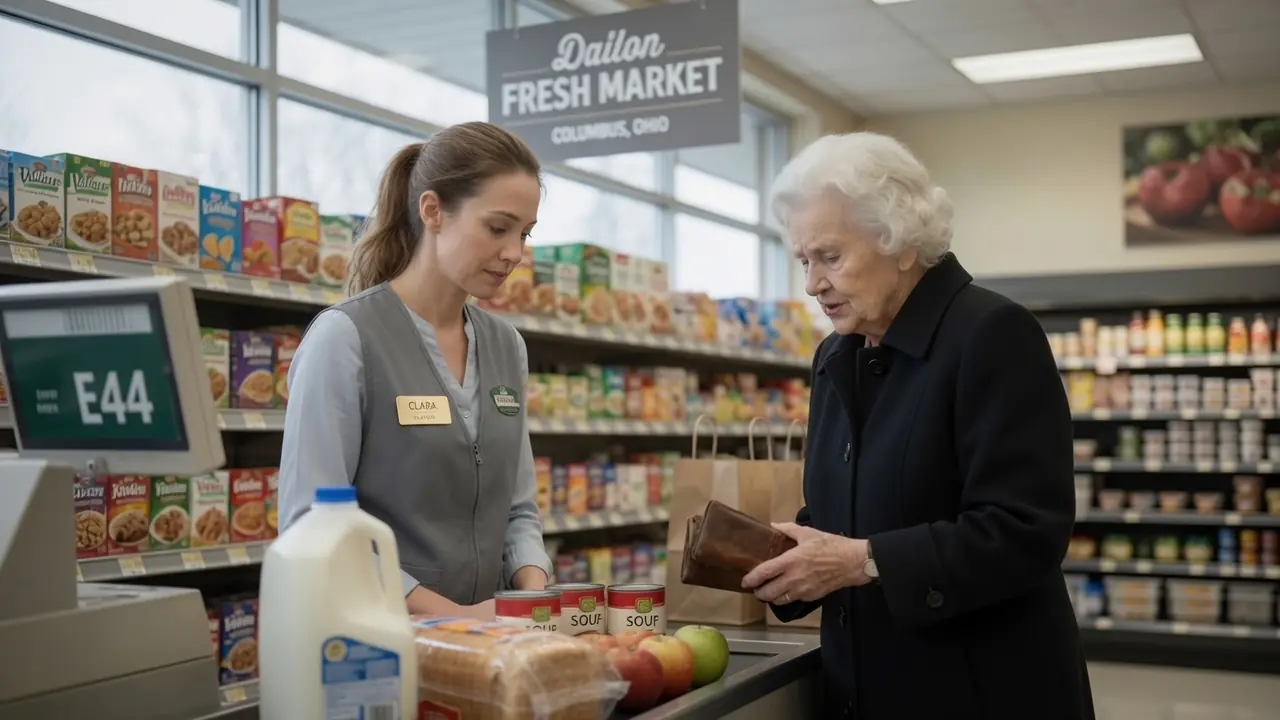
She worked at Dalton Fresh Market in Columbus, Ohio, wearing a green store vest with her name pinned crookedly above her heart. The market was clean, bright, and friendly from the customer side, with polished floors, neat fruit displays, and signs promising fresh food for every family. Behind the employee doors, it was different. There were schedule cuts, warning slips, tired workers, and a manager named Richard Hale who treated kindness like theft if it slowed down the checkout line.
Clara had been on register four since nine that morning. Her feet hurt, her back ached, and she still had another two hours before she could pick Caleb up from after-school care. Caleb was seven, missing one front tooth, and still young enough to believe his mother could solve anything. That belief gave Clara strength on some days and terrified her on others.
At three-thirty, the store was quiet in that strange afternoon way, between lunch rush and after-work crowds. Clara wiped the belt, straightened the reusable bags, and glanced toward the front windows where gray winter light pressed against the glass. She was thinking about Caleb’s school project, a shoebox diorama that somehow required cotton balls, construction paper, glue, and money they did not really have. Then an elderly woman stepped carefully into her checkout lane.
The woman was small and neatly dressed in a gray coat, with white hair brushed back from a gentle, worried face. She placed her items on the belt one at a time, as if each thing mattered. A gallon of milk, a loaf of bread, three cans of soup, and four apples rolled softly toward Clara’s scanner. Nothing fancy, nothing wasteful, nothing that looked like a luxury.
“Good afternoon,” Clara said with a warm smile. “Did you find everything okay?”
The woman nodded, then hesitated. “I think so, dear.”
Her voice trembled slightly. Clara noticed her hands first. They moved slowly, uncertainly, opening a brown wallet with worn corners. The woman kept glancing at the prices on the screen as Clara scanned each item. With every beep, her face became more anxious.
The total appeared. Twenty-three dollars and forty-seven cents.
The woman looked into her wallet, pulled out a few bills, then began counting coins with shaking fingers. Clara waited quietly. She knew that kind of counting. It was not ordinary counting, not simple math. It was the painful calculation of what could be sacrificed and what could not.
The woman counted again, slower this time. Her cheeks turned pink with embarrassment. Behind her, a man holding a basket sighed loudly and shifted his weight. Clara looked at him once, and he looked away.
“I’m sorry,” the old woman whispered. “I don’t have enough money.”
The words were small, but Clara felt them sharply. She saw the woman begin reaching for the milk, probably planning to put it back first because milk was the most expensive item. Clara thought of Caleb eating cereal with water once when she had miscounted groceries near the end of the month. She remembered smiling too brightly and telling him it was just for fun.
Clara reached into the pocket of her green vest. “It’s OK,” she said softly. “I can afford that.”
The old woman froze. “Oh, no, dear. You don’t have to do that.”
“I know.” Clara placed her own bills beside the woman’s cash. “But I want to.”
The man behind her sighed again, louder this time. Clara ignored him. She finished the transaction, bagged the milk carefully, put the soup cans together so they would not crush the bread, and set the apples on top. The old woman kept staring at her like she did not understand why anyone would choose kindness when embarrassment would have been easier.
“What is your name, dear?” the woman asked.
“Clara Bennett.”
The woman touched the name tag gently with one finger. “Clara. That was my sister’s name.”
Clara smiled. “Then it’s a good name.”
The woman’s eyes filled. “Mine is Margaret Ellis.”
“It’s nice to meet you, Mrs. Ellis.”
Margaret opened her mouth as if she wanted to say more, but the line behind her was growing. Clara handed her the receipt and helped place the grocery bag in her cart. Margaret held Clara’s hand for one brief second, her fingers cold and fragile. Then she walked away slowly, leaving Clara with a strange ache in her chest.
For the rest of the shift, Clara thought about Margaret. She wondered if the old woman had someone waiting at home, someone to help carry the groceries from the car, someone who knew she had nearly walked out without milk. Clara did not know why the moment stayed with her so strongly. Maybe because Margaret’s shame had looked too familiar.
Richard Hale appeared at the end of her lane twenty minutes later. He was in his late forties, thin-haired, stiff-backed, and always dressed as if he expected a regional manager to walk in any second. His light-blue shirt was tucked perfectly into his black trousers, and his tie sat straight against his chest. He picked up Clara’s register slip, scanned it, and frowned.
“Clara,” he said quietly. “Office after your shift.”
Her stomach dropped. “Is something wrong?”
“We’ll discuss it later.”
The rest of the afternoon passed slowly. Clara kept smiling at customers, but fear sat behind her ribs. She knew Richard watched everything. She also knew he disliked employees making personal decisions on the clock, even when those decisions cost the store nothing.
At five-thirty, Clara clocked out and stepped into the cramped manager’s office. Richard sat behind the desk with the receipt already printed and placed in front of him. There was a stack of schedule sheets to his left and a pile of warning forms to his right. He did not ask her to sit.
“You paid part of a customer’s bill today,” he said.
“Yes.”
“With your own cash?”
“Yes.”
Richard tapped the receipt. “That creates a problem.”
Clara stared at him. “I didn’t take anything from the store.”
“That is not the point.”
“It was my money.”
“The point is that customers talk. If people think cashiers will cover them when they come up short, then we create expectations.” He leaned back. “This is a business, Clara, not a charity counter.”
Clara’s face warmed. “She was buying milk, bread, soup, and apples.”
Richard’s expression did not change. “And you are not paid to judge which customers deserve personal assistance.”
“I wasn’t judging her.”
“No. You were making the store look like it encourages personal favors, which becomes a policy issue.”
Clara felt anger rise, but fear caught it before it reached her mouth. She needed this job. Caleb needed the after-school program, the rent needed to be paid, and jobs that worked around motherhood were not easy to find. So she folded her hands tightly in front of her and forced herself to stay calm.
“I understand,” she said. “It won’t happen again.”
Richard watched her for a moment. “We’ll see.”
He let her leave, but Clara knew from his tone that the matter was not finished. She walked to the bus stop under a sky turning darker by the minute. Her phone buzzed with a message from Caleb’s after-school program reminding her that late pickup fees had increased. She closed her eyes and breathed through the panic.
At home, Caleb ran to her with a paper crown he had made. “Mom, I’m king of reading this week!”
Clara smiled for real then. “King Caleb the First?”
He nodded proudly. “And you’re queen.”
She bowed dramatically, and he laughed. For an hour, the fear in her chest loosened. They ate scrambled eggs and toast for dinner, worked on the shoebox project, and taped cotton clouds to the inside of the lid. When Caleb fell asleep, Clara sat at the kitchen table and counted the money left in her wallet.
Eleven dollars and twenty-six cents.
She thought of Margaret’s milk and did not regret it. Not even a little. But not regretting a good deed did not make rent easier.
The next morning, Clara arrived ten minutes early. She wore her green vest, tied her hair back neatly, and hoped Richard had decided a warning was enough. Instead, the assistant manager told her Richard wanted her in the office before she clocked in. Clara knew then.
Richard was waiting with a paper on his desk. He did not look angry. Somehow that was worse. Anger could pass. Cold decisions had already been made.
Clara set her grocery bag down on the counter beside the office chair, looked her manager straight in the eye, and said, “She didn’t have enough money. I covered the rest out of my own pocket. That is all I did.”
Richard did not look back at her.
He simply slid the paper across the desk.
Clara stared at it. Termination notice. Violation of conduct policy. Failure to follow store procedure. Creating unauthorized customer expectation.
The words blurred for a second. “You’re firing me?”
Richard finally looked up. “We’re ending your employment.”
“For paying six dollars and change?”
“For ignoring policy.”
“My son depends on this job.”
Richard’s face tightened, but not with pity. More like annoyance at being forced to hear something human. “Clara, this is exactly why employees need boundaries. Personal hardship does not excuse poor judgment.”
“Poor judgment?” Her voice cracked. “An elderly woman was ashamed because she couldn’t afford milk.”
“And there are approved ways to handle that.”
“What approved way?”
“You call a supervisor.”
“So you could tell her to put food back in front of everyone?”
Richard’s eyes hardened. “This conversation is over.”
Clara looked at the paper again. She thought of Caleb’s sneakers, his lunch account, the rent envelope in the drawer, the shoebox project on the table. Then she thought of Margaret’s hand touching her name tag and saying Clara was a good name. Something inside her broke quietly.
She took off the green vest.
Her hands shook as she folded it, but she did not cry in front of Richard. She placed it on the desk beside the termination paper. “I hope nobody you love ever has to stand at a register and choose between food and pride.”
Richard’s mouth tightened. “You can pick up your final check Friday.”
Clara left through the back entrance because she could not bear walking past register four. Outside, the cold air hit her face, and only then did the tears come. She cried at the bus stop with one hand over her mouth, trying not to make sound. A woman in a passing car looked at her, then looked away.
That afternoon, Clara did not know what to tell Caleb. She picked him up from school early because she could not afford the after-school program now. He was excited at first, thinking early pickup meant a treat. Then he saw her face.
“Mommy, what happened?”
Clara knelt in front of him on the sidewalk. “I don’t work at the market anymore.”
His eyes widened. “Did you do something bad?”
She wanted to say no. She wanted to sound certain, strong, unbreakable. Instead, she pulled him close and whispered, “I did something kind, and some people didn’t understand it.”
Caleb hugged her neck. “I understand kindness.”
That made her cry again.
They went home with a small grocery bag Clara had bought using part of her remaining cash. Bread, peanut butter, two bananas, and a bag of carrots. She made Caleb a sandwich, then sat across from him pretending she was not hungry. He noticed anyway and pushed half his sandwich toward her.
“Queens eat too,” he said.
Clara took the half sandwich and smiled through tears. “Thank you, King Caleb.”
The next morning, Clara started applying for jobs online at the library. Cashier positions, diner shifts, warehouse packing, receptionist openings that wanted experience she did not have. She filled out forms until her eyes hurt. Every application asked for availability, and every answer reminded her that motherhood made her complicated on paper.
By noon, she returned to the apartment with no good news. She was walking up the sidewalk with one small grocery bag in her hand when a dark car pulled to the curb. Clara slowed, instinctively cautious. A woman stepped out wearing a black suit, cream blouse, and a long dark coat. She looked polished and serious, with her hair pulled back neatly and a folder held against her side.
“Clara Bennett?” the woman asked.
Clara’s stomach tightened. “Yes.”
“My name is Evelyn Ellis.”
The last name struck her. “Ellis?”
“My mother is Margaret Ellis. You helped her yesterday at Dalton Fresh Market.”
Clara gripped the grocery bag harder. “Is she okay?”
Evelyn’s face changed immediately. Her professional calm cracked, and for a moment she looked less like a businesswoman and more like a frightened daughter. “Yes. She’s safe now.”
“Now?”
Evelyn took a breath. “My mother has early memory loss. She still lives independently with help, but yesterday she became confused and left home without telling anyone. She was supposed to have a caregiver with her, but there was a schedule mix-up.”
Clara’s chest tightened. “I didn’t know.”
“You couldn’t have.” Evelyn looked toward the apartment building, then back at Clara. “She wandered farther than we realized. By the time we found her, she was sitting at home with the groceries you helped her buy, crying because she remembered your name but couldn’t remember how she got back.”
Clara’s eyes filled. “I’m sorry.”
“No.” Evelyn stepped closer. “Please don’t apologize.”
“I only paid a few dollars.”
“You did more than that.” Evelyn’s voice trembled. “You slowed the moment down. You treated her gently. You gave her dignity when she was scared and ashamed. She remembered that.”
Clara looked down at the grocery bag in her hand. “I lost my job because of it.”
Evelyn’s eyes sharpened. “I know.”
Clara looked up. “How?”
“My mother kept repeating your name. Clara Bennett at Dalton Fresh Market. I went there this morning to thank you, and Richard told me you were no longer employed.” Evelyn’s mouth tightened. “He was careful with his wording. Not careful enough.”
Clara felt humiliation rise again. “I didn’t steal. I didn’t break the register. I didn’t do anything except cover the rest.”
“I believe you.”
Those three words nearly undid her. Clara had not realized how badly she needed someone to say them.
Evelyn opened the folder. “Mrs. Bennett, I came here for two reasons. First, to repay what you spent for my mother.”
Clara shook her head. “You don’t have to.”
“I know. But I want to.” Evelyn handed her an envelope. “Second, I came to offer you a job.”
Clara stared at her. “A job?”
“My family runs Ellis Home Care Network. We provide support services for seniors who want to remain safely independent. After what happened with my mother, I reviewed some of our client-facing roles. We need someone who knows how to see people before they become emergencies.”
Clara swallowed. “I’m a cashier.”
“You are a mother. You are patient under pressure. You treated my mother with respect when other people might have rushed her, embarrassed her, or ignored her.” Evelyn held out the folder. “We can train you for the rest.”
Clara’s heart pounded. “What kind of job?”
“Client support coordinator. You would help families schedule care, check in with elderly clients, and visit homes when someone needs extra attention. Starting pay is higher than the market paid you, with health benefits after sixty days. The hours are mostly daytime.”
Daytime.
The word felt almost impossible.
Clara looked toward the apartment building where Caleb’s school papers were spread across the kitchen table. “I have a son.”
Evelyn smiled softly. “My mother told me. She said a woman who helps an old stranger while worrying about her child must have a very good heart. We also have childcare assistance for employees who need it.”
Clara covered her mouth.
Evelyn’s own eyes filled. “My mother could have been humiliated yesterday. She could have left without food. She could have wandered into the street, or forgotten where she was, or stopped trusting people altogether. Instead, she remembered one kind cashier named Clara.”
“I don’t know what to say.”
“Say you’ll come interview tomorrow.”
Clara laughed once through tears. “Is it really an interview if you already came here with a folder?”
“It is an interview,” Evelyn said gently. “But I’ll be honest. I hope you say yes.”
Caleb came running down the apartment steps then, his backpack bouncing behind him. “Mom!”
Clara quickly wiped her face. “Hey, baby.”
He slowed when he saw Evelyn. “Who’s that?”
Clara looked at Evelyn, then back at her son. “This is Ms. Ellis.”
Evelyn crouched slightly so she was closer to his height. “Your mom helped my mother when she needed it.”
Caleb looked proud immediately. “My mom helps people.”
Evelyn smiled. “I can see that.”
Caleb turned to Clara. “Are you still sad?”
Clara looked at the folder in her hand, the envelope, the woman who had arrived at the exact moment hope felt too expensive. Then she knelt and hugged her son tightly. “Not as much.”
The next day, Clara borrowed a blouse from Mrs. Alvarez upstairs and rode the bus to Ellis Home Care Network. The office was in a brick building with wide windows, soft chairs, and framed photographs of older clients smiling with caregivers. Clara arrived twenty minutes early because she was terrified of being late. Evelyn met her in the lobby with coffee and introduced her to the staff as if Clara already mattered.
The interview was not like any interview Clara had ever had. They asked about patience, fear, dignity, and what she would do if an elderly client became confused in public. Clara answered honestly. She spoke about Margaret, about the register, about how shame can make people leave before they get help. She spoke about Caleb too, because she was tired of pretending motherhood was a weakness.
By the end, Evelyn’s father, Arthur Ellis, who chaired the company board, leaned back and nodded. “My wife spent thirty years teaching our family that small kindnesses are not small to the person receiving them.”
Clara looked at him. “Your wife?”
“My mother,” Evelyn said softly. “Margaret.”
Arthur smiled sadly. “I mean my wife, Margaret’s daughter-in-law. She passed several years ago. She built much of this care network because she believed no older person should feel like a burden.”
Clara nodded slowly. “Then I would like to help carry that.”
She was offered the job before she left.
The first week was overwhelming. Clara learned scheduling software, client notes, phone procedures, and how to recognize signs that someone might need a wellness check. She shadowed caregivers and visited seniors who reminded her of Margaret in different ways. Some were cheerful, some stubborn, some lonely, some frightened by the slow betrayal of memory.
Clara discovered she was good at the work. She remembered details. She noticed when a client’s voice sounded different, when someone forgot a usual phrase, when a caregiver sounded too rushed. She did not treat people like tasks, and that made families trust her.
Her first paycheck from Ellis Home Care made her sit down at the kitchen table and cry. Caleb found her holding the paper and panicked until she laughed and pulled him into her arms. “These are good tears,” she promised.
“Can we buy glue sticks?” he asked.
Clara laughed harder. “Yes. We can buy glue sticks.”
A month later, Evelyn invited Clara to a small community event at Dalton Fresh Market. Clara almost refused when she heard the location. The idea of returning to the store made her stomach tighten. But Evelyn explained that Ellis Home Care was launching a senior shopping assistance program there, and the market owner had requested Clara specifically.
Richard no longer worked there.
Clara arrived wearing a navy blouse and an Ellis Home Care badge. The green vest was gone. Her shoulders felt different without it, lighter somehow. Near the entrance stood Margaret Ellis, holding Evelyn’s arm, her white hair neatly styled and her eyes bright when she saw Clara.
“There she is,” Margaret said. “The kind girl.”
Clara walked to her. “Hello, Mrs. Ellis.”
Margaret touched her cheek gently. “I had enough money today.”
Clara smiled through the ache in her chest. “I’m glad.”
The market owner apologized in person. He was a large man named Mr. Dalton, red-faced and uncomfortable. He admitted Richard had mishandled the situation and said the store would begin training staff to call for assistance instead of embarrassing customers who came up short. Clara listened politely. She accepted the apology, not because it erased what happened, but because the change might protect someone else.
Then Margaret insisted on going through Clara’s old lane, register four. A new cashier stood there, nervous but kind. Margaret placed milk, bread, soup, and apples on the belt, the same simple groceries as before. Clara stood beside her, not as an employee afraid of punishment, but as someone who had survived the cost of doing right.
The cashier gave the total. Margaret opened her wallet slowly, then paused and looked at Clara with a mischievous smile. “Sorry, I don’t have enough money.”
Clara understood the joke and laughed softly. “It’s OK, I can afford that.”
Evelyn laughed too, though her eyes filled with tears. Margaret paid the full amount herself, then added a donation to the new senior assistance fund at the register. The cashier rang it up carefully, and everyone clapped in a way that made Clara blush.
That evening, Clara and Caleb stopped for pizza on the way home. Not because it was a special occasion written on a calendar, but because Clara could afford two slices and still buy groceries the next day. Caleb sat across from her in the booth, swinging his legs, talking about school and whether their future yellow house could have a dog. Clara listened, smiling, feeling the strange peace of a woman who had not escaped hardship completely but had finally found a door out of constant fear.
“Mom,” Caleb said, “did you get your new job because you bought milk?”
Clara thought about it. “Not exactly.”
“Then why?”
“Because someone needed help, and I didn’t look away.”
Caleb nodded solemnly, as if filing the lesson somewhere important. “I won’t look away either.”
Clara reached across the table and squeezed his hand. “That is the best thing you could ever promise me.”
Months later, Clara became the lead coordinator for the senior shopping program. Dalton Fresh Market installed a small sign near the registers that read: If you or a loved one needs assistance, please ask. Help is available with dignity. Clara read it the first time and had to step outside for air.
Margaret remained one of her favorite visits. Some days she remembered Clara clearly. Some days she called her by her sister’s name. Clara never corrected her harshly. She simply sat beside her, poured tea, and let Margaret’s memories come in whatever order they could.
One rainy afternoon, almost a year after the day at the register, Clara took Caleb with her to visit Margaret. The old woman was sitting by the window with a photo album in her lap. She looked up when they entered and smiled.
“Clara,” she said clearly.
Clara froze, surprised by the certainty in her voice. “Yes, Mrs. Ellis. It’s me.”
Margaret looked at Caleb. “And this is the boy your heart was working for.”
Caleb smiled shyly. “Hi.”
Margaret patted the seat beside her. “Come here. I want to show you pictures of when milk cost almost nothing and everybody still complained.”
Caleb laughed and sat down.
Clara watched them together, the old woman and the boy, connected by one small grocery bill and one choice made at a checkout counter. She thought of Richard sliding the termination paper across the desk. She thought of walking home with a grocery bag and no job. She thought of Evelyn stepping out of the dark car with tears in her eyes and a folder in her hand.
Life had not become easy. Bills still came, Caleb still outgrew shoes, and Clara still counted money carefully. But she no longer felt like kindness was something she had to hide. She had built a life around the very thing Richard had punished her for.
That night, after Caleb fell asleep, Clara opened a small wooden box on her dresser. Inside were important papers, a few emergency dollars, Caleb’s first lost tooth wrapped in tissue, and the old name tag from Dalton Fresh Market. She had kept it not because she missed the job, but because she wanted to remember the day she stopped apologizing for having a heart.
She held it for a moment, then placed it back in the box.
On her kitchen table lay a new folder from Ellis Home Care. Inside was paperwork for a promotion. More hours, better pay, and a role training other employees to respond when seniors became confused, ashamed, or afraid in public.
Clara smiled softly.
The world often changed loudly in stories, with dramatic speeches and doors slamming. But sometimes it changed at a checkout counter, with milk, bread, soup, apples, and an old woman whispering that she did not have enough. Sometimes it changed because a single mother with only a little money left decided another person’s dignity was still worth protecting.
And sometimes, the kindness that cost six dollars and change came back as a future.