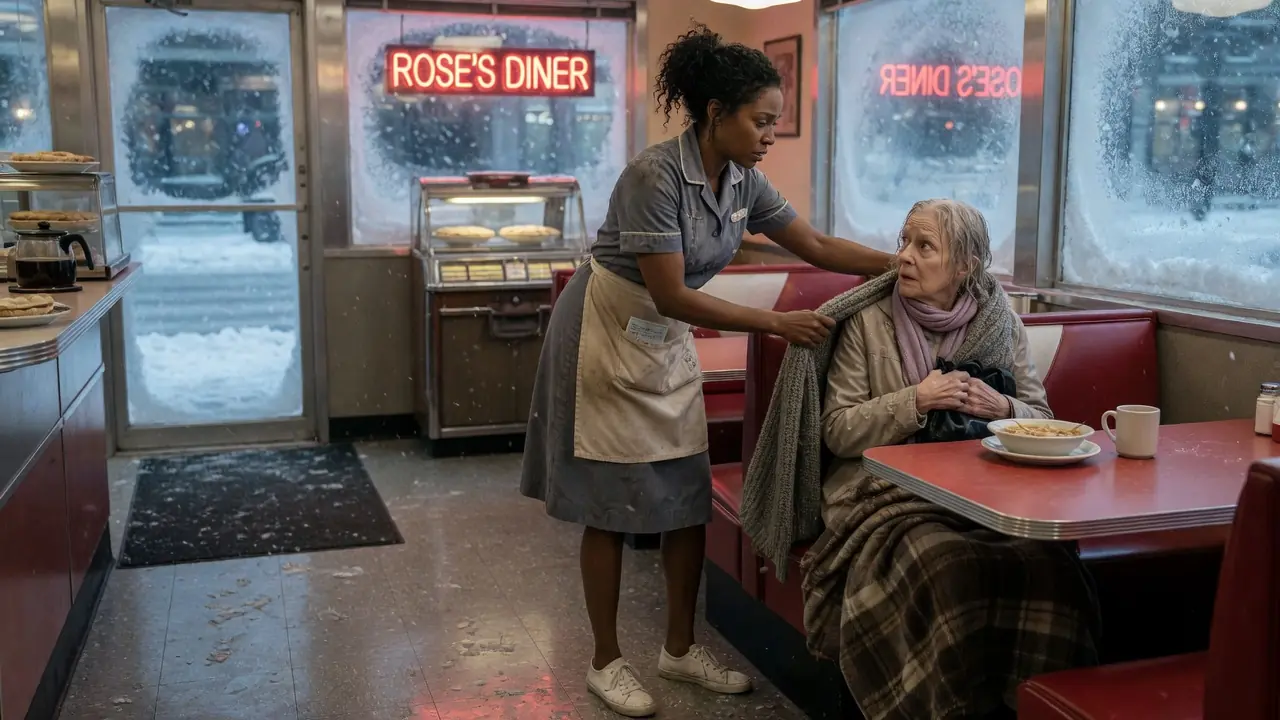
The wind howled through the broken seal of Rose’s Diner like a wounded animal, rattling the windows and sending thin drafts across the cracked linoleum floor.
Outside, Chicago’s South Side had vanished under a wall of white, the kind of snow that erased curbs, swallowed parked cars, and turned familiar streets into a frozen wasteland.
Streetlights glowed as blurred yellow circles through the storm, and every gust threw ice against the glass hard enough to make the old windows tremble.
Inside, Naomi Thompson wiped down the counter for the sixth time that hour, not because it was dirty, but because stillness made her think too much.
At thirty-four, Naomi had learned that a single mother could not afford to fall apart, even when the world gave her plenty of reasons.
She had dark brown skin, tired eyes, and thick black hair tied into a bun that had started neat before dawn and surrendered sometime after noon.
Her uniform was faded at the collar, her sneakers were worn at the sides, and her hands carried small burns from years of coffee pots, hot plates, and hurry.
In the back pocket of her apron, she kept a folded note from her nine-year-old daughter, Maya, written in purple marker: Mom, you are brave even when you are tired.
Naomi thought about that note every time she wanted to quit.
She thought about it when rent was late, when Maya needed new winter boots, when the gas bill came higher than expected, and when her ex-boyfriend sent another text saying he would help “soon.”
Soon had never bought groceries.
Soon had never sat with Maya during asthma attacks, helped with homework, or stood in the pharmacy line counting dollars and pretending not to feel ashamed.
Rose’s Diner was all Naomi had left of a dream she once shared with her grandmother.
Her grandmother, Rose, had opened the place forty-two years earlier with three booths, one grill, and a stubborn belief that food could make strangers feel like neighbors.
When Rose died, Naomi inherited more debt than money, more repairs than equipment, and a diner with a cracked sign that still glowed red whenever the wiring felt generous.
She stayed because leaving would feel like losing her grandmother twice.
That night, the dinner rush never came.
Only two men sat at the counter, both construction workers stranded after their truck got stuck three blocks away.
They hunched over bowls of chili and black coffee, muttering about road closures and plows that never reached the side streets in time.
Naomi should have closed early, but something kept her there.
“Some folks might need shelter,” she murmured to herself, hearing her grandmother’s voice as clearly as if Rose were standing behind the register.
You never turn away someone in need, baby.
You don’t have to save the whole world.
Just don’t close the door on the person standing in front of you.
Naomi glanced at the clock over the pie case.
7:48 p.m.
Maya was safe upstairs in the apartment above the diner with Mrs. Alvarez, their elderly neighbor, who had insisted on staying with her until the storm passed.
Naomi had already called twice to check.
Maya had answered the second time and said, “Mom, I’m fine, but Mrs. Alvarez keeps making me wear two pairs of socks.”
Naomi smiled at the memory, then reached under the counter to turn off the neon sign.
Before her fingers touched the switch, the front door burst open.
A gust of snow and frigid air swept into the diner, carrying flakes across the floor like broken feathers.
Naomi looked up, expecting a plow driver, a delivery worker, or maybe someone whose car had stalled.
Instead, she saw an elderly white woman stumbling through the entrance.
The woman wore a coat far too thin for the weather, a pale lavender scarf twisted unevenly around her neck, and shoes that were soaked through at the toes.
Her silver hair was wild with snowflakes, her face was nearly colorless, and her gloved hands trembled so violently she could barely keep hold of the small purse pressed to her chest.
For one terrible second, she stood there trying to speak.
Then her knees buckled.
Naomi moved before anyone else did.
“Oh my God,” she whispered, rounding the counter and catching the woman by both arms before she hit the floor.
The woman was frighteningly cold, her body stiff with shock, her breath coming in shallow, uneven pulls.
The two men at the counter glanced over, then looked away too quickly.
An old white woman lost on the South Side in a snowstorm was, apparently, someone else’s problem.
Naomi tightened her grip and guided the woman toward the nearest booth.
“Ma’am, can you hear me?” she asked, keeping her voice steady even as fear beat hard against her ribs.
The woman blinked slowly, her pale blue eyes unfocused.
“I got lost,” she whispered.
Naomi eased her down onto the booth seat and stripped off her own sweater without thinking.
The diner was cold, but the woman was colder.
Naomi wrapped the sweater around the woman’s shoulders, then grabbed a clean towel from beneath the counter and gently brushed snow from her hair.
“You’re inside now,” Naomi said. “You’re safe. I’m Naomi.”
The woman’s lips trembled.
“I was looking for my son.”
Naomi crouched beside the booth.
“Okay. What’s your son’s name?”
The woman frowned as if the question had struck a locked door inside her mind.
“My son,” she repeated.
“That’s all right,” Naomi said quickly. “No rush. We’ll figure it out.”
The woman’s eyes filled with panic.
“I can’t remember the address.”
Naomi looked toward the men at the counter.
One of them stirred his chili without lifting his face.
The other checked his phone and pretended he had not heard.
Naomi felt anger burn through her exhaustion.
She stood, went behind the counter, and poured hot tea with honey, then ladled chicken soup into a bowl from the pot she had kept warm all evening.
When she returned, the woman was rubbing her hands together as if trying to bring feeling back into her fingers.
Naomi placed the tea carefully in front of her.
“Small sips,” she said. “You’re freezing.”
The woman looked at her with sudden clarity.
“Thank you, dear.”
The words were simple, but they carried old manners, old pride, and a kind of grief Naomi recognized too well.
“You’re welcome,” Naomi said.
The woman warmed her hands around the mug.
“My name is Dorothy,” she said after a long moment. “Dorothy Caldwell.”
Naomi smiled gently.
“That’s a beautiful name.”
Dorothy’s eyes moved around the diner, taking in the red booths, the faded photos, the pie case, the cracked tile near the jukebox.
“This place reminds me of somewhere,” she said softly.
“My grandmother’s diner,” Naomi replied. “Her name was Rose.”
Dorothy looked at her.
“She raised you?”
Naomi hesitated, then nodded.
“Mostly. My mother worked double shifts, and my father was gone before I could remember him.”
Dorothy’s mouth softened.
“Women do what they must.”
“Yes, ma’am,” Naomi said. “They do.”
For a few minutes, Dorothy ate soup slowly, her hands still shaking but less violently than before.
Naomi sat across from her, ignoring the dirty counter, the storm, and the part of her mind counting how late it was getting.
There was a child upstairs waiting for her.
There were bills waiting on the kitchen table.
There was a whole life waiting to remind Naomi she could not afford another problem.
But Dorothy looked so lost that Naomi could not make herself stand.
“You said you were looking for your son,” Naomi said gently.
Dorothy stared down into the soup.
“I haven’t seen him in seven years.”
Naomi said nothing.
“He became someone I didn’t recognize after his father died,” Dorothy continued, her voice fragile. “Or maybe he became someone he had been hiding. I don’t know anymore.”
The wind slammed snow against the windows.
The old lights flickered once.
Naomi leaned forward.
“What happened?”
“Power happened,” she whispered. “Money happened. Men started coming to the house in black cars, speaking softly and never smiling. My Daniel stopped laughing.”
Naomi felt the name settle between them.
“Daniel?”
Dorothy nodded.
“My boy. My only child. He used to bring me flowers from empty lots because we couldn’t afford real ones. Dandelions, mostly. He said yellow was still yellow even if rich people called it a weed.”
Naomi smiled despite herself.
Dorothy’s eyes shone.
“He was such a good boy once.”
The words came out like a prayer.
Naomi glanced toward the storm.
“Do you have his address?”
Dorothy searched her purse with stiff fingers and finally produced a crumpled slip of paper.
Naomi took it carefully.
Lakeshore Tower.
Penthouse.
Her eyebrows rose before she could stop them.
Lakeshore Tower was one of the most exclusive addresses in Chicago, a glass building downtown where people paid more for parking than Naomi paid in monthly rent.
Whoever Dorothy’s son was, he was not hurting for money.
Naomi looked from the paper to Dorothy’s thin coat and soaked shoes.
Something did not fit.
“Dorothy,” Naomi said carefully, “how did you end up here?”
Dorothy pressed one hand to her forehead.
“I took a bus. Then another. Then I got turned around. The snow came so fast.”
“You were going to Lakeshore Tower in this storm?”
“I thought if I saw him, he would remember me,” Dorothy whispered.
Naomi’s throat tightened.
“Remember you?”
“Not my face,” Dorothy said. “His own heart.”
The two men at the counter shifted uncomfortably now.
Maybe shame had finally found them.
Maybe not.
Naomi did not care.
“The roads won’t clear until morning,” she said gently. “You can stay here as long as you need.”
Dorothy looked up quickly.
“Oh no. I can’t impose.”
“You’re not imposing.”
“I’m a stranger.”
“So was everyone before somebody learned their name.”
Dorothy stared at her.
Then her face crumpled with the effort of not crying.
“You sound like my mother.”
Naomi smiled softly.
“Then your mother was a smart woman.”
Dorothy gave a weak laugh.
The clock moved slowly after that.
The snow deepened against the windows until the bottom half of the glass turned white.
The two men finally left when a friend with a pickup came for them, offering Naomi a careless “good luck” before vanishing into the storm.
Naomi locked the door behind them, flipped the sign to CLOSED, and turned back to find Dorothy watching her with guilt in her eyes.
“I’ve caused you trouble,” Dorothy said.
“No,” Naomi replied. “You gave me a reason to keep the lights on.”
Dorothy looked toward the back hallway.
“You have family upstairs?”
“My daughter,” Naomi said. “Maya. She’s nine.”
“You’re a mother.”
Naomi smiled.
“Every minute of every day.”
Dorothy’s eyes warmed.
“What is she like?”
“Smart. Stubborn. Too observant. She draws pictures of houses with big kitchens because she says one day we’ll have room for a real table.”
Dorothy listened with aching tenderness.
“And her father?”
Naomi took the empty soup bowl.
“Gone.”
“I’m sorry.”
“Don’t be,” Naomi said quietly. “He left, but I stayed. That tells the story well enough.”
Dorothy nodded, understanding more than Naomi expected.
Women who had loved disappointing men often recognized each other without many words.
Near midnight, the heat in the diner weakened.
Naomi cursed under her breath and checked the old thermostat, tapping it twice as if the machine might respond to respect.
It did not.
She gathered extra tablecloths, clean towels, and the wool blanket she kept in the storage room for emergencies.
Then she made a bed for Dorothy in the back office, clearing stacks of invoices, Maya’s coloring books, and a broken fan from the old couch.
“You can sleep here,” Naomi said. “It’s not fancy, but it’s away from the windows.”
Dorothy stood in the office doorway, looking at the small couch and the blanket folded over it.
“You’re giving me your blanket.”
“I’ve got others upstairs.”
“That’s not true.”
Naomi paused.
Dorothy smiled sadly.
“I raised a son through hard years, dear. I know when a woman is giving from the part she cannot spare.”
Naomi looked away.
“It’s just a blanket.”
“No,” Dorothy said. “It’s not.”
For a moment, they simply stood there in the hum of the old building.
Then Dorothy reached out and touched Naomi’s hand.
“You should not have had to become this strong so young.”
Naomi swallowed.
“I’m not that young.”
“You are to me.”
Naomi helped her settle onto the couch.
Before Dorothy drifted off, her eyes opened one last time.
“He runs an organization,” she murmured. “A very powerful one.”
Naomi tucked the blanket around her shoulders.
“Your son?”
Dorothy nodded faintly.
“People fear him. They whisper his name like he’s already dead inside.”
A chill moved through Naomi that had nothing to do with the storm.
“What organization?”
Dorothy’s eyelids fluttered.
“Quan,” she whispered. “Daniel Quan. But he was Daniel Caldwell before he changed it. Before he changed everything.”
Naomi went still.
Daniel Quan.
Even Naomi knew that name.
Everyone in Chicago knew that name, though most people pretended they did not.
He owned clubs, freight companies, private security firms, restaurants, and real estate across the city.
Some called him a businessman.
Some called him worse.
People said he controlled half the city’s underworld, though no paper ever printed that without using words like alleged or suspected.
Naomi looked down at the old woman sleeping on her office couch.
Daniel Quan’s mother.
Lost in a snowstorm.
Wearing a coat too thin for January.
Searching for a son who lived in a penthouse.
“I don’t know what he is now,” Dorothy murmured.
Then her eyes closed fully.
Naomi returned to the empty diner and stood behind the counter, watching snow pile against the windows.
She did not sleep.
By morning, the storm had stopped.
The world outside had become gray, buried, and strangely quiet.
Snowbanks rose along the curb, cars looked like rounded white shapes, and the first plows carved narrow paths through streets that seemed unfamiliar beneath all that white.
Naomi brewed fresh coffee and checked on Dorothy twice.
The old woman slept deeply, one hand tucked under her cheek, her face peaceful in a way it had not been the night before.
At 6:15, Naomi called upstairs.
Mrs. Alvarez answered.
“Maya is still asleep,” the older woman said. “I made oatmeal.”
“You didn’t have to.”
“I am old, not useless.”
Naomi smiled.
“Thank you.”
“Did the woman survive the night?”
“Yes.”
“Good. Then maybe God kept you open for a reason.”
Naomi looked toward the office.
“Maybe.”
At 6:42, headlights cut through the gray dawn.
Not one car.
Three massive black SUVs pulled up in front of Rose’s Diner in perfect formation.
Naomi froze with the coffee pot in her hand.
The vehicles were spotless despite the storm, dark and heavy, their tinted windows reflecting the diner’s flickering sign.
Men in dark coats stepped out first, scanning the street with cold efficiency.
They did not look like police.
They did not look like customers.
They looked like men who were used to entering rooms before danger had a chance to introduce itself.
Then the door of the middle SUV opened.
He stepped out.
Tall.
Imposing.
Black hair cut short.
A long wool coat over a dark suit.
Tattoos climbed from beneath his collar onto the sides of his neck, disappearing beneath his jaw like inked shadows.
He moved through the snow like it did not dare touch him.
Naomi set the coffee pot down slowly.
For the first time in a long while, she wished the diner was full.
The bell over the door rang when he entered.
Cold air followed him inside.
The men stopped behind him, but he lifted one hand, and they remained by the door.
His eyes found Naomi immediately.
They were dark, controlled, and so cold they seemed almost empty.
“I’m looking for Dorothy Caldwell,” he said.
His voice was low.
Flat.
No wasted emotion.
Naomi straightened behind the counter.
“She’s here.”
Something moved in his face.
Not enough for most people to notice.
Naomi noticed because single mothers survived by reading tiny shifts in dangerous rooms.
His right hand flexed once.
“Where?”
“In the back office,” Naomi said. “She was half frozen when she came in last night. I’ve been taking care of her.”
The men near the door exchanged a glance.
Daniel Quan did not move.
“You took care of her.”
“Yes.”
“Why?”
Naomi blinked.
“Because she needed help.”
His gaze sharpened.
“That simple?”
Naomi stepped out from behind the counter.
“It should be.”
One of his men shifted forward, but Daniel raised two fingers without looking back.
The man stopped.
Naomi kept her eyes on Daniel.
“She came in shaking, confused, and underdressed in the worst blizzard this city has seen in twenty years. Two men sitting right there looked away like she was a weather problem.”
Her voice grew harder.
“Someone had to care.”
For a long moment, Daniel stared at her.
Then his eyes moved over her faded uniform, her tired face, the burn mark near her wrist, the cheap shoes damp at the edges from mopping snow near the entrance.
“You own this place?” he asked.
“My grandmother did. Now I do.”
“You live upstairs?”
Naomi’s body went still.
Daniel saw it.
His voice changed slightly.
“I’m not threatening you.”
“You’re asking questions like a man who’s used to answers.”
“Fair.”
Naomi studied him.
This was the son Dorothy had described.
Powerful.
Feared.
Sharp-edged.
But beneath the ice, Naomi thought she saw something else.
Panic wearing a suit.
“She’s safe,” Naomi said more softly. “She’s sleeping.”
Daniel’s jaw tightened.
“Show me.”
Naomi hesitated.
Then she nodded.
“This way.”
She led the most dangerous man she had ever seen past the counter, through the narrow hallway, and to the back office where unpaid invoices sat in folders beside Maya’s crayons.
At the doorway, Daniel stopped.
Dorothy was still sleeping on the couch, wrapped in Naomi’s blanket.
Her silver hair had dried into soft waves around her face, and her thin hands rested over the edge of the quilt.
For the first time since entering the diner, Daniel Quan looked young.
Not in his face.
In the way grief hit him before he could defend against it.
“Mom,” he whispered.
Dorothy stirred.
Her eyes opened slowly, unfocused at first.
Daniel stepped closer, then stopped, as if afraid his presence might frighten her.
“Mom,” he said again, quieter now.
Dorothy blinked.
For one heartbreaking moment, she looked at him like a stranger.
Then something inside her found the right door.
“Daniel?”
He dropped to one knee beside the couch.
“Yes.”
Dorothy lifted one trembling hand to his face.
“You came.”
His cold expression broke.
Only for a second.
But Naomi saw it.
“I’ve had people looking all night,” he said. “I thought—”
His voice stopped.
Dorothy touched the tattoo near his neck with the sadness of someone remembering a baby’s smooth skin beneath all that ink.
“You look tired,” she whispered.
Daniel bowed his head.
Naomi quietly stepped back, giving them space.
But Dorothy turned her face toward her.
“This girl helped me,” she said.
Daniel looked over his shoulder at Naomi.
“I know.”
“No,” Dorothy said, stronger now. “You don’t know. She gave me soup. She gave me warmth. She didn’t look at me like I was a foolish old woman.”
Daniel looked back at his mother.
Dorothy’s voice trembled.
“She looked at me like I was still your mother.”
That sentence seemed to strike him harder than any weapon could have.
He closed his eyes.
“I’m sorry,” he whispered.
Dorothy’s fingers moved over his cheek.
“For which thing?”
Daniel let out a broken breath.
Naomi looked away.
That question carried seven years inside it.
For the next half hour, the diner remained closed.
Daniel’s men waited by the door without speaking.
Naomi made fresh tea for Dorothy and coffee for Daniel, though he did not ask for it.
When she placed the mug near him, he looked at it as if startled by the idea that someone might serve him without fear.
“Thank you,” he said.
“You’re welcome.”
Dorothy sat up slowly with Naomi’s help.
Daniel moved too quickly to assist, and Dorothy flinched slightly.
He froze.
The hurt that crossed his face was immediate and quickly hidden.
Naomi saw that too.
Power had made him fast, but his mother needed gentleness.
“Slow,” Naomi said quietly.
Daniel looked at her.
Naomi did not lower her eyes.
“She’s been through a hard night. Let her see your hands before they touch her.”
One of the men near the front shifted as if offended that anyone had corrected Daniel Quan.
Daniel only nodded.
Then he placed his hands where Dorothy could see them.
“May I help you sit up, Mom?”
Dorothy looked at him for a long moment.
Then nodded.
He helped her carefully this time.
Naomi turned away before the tenderness could embarrass them both.
When Dorothy was settled in a booth near the window, wrapped in the blanket with tea in front of her, Daniel stood beside the table like a man unsure whether he had permission to sit.
Dorothy patted the booth.
“Sit down, Daniel.”
He sat.
For a while, neither of them spoke.
Naomi cleaned a counter that was already clean and pretended not to hear what came next.
“You changed your name,” Dorothy said.
Daniel looked down at the coffee.
“Yes.”
“Why?”
“To survive.”
“From what?”
He gave a faint, humorless smile.
“From being Daniel Caldwell.”
Dorothy’s eyes filled.
“I loved Daniel Caldwell.”
His hand tightened around the mug.
“No one else did.”
“I did.”
“You loved the boy,” he said. “Not what the boy became.”
Dorothy’s voice trembled.
“You never let me know what you became. You locked me outside your life and called it protection.”
Daniel did not answer.
Outside, one of the SUVs idled softly.
Inside, Naomi felt the air thicken with words long delayed.
Dorothy reached across the table.
Daniel stared at her hand.
Then, slowly, he took it.
“I came because I’m dying,” Dorothy said.
Naomi froze near the coffee machine.
Daniel’s face went white beneath his controlled expression.
“What?”
Dorothy looked tired, suddenly older than she had the night before.
“The doctor says my heart is failing. Not today. Not tomorrow. But soon enough that I got tired of waiting for pride to become forgiveness.”
Daniel’s lips parted, but no sound came.
“I wanted to see you once before I ran out of mornings,” she said.
He stood so abruptly the booth shook.
“No.”
Dorothy looked up at him.
“Daniel.”
“No,” he said again, voice hard now, as if he could command death itself to leave the room. “Which doctor? What hospital? I’ll get specialists. I’ll fly someone in.”
Dorothy smiled sadly.
“There he is.”
“What?”
“The man who thinks money can drag time backward.”
His jaw clenched.
“I’m not losing you.”
“You already did for seven years.”
The words were not cruel.
That made them worse.
Daniel sat down slowly.
Dorothy kept hold of his hand.
“But you are here now,” she said. “And that still matters.”
Naomi felt tears sting her eyes.
She turned away quickly and nearly collided with one of Daniel’s men, who had come quietly to the hallway entrance.
He looked enormous, expressionless, and uncomfortable.
“Boss,” he said.
Daniel did not look away from his mother.
“What?”
“News vans are outside.”
Naomi’s head snapped toward the windows.
Sure enough, two vans had pulled up near the plowed edge of the street.
Cameras.
Reporters.
People always smelled power faster than suffering.
Daniel’s face turned cold again.
“Who called them?”
The man hesitated.
“Unknown.”
Dorothy closed her eyes.
“I don’t want cameras.”
Daniel stood.
“They won’t come in.”
Naomi moved before thinking.
“No.”
Daniel turned toward her.
“What?”
“You are not turning my diner into a war room.”
His men went still.
Naomi’s heart hammered, but she did not step back.
“My daughter is upstairs,” she said. “My neighbor is with her. This diner is my home. If there are reporters outside, you handle them without dragging danger through my door.”
For one long second, nobody breathed.
Daniel looked at her as if no one had spoken to him that way in years.
Maybe no one had.
Then he nodded once.
“You’re right.”
His men looked more shocked by the apology than by Naomi’s courage.
Daniel turned to them.
“No one enters. No one speaks to the press. Move the vehicles to block the windows, not the exits. Make it quiet.”
The men left immediately.
Dorothy watched Naomi with soft eyes.
“You’re a mother,” she said.
Naomi looked back.
“Yes.”
“A mother’s voice is different.”
Naomi smiled faintly.
“So is a grandmother’s.”
That made Dorothy laugh.
Daniel watched the exchange silently.
For the first time, he seemed to truly see Naomi.
Not as a waitress.
Not as a problem.
Not as a stranger who had accidentally touched his world.
As a woman who knew how to protect what mattered.
The reporters left after twenty minutes with no footage worth airing.
The SUVs moved.
The diner remained closed until Dorothy had eaten scrambled eggs, toast, and half a bowl of oatmeal Naomi made because Dorothy said soup for breakfast felt “too dramatic.”
Daniel tried to pay for the meal with a stack of cash.
Naomi stared at it.
“No.”
He looked confused.
“No?”
“No.”
“It’s for my mother’s food. The blanket. The night. The trouble.”
Naomi crossed her arms.
“You can pay for breakfast when the register opens. You cannot buy back a night of basic human decency.”
Daniel’s eyes narrowed slightly.
“Most people take money from me.”
“That sounds like your problem.”
A sound came from the kitchen doorway.
One of his men choking on a laugh.
Daniel turned his head just enough for the sound to die immediately.
Then he looked back at Naomi.
“My mother told me you were stubborn.”
“She just met me.”
“She knows women.”
Naomi almost smiled.
Dorothy lifted her tea.
“I do.”
Daniel placed the cash back inside his coat.
“All right,” he said. “Breakfast only.”
Naomi rang him up for $18.64.
He paid with a hundred.
She gave him exact change from the register, including coins.
He looked at the pile in his palm.
Naomi looked back.
“I said breakfast only.”
Dorothy laughed hard enough to cough.
Daniel stared at the coins, then at Naomi, and something almost like amusement moved across his face.
“I see.”
“I hope so.”
Before leaving, Dorothy asked to meet Maya.
Naomi hesitated.
Daniel noticed and stepped back.
“No,” he said quietly. “Not unless you’re comfortable.”
That surprised her.
It should not have, but it did.
Dorothy reached across the table and touched Naomi’s wrist.
“It is all right, dear. A mother knows when to keep a door closed.”
Naomi softened.
“She’s upstairs. Maybe another day.”
Dorothy nodded.
“Then I will have to come back.”
Daniel looked at his mother.
“You will?”
Dorothy lifted her chin.
“If Naomi allows it.”
Naomi smiled.
“Thursday mornings are quiet.”
Dorothy looked pleased.
“Then Thursday.”
When Daniel helped his mother into the SUV, he looked back once through the diner window.
Naomi stood inside, arms folded, the morning light behind her and exhaustion written into every line of her body.
He had met governors who trembled when he entered rooms.
He had met judges who smiled too quickly.
He had met business owners who folded before negotiations began.
Naomi Thompson had looked him in the eye and told him he could not buy decency.
That stayed with him.
For the rest of the day, Naomi tried to return to normal.
Normal, however, had become impossible.
By noon, half the neighborhood had heard that Daniel Quan’s SUVs had surrounded Rose’s Diner.
By two, people came in pretending they wanted coffee while looking around for bullet holes, bodyguards, or gossip.
By four, Tommy from the bakery next door leaned in and asked, “Naomi, did Chicago’s most dangerous man really eat oatmeal in your booth?”
“My booth ate nothing,” Naomi said.
“You know what I mean.”
“He paid for breakfast.”
“With a briefcase?”
“With a hundred-dollar bill. I gave him change.”
Tommy stared.
“You gave Daniel Quan coins?”
“Yes.”
“You are either fearless or deeply exhausted.”
“Both.”
That evening, after Naomi finally climbed the stairs to the apartment, Maya ran into her arms.
“Mom!”
Naomi held her tightly.
Maya smelled like oatmeal, crayons, and the lavender soap Mrs. Alvarez used.
“Were there really scary men downstairs?” Maya asked.
Naomi shot a look at Mrs. Alvarez.
The older woman shrugged.
“She has ears.”
Naomi sat on the couch and pulled Maya beside her.
“There were men downstairs,” she said carefully. “But they did not hurt anyone.”
“Were they bad?”
Naomi thought of Daniel kneeling beside Dorothy, his cold face breaking when his mother touched him.
“I don’t know,” she said honestly. “People are complicated.”
Maya frowned.
“Am I allowed to be complicated?”
Naomi kissed the top of her head.
“You are allowed to be nine.”
Maya leaned into her.
“Did you save the old lady?”
Naomi closed her eyes.
“I helped her stay warm.”
“That sounds like saving.”
“Maybe a little.”
Maya looked up.
“Grandma Rose would be proud.”
That broke Naomi more than the storm had.
She held her daughter and cried quietly into her hair.
The next Thursday, Dorothy returned.
Not with three SUVs.
One black sedan parked at the curb, and Daniel himself helped her inside.
He wore a dark coat and no visible security beyond the driver, though Naomi suspected men were nearby because men like Daniel did not travel truly alone.
Dorothy wore a proper wool coat now, navy blue, with matching gloves and a hat that made her look dignified and pleased with herself.
“Good morning,” she said, settling into the same booth by the window.
Naomi smiled.
“Tea?”
“With honey, if you have it.”
“I do.”
Daniel remained standing.
Dorothy looked up at him.
“Sit.”
He sat.
Naomi brought tea for Dorothy and coffee for Daniel.
He glanced at the cup.
“I didn’t order.”
“I know.”
“Then why bring it?”
“You look like you haven’t slept.”
Dorothy patted the table.
“She’s right.”
Daniel looked between them and gave up.
Over the next few weeks, Thursday mornings became a strange new ritual.
Dorothy came for tea and toast.
Daniel came with her, sat stiffly at first, and slowly learned how to occupy a booth without looking like he was planning an acquisition.
Naomi learned that Dorothy liked honey but not lemon, that she preferred oatmeal when her hands trembled, and that she remembered her husband most clearly when snow fell.
Daniel learned that Naomi’s daughter loved astronomy, that the diner’s heater failed when the wind came from the east, and that Naomi refused large tips with the aggression of a woman defending a border.
Maya eventually met Dorothy on a school holiday.
She came downstairs with a sketchbook under one arm, stopped at the booth, and looked at Daniel’s neck tattoos with open curiosity.
“Did those hurt?” she asked.
Naomi nearly dropped the coffee pot.
“Maya.”
Daniel looked at the little girl.
“Yes.”
“Why did you get them?”
He considered lying.
Then he looked at Naomi and chose not to.
“Because when I was younger, I wanted people to know I was dangerous before they got close enough to hurt me.”
Maya nodded seriously.
“Did it work?”
Daniel’s mouth twitched.
“Too well.”
Dorothy laughed softly.
Naomi watched Daniel’s face change under Maya’s fearless questioning.
Not soften completely.
But loosen.
As if a door long locked had opened a crack.
Maya sat with Dorothy and drew stars while Naomi worked.
Daniel watched them, his expression unreadable.
Later, when Maya went back upstairs, he said, “Your daughter isn’t afraid of much.”
Naomi wiped the counter.
“She’s afraid of plenty. She just asks questions anyway.”
Daniel nodded slowly.
“That sounds familiar.”
Naomi did not answer.
One month after the storm, trouble arrived in a different form.
A man named Victor Hales came into the diner wearing a city inspector badge and a smile Naomi did not trust.
He walked around slowly, pointing at old wiring, the cracked floor, the back exit, the stove hood, the loose tile near the sink.
Naomi knew the diner had problems.
She also knew the timing was strange.
Victor handed her a notice.
“Temporary closure pending safety review.”
Naomi’s blood went cold.
“What? No. You can’t just close me.”
“Ma’am, this building has multiple violations.”
“These have been on record for years. I’ve been paying them down.”
“Not fast enough.”
Naomi looked at the paper, then at him.
“Who sent you?”
Victor’s smile thinned.
“The city.”
“No,” Naomi said. “Who sent you today?”
His eyes flickered.
Just once.
Enough.
He left with the same smile, and Naomi stood behind the counter holding the notice while the room tilted around her.
If the diner closed, she lost income.
If she lost income, she lost the apartment.
If she lost the apartment, Maya lost home.
By the time Daniel arrived that Thursday, Naomi had not slept in two nights.
Dorothy noticed first.
“What happened?”
Naomi tried to smile.
“Nothing you need to worry about.”
Daniel looked at the closure notice taped near the register.
His face went still.
“Who is Victor Hales?”
Naomi took the paper down quickly.
“A city inspector.”
Daniel read her face.
“Why are you lying?”
“I’m not.”
“You’re editing.”
Dorothy leaned forward.
“Naomi.”
That gentle voice undid her.
She told them.
Not all of it, but enough.
The violations.
The notice.
The timing.
The strange feeling that someone had decided Rose’s Diner was suddenly inconvenient.
Daniel listened without interrupting.
When she finished, he reached for his phone.
“No.”
He looked up.
Naomi’s voice was firm.
“No, Daniel.”
“You don’t know what I was going to do.”
“Yes, I do. You were going to make one call, scare someone, and solve the problem in a way that leaves me owing a man no one says no to.”
His jaw tightened.
“That is not what this is.”
“Then prove it.”
Dorothy sat back, watching them both.
Daniel slowly put the phone down.
“What do you want?”
“I want my diner fixed legally. I want the city off my back because the building is safe, not because they’re afraid of you.”
For a long moment, he said nothing.
Then he nodded.
“All right.”
“All right?”
“I have attorneys. Engineers. Contractors. Accountants. People who do legal things very loudly.”
Naomi stared.
Dorothy smiled into her tea.
Daniel continued.
“You will not owe me. But if there is a legitimate safety issue in a building where my mother eats breakfast and your daughter sleeps upstairs, I’m not pretending it doesn’t exist.”
Naomi wanted to argue.
Then the wind rattled the same broken window seal that had howled through the blizzard.
She thought of Maya’s bed upstairs.
She thought of the old wiring near the kitchen.
She thought of pride, and whether pride could keep a roof from burning.
“Legal,” she said.
“Legal,” Daniel agreed.
“And no intimidation.”
Daniel paused.
Naomi narrowed her eyes.
“No intimidation.”
He sighed.
“Fine.”
Dorothy patted his hand.
“See? You can learn.”
Within a week, the truth came out.
Victor Hales had not acted alone.
A developer had been quietly buying old properties along the block, planning to demolish them for luxury apartments once enough small businesses failed or sold cheap.
Rose’s Diner sat in the center of the planned project.
Naomi’s refusal to sell had made her a problem.
The safety review was not entirely fabricated, but it had been weaponized.
Daniel’s attorneys did not threaten anyone.
They requested records.
They filed appeals.
They brought in independent inspectors, structural engineers, and a nonprofit small-business advocate Naomi had never heard of but immediately trusted because the woman wore practical boots and carried three pens in her hair.
The building did need repairs.
Serious ones.
Naomi cried when she saw the estimate.
Daniel did not offer cash.
He had learned.
Instead, he arranged a meeting with a community development fund, the small-business advocate, and a contractor who specialized in preserving family-owned buildings.
Dorothy attended the meeting in Naomi’s booth and insisted on being served tea before anyone discussed money.
Maya sat upstairs with Mrs. Alvarez, making a sign that read SAVE ROSE’S DINER in glitter marker.
The funding came as a combination of emergency repair grants, a low-interest preservation loan, and a neighborhood fundraiser that began with regular customers and somehow spread across the city.
Naomi suspected Daniel’s influence helped.
But nothing came under the table.
Nothing came as a favor with hooks.
Everything had paperwork.
Everything had signatures.
Everything had Naomi’s name as owner.
When the repairs began, Daniel showed up in jeans and work boots on a Saturday morning.
Naomi stood in the doorway, arms folded.
“What are you doing?”
He held up a toolbox.
“Being legal.”
“You know how to fix things?”
He looked mildly offended.
“I was poor before I was feared.”
Dorothy, seated near the counter, said, “He fixed our sink when he was twelve.”
Daniel glanced at her.
“It leaked again the next day.”
“Yes,” Dorothy said. “But with confidence.”
Maya giggled from behind Naomi.
Daniel spent six hours helping remove damaged paneling, hauling debris, and listening to old men from the neighborhood tell him he was holding tools wrong.
He did not threaten anyone.
Not even once.
Naomi noticed.
So did Dorothy.
Over time, Rose’s Diner became more than repaired.
It became restored.
The windows were sealed.
The heater worked.
The back exit was replaced.
The wiring was updated.
The cracked linoleum was lifted, revealing old tile beneath that Naomi had not known existed.
On the day the new sign went up, it still said Rose’s Diner, but below the name, in smaller letters, Maya had insisted on adding: Open During Storms.
Naomi cried when she saw it.
She blamed dust.
No one believed her.
Dorothy’s health declined as spring arrived.
Some days she came to the diner strong enough to sip tea and tease Daniel.
Other days, Daniel came alone, ordered coffee, and stared at the booth where she usually sat.
Naomi began sending soup home with him.
He tried to pay.
She gave him exact change for nothing and told him to leave.
Their relationship changed slowly.
Not like a movie.
Not like a rescue.
Like two guarded people learning the shape of each other’s silence.
Daniel learned Naomi hated being called strong when people used it as an excuse not to help.
Naomi learned Daniel hated being called dangerous by people who had never asked what made him build armor in the first place.
She did not excuse the things whispered about him.
He did not deny that power had cost him pieces of himself.
But around Dorothy, around Maya, and eventually around Naomi, he tried to become someone who did not need every room to fear him.
One night in May, Dorothy asked Naomi to sit with her at the booth.
The diner was closed, Maya was upstairs, and Daniel had stepped outside to take a call.
Dorothy’s hands were thinner now.
Her voice softer.
“I need to ask you something,” she said.
Naomi sat across from her.
“Anything.”
“When I am gone, will you not let him turn back into ice?”
Naomi’s heart clenched.
“Dorothy…”
“He listens to you.”
“Sometimes.”
“More than he likes.”
Naomi smiled sadly.
Dorothy reached across the table.
“My son has done things I do not understand. Some I may not forgive before I die. But I know this. There is still a boy inside him who brought me dandelions because yellow was yellow.”
Naomi’s eyes filled.
Dorothy squeezed her hand.
“You saw me in the storm. See him too, when he forgets himself.”
Naomi could not promise to save a man.
She had learned long ago that women were too often asked to repair broken men at the cost of themselves.
But she could promise something honest.
“I won’t let him lie to himself around me,” she said.
Dorothy smiled.
“That is better.”
Dorothy Caldwell died three weeks later in her sleep.
Daniel called Naomi before dawn.
He said only, “She’s gone.”
Naomi did not ask if he was okay.
He was not.
She left Maya with Mrs. Alvarez, drove through quiet streets, and found Daniel standing in the marble lobby of Lakeshore Tower looking like a man whose entire empire had become useless overnight.
When he saw Naomi, his face broke.
Not fully.
But enough.
“She wanted you at the service,” he said.
“I’ll be there.”
“She wanted soup afterward.”
Naomi let out a small, tearful laugh.
“Of course she did.”
The memorial was private.
No reporters.
No spectacle.
No black-suited army filling the church.
Just a small gathering of people Dorothy had loved before life divided them from her son’s world.
Naomi brought Maya.
Maya placed a drawing in Dorothy’s casket: an old woman in a blue coat sitting inside a diner while snow fell outside, with the words You were safe here written at the bottom.
Daniel stood beside them, silent and rigid.
After the service, Naomi served chicken soup at Rose’s Diner because Dorothy had asked for it.
Daniel sat in his mother’s booth.
He did not eat.
Maya sat across from him and pushed a bowl toward him.
“My mom says grief needs food even when it says no.”
Daniel looked at the child.
Then at Naomi.
Then he picked up the spoon.
That was the first time Naomi believed Dorothy might have been right.
Six months after the storm, Daniel announced something that shocked half the city.
The Quan Organization was restructuring.
The private security contracts stayed.
The freight company stayed.
The restaurants stayed.
But several “silent partnerships” disappeared.
Cash-heavy clubs were sold.
Questionable associates were cut loose.
Men who had stayed close because they feared him suddenly found the doors closed.
Reporters called it a business pivot.
People in darker rooms called it betrayal.
Daniel called it cleaning house.
Naomi did not ask for details.
She only knew that some nights he arrived at the diner looking exhausted, sat in Dorothy’s booth, and drank coffee until closing.
One night, after Maya had gone upstairs and the last customer left, Naomi sat across from him.
“You look like you’re losing friends,” she said.
Daniel stared into his coffee.
“They weren’t friends.”
“Then why does it hurt?”
“Because even false loyalty can feel like company when you’ve been alone long enough.”
Naomi understood that more than she wanted to.
“Dorothy would be proud,” she said.
His jaw tightened.
“She would ask why it took so long.”
Naomi smiled.
“Yes. Then she’d be proud.”
He looked at her then.
“You make me want to answer questions honestly.”
“That sounds inconvenient.”
“It is.”
“Good.”
For the first time that night, he smiled.
A year after Dorothy walked into the diner, Chicago had another snowstorm.
Not as terrible as the first one, but enough to turn streets white and make customers hurry home early.
Naomi stood behind the counter, watching flakes gather against the newly sealed windows.
The diner was warm now.
Truly warm.
Maya sat at the end booth doing homework, her boots dry beneath the table.
Mrs. Alvarez knitted near the coffee station.
Daniel sat in Dorothy’s booth with a cup of tea instead of coffee because Maya had told him caffeine made him “more intense.”
The bell over the door chimed.
A young delivery driver stood there, shivering, coat soaked through.
“My car died,” he said. “Can I wait here?”
Naomi smiled.
“Of course.”
Maya looked up and pointed to the sign beneath the window.
Open During Storms.
Daniel watched Naomi bring the young man a towel, soup, and a place to sit.
He saw Dorothy in the gesture.
He saw Rose too, though he had never met Naomi’s grandmother.
He saw the strange inheritance of women who kept doors open when the world outside became cruel.
Later, when the diner had quieted, Daniel walked to the counter.
“I bought something,” he said.
Naomi raised an eyebrow.
“That sentence worries me.”
“It’s not for you.”
“That worries me less.”
“It’s for the building next door.”
Naomi froze.
“The vacant pharmacy?”
He nodded.
“The owner wanted to sell. I bought it through a community trust. Legal paperwork. Your advocate reviewed it. No hooks.”
Naomi stared at him.
“Why?”
He looked toward Maya, who was helping Mrs. Alvarez fold napkins.
“My mother needed somewhere safe that night. You gave it to her. But one diner booth isn’t enough for a city full of people who get lost, cold, hungry, or forgotten.”
Naomi’s throat tightened.
Daniel continued.
“I want to turn it into a warming center and caregiver resource office. Dorothy’s Room. If you approve the name.”
Naomi covered her mouth.
For a moment, she could not speak.
Daniel waited.
He had learned how.
Finally, Naomi whispered, “Dorothy would call it dramatic.”
“Yes.”
“Then she would secretly love it.”
“I thought so.”
Dorothy’s Room opened the following winter.
It was connected to Rose’s Diner by a painted blue door Maya designed herself.
Inside were blankets, coffee, phone chargers, caregiver resource folders, emergency ride information, and a quiet corner for seniors with memory loss who needed calm.
Mrs. Alvarez volunteered twice a week.
Maya organized donated books.
Daniel funded it through the community trust, but Naomi ran it with a board that included local nurses, church volunteers, small-business owners, and people who understood that help should not depend on who someone knew.
On the wall near the entrance hung a framed photograph of Dorothy sitting in the diner booth with tea in both hands.
Below it were her words:
You looked at me like I was still his mother.
People often stopped to read that line.
Some cried.
Naomi cried the first time she saw it, then pretended she had not.
Daniel did not pretend.
He stood beside her in silence, one hand resting lightly near the frame but not touching it.
“Thank you,” he said.
“For what?”
“For not closing the door.”
Naomi looked through the blue door toward Rose’s Diner, where Maya was laughing at something Mrs. Alvarez had said.
“I almost did.”
“But you didn’t.”
“No,” Naomi said softly. “I didn’t.”
Daniel turned toward her.
The tattoos on his neck were still there.
The coldness in his eyes had not vanished completely.
People did not become new just because grief taught them a lesson.
But he was trying.
And Naomi had learned that trying, when honest and consistent, deserved to be seen.
“You changed everything,” he said.
Naomi shook her head.
“No. Dorothy did.”
His eyes softened.
“Maybe.”
Then he looked toward the window, where snow had begun falling again.
“But you kept her warm long enough for me to find her.”
Naomi thought of that first night.
The broken seal howling.
The old woman in a thin coat.
The two men looking away.
The soup.
The blanket.
The whispered name.
Daniel.
She thought of how small the choice had seemed in the moment.
A booth.
A bowl.
A blanket.
A locked door kept open.
And she thought of everything that had followed: repairs, safety, grief, honesty, a community room, Maya learning that kindness could be strong without being foolish, and a dangerous man slowly remembering the boy who brought his mother dandelions.
Naomi looked at Daniel.
“She found you,” she said.
He looked back.
“No,” he answered quietly. “You brought her back to me.”
Outside, the snow fell steadily over Chicago.
Inside, Rose’s Diner glowed warm against the storm.
And for the first time in years, Naomi did not feel like a single mother standing alone between her child and the whole hard world.
She felt rooted.
Surrounded.
Seen.
The diner that had once been all that remained of her dreams had become something larger than survival.
It had become shelter.
For lost mothers.
For frightened daughters.
For dangerous sons trying to become human again.
For anyone who stepped in from the cold and needed someone to say, without hesitation, “You can stay here.”
And it all began during the worst snowstorm Chicago had seen in twenty years, when Naomi Thompson looked at an old woman everyone else ignored and chose not to look away.