The wind hit Pine Ridge, Wyoming, before sunset, screaming down from the mountains hard enough to rattle every sign on Main Street. Snow crossed the road sideways, thick and white, swallowing headlights before they could reach the next bend. By late afternoon, the curbs were gone, the mailboxes were buried, and the town looked less like a place people lived than a place winter had decided to erase. Inside Nora Ellis’s diner, the windows trembled every time the wind struck.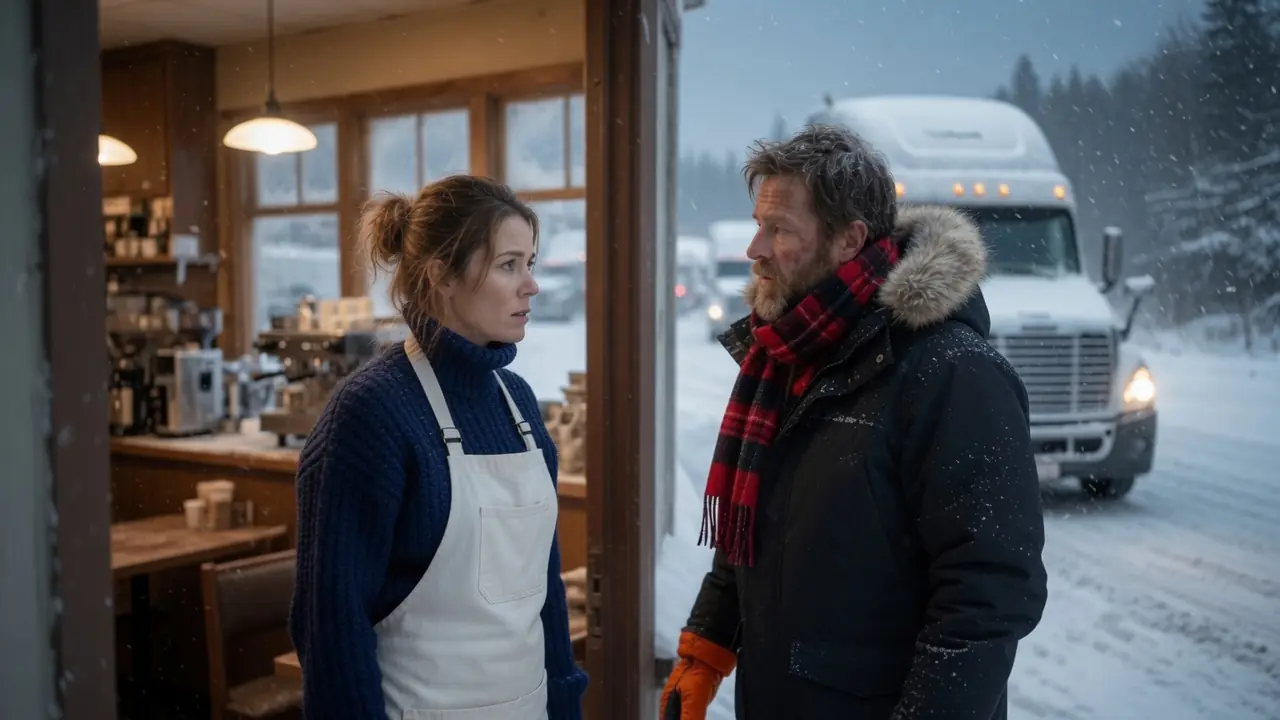
Nora stood behind the counter in a faded denim apron, counting the last bills in the register while her seven-year-old son, Mason, slept in a booth beneath a patched red blanket. The diner was called The Blue Kettle, though the sign outside had lost two letters and now buzzed weakly whenever the wind touched it. Nora had owned nothing in that building except the coffee machine, the recipe cards, and the stubborn belief that she could keep going one more week. Everything else belonged to Walter Briggs, a landlord with a soft voice and a cruel calendar.
Her rent was twelve days late. The pantry was thin. The freezer held two trays of hamburger patties, one bag of chicken, and enough frozen biscuits to survive breakfast if the storm eased by morning. Nora had already watered down the soup twice that day, though she hated herself for it.
Mason shifted in the booth, half waking. “Mama?”
“I’m here, baby,” Nora said softly.
“Are we sleeping here tonight?”
She glanced toward the window, where snow slapped the glass like handfuls of salt. Their little rental house sat three blocks away, but three blocks in a Wyoming blizzard could become three miles if the drifts rose fast enough. Nora forced a smile her son was too sleepy to question. “Looks like we might have an adventure.”
Mason closed his eyes again. “Can adventures have pancakes?”
“If the power stays on,” she whispered.
The phone rang just after five. Nora picked it up expecting a weather update from her neighbor, but Walter Briggs’s voice slid through instead. He did not ask if she was safe. He did not ask whether Mason was warm. He cleared his throat and said, “Nora, I hope you understand tomorrow is the last day I can wait.”
She closed her eyes. “Walter, the storm has the whole town shut down.”
“The storm did not make you late before it arrived.”
“I’ll have more after the weekend.”
“You said that last weekend.”
Nora looked at Mason sleeping under the blanket and lowered her voice. “I’m trying.”
Walter sighed as if her struggle inconvenienced him personally. “Trying does not pay property taxes. A fuel company has made an offer for that corner. If I lease to them, they’ll tear down the diner and put in a proper stop. Clean pumps, card readers, fast food, real money.”
“My boy sleeps in this diner when storms come,” she said.
“That is exactly the problem,” Walter replied. “You treat a business like a charity room.”
Nora’s hand tightened around the phone.
“If you cannot pay by noon tomorrow,” he continued, “I will begin removal. And Nora, do not make trouble tonight. No free meals, no strays, no turning my property into a shelter. I mean it.”
The line went dead.
Nora stood there for a long moment, listening to the storm. She wanted to cry, but crying took time, and she had coffee to pour, soup to stretch, and a little boy who needed to wake up believing his mother still had answers. She placed the phone back in its cradle and wiped the counter until the same spot shone under the yellow light.
At six-thirty, the first horn sounded outside.
It was long, low, and desperate.
Nora looked up. Through the frosted glass, she saw headlights smeared across the snow. Not one set. Several. Big rigs sat angled on the road beyond the diner, their hazard lights blinking like red wounds in the whiteout.
A heavy fist pounded the side door.
Nora froze.
The knock came again, weaker this time.
She crossed the diner slowly, every instinct in her body alert. When she opened the door a few inches, the wind nearly ripped it from her hands. A man stood outside, covered in snow from his beard to his boots, one gloved hand braced against the frame and the other pressed to his ribs as if he had fallen.
“Ma’am,” he said, voice rough with cold, “I’ve got ten drivers freezing out there, and every other door in town is locked.”
Nora stared past him at the trucks. Their engines rumbled unevenly. Snow had packed around the tires. One cab door hung open, and a man inside was waving weakly.
“I’m a single mother with one diner,” Nora said, her voice tight. “Not a rescue shelter.”
The man’s face tightened with shame. “Then tell me to leave, but know those men may not make it till morning.”
Nora looked back at Mason sleeping in the booth. She thought of Walter’s warning. No strays. No free meals. No shelter. Then she looked at the trucker again and saw frost clinging to his eyelashes.
She opened the door wider.
“Get them inside,” she said. “Tonight nobody freezes while my stove is still burning.”
The man stared at her for half a second, as if kindness had arrived in a language he had forgotten. Then he turned into the storm and shouted, “Blue Kettle’s open! Move now!”
Nora grabbed every towel behind the counter and threw them near the door. One by one, the truckers stumbled inside, bringing snow, diesel, cold air, and the blunt terror of men who had nearly accepted dying in their cabs. They were big men, tired men, silent men, and one woman named Denise who had driven eighteen wheels for twenty-two years and walked in with lips so blue Nora almost called for an ambulance.
There was no ambulance coming. The roads were gone.
Nora locked the door behind the last driver and pointed toward the booths. “Coats off if they’re soaked. Boots near the mat. Nobody sits alone if they’re shaking too hard.”
The first man, the one who had knocked, pulled off his gloves with stiff fingers. “Name’s Jack Mercer.”
“Nora Ellis.”
“I’m sorry to bring this to your door.”
“You didn’t bring the blizzard.”
“No,” he said, looking at the room. “But you brought us inside it.”
She pretended not to hear the gratitude because gratitude could break her if she let it. “Coffee first. Then soup.”
She moved fast. The diner became a shelter in less than ten minutes. Coffee filled every mug she owned, then every paper cup she could find. Soup warmed in the largest pot. She sliced bread thin, buttered it thinner, and set plates in front of men whose hands shook so hard they could barely lift spoons.
Mason woke when the second pot of coffee started. He sat up, blinking at the room full of strangers. Nora crossed to him quickly, ready to explain, but Jack crouched several feet away, keeping his distance.
“Evening, young man,” Jack said gently. “We borrowed your diner from the storm.”
Mason studied him. “Are you a trucker?”
“Yes, sir.”
“Did your truck get stuck?”
“All of us did.”
Mason looked at his mother. “Can they have pancakes?”
The truckers laughed, and the sound changed the room. Not enough to erase the storm, but enough to remind everyone they were still alive. Nora kissed Mason’s hair and said, “Maybe in the morning.”
The power flickered at seven-fifteen.
Every head turned upward.
Nora held her breath. The lights buzzed, dimmed, and came back. A few minutes later, they flickered again. Jack rose from his booth.
“Where’s your breaker panel?”
“Back hallway.”
“You got a generator?”
“Old one behind the shed,” Nora said. “Hasn’t run right since last winter.”
Jack looked at two drivers. “Luis, Pat, with me.”
“No,” Nora said immediately. “You’re half frozen.”
Jack met her eyes. “So is the generator. We’ll see which one quits first.”
The three men went out through the kitchen door with scarves wrapped high around their faces. Nora watched them disappear into the storm and hated the helpless feeling that came with waiting. She kept serving because standing still made fear louder. Denise helped Mason collect blankets from the storage closet, and another driver named Carl started stacking chairs to clear more floor space.
Ten minutes later, the kitchen lights died.
The diner went dark except for the gray-blue storm light at the windows and the glow of truck headlights outside. Mason whimpered, and Nora pulled him close. Then, from behind the building, the old generator coughed once. Twice. A rough growl rose through the walls.
The lights came back dimmer than before.
When Jack returned, snow covered his shoulders and blood marked one knuckle where the machine had fought back. Nora handed him a towel.
“You saved the heat,” she said.
He shrugged. “You saved us first.”
By eight, Walter Briggs arrived.
He did not knock like a man in danger. He pounded like a man who owned the door. Nora opened it only because she saw his truck pulled crooked near the plowed edge, engine running, headlights burning through the storm.
Walter stepped inside, took one look at the truckers, and his face turned red. “What is this?”
Nora stood in front of him. “People who needed warmth.”
“I told you not to do this.”
Jack rose from the nearest booth. “Sir, the highway is closed. We had drivers losing heat.”
Walter ignored him. His eyes stayed on Nora. “You are using my building without permission.”
Nora laughed once, cold and humorless. “Your building has heat because the men you want outside just fixed your generator.”
“I don’t care if they fixed the roof. This is not a shelter.”
“No,” Nora said. “It’s a diner.”
“Then charge them.”
Several drivers reached for wallets at once, but Nora lifted a hand. “They can pay when the sun comes up.”
Walter stepped closer. “You are done here.”
Mason slid out of the booth. “Don’t yell at my mom.”
Nora turned sharply. “Mason, stay back.”
Walter looked down at the boy, then back at Nora. “Pack your things tomorrow. I’m changing the locks.”
The room went silent.
Jack moved one step forward. Nora saw the hard line of his shoulders and shook her head slightly. She did not want a fight. Walter wanted one, because a fight would give him a reason to make her look unstable.
“You would throw out a mother and child during a blizzard?” Denise asked from the counter.
Walter’s mouth tightened. “I’m removing a tenant who cannot pay.”
Nora felt every eye on her. Shame rose hot in her throat, but she refused to bow beneath it. Walter had wanted the truth exposed in front of strangers. Fine. Let it stand there.
“I’m late,” she said. “I’m not dishonest.”
“You’re finished,” Walter replied.
Jack’s voice cut through the room, low and dangerous. “Careful, friend. Every man in this room knows what it looks like when someone mistakes power for character.”
Walter turned toward him. “And who are you?”
“Someone she opened the door for.”
“That gives you no say in my property.”
Jack stepped closer. “No. But it gives me a reason to remember your name.”
Walter stared at him, then at the nine other drivers who had gone still as fence posts. For the first time since he entered, uncertainty crossed his face. He backed toward the door, pointing at Nora.
“Noon tomorrow,” he said. “Have my rent or have your things out.”
Then he left, taking a blast of snow and cold with him.
Nora stood very still after the door closed. She could feel herself shaking now that anger had no one to hold it against. Mason wrapped both arms around her waist. She rested one hand on his head and stared at the floor.
“I’m sorry,” Jack said quietly.
She shook her head. “You didn’t make him cruel.”
“No,” he said. “But I saw it.”
The night stretched long. The storm raged, then softened, then returned harder. Nora made everything she had. Soup, coffee, biscuits, eggs, pancakes after all because Mason asked and because men who almost froze deserved something sweet. By midnight, half the truckers slept in booths, two slept on the floor near the heater, and Denise sat by the window keeping watch on the trucks.
Jack remained awake.
Nora found him near the counter at two in the morning, holding a mug in both hands. “You should sleep,” she said.
“So should you.”
“I own the worry here.”
He smiled faintly. “Looks like you rent it.”
Despite herself, she laughed.
Jack looked toward Mason sleeping again beneath the red blanket. “His father around?”
“No.”
Jack nodded, not pushing.
“He left when Mason was two,” Nora said after a moment. “Said this town was too small, the diner was too much work, and being a father made him feel trapped.”
“His loss.”
“It became mine.”
Jack’s face softened. “You’ve carried a lot.”
“So has everyone.”
“Not like that.”
Nora looked away because kindness spoken too directly could feel like touch on a bruise. “I just need one good week. That’s what I keep telling myself.”
“What happens tomorrow?”
“I don’t know.”
Jack studied her for a long second. “How much do you owe?”
She stiffened. “That’s not your problem.”
“You made ours yours.”
“That was different.”
“Was it?”
Nora met his eyes, tired and proud. “I didn’t open the door so you could pay my bills.”
“No,” Jack said. “You opened it because men were freezing. That’s why it matters.”
Before dawn, the storm finally broke.
The world outside the diner was buried but visible. Snowdrifts rose against the windows. Trucks sat like sleeping beasts along the road, half-covered and silent. The sky turned pale behind the mountains, and the first county plow appeared around seven.
Nora cooked breakfast with the last of the eggs and flour. Every driver tried to pay. She accepted enough to cover the food because pride still mattered, but when Jack placed a thick fold of cash beside the register, she pushed it back.
“No.”
“Nora.”
“I said no.”
He looked at her for a moment, then took the money back. “All right.”
That should have warned her.
The drivers left in stages after the plows cleared the road. One by one, they thanked her, hugged Mason, promised to stop again, and climbed into their rigs. Jack was last. He stood at the door, cleaner now but still worn by the night, with his coat zipped high.
“You did more than serve coffee,” he said.
Nora leaned against the counter. “You fixed my generator.”
“We’ll call it even for now.”
“For now?”
Jack opened the door, and cold sunlight flooded in. “You’ll see.”
By ten-thirty, Nora was alone with Mason in the diner, staring at empty shelves and dirty dishes. The place looked wrecked. Every towel was used, every mug needed washing, and the freezer was nearly bare. But everyone had survived.
At eleven-forty, Walter’s truck pulled into the lot.
Nora’s stomach turned.
He stepped out carrying a folder and wearing the expression of a man who had already decided mercy was bad business. Mason stood behind the counter, gripping the edge. Nora wiped her hands on her apron and walked to meet Walter at the door before he could step inside like he owned her breath too.
“Do you have the rent?” Walter asked.
“No.”
“Then we’re done.”
He opened the folder and removed papers. “You have until five to remove personal property. Anything left behind becomes mine.”
Before Nora could answer, a horn sounded in the distance.
Then another.
Then many.
Walter frowned and turned.
The first truck rolled into view at the edge of town, polished chrome flashing under the winter sun. Then a second came behind it. Then a third, fourth, tenth, twentieth, until the road beyond The Blue Kettle filled with rigs moving slow and steady through the plowed snow. Their headlights burned bright. Their horns echoed across Pine Ridge like a warning.
Nora stepped outside, stunned.
Trucks filled the road, the shoulder, the lot, and the open yard beside the diner. One hundred rigs, maybe more, rolled in from every direction and parked in lines with careful precision. Names marked the doors from companies across Wyoming, Montana, Colorado, Nebraska, and Utah. Drivers climbed down, men and women in heavy coats, all turning toward the diner.
At the front was Jack Mercer.
He walked toward Nora with Denise beside him and the other nine drivers from the night before close behind. Walter stared at the convoy, his face draining of color.
“What is this?” Walter snapped.
Jack stopped beside Nora. “Breakfast crowd.”
Walter’s voice cracked. “You can’t park here.”
Denise smiled coldly. “We can if we’re customers.”
A man from one of the front trucks raised a paper bag. “We brought supplies.”
Another called, “Eggs, flour, bacon, coffee, and about two hundred people hungry enough to pay.”
Nora covered her mouth.
Jack looked at Walter. “Last night, she opened your building when you wanted it closed. She fed drivers who would have frozen while you worried about rent.”
Walter tried to regain control. “This is private property.”
Jack nodded toward a tall woman stepping forward from a black pickup. “Good. Then you’ll want to talk to the person who just bought the note on it.”
The woman handed Walter a document. “Briggs Holdings owed against this property. As of nine this morning, the debt was purchased and assigned.”
Walter looked at the paper. “Who are you?”
“Attorney Ellen Price. I represent Mercer Freight Cooperative.”
Nora turned to Jack. “Mercer?”
He smiled gently. “Family business. I drive because I like the road better than offices.”
Walter’s face twisted. “You can’t do this.”
Ellen Price adjusted her gloves. “Actually, we can. The cooperative now controls the debt secured against this property. Miss Ellis is no longer your tenant. She has been offered a purchase agreement on generous terms, beginning with a first year at one dollar rent while ownership transfer is completed.”
Nora could not breathe.
Jack turned to her. “If you want it.”
She stared at the diner, the cracked sign, the frosted windows, the doorway where ten freezing people had come in from the storm. Then she looked at Mason, who stood in the doorway with wide eyes.
“You bought the diner?” she whispered.
“No,” Jack said. “We bought time. You earn the rest the way you already were.”
Walter’s mouth opened and closed. No words came.
The drivers began unloading supplies. Boxes of eggs, sacks of flour, coffee beans, canned goods, blankets, cleaning supplies, new tires for the generator cart, and a hand-painted sign that read: TRUCKERS WELCOME, STORMS OR SUN. Someone repaired the broken letters on The Blue Kettle sign before noon.
By one o’clock, Nora was cooking again.
This time, every plate was paid for. Every coffee came with a tip. Drivers filled the booths, the counter, and the yard outside, eating from paper plates and laughing under the cold blue sky. Mason ran between tables refilling napkins like he owned the place already.
Walter left without being noticed.
Jack stayed near the kitchen, sleeves rolled, washing dishes badly but earnestly. Nora finally took the towel from his hand. “You’re terrible at that.”
“I saved ten men and bought a diner note,” he said. “Can’t be good at everything.”
She laughed, then cried before she could stop herself.
Jack did not touch her without permission. He simply stood there, steady and quiet, while the sound of one hundred trucks filled the yard outside. Nora wiped her eyes and looked through the kitchen window at the convoy, at Mason, at the diner that no longer felt like it was slipping from her hands.
“You didn’t have to do all this,” she said.
Jack looked at her. “Neither did you.”
The answer settled between them, simple and impossible to argue with.
Years later, truckers still told the story of the night The Blue Kettle opened in a blizzard. They told it at fuel stops, dispatch offices, repair yards, and lonely diners along long highways. They said a single mother with almost nothing left opened her door when the whole town had locked theirs.
Nora never became rich. The diner did not turn into a chain or a polished roadside empire. It remained small, warm, crowded, and stubborn, with a repaired sign, strong coffee, and a wall covered in photos of trucks that had passed through.
But she owned it.
Mason grew up knowing that kindness was not weakness. He learned that a locked door can be practical, but an open one can change a life. He learned that sometimes the people you shelter return with more strength than you ever imagined.
And every winter, when the first hard snow came down from the mountains, Nora kept an extra pot of coffee on.
Just in case someone was still out there.
Just in case the road disappeared.
Just in case another stranger knocked and needed to hear the words that had saved ten men and filled her yard with one hundred trucks by morning.
“Get inside. Nobody freezes while my stove is still burning.”