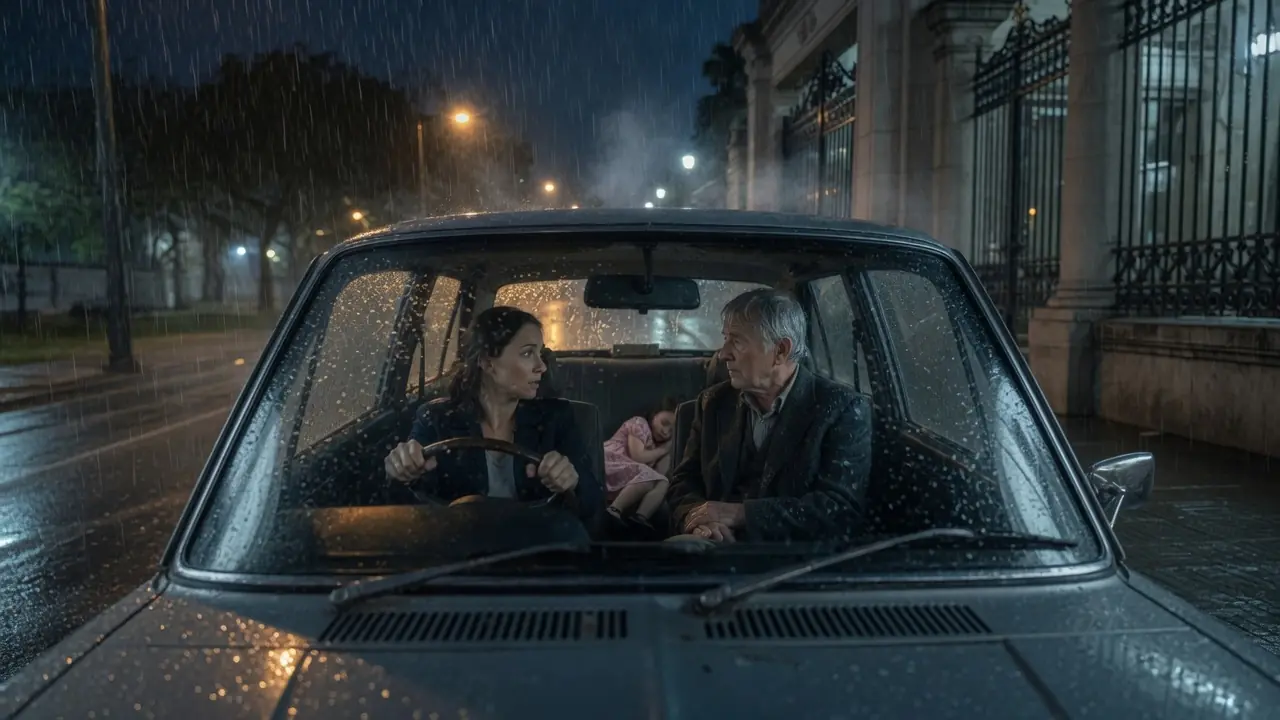
Rain was falling so hard that Laya Thompson could barely see the road in front of her. The windshield wipers on her old sedan scraped back and forth with a tired squeal, pushing sheets of water aside only for the storm to cover the glass again. In the back seat, her five-year-old daughter Maya slept curled in her pink dress, one small shoe hanging halfway off her foot, her breath soft and steady after a long evening at the diner. Laya’s waitress uniform still smelled faintly of coffee, fryer grease, and spilled syrup, and every muscle in her back begged her to drive straight home.
She had worked a double shift that day because rent was due in five days and her checking account looked like a bad joke. The tips had been thin, the customers impatient, and her manager, Steve Simmons, had spent the evening reminding everyone that being tired was no excuse for being slow. Laya had smiled through it because smiling was part of survival. A single mother did not get to collapse just because life felt heavy.
It was nearly midnight when she saw the old man. He stood under a streetlight near the edge of the sidewalk, soaked from head to toe, one trembling hand wrapped around a lamppost to keep himself upright. His wool blazer clung to his thin shoulders, his silver hair dripped rainwater down his face, and his other hand held a dead phone like he was still hoping it might save him. Cars passed without slowing.
Laya’s foot eased off the gas before her mind could argue. This part of town was quiet, but helping strangers at midnight was still dangerous, especially with Maya asleep in the back. She gripped the steering wheel, looking at the old man through the watery blur. Then his shoulders shook—not with drunkenness, not with anger, but with exhaustion so plain it pierced her caution.
She pulled over. Cold rain blew in as she lowered the passenger window halfway. “Sir, are you okay out here?” she called.
The old man turned slowly, blinking through the rain. “I got lost in the rain, my phone died, and I couldn’t walk another block.”
Laya looked at him for a long moment. There was something dignified about him, even soaked and trembling. He did not beg, did not demand, did not try to step closer to the car. He only stood there like a man who had reached the end of his strength and was ashamed of needing help.
She leaned across the seat and unlocked the door. “Get in,” she said. “Let me take you home.”
He hesitated just long enough to show he understood the risk she was taking. Then he opened the door and lowered himself carefully into the passenger seat, trying not to drip too much water onto the floor mat. Laya turned the heater up, though it coughed more than it warmed. The old man folded his wet hands in his lap and looked back at Maya, sleeping under her little pink jacket.
“You did not have to stop,” he said quietly.
“I know,” Laya answered, keeping both eyes on the road. “But no one’s grandfather should be left freezing in the rain.”
A faint smile touched his mouth. “Walter. My name is Walter Weston.”
“Laya Thompson,” she said. “And the sleeping beauty in the back is Maya.”
Walter looked at the child again, and something in his face softened with a pain Laya recognized too well. It was the look of someone remembering a home that no longer sounded the way it used to. He gave her an address after a few silent blocks. Laya’s eyebrows lifted before she could stop them.
The Weston address belonged to the wealthy side of town. Not comfortable wealthy, but old-money wealthy, where houses sat behind iron gates and the lawns looked cared for by people who never lived inside them. Laya said nothing. She had learned long ago that asking too many questions about rich people could make them treat you like you had stepped out of place.
At the door, Walter turned to her. His eyes were tired but clear. “You never asked who I was.”
Laya shrugged, rain dripping from her hair. “Didn’t seem important.”
He stared at her as if that answer had meant more than she intended. Then he nodded once and opened his door. Laya waited until the lights came on inside before running back to her car. As she drove away, Maya shifted in the back seat and mumbled in her sleep, and Laya felt strangely peaceful for the first time all day.
The next morning punished her for that peace. After less than four hours of sleep, Laya rushed Maya to daycare under a pink umbrella, then drove across town with wet hair, tired eyes, and her uniform still slightly damp from the night before. She pushed through the diner’s back door fifteen minutes late, tying her apron as she hurried toward the counter. Before she could say a word, Steve Simmons turned on her.
“Carter,” he snapped, using the last name from her old paperwork because he never bothered to correct himself after her divorce. “You’re late.”
“I know. I’m sorry,” Laya said breathlessly. “There was an elderly man last night. He was lost in the storm, and I couldn’t just leave him—”
Steve raised one hand. “Save it.”
The kitchen quieted. Two cooks glanced over. A waitress holding a coffee pot froze near the pass-through window. Steve stepped closer, his mouth curling into the kind of smile that made humiliation feel planned.
“You think helping someone gives you permission to stroll in whenever you want?” he said loudly. “This is a job, Laya. Not a charity.”
“I’ve never been late before,” she whispered. “Four years, Steve. Please.”
“Four years, and you still don’t understand that good deeds don’t fry eggs.” His voice rose enough for customers to hear. “Hand over your apron.”
Laya stared at him. Her fingers went numb as if the rain had followed her inside. “You’re firing me?”
“I’m firing an employee who thinks sob stories pay rent.” Steve leaned against the counter, enjoying the room’s attention. “Try not to be late to your next charity gig.”
A few customers shifted uncomfortably. One man looked down at his plate. A woman in a booth pressed her lips together but said nothing. Laya untied her apron slowly and placed it on the counter, refusing to let Steve see her cry.
She walked through the diner past booths she had cleaned for years, past the coffee station where she knew every regular’s preference, past the window where rain still streaked the glass. She did not notice the elderly man sitting alone in the far corner booth, silver-rimmed glasses low on his nose, watching everything with quiet fury. Walter Weston stirred his tea once and then stopped.
Outside under the awning, Laya finally let one tear fall. She had done the right thing. She knew she had. But the right thing had just cost her the only income she had.
Inside, Walter placed a large bill on the table, stood slowly with his cane, and walked toward the door. He did not confront Steve yet. Some men shouted when angry. Walter Weston began making decisions.
By noon, Laya was home in faded jeans and a gray T-shirt, standing at the sink while Maya colored quietly at the kitchen table. The apartment felt smaller than usual. The rent notice on the counter looked larger than it had that morning. Laya kept rinsing the same spoon because if she stopped moving, she might break.
A knock came at the door.
She dried her hands and opened it cautiously. A tall man in his early thirties stood on the porch in a navy coat damp from the weather. He was clean-cut, composed, and carried himself with quiet confidence, but there was no arrogance in his eyes. He looked at Laya like he already knew he was standing in front of someone his family owed.
“Miss Thompson?” he asked.
“Yes.”
“My name is Julian Weston. Walter Weston is my father.”
Laya blinked. “The man from the rain.”
A small smile touched his face. “Yes. He asked me to find you.”
She held the door only halfway open. “Is he okay?”
“He is now,” Julian said. “Because of you.”
“I only gave him a ride.”
“No,” Julian replied softly. “You saw him when everyone else drove past.”
Laya looked back at Maya, who was peeking over her coloring book. She suddenly felt conscious of the small apartment, the cheap curtains, the unpaid bills, the sink full of mismatched dishes. Julian did not look around with judgment. That helped, but only a little.
“My father told me what happened at the diner,” Julian continued. “He was there this morning.”
Laya’s face warmed with embarrassment. “Then he saw me get fired.”
“He saw a cruel man punish you for saving someone’s life.”
Her throat tightened, but she lifted her chin. “I don’t need pity.”
“This isn’t pity.” Julian reached into his coat and took out a folded note. “My father wants to invite you and Maya to lunch. He also asked if you would consider working with us part-time.”
Laya frowned. “Doing what?”
“Keeping him company,” Julian said. “Light help. Tea, reading, reminders for medication, conversation. He has nurses if he needs nurses. What he asked for was someone kind.”
Laya almost laughed because kindness had just gotten her fired. “I’m not qualified for that kind of work.”
“You don’t need a degree to make someone feel human again.”
The apartment went silent except for Maya’s crayon scratching across paper. Laya looked at Julian, searching for the trap. Rich people often disguised control as generosity. But his face held no performance, only sincerity and something else—hope, maybe.
“Three afternoons a week,” he said. “Proper pay. Flexible around Maya.”
Laya looked down at her bare feet. Rent was due. Groceries were low. Her daughter needed winter shoes. Pride was useful, but it could not feed a child.
“I can try,” she said quietly.
Julian smiled with visible relief. From the table, Maya raised her hand like she was in school. “Can I come too?”
Laya almost scolded her, but Julian looked at the little girl and smiled. “I think my father already hoped you would.”
The first visit to the Weston house was meant to be simple, but nothing about it felt simple to Laya. The brick house stood elegant behind ivy and wide windows, yet when Walter opened the door in a cardigan and slippers, his smile made it feel less intimidating. “You came,” he said, as if he had been afraid she might not. Maya stepped forward first and handed him a drawing of a stick man in the rain beside a car.
Walter accepted it like a priceless painting.
Julian cooked lunch, though Walter teased him by saying he had mostly supervised the oven. The dining table held four place settings, fresh flowers in a mason jar, and food served without fuss. Julian checked Maya’s plate before handing it to her, making sure it was not too hot. Laya noticed because mothers notice the small careful things.
After lunch, Walter led Laya into his study. He asked her to read aloud from a book of short stories, and she did, awkwardly at first, then with more ease when she realized he was truly listening. Later, she made tea and helped fold linens while he told her about his late wife, Eleanor, and how the house had grown too quiet after illness took her. He did not speak like a millionaire. He spoke like an old man who missed the sound of being needed.
Weeks passed, and the Weston house changed around Laya and Maya. Maya brought drawings, pink cupcakes from the bakery, and endless questions Walter answered with grandfatherly patience. Laya read in the study, made tea, organized medicine bottles, and sometimes simply sat while Walter talked. Julian returned from work each evening and always paused in the hallway when he heard his father laughing.
One afternoon, Laya caught Julian watching from the doorway while Walter and Maya played a card game badly. “He hasn’t laughed like this in years,” Julian said quietly.
Laya looked at Walter, whose eyes were bright as Maya scolded him for cheating incorrectly. “Maybe he just needed someone to laugh with.”
Julian’s gaze shifted to her. “Maybe we all did.”
The words stayed with her longer than they should have. Laya reminded herself that Julian Weston belonged to a world of polished cars, old money, and rooms with too much space. She belonged to coupon folders, daycare pickups, and counting coins at midnight. Still, when he pulled out her chair, listened without interrupting, or carried sleepy Maya to the car with careful arms, the distance between their worlds felt less certain.
The storm between them came from something small and sacred.
One Saturday, Julian invited Laya and Maya for lunch as guests, not employees. Walter was delighted, Maya wore her favorite pink dress, and the sunroom table was set with scones and lemonade. While Julian finished in the kitchen, Maya wandered into his study with Walter following slowly behind her. On the desk sat a small wooden box with tiny etchings along the side.
Maya touched it. The lid slipped. The box fell.
A string of worn green-blue stones scattered across the hardwood floor with a brittle sound that froze the room. Julian rushed in, then stopped as soon as he saw the broken bracelet. His face changed—not with anger, but with grief so deep that Laya felt it before he spoke.
“It was my mother’s,” Julian said quietly, kneeling to pick up one bead. “She made it for me when I turned ten.”
Maya’s eyes filled with tears. “I didn’t mean to.”
Julian looked at her, and his voice stayed gentle, but the warmth had vanished from it. “I know.”
Laya apologized again and again, offering to repair it, replace it, pay whatever she could, but Julian only shook his head. “It’s all right,” he said politely. Too politely. The lunch ended without being eaten, and Laya drove home with Maya crying softly in the back seat.
For four days, Laya did not return to the Weston house. She texted Walter an apology and told him it might be best to find someone else. Walter replied with only two words: You matter. Laya cried when she read them, but she still stayed away.
At home, Maya sat on the living room rug with plastic beads from her craft box. “What are you making?” Laya asked.
“A bracelet,” Maya whispered. “For Mr. Julian. It won’t be shiny like his mommy’s, but maybe it can still be full of love.”
Laya knelt beside her, heart aching. “Sweetheart, you don’t have to fix everything.”
Maya threaded another bead carefully. “He looked sad. I want him to smile again.”
The bracelet was messy, bright, and uneven. Maya wrote a note in purple crayon: I’m sorry I broke your shiny bracelet. I made this one for you. It’s not shiny, but it’s full of love. Love, Maya, 5 years old.
Walter came to pick it up himself. He looked at the note, then at Laya. “Sometimes children understand repair better than adults.”
That night, Julian sat alone in his study when Walter placed the paper bag on the desk. Julian opened the note first. By the time he reached “full of love,” his hands were trembling. He lifted the plastic bracelet from the bag as if it were something holy.
A tear slipped down his cheek before he could stop it. For years, he had cried because he missed his mother. Tonight, he cried because a child who had broken something by accident loved him enough to try making something whole.
He arrived at Laya’s apartment after dark.
When she opened the door, he did not wait behind pride. “I was angry,” he said. “Not at Maya. Not really at the bracelet. I was angry because grief made me forget people are more important than things.”
Laya’s eyes softened, but she stayed still.
Julian held up the plastic bracelet on his wrist. “I’m wearing it tomorrow. And every day after that, if she lets me.”
Maya peeked from behind her mother. “Really?”
Julian crouched to her level. “Really.”
Maya ran into his arms, and Laya turned away before he could see the tears on her face. But he saw them anyway. He stood slowly, still holding Maya, and looked at Laya like something fragile had returned to life between them.
The diner reckoning came the next week.
Julian had taken Laya to collect her final paycheck because Steve had ignored her calls. Maya came too, holding Laya’s hand tightly. The diner was busy when they entered, full of clattering plates, coffee steam, and customers who remembered the morning Laya was fired.
Steve Simmons saw her and smirked. “Back for charity work, Carter?”
Laya stiffened, but Julian stepped beside her. “She came for the wages you owe her.”
Steve looked Julian up and down. “And you are?”
“Julian Weston.”
The name meant nothing to Steve at first. “Good for you.”
Then the door opened behind them.
Walter Weston entered slowly with his cane, dressed neatly in a dark coat, his silver hair combed back and his eyes fixed on Steve. The diner quieted as he approached the counter. He placed a document down with one calm hand.
Steve’s smile faltered. “Mr. Weston?”
Walter’s voice was hard enough to cut through every whisper. “I was the old man she helped in the rain.”
Steve swallowed. “I didn’t know that.”
“No,” Walter said. “You did not know whether I was rich, poor, useful, or forgotten. You only knew she had been kind, and you punished her for it.”
Steve’s face flushed. “This is a business.”
Walter tapped the document. “A business leasing property from my family’s company.”
The diner went dead silent.
Laya stared at Walter, stunned. Julian’s jaw was tight, but he did not speak. This was Walter’s moment, and everyone in the room seemed to understand it.
Walter looked at Steve. “Fire her for mercy again, and tomorrow this diner won’t have a door to open.”
Steve went pale.
Walter turned to Laya then, and his expression softened. “Your kindness cost you a job,” he said. “It should not cost you your dignity too.”
Several customers began clapping, quietly at first, then louder. The same woman who had looked down at her plate the morning Laya was fired stood and said, “She was the best waitress you had.” Others nodded. Steve looked around and realized the room he once used to humiliate Laya had turned against him.
Laya received her final paycheck before leaving. She did not ask for her job back. She did not want it anymore.
Months unfolded into something gentler. Laya continued working with Walter, but it no longer felt like employment alone. It felt like belonging. Maya had her own drawer in the Weston kitchen now, filled with crayons, hair clips, and snacks Walter pretended not to overbuy.
Julian and Laya moved carefully toward each other. He never rushed her, never used money to impress her, never made her feel small for having less. He learned Maya’s favorite bedtime story, fixed the loose latch on Laya’s apartment door, and kept wearing the plastic bracelet even to business meetings. When someone once asked why, he said simply, “It was made by someone who forgave me before I forgave myself.”
One rainy Sunday afternoon, the three of them sat on a picnic blanket under the covered patio while Walter read nearby. Maya leaned against Julian’s shoulder and watched the rain bead along the garden leaves. Without warning, she asked, “If we stayed here forever, would you be my daddy?”
Laya froze.
Julian looked down at the little girl, his face softening with emotion. He cupped her cheek gently. “That would be an honor.”
Laya turned away, blinking hard, but Julian reached for her hand. She let him take it. Walter pretended to keep reading, though his page had not turned in ten minutes.
The proposal came at a family dinner months later. Not grand, not theatrical, but full of warmth. Walter tapped his glass and gave a toast to the woman who had found him in the rain and the child who had brought laughter back into his house. Julian stood beside Laya, holding her hand.
“You walked into our lives during a storm,” he said. “You helped my father when no one else would. You brought light into a house that had forgotten how to feel alive.”
Laya’s lips parted, trembling.
Julian continued, “Let me spend the rest of my life making sure you and Maya never have to wonder where home is again.”
Before Laya could answer, Maya shouted, “Say yes, Mommy!”
Everyone laughed through tears. Laya nodded, pulling Maya close with one arm and reaching for Julian with the other. Walter wiped his eyes with a handkerchief and pretended it was only because the soup had been too peppery.
Later that week, Julian drove Laya and Maya to a modest sunlit house with a garden gate and ivy climbing the porch railing. It was not the Weston estate. It was smaller, warmer, and chosen carefully with Laya’s comfort in mind.
Julian opened the passenger door and smiled through his nerves. “Get in,” he said softly. “This time, let me take you home.”
Laya looked at the house, then at Maya bouncing with excitement in the back seat. Tears filled her eyes, but they were no longer the kind she had cried under the diner awning. She took Julian’s hand and stepped out.
The storm that began with a lost old man in the rain had brought all of them here. Walter had found hope. Julian had found love. Maya had found the father her little heart had been brave enough to ask for.
And Laya Thompson, who once thought one act of kindness had cost her everything, learned that mercy sometimes leaves and returns by another road.
Sometimes it comes back as a knock at the door.
Sometimes as a child’s handmade bracelet.
And sometimes, as a man standing beside an open car door, ready to take you home.