The Black man reached Gate C twenty-seven minutes before the gates officially opened to the general public.
At nearly two meters tall, he was impossible to miss even in a crowd.
He had deep-brown skin, close-cropped black hair with a trace of gray at the temples, a neatly trimmed salt-and-pepper goatee, and the broad shoulders of someone who had spent decades taking physical fitness seriously.
Dark rectangular sunglasses covered his eyes.
A long black wool overcoat fell nearly to his knees, revealing only the bottom of a charcoal suit, polished black shoes, and the narrow edge of a white dress shirt.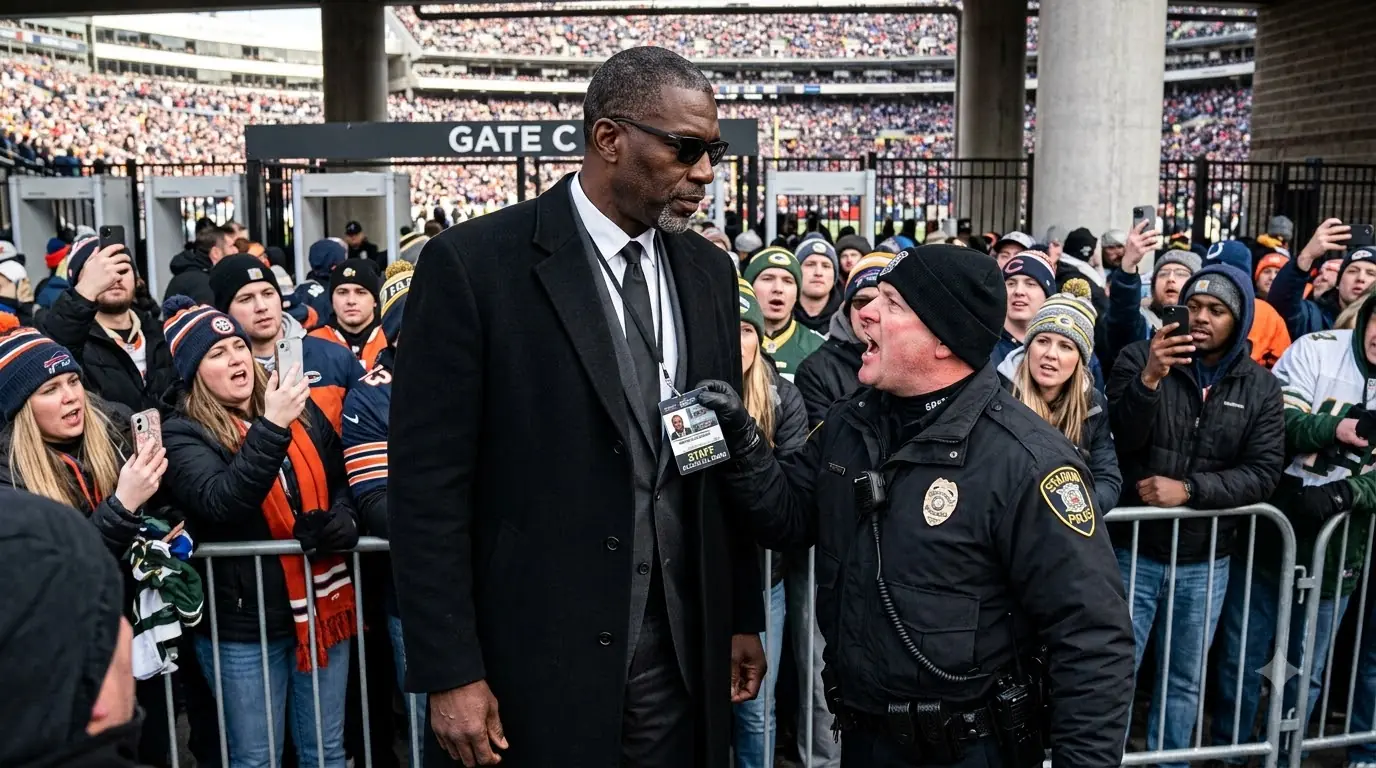
Around his neck hung a dark stadium lanyard.
The credential attached to it looked ordinary from a distance.
That was intentional.
No giant executive label.
No gold border.
No oversized title.
Just a photograph, an identification number, several encoded access zones, and a small security chip inside the card.
The Black man preferred it that way.
The stadium was already awake.
Delivery trucks moved beneath the east loading platform.
Food-service crews pushed carts through employee entrances.
Broadcast technicians carried equipment toward the upper levels.
Security teams checked metal detectors and tested handheld scanners.
Outside, thousands of fans were gathering several blocks away.
The home team had not played a meaningful December game this late in the season for years.
Every local sports station had spent the entire week talking about playoff possibilities.
Tickets were selling for ridiculous prices.
People had arrived before sunrise.
The atmosphere around the stadium already felt like a game had started.
The Black man walked toward Gate C without an escort.
That was also intentional.
He had been hired six weeks earlier as the stadium's new Director of Security Operations.
The appointment had not yet been publicly announced.
Only senior executives, department supervisors, and a small group of administrative employees knew his face.
Most frontline staff had received an internal notice with his name and a brief biography, but the Black man knew how internal messages worked.
Some employees read every announcement.
Some skimmed them.
Some ignored anything that did not affect their next shift.
That did not bother him.
He did not expect recognition.
In fact, he preferred not being recognized.
His official introduction was scheduled for a staff briefing after the game.
Before that happened, he wanted to see the stadium as a regular credentialed employee would see it.
He had asked the Chief Operations Executive not to send anyone to meet him.
The executive resisted.
“You're going to walk into a seventy-thousand-seat stadium on game day without an escort?”
“Yes.”
“You've been here once.”
“Twice.”
“That is not helping.”
The Black man had smiled.
“If everyone knows when I'm coming, I will only see what they want me to see.”
The executive understood the logic.
He still disliked it.
The Black man won the argument.
So that morning, he parked in an ordinary staff lot almost half a mile away.
He walked through the cold with his hands in his coat pockets.
Nobody greeted him.
Nobody opened a special door.
Nobody radioed ahead.
Exactly as planned.
He reached Gate C and stopped beside a metal barrier.
Several hundred early-arrival fans were already forming lines outside.
Some wore thick blue jackets and red scarves.
Others had team jerseys over winter coats.
A few carried handmade signs.
Several teenagers were filming themselves for social media.
The Black man looked toward the security lanes.
Four walk-through scanners stood beneath the concrete overhang.
Three were powered on.
One displayed an error light.
He noticed it immediately.
The leftmost handheld scanner had been placed on the wrong charging dock.
A temporary crowd-control barrier had been positioned too close to the bag-check table.
One emergency exit sign was partially blocked by a promotional banner.
Small things.
Nothing catastrophic.
But small things told him how a department operated.
A security attendant approached.
“Sir, employees enter through the staff lane.”
The Black man nodded.
“Thank you.”
He moved toward the staff checkpoint.
The attendant looked at the credential hanging from his neck but did not stop him.
At the lane, a younger security employee held out a scanner.
“Badge, please.”
The Black man lifted the credential.
The employee scanned it.
A green light appeared.
The handheld screen displayed several lines of information.
The employee looked at the screen.
Then looked again.
His expression changed.
“Sir.”
“Yes?”
The employee straightened slightly.
“You have executive access.”
“That is what the card says.”
“Yes, sir.”
The Black man smiled faintly.
“Then the card is working.”
The younger employee laughed nervously.
“Yes, sir.”
“Good.”
The Black man stepped forward.
That should have been the entire interaction.
Then a voice came from behind the checkpoint.
“Hold it.”
The Black man stopped.
A stocky white stadium police officer walked toward them.
He was in his late forties with a heavy black winter patrol jacket, black knit cap, gloves, radio, badge, and duty belt.
His face was already tight with irritation.
He looked at the younger employee.
“What did you just scan?”
The employee pointed toward the Black man.
“His credential.”
The officer looked at the card.
“Show me.”
The Black man lifted it slightly.
The officer moved closer.
His eyes narrowed.
“What access level?”
The younger employee checked the scanner.
“Executive.”
The officer frowned.
“That can't be right.”
The Black man said nothing.
The employee looked uncertain.
“The scanner says unrestricted operational access.”
The officer reached toward the credential.
The Black man moved it back slightly.
“Do you need something?”
The officer looked at him.
“I need to see that badge.”
“You can look.”
The Black man held it forward.
The officer grabbed the card by the plastic sleeve.
Not gently.
The lanyard pulled tight against the Black man's neck.
The younger employee glanced between them.
The Black man remained still.
“Release the lanyard.”
The officer ignored him.
He examined the credential.
Then looked at the Black man.
“Where did you get this?”
“It was issued to me.”
“By who?”
“Stadium administration.”
The officer turned the card over.
It contained a holographic security mark, embedded chip, barcode, and the correct stadium branding.
Nothing about it looked fake.
That seemed to bother the officer more.
“What's your job?”
The Black man looked at him.
“That information is encoded on the badge.”
“I asked you.”
“And I answered.”
The officer's mouth tightened.
“No, you didn't.”
The Black man remained calm.
“I work for stadium operations.”
The officer looked at the younger employee.
“You know him?”
“No.”
The officer gave a short laugh.
Then he looked toward several other checkpoint employees.
“Anybody know this guy?”
Nobody answered.
One employee shook his head.
The officer looked satisfied.
“There.”
The Black man raised an eyebrow.
“There what?”
“Nobody knows you.”
The Black man looked around.
“Should every employee know every other employee?”
“That badge says executive access.”
“Yes.”
“And nobody knows you.”
“That is not unusual when someone is new.”
The officer studied him.
“New.”
“Yes.”
“How new?”
“New enough that you apparently haven't seen me before.”
The younger employee covered his mouth, pretending to cough.
The officer noticed.
His expression hardened.
He turned toward the Black man.
“Take the badge off.”
“No.”
The answer was quiet.
The officer stared.
“What did you say?”
“I said no.”
“You want to get inside?”
“I already cleared the scanner.”
“I decide whether you clear this gate.”
The Black man looked toward the green confirmation screen.
“Your equipment appears to disagree.”
The younger employee looked down.
Several fans in the nearest public line had started watching.
The white officer noticed them.
His voice became louder.
“This badge is fake.”
The Black man looked at him.
“You've inspected it for less than a minute.”
“I know what real credentials look like.”
“So do I.”
The officer held the card closer to his own face.
“This access designation doesn't make sense.”
“Why?”