The government pickup appeared at the end of County Road 14 shortly after nine on an April morning in 2009. It was white, clean, and almost unnaturally bright against the brown fields surrounding the Cotter farm outside Mill Haven, Indiana. Earl Cotter stood near the machine shed with one boot resting on a rusted cultivator, watching the truck leave the county road and follow the gravel drive toward his barn. He had already been awake for five hours and had no reason to expect visitors.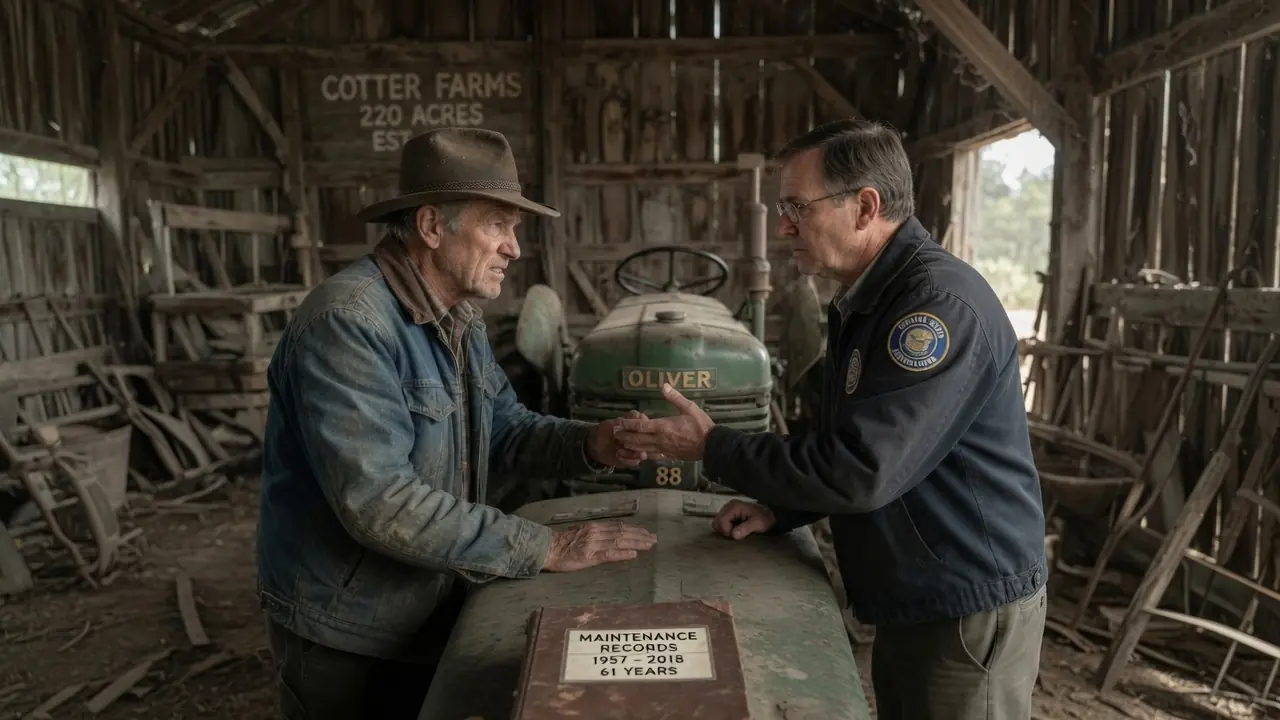
The truck stopped beside the fuel tank. A young man in a clean khaki shirt stepped out holding a clipboard and a thick black binder. His badge identified him as Dennis Hargrove, Agricultural Compliance Inspector for the State of Indiana. Dennis looked across the barnyard, noticed the faded green tractor beneath the open shed, and checked something on his paperwork before approaching Earl.
“Mr. Earl Cotter?”
“That depends on what you’re selling.”
“I’m not selling anything.”
“That usually costs more.”
Dennis did not smile. He introduced himself, explained that the state had adopted updated environmental rules for agricultural machinery, and asked whether the green tractor was still used in commercial farming. Earl looked toward the 1948 Oliver 88 as though Dennis had asked whether an old member of the family still ate supper at the table.
“Used it yesterday,” Earl answered.
Dennis wrote something down. “How many acres do you operate?”
“Two hundred and twenty.”
“That places you above the commercial threshold.”
Earl removed his cap and wiped the sweat beginning near his hairline. The April air was cool, but he had spent the morning repairing a section of fence near the south field. He watched Dennis walk around the tractor, inspecting the exhaust stack, engine housing, and original identification plate with the seriousness of someone studying evidence at a crime scene.
The Oliver 88 was sixty-one years old. Its olive-green paint had faded beneath decades of sunlight, and honest dirt filled every seam in the sheet metal. The seat had been repaired more than once, the steering wheel was worn smooth where three generations of Cotter hands had gripped it, and several areas of the frame carried welds Earl had made himself.
Dennis returned to the front of the tractor and opened his binder. “This machine does not meet the emissions standards adopted last year.”
“It was built before anybody knew the word emissions.”
“That does not change the regulation.”
“What does the regulation require?”
“Either approved modification or removal from commercial operation.”
Earl studied him. “You’re saying I can’t use it?”
“I’m saying that under the updated standard, this tractor is illegal for commercial agricultural work.”
The word remained in the barnyard between them.
Illegal.
Not unsafe. Not broken. Not unreliable. Illegal.
Earl looked at the Oliver again. His father, Thomas Cotter, had purchased it new in 1948 for $1,650, more money than the family had ever spent on a single machine. It had broken the south field, hauled corn, pulled flooded trucks from ditches, and kept the farm alive through droughts, low prices, and bank pressure.
“What would modification cost?” Earl asked.
Dennis handed him a printed page from a contractor approved by the state. The estimate ranged from $4,200 to $6,800, depending on the exhaust system, fuel conversion, and inspection fees. Earl read the page slowly before returning it.
“I’ll need the full regulation.”
Dennis tapped the binder. “This is the state compliance summary.”
“I didn’t ask for the summary.”
“The requirements are clear.”
“Then the full version should be clearer.”
Dennis’s patience thinned. “Mr. Cotter, every farmer I have visited has received the same information.”
“That doesn’t answer me.”
“You are required to sign the notice acknowledging the violation.”
Earl looked at the form but did not take the pen. “My father taught me not to sign what I haven’t read.”
“This is not a contract.”
“It has my name, your name, and a place for my signature. That makes it close enough.”
Dennis flipped through the binder, searching for a document he did not have. He carried the two-page summary, the notice of violation, a compliance timeline, and information from the modification contractor. The complete regulation consisted of forty-seven pages and remained in his department office.
“I can have it mailed,” Dennis finally said.
“Good.”
“You still have to sign this.”
“I’ll sign after I read what you say I violated.”
Dennis closed the binder. “Failure to comply could result in penalties and suspension of agricultural operations.”
“Then you should be certain before you suspend them.”
The two men faced each other beside the Oliver. Dennis was thirty-four, educated, trained, and accustomed to farmers complaining before eventually signing. Earl was sixty-seven, formally educated only through high school, and appeared no different from the other aging farmers Dennis had visited that spring.
Dennis did not yet understand that Earl had spent his entire life reading documents other men trusted someone else to explain.
Thomas Cotter had finished eighth grade during the Depression. He struggled with long words and kept an old dictionary beside the kitchen table whenever seed contracts, co-op agreements, or bank papers arrived. Earl remembered sitting across from him as a boy, watching his father read each page with one finger following every line.
“Other men trust the fellow across the desk,” Thomas once told him. “I trust the paper. The fellow might forget. The paper never does.”
Earl had never considered that statement wisdom. It was simply how the Cotter family did business. They kept receipts, stored contracts, recorded repairs, and never signed a page because the person presenting it appeared confident.
Dennis left without Earl’s signature.
His report that afternoon described the Oliver as noncompliant equipment and noted that the operator had requested the complete regulation before acknowledging the violation. Dennis expected to return within two weeks. He believed Earl would read several pages, become frustrated, and eventually accept the contractor estimate.
The packet arrived eleven days later.
Forty-seven pages lay inside a brown state envelope addressed to Earl D. Cotter. He placed the document on the kitchen table after supper, cleared away seed catalogs and machinery invoices, and began reading. A yellow legal pad sat beside him, along with a pencil and the same dictionary his father had once used.
The language was dense.
Definitions led to references, references led to code sections, and one subsection depended on classifications explained twenty pages earlier. Earl read slowly, circling unfamiliar terms and writing page numbers in the margins. He stopped shortly before midnight and continued the following evening.
On page thirty-one, he found Section Seven.
Subsection C.
Paragraph Four.
The clause stated that equipment classified as historic agricultural machinery under Indiana law was exempt from the emissions compliance requirements. To qualify, the machinery had to be manufactured before January 1, 1955, registered with the State Historic Preservation Commission, and continuously maintained in operational condition.
Earl read it once.
Then again.
Then a third time.
The Oliver had been manufactured in 1948. It had worked continuously on the Cotter farm since Thomas drove it home from the dealership. Every repair, oil change, belt, clutch, and engine rebuild had been recorded in a ledger beginning on the date of purchase.
Earl stood from the table and walked to the barn carrying the regulation.
He switched on the overhead light and faced the Oliver. The tractor sat exactly where it had rested for more than six decades, its left rear tire stained by the earth of the south field. Earl placed one hand on the hood.
“You were never illegal,” he said.
The next morning, he opened the steel filing cabinet beneath his father’s old workbench. Inside were stacks of farm records arranged by year. Earl found the original dealer receipt from 1948, Thomas’s maintenance ledger, insurance documents, parts invoices, and photographs showing the Oliver working across different decades.
The first ledger entry was written in Thomas’s slanted handwriting.
October 9, 1948. Oliver 88 delivered. Paid $1,650. Checked oil and belt tension before first use.
Earl sat on an overturned bucket and read several pages.
There was the replacement carburetor in 1954. The new clutch in 1962. The front axle repair in 1979, recorded in Earl’s more upright handwriting after he had taken over the farm. Sixty-one years of care existed in two hands, father and son, one continuing where the other stopped.
The exemption required proof of continuous maintenance.
Earl had more proof than the regulation’s authors had probably imagined anyone would possess.
He began building his case.
Over the next three months, the Oliver received more attention than any other machine on the farm. Earl pulled the engine, replaced worn rings and bearings, reground the valves, and honed the cylinder walls. He rebuilt the carburetor with a kit sourced from an antique tractor supplier in Ohio and replaced every aging rubber component in the fuel, cooling, and hydraulic systems.
He did not restore the tractor into a polished ornament.
He preserved it as a working machine.
The sheet metal was straightened but retained several small dents earned through decades of use. The green paint was cleaned and protected rather than covered beneath a false showroom finish. Earl wanted the commission to see a tractor that had survived because it worked, not because someone hid its history beneath fresh paint.
He organized the records into a thick binder.
The original dealer receipt came first. Then photographs, serial numbers, engine stampings, parts invoices, and selected pages from the maintenance ledger. He contacted the Oliver Heritage Foundation and received confirmation that the tractor’s serial number matched a 1948 production model.
Finally, Earl wrote a two-page history of the machine.
He described Thomas purchasing it after years of farming with horses and borrowed equipment. He explained how the tractor expanded the family’s operation from eighty acres to more than two hundred. He documented every decade of continuous agricultural use.
Then he completed the application for historic classification.
When the packet was ready, Earl called Dennis Hargrove.
“This is Earl Cotter on County Road 14.”
“I remember you.”
“You told me the Oliver was illegal.”
“It remains subject to the regulation until compliance is established.”
“I found Section Seven, Subsection C, Paragraph Four.”
Silence followed.
Earl continued. “It exempts historic agricultural machinery manufactured before 1955 and continuously maintained in operational condition. My Oliver was built in 1948. I have sixty-one years of records.”
Dennis did not answer immediately.
“I wasn’t aware of that exemption,” he finally said.
“Neither was I until I read all forty-seven pages.”
“I will need to speak with my supervisor.”
“That sounds sensible.”
Dennis reviewed the clause that afternoon.
His supervisor reviewed it the following morning. The department’s legal office confirmed that the exemption applied, provided Earl obtained the historic classification. The two-page inspector summary had omitted the clause entirely.
Three weeks later, an official letter arrived withdrawing the violation notice.
The Oliver had never been illegal.
Dennis returned to the farm personally.
He parked beside the barn and approached Earl carrying the full regulation instead of the usual summary. The Oliver stood behind them, cleaner now, its engine components renewed and its records waiting in the binder.
“You were right,” Dennis said.
“The paper was right.”
“I should have known about the exemption.”
“You were given a summary.”
“That doesn’t excuse it.”
Earl looked at the younger man. Dennis appeared more embarrassed than defensive, which mattered. A proud man would have blamed the department, the training, or the person who prepared the summary.
Dennis accepted responsibility.
“What happens now?” he asked.
“I wait for historic classification.”
“And if they deny it?”
“They won’t.”
“You sound certain.”
Earl tapped the maintenance binder. “Because the tractor has better records than most people.”
The State Historic Preservation Commission approved the Oliver in October 2009. The certificate arrived before the first hard frost. Earl placed it inside a wooden frame and mounted it near the barn door where he could see it each morning.
Word traveled quickly through Franklin County.
Farmers heard the story at the grain elevator, the co-op, the diner, and the church parking lot. Some initially believed Earl had found a personal favor or political connection. Then he showed them page thirty-one.
Harold Fenwick arrived one afternoon carrying paperwork for his 1951 Farmall M. An inspector had told him the tractor would need retirement before the following planting season. Earl opened the regulation and pointed to the exemption.
“Read the whole paragraph,” he said.
Harold did.
Two weeks later, he applied for historic status.
Another farmer, Lewis Parker, had already paid $5,100 to modify an old tractor that qualified for the exemption. After reviewing Earl’s documents, Lewis filed for reimbursement. The state did not return everything, but it refunded $3,800 because the modification had been unnecessary.
Dennis Hargrove learned about those cases.
He returned to his office and opened the reports from all fourteen inspections he had conducted that spring. Seven farms owned equipment manufactured before 1955. Dennis personally revisited each property carrying the full regulation and an explanation of the historic classification process.
Two farmers had already sold their tractors.
One had parked his machine permanently.
Another had paid for modifications.
Dennis could not repair every consequence, but he wrote a formal report recommending that the department issue a statewide clarification. The historic exemption was added to all future summaries, and inspectors were instructed to ask about production dates before issuing violation notices.
Earl learned of the change from Harold.
“You made the state rewrite its paperwork,” Harold said.
“No.”
“You found what they left out.”
“That’s different.”
“How?”
“The rule was already there. I just read far enough to see it.”
Earl continued farming with the Oliver for three more years.
The rebuilt engine started easily, settling into the deep mechanical rhythm that had crossed the Cotter fields since Harry Truman was president. Earl used it for light cultivation, hauling, and jobs that did not require the larger modern tractor operated by his son-in-law, Gary Purcell.
By 2012, Earl’s knees had begun protesting every hour spent on the Oliver’s rigid seat. He was seventy and no longer interested in proving pain could be ignored. He decided to retire the tractor from daily work, but not from usefulness.
That winter, he completed a full restoration.
The paint was matched to the original 1948 Oliver green. The engine was inspected, the hydraulics rebuilt, and the seat replaced with a correct canvas model sourced from Illinois. Earl reinstalled every original identification plate and preserved each repair mark that told part of the tractor’s history.
In March, the telephone rang at the farmhouse.
The caller introduced herself as Dr. Sarah Elroy, curator of agricultural history at the Indiana State Museum. She had reviewed Earl’s historic classification application and had been following the Oliver’s documentation for nearly three years.
“Mr. Cotter, your tractor is unusual,” she said.
“There are plenty of Oliver 88s still around.”
“Not with sixty-four years of continuous maintenance records.”
Earl looked through the kitchen window toward the barn.
Dr. Elroy explained that the museum wanted to acquire the Oliver for its agricultural heritage collection. The tractor would not become a motionless decoration. It would be preserved as an operational machine and run during selected demonstrations.
“The records would be displayed with it,” she added.
“Copies?”
“The originals, if you agree.”
Earl was silent.
The maintenance ledger contained his father’s handwriting. Those pages had remained on the farm since 1948. Sending them away felt more difficult than parting with the tractor itself.
“What about the inspector story?” Earl asked.
“We believe it is part of the machine’s historical significance.”
“You want to tell people the state called it illegal?”
“We want to tell them that the full regulation protected it when the summary did not.”
Earl walked to the barn after the call.
He sat on the restored seat and rested his hands on the steering wheel. The south field stretched beyond the open doors. He could almost see Thomas standing there in 1948, younger than Earl had ever remembered him, proud and frightened by the money he had spent.
The Oliver belonged to the farm.
Yet its story had grown larger than the farm.
Earl called Dr. Elroy the following morning. “One condition.”
“Name it.”
“The maintenance records go with the tractor, and they stay open to my father’s first page.”
Dr. Elroy agreed.
The museum transport arrived in October 2012.
Patricia and Gary stood near the barn with several neighbors. Harold Fenwick came carrying his cap in both hands. Earl had also invited Dennis Hargrove.
Dennis arrived in the same white government pickup, though the vehicle no longer looked threatening to Earl. He stepped out holding no clipboard. Instead, he carried a small box containing archival copies of the corrected inspection materials.
“I thought the museum might want them,” Dennis said.
“They probably will.”
The Oliver was already running.
Its engine filled the barnyard with the same steady note Earl had heard since childhood. He climbed onto the seat one final time and drove the tractor around the farm.
He passed the south field where Thomas first broke new ground. He passed the fence line where the Oliver pulled a neighbor’s truck from mud in 1963. He passed the corn crib built during the same year the tractor arrived.
Then he returned to the barnyard.
The museum driver lowered the loading ramp.
Earl remained on the seat for several seconds after the engine stopped. Patricia wiped her eyes. Gary looked toward the ground, while Dennis stood beside the transport with a solemn expression.
Earl climbed down.
“She’s ready,” he said.
The Indiana State Museum opened its new agricultural heritage exhibition in the spring of 2013. The Cotter Oliver 88 stood beneath bright lights, restored but not stripped of the evidence that it had worked. The tires carried faint marks from Indiana soil, and the steering wheel remained worn by decades of hands.
Beside it rested the maintenance ledger in a climate-controlled glass case.
Thomas Cotter’s 1948 entry appeared on the first open page. The original dealer receipt, historic classification certificate, family photographs, and regulation packet surrounded it. Page thirty-one was displayed with Section Seven, Subsection C, Paragraph Four highlighted.
Earl sat beside Patricia during the opening ceremony.
Dennis stood near the rear of the audience.
Dr. Sarah Elroy addressed the visitors. She spoke about the Oliver Corporation, postwar agriculture, mechanical durability, and the transformation of family farms. Then she looked toward Earl.
“This machine survived because it was maintained,” she said. “But it is here because someone read beyond the summary.”
The audience became quiet.
“Thomas Cotter taught his son to read every document before surrendering a right, signing a name, or giving up something valuable. Earl carried that habit for decades. When the state summary declared this tractor illegal, he read all forty-seven pages and found the truth waiting on page thirty-one.”
Earl did not enjoy public praise.
He shifted in his chair and stared toward the tractor. Yet when Dr. Elroy described the maintenance ledger as a record of attention passed from father to son, Patricia saw him nod.
After the ceremony, Dennis stood alone before Thomas’s photograph.
Earl approached him.
“You came back with the full document,” Earl said. “A different man might have sent another notice.”
Dennis looked at the regulation displayed beneath the glass. “A different farmer might have signed the first one.”
“My father taught me not to.”
“He taught you well.”
Earl studied Dennis. “You went back to the other farms.”
“It was the least I could do.”
“No,” Earl said. “The least would have been nothing.”
Dennis looked toward the Oliver. “I still think about the two farmers who sold their machines before I found the exemption.”
“You can’t undo every mistake.”
“I know.”
“You can make certain the next man has the full page.”
Dennis nodded. “I carry it now.”
The museum began running the Oliver twice each year, once during the spring agricultural program and again during the autumn harvest demonstration. Visitors gathered as the old gasoline engine coughed, caught, and settled into the same rhythm that once crossed the Cotter fields.
Schoolchildren often became more interested in the ledger than the tractor.
Teachers explained that the pages proved sixty-four years of continuous care. The records transformed an old machine into documented history and turned an overlooked exemption into legal protection.
Earl’s granddaughter Megan visited the exhibit with her class that winter.
She was fourteen and recognized Thomas’s handwriting from old birthday cards stored in the family home. That Sunday, she sat across from Earl at the same kitchen table where he had once watched his father read contracts beside a dictionary.
“Grandpa, why didn’t the inspector know about the exemption?” she asked.
“He had a two-page summary.”
“But the rule was right there.”
“On page thirty-one.”
“Why didn’t he read all of it?”
Earl looked at the old dictionary still resting on a nearby shelf. “Most people trust the person who already read it.”
“But you didn’t.”
“My father taught me to trust the paper.”
Megan thought for a moment.
“So the museum didn’t really want the tractor,” she said.
Earl smiled. “They certainly wanted it.”
“But without the records, it was only an old tractor.”
“That’s true.”
“And without reading the full rule, the records wouldn’t have mattered.”
“Also true.”
Megan leaned forward. “Then the important thing wasn’t the tractor or the records. It was the habit.”
Earl looked at his granddaughter and saw something familiar in her expression. It was the same careful understanding Thomas showed whenever a difficult repair finally made sense.
“That’s exactly it,” Earl said.
Years later, the Oliver still stood inside the museum.
The engine continued running twice each year. The maintenance ledger remained beside it, Thomas’s slanted handwriting beginning the story and Earl’s upright print completing it. Visitors saw sixty-four years of planting, repairing, documenting, and refusing to surrender something simply because an incomplete summary said they must.
The tractor had never changed.
The exemption had always existed.
Only one thing made the difference.
A farmer read to page thirty-one.