By dawn the storm had already taken the best tree on the lower slope.
Cal Mercer saw that before he saw the door.
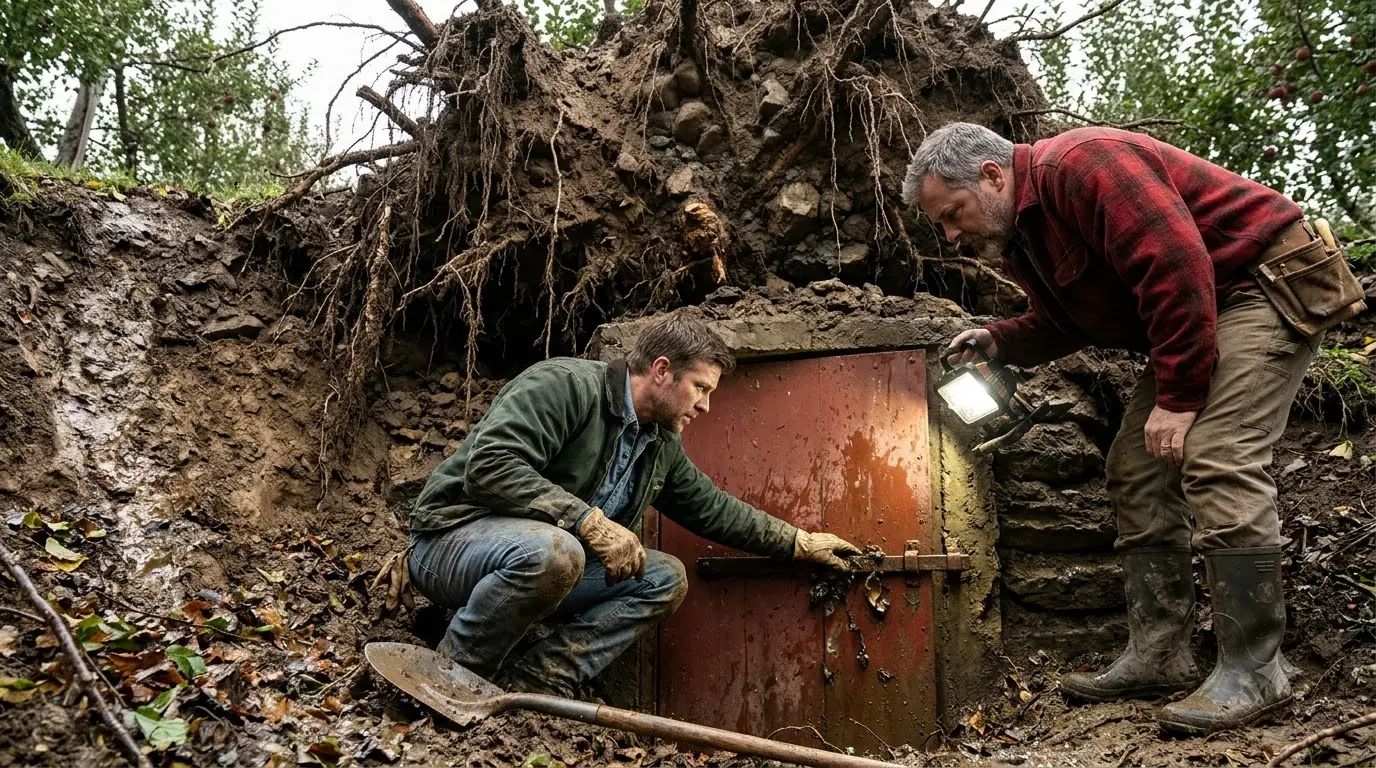
The rain had stopped sometime in the hour before sunrise, leaving the hillside orchard slick, torn open, and strangely bright beneath a pale clearing sky. Wet leaves lay plastered to the ground in red and brown ribbons. Broken limbs were scattered between the rows. Muddy water still ran downhill in thin restless streams, carrying bark shreds and apple skins toward the split rail fence at the base of the property. Beyond the orchard, the valley below sat under a low drift of silver mist, and every puddle held the cold white light of a morning that looked cleaner than it had any right to after the violence of the night.
Cal stood near the battered fence with a shovel in both hands and stared at the uprooted tree.
It had been there longer than he had been alive.
One of the old Winesaps, planted back when his grandfather still believed every strong tree deserved twenty feet of breathing room and a man could always buy himself one more season if he worked hard enough. Now it lay canted on its side across the broken fence, limbs twisted and slick with rain, the trunk wrenched halfway out of the ground. Its roots had come up in a towering muddy wall taller than Cal’s shoulders, packed with stones, torn grass, and black wet earth that still dripped steadily back into the wound it had left behind.
He had lost branches before. Lost rows, once, to a late freeze. Lost a shed roof to wind six years ago. That happened in farming. The land gave and the land took. But there was something brutal about seeing an old tree ripped wholly from the hillside, roots exposed like bones. It made the storm feel personal.
Cal jammed the shovel blade into the mud and worked one gloved hand across the back of his neck. His jacket was already damp from the waist down. Mud coated his boots and hemmed his jeans in a dark heavy cuff. The air smelled of wet bark, churned soil, and apples split open in the grass.
He heard the pickup before he saw it.
Ben Carter’s old truck growled up the orchard lane, tires slipping a little where gravel met runoff, and stopped beside the gate with a complaining rattle. Ben climbed out with the slow, broad movement of a man who no longer pretended his knees enjoyed cold mornings. He wore a red flannel jacket over canvas trousers, rubber boots dark with muck, and a tool belt hanging loose at one side. In one hand he carried a portable work light shaped like a square lantern with a reinforced handle.
He shut the truck door with his hip and looked up the slope.
“Lord,” he said. “From the road I thought maybe you lost a limb.”
Cal gave him a humorless half smile. “It was attached to most of the tree.”
Ben trudged over, taking in the damage as he came. He was fifty and built broad as a feed barn door, with graying hair under his cap and a short beard that always made him look sterner than he was. He and Cal had known each other in one form or another since Cal was the age of the fence posts.