Jack Turner unlocked his repair garage before sunrise, the same way he had done every morning for sixteen years. The old metal door groaned as he pushed it upward, rattling on its tracks like it was complaining about another hard day. Inside, the shop smelled of oil, dust, rust, and yesterday’s work, though yesterday had barely brought enough money to cover the electric bill. He stepped inside, turned on the lights, and watched the weak fluorescent glow spread across worn tools, cracked concrete, and shelves of parts he could not afford to replace.
His garage sat beside a quiet rural highway outside a small farming town in Kansas, where fields stretched for miles and business used to arrive before breakfast. Years ago, farmers lined up outside Jack’s door with tractors, balers, trucks, sprayers, and combines that needed his hands. Now many of them drove past him toward larger service centers with newer signs, bigger buildings, and financing plans printed on glossy paper. Jack did not blame them, but every passing truck felt like another nail tapped gently into the future of his shop.
He made coffee in a stained pot near the back office and opened the unpaid bills again, even though he already knew every number by heart. Rent on the building. Insurance. Tool payments. Parts account. A final notice from the power company folded beneath a supplier invoice that had been overdue for two weeks. Jack rubbed his thumb across the paper and told himself what he always told himself: one good job could buy another month.
By noon, the sun had turned the highway bright and empty. Jack had replaced a belt on an old pickup, repaired a mower carburetor, and earned less than he needed. He was tightening the last bolt on the mower when he heard the slow scrape of tires outside the garage door. A tractor appeared in the yard, coughing badly, its engine missing every few seconds as if it were trying to breathe through mud.
A young woman climbed down from the tractor’s step and wiped dust from her forehead with the back of her wrist. She wore faded jeans, a simple plaid shirt, sturdy work boots, and a cap pulled low over her hair. Her clothes looked like they had spent the morning in a field, not in an office. She stood for a moment beside the tractor, then looked toward Jack with worry held tightly behind calm eyes.
“Are you Jack Turner?” she asked.
“That depends,” Jack said, setting down his wrench. “If you’re here with a bill, he stepped out.”
She smiled, but only a little. “I’m Emily Carter. My tractor started losing power three miles back, and now it barely moves.”
Jack walked toward the machine, already listening to the sound before touching anything. The idle was rough, uneven, and heavy with a low knocking rhythm that made his jaw tighten. He opened the side panel, leaned in, and felt heat roll out of the engine compartment. The smell told him part of the story before the engine did: old fuel, clogged lines, and something burning where it should not be.
“Shut it down,” he said.
Emily climbed back up and turned the key. The engine gave one last ugly shake before dying. Silence settled over the yard, broken only by the ticking of hot metal. Jack reached inside with a rag, touched the fuel line, then checked the belt alignment and the intake housing.
Emily stood close but not too close. “Is it bad?”
“It’s not good,” Jack said.
“That sounds like mechanic language for expensive.”
“It can be.” He looked at her boots, then at the dirt caked around the tractor tires. “Planting?”
“Preparing ground. I needed this running yesterday.”
Jack nodded, because every farmer who brought him a broken machine needed it yesterday. He had heard that urgency in every voice for half his life. The calendar did not care when equipment failed, and weather windows closed faster than men could pray them open. He looked back into the engine and saw the problem was not one problem, but several small failures that had begun shaking hands.
“Fuel system is clogged,” he said. “Filter’s bad, line’s restricted, belt is worn, and that pump is not responding right.”
Emily’s shoulders dropped slightly. “Can you fix it?”
“I can try,” he said. “Pull it into the bay.”
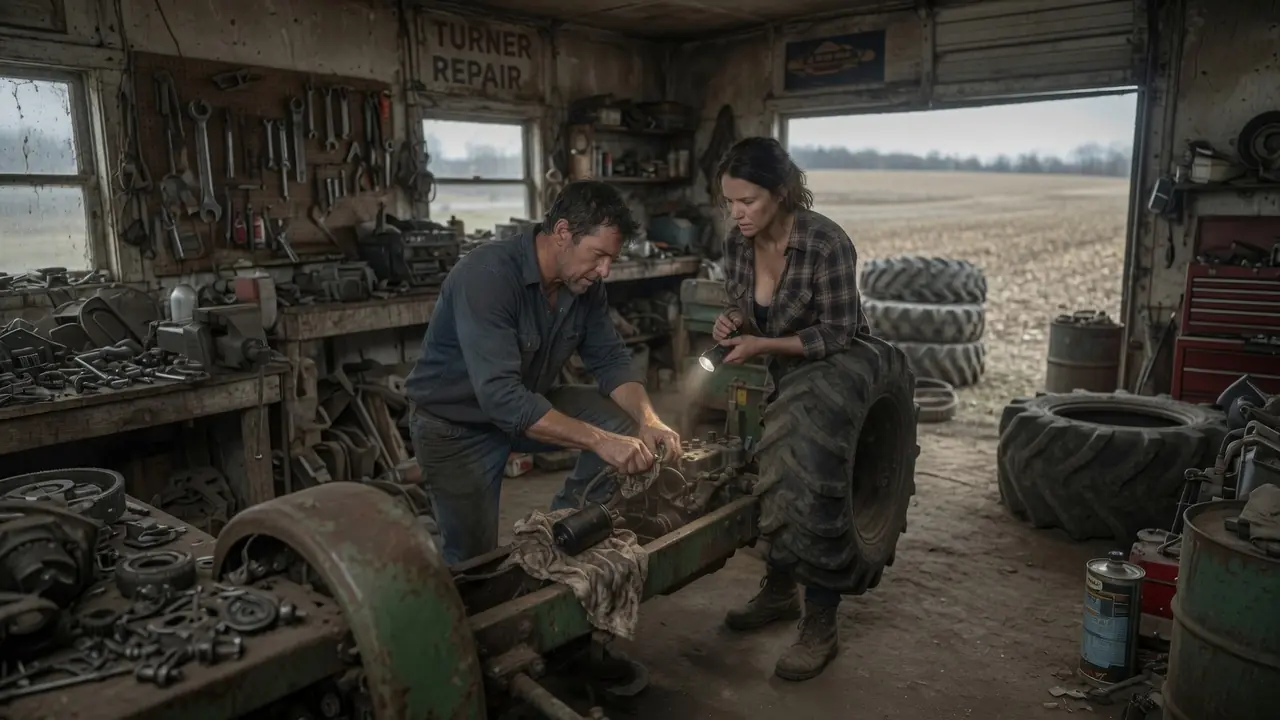
The tractor barely moved under its own power, so Jack hooked an old chain to the front and used his shop truck to drag it slowly into the garage. Emily walked beside the front tire, one hand on the fender, guiding it carefully over the cracked concrete. The machine came to rest beneath the main work light, its faded paint showing years of sun and field dust. Jack rolled his tool cart over, pulled on gloves, and lifted the hood wider.
“Hold this,” he said, handing Emily a small flashlight.
She took it without hesitation and stepped to the opposite side of the open engine compartment. The beam cut across the dark maze of hoses, clamps, lines, and worn metal. Jack leaned in, shoulder pressing against the hood frame, and reached deep under the fuel housing. The first clamp resisted him, rusted tight, and he had to twist the screwdriver hard enough that the tendons stood out in his wrist.
Emily watched closely. “You don’t want me out of the way?”
“If you can hold a light steady, you’re useful.”
“I can do that.”
“Then stay.”
Jack loosened the clamp, pulled the fuel line free, and thick black residue dripped onto the rag beneath his hand. He held it up, frowning. “That’s your first problem.”
Emily leaned forward, her face tightening. “That looks terrible.”
“It is terrible.”
“Can bad fuel do all this?”
“Bad fuel can start it,” Jack said. “Neglect finishes it.”
She did not answer defensively. That told him something. Some customers argued before they understood the problem because pride was easier than repair. Emily only shifted the flashlight and followed his hands as he removed the clogged filter. Her eyes stayed serious, almost studying the process rather than simply waiting for the result.
Jack laid the filter on the bench and cut it open. The inside was packed with dark sludge and fine grit. He turned it toward her so she could see. “This didn’t happen today.”
Emily’s lips pressed together. “I bought this tractor used from a smaller operation last month. They said it had been serviced.”
Jack gave a short breath that was almost a laugh. “People say many things when they want a machine off their lot.”
“I should have checked better.”
“Maybe,” he said. “But right now we fix what’s real.”
That sentence seemed to stay with her. She looked at him differently, not with surprise exactly, but with a quiet interest that made Jack aware of his own dirty sleeves and tired posture. He turned away, partly because he did not like being watched too closely. Work was easier than attention.
For the next hour, Jack worked through the tractor one problem at a time. He removed the damaged belt, checked the pulley alignment, and cleaned the fuel housing with solvent until the rag came away almost clean. Emily held the flashlight, handed him tools when he pointed, and never complained when heat gathered under the tin roof. Sweat ran down Jack’s face and dropped from his jaw onto the concrete.
A larger shop would have assigned two technicians and charged three hours before the first part was even cleaned. Jack had no one else. His helper had quit two months earlier because Jack could not guarantee steady pay. So he moved from one side of the tractor to the other alone, bending, reaching, loosening, tightening, and muttering under his breath whenever some stubborn piece of metal acted like it had a personal grudge.
Emily noticed the old shelves on the wall, the cracked toolbox, and the handwritten notices pinned near the office door. She saw the final warning from the electric company before Jack turned a clipboard over it. He pretended not to notice her noticing. Pride was a quiet thing in him, but it was still pride.
“You work by yourself?” she asked.
“Most days.”
“Hard to run a repair shop alone.”
“Harder to run one with employees you can’t pay.”
Emily lowered the flashlight slightly, then lifted it again when he reached into the engine. “Business slow?”
Jack tightened a fitting before answering. “Farmers are careful with money now. Bigger shops can offer credit. I offer honest work and a coffee pot that burns everything after noon.”
She smiled faintly. “Honest work is worth something.”
“It is,” Jack said. “But the power company doesn’t accept honesty.”
Emily looked toward the office again, but said nothing.
By late afternoon, Jack had the fuel system cleaned and a new filter installed. He replaced the belt with one from his limited parts stock, then removed the fuel pump and set it on the bench. That was where the job became worse. The pump had internal wear, and a replacement would cost more than Emily probably expected.
He glanced at her. “You may not like this part.”
“What is it?”
“Pump’s weak. I can clean it and adjust it, maybe get you through the season, but if you want this tractor dependable long-term, it needs replacement.”
Emily came closer, looking at the pump on the bench. “How much?”
Jack told her.
She did not flinch the way he expected. Instead, she looked thoughtful, like she was comparing the number to something larger. That made him wonder if he had misread her, but her clothes, boots, and tired face still told the story of a woman working close to the ground. Rich people rarely looked that comfortable beside grease.
“I need it running today,” she said. “But I don’t want a bad fix.”
Jack nodded. “Then I’ll rebuild what I can, clean what I can, and tell you exactly what it still needs. I won’t call a temporary repair permanent.”
Emily looked at him for a long second. “Most people would.”
“Most people aren’t standing in my shop.”
That answer made her smile again, this time with something warmer behind it.
Jack removed the pump cover and cleaned each part with patience that cost him time he could not bill honestly. The screws were tiny, the seals worn, and one spring had lost tension. He found a replacement from a labeled drawer that had been sitting untouched for years. Emily watched as he compared the old spring to the new one, then placed the better part into the assembly.
“Where did you learn all this?” she asked.
“My father.”
“He owned this shop?”
“He started it.” Jack wiped his hands on a rag. “Back then, it was Turner & Son. Now it’s just Turner, and sometimes that feels like a warning.”
Emily’s expression softened. “Is he gone?”
“Ten years.”
“I’m sorry.”
Jack nodded once and returned to the pump. Sympathy was kind, but it did not tighten bolts. He had learned after his father’s funeral that grief respected only work and time, and sometimes not even time. The shop had been full for a while after his father died, neighbors bringing business out of loyalty. Then years passed, machines changed, dealers grew bigger, and loyalty became a luxury few could afford.
As evening pushed golden light through the garage door, Jack reinstalled the pump. He checked the lines twice, tightened the clamps, adjusted the belt, and cleaned the spilled residue from the frame. Emily still stood across from him, holding the flashlight though the light was no longer needed. Her arm must have ached, but she never lowered it.
“Moment of truth,” Jack said.
Emily stepped back.
Jack climbed onto the tractor, turned the key, and listened as the engine cranked once, twice, then caught. At first, it coughed hard. He eased the throttle, watching the gauges. The rough knock faded into a stronger rhythm, and the engine settled into a steady roar that filled the garage.
Emily’s face changed completely.
Relief washed over her so clearly that Jack felt it before she spoke. She stepped toward the tractor, one hand covering her mouth for a moment. “That sounds better than when I bought it.”
“It should,” Jack said, climbing down. “It can run, but I want you careful with it. Don’t push it too hard until that pump gets replaced properly.”
She nodded. “You saved me days.”
“I saved you tonight. Days depend on how you treat it.”
Emily laughed softly. “Fair.”
Jack shut the engine down, then wrote the bill at the metal workbench. He listed the parts, the filter, the belt, the spring, the fluids, and a labor charge that made him pause. He had worked on the tractor for hours. He had used parts he needed to replace. He had earned the right to charge a full amount, and the full amount would help keep his own shop alive.
But when he looked at Emily, he saw a farmer standing in dusty boots beside a machine she needed to work. He remembered years when his father had cut bills for men who came in during planting with fear hidden under their caps. His father used to say, “Don’t make a hard season harder unless you have to.” Jack wrote a lower number than he should have.
Emily took the bill and looked at it. Her eyebrows pulled together. “Jack, this isn’t enough.”
“It covers the parts.”
“Barely.”
“And some labor.”
“Not the labor you did.”
Jack capped the pen. “You needed a running tractor more than I needed to prove a point.”
Emily stared at him.
He shrugged, uncomfortable. “Pay that when you can. Bring it back for the pump when you’re ready. And don’t let anyone tell you this machine was fully serviced before they sold it.”
She folded the bill carefully. “You don’t know me.”
“No,” Jack said. “But I know planting season.”
Emily’s eyes stayed on him, serious and unreadable. “What if I could have paid more?”
“Then I suppose you got lucky.”
“What if I came in here dressed differently?”
Jack frowned. “Wouldn’t change the engine.”
For a moment, Emily looked as if she wanted to say something important. Then she only reached into her pocket, counted out the cash, and placed it on the bench. “Thank you, Jack.”
He nodded. “Get home before that tractor changes its mind.”
Emily climbed into the seat, started the engine again, and drove slowly out of the garage into the evening. Jack stood in the doorway, watching the tractor roll down the dusty road until it became a shape against the fields. He felt tired all the way through his bones. He also felt foolishly satisfied, the way a mechanic feels when broken metal leaves stronger than it arrived.
Then he returned to the office and counted the money.
It was not enough.
The next week did not reward his kindness. Business stayed slow. A farmer who promised to bring in a baler never came. A truck repair got canceled after the owner found someone cheaper. Jack paid half of one bill, delayed another, and ignored three calls from a supplier because answering would not create money he did not have.
He thought about Emily a few times, mostly when he saw the old filter still sitting near the trash bin. He wondered whether the tractor made it through her fieldwork. He wondered if she would ever come back for the pump replacement. He did not wonder who she really was, because he believed he already knew enough: another farmer trying to keep moving.
On the eighth morning, an envelope arrived.
It was thick, cream-colored, and too elegant for anything that belonged in his mailbox. Jack almost tossed it onto the desk with the bills, but his name was written across the front in clean black print. Inside was an invitation to an agricultural leadership conference in Wichita. The letter specifically requested his attendance as an honored guest.
Jack read it twice, then checked the envelope for a mistake.
There was no mistake.
He almost did not go. Closing the shop for a day felt irresponsible, especially when he could not afford another empty morning. But curiosity won because the invitation included a phone number, and when he called, a polite woman confirmed that his seat had been reserved by Emily Carter. That name made him look toward the bay where the tractor had sat.
The next morning, Jack put on his cleanest shirt, drove his old pickup to Wichita, and walked into a conference center larger than any building he had entered in years. Farmers, executives, equipment representatives, investors, and agricultural leaders filled the hall. Their boots were cleaner than his. Their jackets fit better. Their conversations carried words like expansion, logistics, sustainability, and market position.
Jack found a seat near the back.
When the lights dimmed, the announcer stepped onto the stage and began introducing the keynote speaker. He spoke of land holdings across multiple states, food supply partnerships, thousands of employees, national influence, and one of the most successful privately owned farming operations in America. Jack listened without much interest at first. Then the announcer said the name.
“Please welcome Emily Carter.”
Jack sat forward.
The woman who walked onto the stage wore a tailored navy suit, not dusty jeans. Her hair was neatly pulled back, and the room stood in applause before she even reached the podium. She looked confident, respected, and entirely at home beneath the lights. But when she glanced toward the back of the hall and found Jack, he saw the same calm eyes that had watched him rebuild a fuel pump under a dim garage light.
His stomach dropped.
Emily began speaking about agriculture, leadership, machines, and the difference between service and sales. She spoke clearly, without arrogance, and the room listened as if her words could move markets. Then her tone changed. She told them about an old tractor that broke down near a rural highway, a worn repair shop, and a mechanic who did not ask who she was before deciding how honestly to treat her.
Jack felt every person in the hall slowly become aware of him.
“He had every reason to overcharge me,” Emily said from the stage. “He was struggling. His shop needed the money. He worked for hours in brutal heat, used parts he could barely spare, and still charged me less because he thought I was just another farmer trying to make it through planting season.”
Jack looked down at his hands.
They were clean that morning, but he could still see grease in the lines of his skin.
Emily continued, “Character is not what people do when wealth is visible. Character is what they do when they believe no reward is coming.”
The room erupted in applause.
Then Emily looked directly at him. “Jack Turner, would you please come to the stage?”
Jack froze.
A man beside him smiled and stepped aside. Jack walked down the aisle slowly, his heartbeat louder than the applause. By the time he reached the stage, his throat felt too tight to speak. Emily met him halfway and shook his hand with both of hers.
“I owe you a better introduction,” she said softly, away from the microphone.
Jack swallowed. “You could have mentioned you were the richest farmer in America.”
She smiled. “Would you have charged me differently?”
“No.”
“I know.”
That was when she turned back to the microphone.
Emily announced that Carter Agricultural Group was seeking an official maintenance provider for a regional fleet of tractors, harvesters, trucks, irrigation engines, and field equipment. Jack stood beside her, barely breathing, as she explained that the contract required skill, honesty, emergency response, and the kind of judgment no corporate service manual could manufacture. Then she placed a folder in his hands.
“I would like Turner Repair to take that contract,” she said.
Jack stared at the folder.
The number on the first page made the $11,400 he had not charged feel like dust.
“I can’t handle all this alone,” he whispered.
Emily kept her voice low. “Then hire people. Buy tools. Expand. Build the shop your father meant for you to have.”
He looked at her, overwhelmed. “Why me?”
“Because when you thought I had nothing, you still gave me your best.”
For the first time in years, Jack Turner could not find words. The audience stood again, clapping, but the sound reached him from far away. All he could see was the old garage, the dim light, Emily holding a flashlight over the engine, and his own hand writing a smaller bill because it felt like the right thing to do.
Within six months, Turner Repair changed beyond recognition.
New lifts were installed. The roof was repaired. The shelves filled with organized parts. Two experienced mechanics joined him, then four more. A young apprentice from the local high school began sweeping floors after class, and Jack taught him the same lesson his father had taught him: fix what is real, tell the truth, and never use another person’s emergency as permission to rob them.
Emily’s fleet kept the shop busy, but not spoiled. Jack still worked with his hands every day. He still took local jobs, still cut a bill when a farmer truly needed mercy, and still kept the old workbench where Emily’s first invoice had been written. He framed that invoice and hung it in the office, not because it showed what he had lost, but because it reminded him what honesty had returned.
One evening nearly a year later, Emily brought the same old tractor back to the shop. This time, she arrived without mystery, driving it herself across the yard while Jack stood in the open bay door. The engine ran strong now, steady and clean. He walked around it once, listening like he always did.
“Pump finally ready to replace?” he asked.
Emily climbed down, smiling. “No. I just thought you’d like to hear how well it still runs.”
Jack looked at the tractor, then at her. “You kept it?”
“Of course. It brought me to the mechanic I was looking for.”
He shook his head. “You tested me.”
“I observed you,” she corrected.
“That’s a rich person word for tested.”
Emily laughed, and this time there was no secret between them.
Jack leaned against the workbench, watching the evening sun spread across the clean floor of the expanded garage. “You know, that day you came in, I almost charged full price.”
“You should have.”
“Maybe.”
“But you didn’t.”
Jack looked at the old invoice on the wall. “No. I didn’t.”
Emily followed his gaze. “Do you regret it?”
He thought about the empty mornings, the final notices, the fear that had lived in his chest so long he had mistaken it for normal breathing. Then he looked at the busy shop, the mechanics at work, the apprentice learning how to label parts, and the old tractor sitting like a witness near the bay door.
“No,” he said. “I think it was the most expensive discount I ever gave.”
Emily tilted her head. “Expensive?”
Jack smiled. “Cost me a few hundred dollars and bought me my life back.”
The tractor ticked softly as it cooled. Outside, trucks moved along the rural highway, some slowing now because Turner Repair was no longer a fading shop people passed without thinking. Farmers came from three counties. Carter Agricultural machines filled the schedule. And Jack’s father’s name, once nearly forgotten on the old sign, had been restored over the door.
Turner & Son Repair.
Jack had added the words back the day the expansion finished. There was no son working beside him yet, but that was not the point. The name was a promise to the man who taught him that a shop was only as good as the honesty under its roof.
Emily stepped toward the tractor and ran one hand along its fender. “Do you remember what you said when I asked what would change if I came in dressed differently?”
Jack nodded. “I said it wouldn’t change the engine.”
“That’s when I knew.”
“Knew what?”
“That you understood something most people forget.” She looked at him across the tractor hood. “The machine tells the truth. People decide whether they will.”
Jack looked around his shop and felt a quiet pride settle in him, not loud, not showy, but steady enough to stand on. He had not become successful because he chased a powerful customer. He had become successful because he treated a powerless one fairly, even when power had been hidden in plain sight.
That was the lesson he kept.
Not that kindness always brings reward. It does not. Not that every good deed is secretly being watched by someone rich. It is not. The real lesson was simpler and harder: a man should do honest work because honest work is the only kind that lets him sleep when the shop is dark.
Jack walked to the tractor, lifted the hood, and listened as Emily laughed softly.
“What are you doing?” she asked.
“Checking my work.”
“It’s running fine.”
“I know,” Jack said, reaching for a wrench. “That’s why I want to keep it that way.”
And under the clean lights of Turner & Son Repair, with Emily Carter holding the flashlight again from the other side of the hood, Jack bent over the engine and went back to work.